
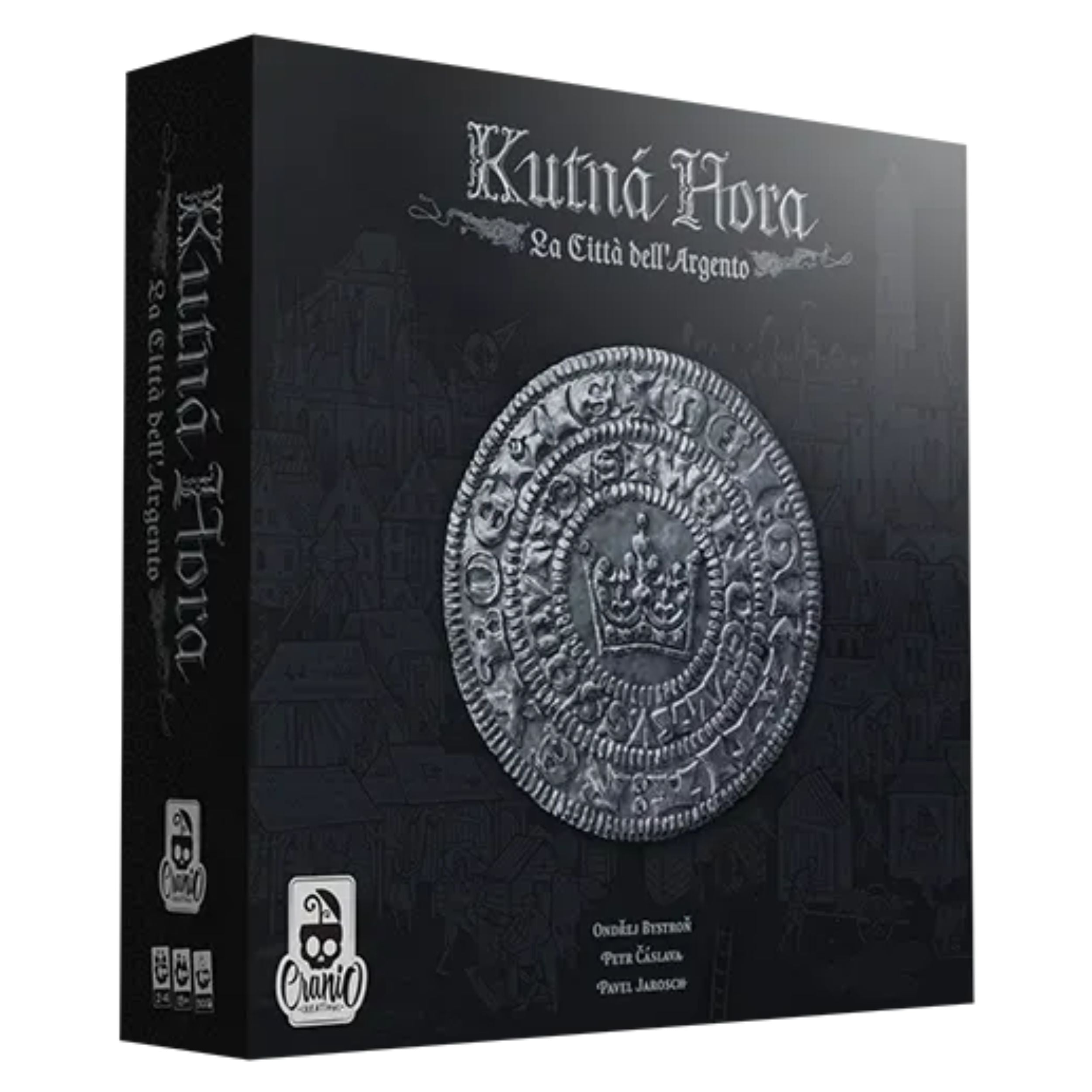
Kutná Hora - La Città dell'Argento
🐸 Dettagli da BoardGameGeek
Consiglio BGG sul numero di giocatori
Categorie
Meccaniche
Design & Art
Lingua
Si abbina bene con
FroGames — Moments You'll Remember
Some extract silver, some sell dear. Then prices crash, and those who invested everything curse their luck. The cathedral grows slowly, but in the end, it's about who built it best.
WHAT IT IS ABOUT
The silver rush that made a Bohemian city great
Kutná Hora - The Silver City is an economic eurogame set in 14th-century Bohemia, during the mining town's heyday. Designed by Ondřej Bystroň, Petr Čáslava, and Pavel Jarosch for Czech Games Edition, the game recreates the discovery of silver mines near the Cistercian monastery and the rapid urban expansion that followed. Each player leads a guild with unique objectives and powers, competing to build the most important buildings and contribute to St. Barbara's Cathedral.
At the table, you manage multi-use cards to extract ore, smelt silver, acquire building plots, obtain permits, and build. But here, every action you take changes the market: if many produce silver, the price crashes; if everyone wants the same permit, costs rise. The economic system responds in real-time to collective choices, creating a constant tension between personal profit and shared city growth.
What they say abroad
"A living economy that rewards planning but punishes predictability."
A living economy that rewards planning but punishes predictability.
— Space Biff
"Every decision ripples through the shared market in fascinating ways."
Every decision ripples through the shared market in fascinating ways.
— Meeple Mountain

Kutná Hora - The Silver City
FrogScore · FroGames editorial rating · based on rules, international reviews, and gameplay sessionsYour guild's tools
Four elements that build the city
Mines and Foundries
Extract raw ore from tunnels and smelt it into pure silver. But if everyone produces, the price crashes, and your hard work is worth less. Timing is everything.
Guild Buildings
Each guild has its own palaces, workshops, and production facilities. Building them generates continuous profit, but requires expensive permits and well-placed plots on the shared grid.
St. Barbara's Cathedral
The collective monument everyone helps to erect. Investing in the cathedral gives immediate prestige, but distracts from your private constructions. You need to balance it.
Multi-use cards
Each card has two sides and can be used for different actions. Choosing which side to play and when is the core of the game: each decision closes other doors.
Recommended sleeves 95 cards in 1 size ▼
If you play often, we recommend protecting your cards with clear sleeves to make them last longer.
| Size | Quantity |
|---|---|
| 63 × 88 mm | 95 |
| Total cards | 95 |
In two hours, you will have built a city. Or discovered that the free market is less free than you thought.
A game in five acts
What happens at the table
Not the rules. The experience.
Guilds take their positions
Everyone receives their own guild with unique buildings and powers. Some have advantages in mining, others in permits. Players study the asymmetries and plan their first move. The market is neutral, prices are low. It won't last.
The silver rush
The first turns are about mining and smelting. Mines are working, silver is produced, prices hold. But as soon as three players produce together, the value plummets. Those who sold early smile, those who waited curse. It's immediately clear: timing is everything here.
Permits and speculation
Now you need building lots and permits to construct. But if everyone wants the same permit, the cost skyrockets. Some speculate, accumulate resources, and wait. Others build immediately, blocking the best positions on the grid. Tension rises.
The cathedral and the crossroads
St. Barbara's Cathedral slowly grows. Investing gives sure points, but distracts from your guilds. Some put everything into the collective monument, others ignore it and build only for themselves. This is the moment when strategies completely diverge.
Final counts and surprises
The last turns are frenetic conversions: silver into buildings, permits into the cathedral, cards into points. Buildings, cathedral contributions, secret objectives are tallied. Someone who seemed behind emerges with 15 hidden bonus points. Someone who seemed ahead discovers they invested poorly.
How to play
The flow of each round
A game turn is fast: choose a card, play a side, the market reacts.
Each player chooses a card from their hand and decides which side to use. Cards have two different functions: mining or building, production or sale. Choosing one blocks the other option.
Actions are resolved in order: extract ore, smelt silver, buy lots, obtain permits, build buildings, or contribute to the cathedral. Each action modifies the market in real time.
Prices and availability change based on collective actions. If many have produced silver, the price drops. If many have bought permits, costs rise. The market is a direct consequence of choices.
Periodically, events are drawn that alter game conditions: taxes, bonuses, new opportunities. Some shared resources are restored and the next round is prepared.
Why it's different from others
Six mechanics that make a difference
Live, not simulated, market
There isn't an event deck pretending to be the economy. Here, supply and demand are generated by player actions. If everyone produces, prices really crash. If no one buys permits, they cost little. The market is a mathematical consequence of your choices and those of others.
Asymmetric guilds without imbalances
Each guild has unique buildings and specific powers, but none is dominant. One excels in mining, another in permits, a third in the cathedral. Asymmetry isn't cosmetic: it changes how you play the first turns and build your engine.
Multi-use cards with real costs
Each card has two usable sides. Choosing one means giving up the other. It's not free versatility: it's a continuous trade-off. Hand management becomes a puzzle of lost and gained opportunities.
Shared grid placement
Buildings are constructed on a common grid where position matters. Blocking a key lot from opponents is as valid a move as building your own palace. The city grows physically and spatial choices have strategic weight.
Collective monument with private incentives
St. Barbara's Cathedral is a common project, but everyone contributes for personal profit. It's not cooperation: it's speculation on a public good. Those who invest early gain positions, those who wait find increased costs.
Hidden points and final surprises
Secret objectives and building bonuses can be worth 20+ points at the end of the game. Someone who seems behind mid-game can win if they built the right engine. The visible score is deceiving: the game is only revealed at the end.
How it ends
How you win and how you lose
The game ends when the cathedral is completed or after a fixed number of rounds. The player with the most points from buildings, cathedral, and objectives wins.
Victory
- Building your guild's buildings in strategic positions generates continuous points
- Contributing to the cathedral gives immediate prestige and positional bonuses if you're among the first
- Completing your guild's secret objectives unlocks 15-25 points at the end of the game
Ways to fall behind
- Producing silver when the market is saturated: you earn little and waste turns
- Completely ignoring the cathedral: those who invest in it get too many points to be caught up
- Buying permits and lots at the wrong time: if prices are high, you burn resources without building
Kutná Hora is an economic eurogame for those who love interconnected systems where every choice modifies the table for everyone. It's not a multiplayer solitaire: it's pure speculation.
Frequently asked questions
FAQ about Kutná Hora - The Silver City
How complex is it to learn compared to other eurogames?
The basic rules can be explained in 20-25 minutes, but mastering the market requires 2-3 games. It's not a Lacerda-level burden (infinite rules), but not a gateway either: the dynamic economic system needs to be understood by playing. Expect 90-120 minutes for the first game, then it drops to 60-90.
Are the asymmetric guilds balanced?
Yes, they have been extensively tested. No guild dominates, but each excels in different phases of the game. Some start strong (miners), others mature late (builders). The balance is not symmetrical: it's contextual to the table.
Does it work well with 2 players or do you need a full table?
It works at all player counts, but with 3-4 players the market is more unpredictable and reactive. With 2, economic fluctuations are more controllable, and it becomes almost a clash of engines. Not worse, just different: more calculated, less chaotic.
Is there an expansion or additional content planned?
Not at launch. The base game has variable setup and asymmetric guilds that ensure high replayability. Czech Games Edition might expand in the future, but the base box is complete and self-sufficient.
Is it available in Italian?
Yes, this is the complete Italian edition published by Cranio Creations. Rulebook, cards, buildings, and materials are all translated. No need to know English.
Kutná Hora - The Silver City is an economic eurogame for 2-4 players, lasting 60-120 minutes, recommended age 13+. Designed by Ondřej Bystroň, Petr Čáslava, and Pavel Jarosch for Czech Games Edition, it recreates 14th-century Bohemia with a dynamic market system where supply and demand react in real-time to collective actions. Manage multi-use cards, build asymmetric buildings for your guilds, and contribute to the shared cathedral. Published in Italian by Cranio Creations. Available on FroGames.it
Kutná Hora - La Città dell'Argento
Frequently Asked Questions
The answers you're looking for, no beating around the bush.
📸Do the images match the actual product?
The photos on the website often come from BoardGameGeek and are intended to give you an idea of the game. They may vary slightly from the version you receive. The content declared by the publisher is always binding.
📦Does the content of the box match what is indicated?
We always strive to provide the correct content, but minor variations are possible due to reprints or updates. The information comes directly from the publishers. If you have any questions, please contact us!
⏳How do pre-orders work?
Pre-order the game before release, payment is immediate, and the game is reserved for you. As soon as it arrives, we'll ship it right away! If there are any delays, we'll update you promptly.
🔒Can I trust buying here?
Absolutely! Secure payments, tracked shipments, and a team that loves board games as much as you do. If something goes wrong, we'll do our best to fix it.
🛠There's a problem with my order, what should I do?
Write to us now! Whether it's a missing part, damage, or an error, we'll help you resolve it as soon as possible. Your experience truly matters to us.