
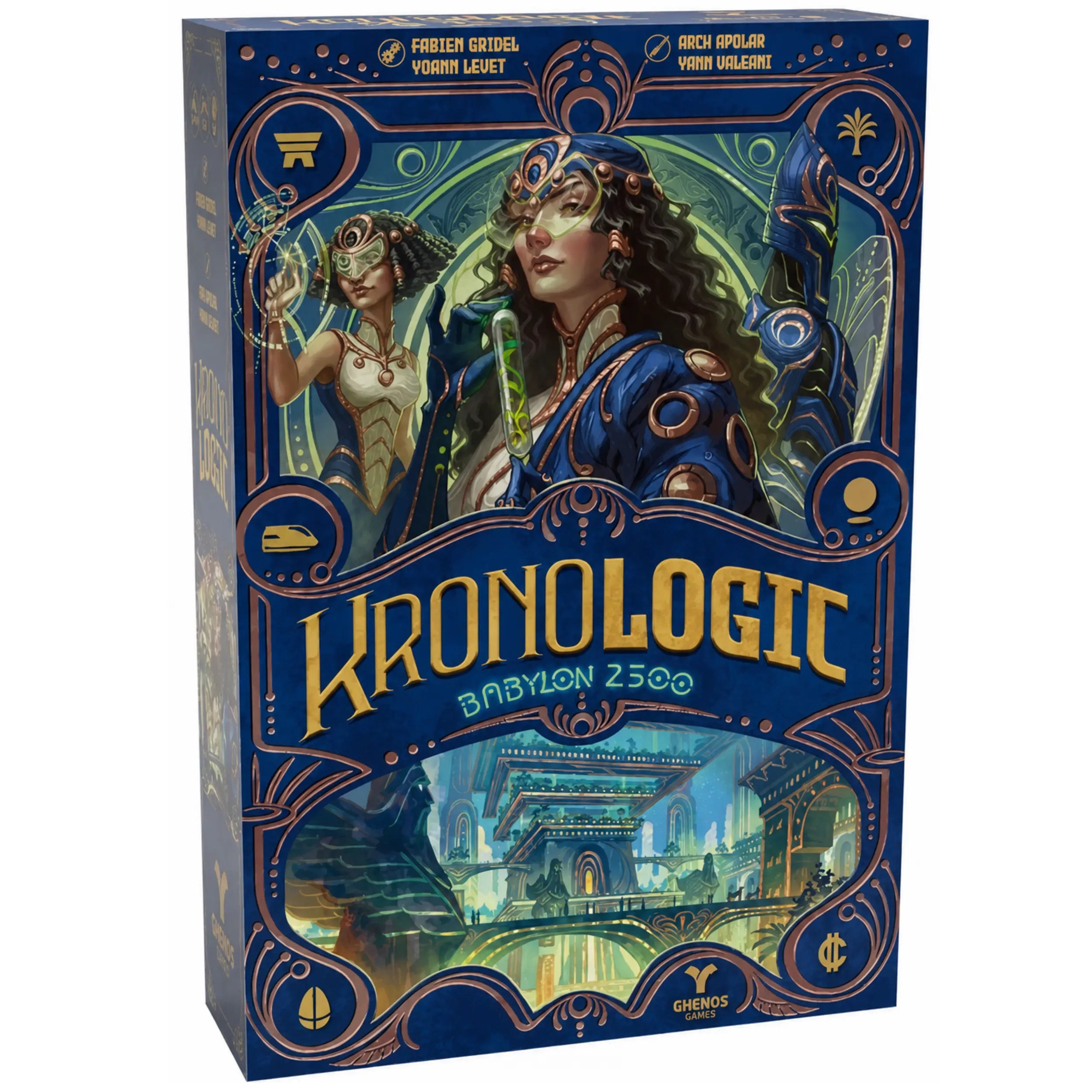
Kronologic - Babylon 2500
🐸 Details from BoardGameGeek
Consiglio BGG sul numero di giocatori
Categorie
Meccaniche
Design & Art
Lingua
🐸 How pre-orders work
🐸 A wise frog knows when to split the order… and when to wait for the right leap.
- Arrives
- October 23, 2026
Si abbina bene con
FroGames — Moments You'll Remember
Someone is frantically taking notes. Someone else is staring at the cards, looking for the missing detail. Someone is pointing a finger. And in the end, whoever solves the case first wins, but everyone wants to know how it really went down.
WHAT IT'S ABOUT
A murder in 2500 Babylon, and six interrogations to solve it
Kronologic: Babylon 2500 is the second installment in the Kronologic series, designed by Fabien Gridel and Yoann Levet. The setting is sci-fi, but the structure is that of a classic detective game: culprit, weapon, location. The difference lies in the interrogation system, which uses cards and perforated masks to reveal clues in an asymmetric way.
Each turn, a player interrogates a suspect, aligning cards under a perforated mask. Everyone sees some information, but the active player receives extra: how many times a character was in a location, at what time, what they had with them. Whoever solves the mystery first wins, but the race is against the other players, not against time.
What they say abroad
An elegant system that turns every interrogation into a moment of shared tension.
— FroGames
The beauty is that everyone has pieces of the puzzle, but no one has everything. You have to decide when you're confident enough to declare.
— FroGames

Kronologic: Babylon 2500
The game includes an official solo mode where you play against time: you must solve the case in a limited number of interrogations. The experience is solid, but it loses the tension of racing against other players trying to beat you.
FrogScore · FroGames editorial rating · based on rules, international reviews, and play sessionsThe investigation tools
What you have in front of you when solving the case
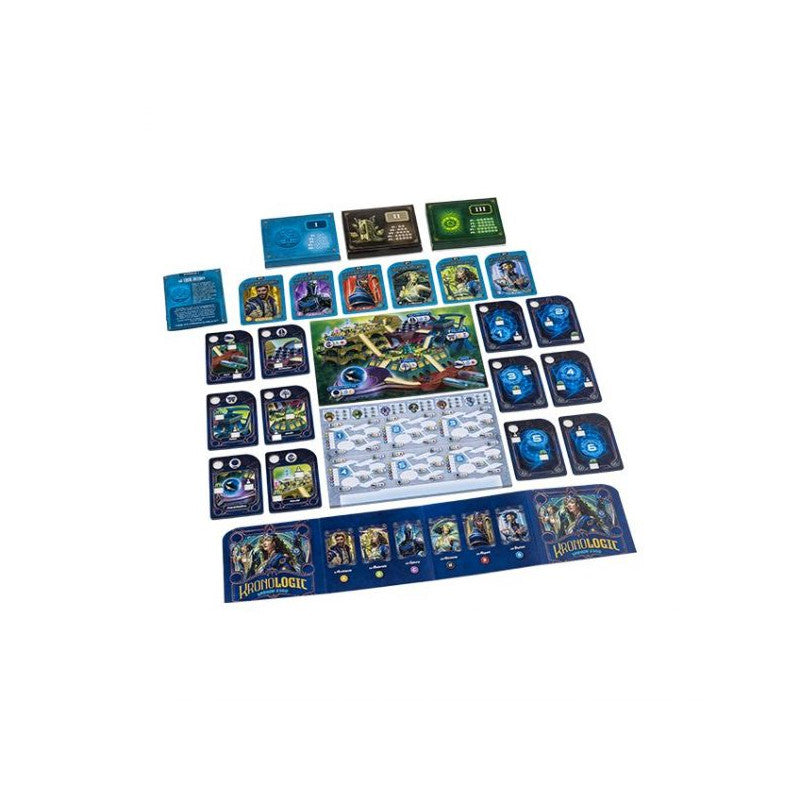
Perforated masks
Perforated cards that overlap the suspect cards. Each mask reveals some information while hiding others. The heart of the system.
Suspect cards
Each character has a card indicating movements, times, possessed objects. Aligning it under the mask gives you partial clues, but never everything at once.
Location board
Map of 2500 Babylon: laboratories, markets, stations. Each location is a possible crime scene; you need to figure out which one.
Weapon cards
Laser pistols, poisons, technological weapons. One of these was used. Clues tell you who had access to what, but not everything is clear until you connect the pieces.
In half an hour, you'll have written names, drawn arrows, and crossed out hypotheses. And when someone declares the solution, you'll immediately want to play again to see if you could have figured it out sooner.
Come si gioca
Video dimostrativo di gameplay.
A game in five acts
What happens at the table
Not the rules. The experience.
Everyone starts from scratch
Choose the first suspect to interrogate. You align the card under the mask, read the revealed clues aloud. Everyone takes notes, but you've also seen extra information that you don't share. The information asymmetry begins here.
Hypotheses are formed
Second interrogation. Someone already has a vague idea, someone else is still eliminating possibilities. You observe who is taking frantic notes and who seems too confident. You're trying to figure out what others know, not just what the cards say.
Someone speeds up
Third, fourth interrogation. A player starts interrogating suspects who seem to have already been discarded: are they confirming a hypothesis or bluffing? Tension rises because you don't know how much time is left before others declare. You have to decide whether to risk it or wait for one more clue.
Someone declares
A player announces: culprit, weapon, location. Everyone stops writing and watches. The solution is revealed. If they are right, they win. If they are wrong, they are out, and the others continue playing. That moment of silence when the answer is checked is the heart of the game.
End of game
Someone has won or everyone has made a mistake (rarely happens). Notes are compared, the solution is reconstructed. Details always emerge that someone misunderstood, badly read clues, wrong deductions for a suspect discarded too quickly. And immediately everyone wants to play again.
How to play
The flow of each round
A turn is quick: choose a suspect, align the card, read the clues, decide whether to declare or pass.
The active player chooses one of the suspects not yet fully interrogated. Each suspect can be interrogated multiple times, but with different masks.
Overlap the perforated mask onto the suspect's card. Read aloud the information visible through the holes: times, locations, objects. Everyone hears, everyone takes note.
Look at the complete card without saying anything. You see data that others don't have: frequency of visits, details of movements. This information is yours alone, until you decide to use it to declare.
If you believe you have the solution, announce the culprit, weapon, and location. It is verified immediately. If it's correct, you win; if you're wrong, you're out and the others continue. If you don't declare, the turn passes to the next player.
Why it's different from others
Six mechanics that make a difference
Asymmetric information
Kronologic is not a cooperative deduction game disguised as a competitive one. Information is unequally distributed: the interrogator always knows more than the others. You cannot rely solely on what you hear; you must also deduce from what is not told to you.
Fixed and short duration
Thirty minutes, always. No game drags on due to indecision or analysis-paralysis. Time pressure is implicit: the longer you wait, the more clues others gather. You cannot afford to fall behind.
Perforated mask system
The masks create a unique physical experience: you align, you read, you lift, you look. It's not just mechanics, it's ritual. Each interrogation becomes a theatrical moment at the table, and the act of partially revealing information generates natural suspense.
Risky declaration
You don't win by finding the solution, you win by declaring it first. But if you're wrong, you're out. This creates a constant dilemma: are you certain enough or just hoping? 100% certainty often comes too late, when someone else has already won.
Deterministic puzzle
Zero randomness during the game. The solution exists, is consistent, and can be derived from the clues. If you lose, it's because you reasoned incorrectly, not because you drew the wrong cards. This makes every mistake more painful, but every victory more satisfying.
Immediate replayability
Each case mixes the culprit, weapon, and location differently. Clues change distribution, deductions that worked before might be misleading now. You finish a game and immediately want to play again, either for revenge if you lost, or because the short duration allows it.
How it ends
How to win and how to lose
The game ends when someone correctly declares the culprit, weapon, and location, or when everyone makes a mistake.
Victory
- You declare the culprit, weapon, and location correctly
- You check the solution and it matches exactly
- You win immediately, the game ends
Elimination
- You declare a wrong solution (even just one incorrect element)
- You are eliminated from the game, the others continue
- If all players make a mistake, no one wins (rare case)
Kronologic: Babylon 2500 is a deduction game that rewards those who reason best and declare at the right moment. Not those who wait to be 100% sure, because by then someone else has already won.
Frequently asked questions
FAQ about Kronologic: Babylon 2500
Does it really work well with 2 players or do you need a full table?
It works very well with two players. The head-to-head race is intense, because each interrogation by the opponent gives you indirect information about what they know. With 3-4 players, the chaos and unpredictability of premature declarations increase, but the two-player experience is more tactical and cerebral.
If I make a wrong declaration, can I continue to give suggestions to others?
No. Once eliminated, you can no longer speak or interfere. You can observe, but you cannot help or mislead. This prevents an eliminated player from ruining the game by revealing information or bluffing.
How many cases are in the box? Does it run out quickly?
The game includes several playable cases, and each case can be re-combined with different solutions. Replayability does not depend on how many times you play the same scenario, but on the fact that the culprit, weapon, and location change configuration. After playing all the cases, you can still replay them with different solutions.
Is it suitable for those who have never played deduction games before?
Yes, it's a good entry point. The rules are simple, the mask mechanic is intuitive, and the game is short. If you're looking for a deduction game that doesn't require two and a half hours of mental setup, Kronologic is a solid choice.
Is it available in Italian?
Yes, this Ghenos Games edition is entirely in Italian: cards, rulebook, masks, everything localized. No need for translations or support apps.
Kronologic: Babylon 2500 is a deduction game for 1-4 players, 30 minutes, ages 10 and up. Designed by Fabien Gridel and Yoann Levet, published by Ghenos Games. It uses a system of perforated masks to create asymmetric information among players: the one who interrogates a suspect sees more than the others. Objective: discover the culprit, weapon, and location before opponents. Includes official solo mode. Available on FroGames.it.
Kronologic - Babylon 2500
Frequently Asked Questions
The answers you're looking for, no beating around the bush.
📸Do the images match the actual product?
The photos on the website often come from BoardGameGeek and are intended to give you an idea of the game. They may vary slightly from the version you receive. The content declared by the publisher is always binding.
📦Does the content of the box match what is indicated?
We always strive to provide the correct content, but minor variations are possible due to reprints or updates. The information comes directly from the publishers. If you have any questions, please contact us!
⏳How do pre-orders work?
Pre-order the game before release, payment is immediate, and the game is reserved for you. As soon as it arrives, we'll ship it right away! If there are any delays, we'll update you promptly.
🔒Can I trust buying here?
Absolutely! Secure payments, tracked shipments, and a team that loves board games as much as you do. If something goes wrong, we'll do our best to fix it.
🛠There's a problem with my order, what should I do?
Write to us now! Whether it's a missing part, damage, or an error, we'll help you resolve it as soon as possible. Your experience truly matters to us.