
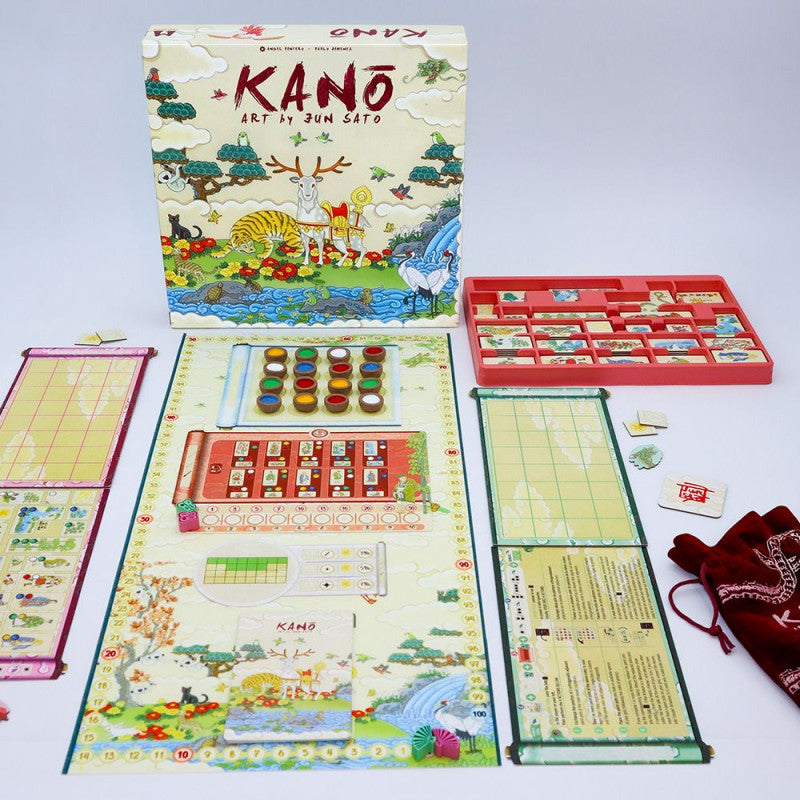
Kano
🐸 Details from BoardGameGeek
Consiglio BGG sul numero di giocatori
Categorie
Meccaniche
Design & Art
Lingua
🐸 How pre-orders work
🐸 A wise frog knows when to split the order… and when to wait for the right leap.
- Arrives
- November 6, 2026
Si abbina bene con
FroGames — Moments You'll Remember
You finish your emakimono one turn before the others and you look at that red jar you're missing. They know it. You know it. And at that point the whole table becomes merciless geometry.
WHAT IT'S ABOUT
Painting Japanese scrolls with the laws of physics
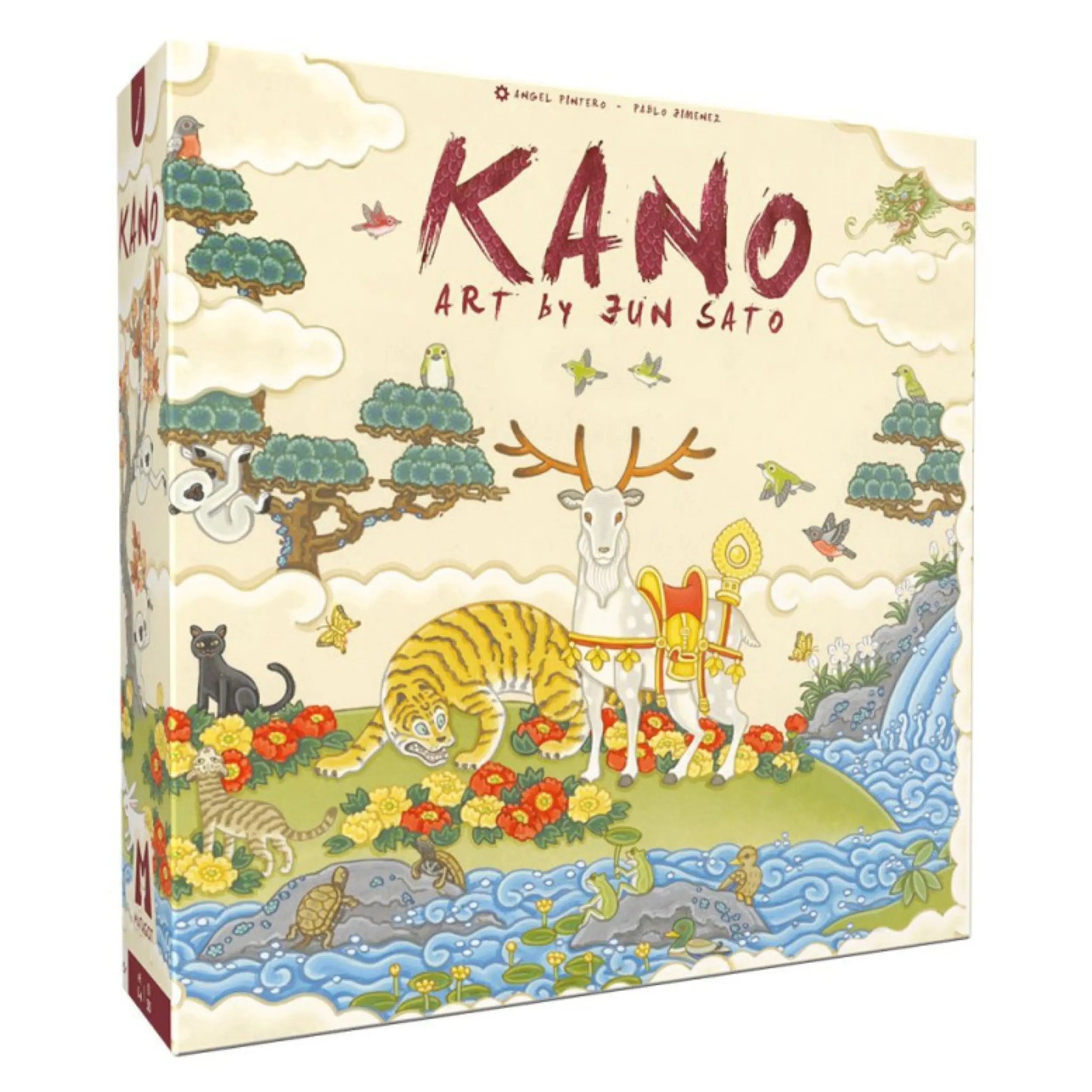
Kano brings the art of emakimono, hand-painted scrolls of Japanese tradition, to the table through the design of Pablo Jiménez and Angel Pintero and illustrations by Jun Sato. It's not a themed game: it's a pure spatial puzzle where each pigment jar follows gravity, falls downwards, and forms patterns that earn points.
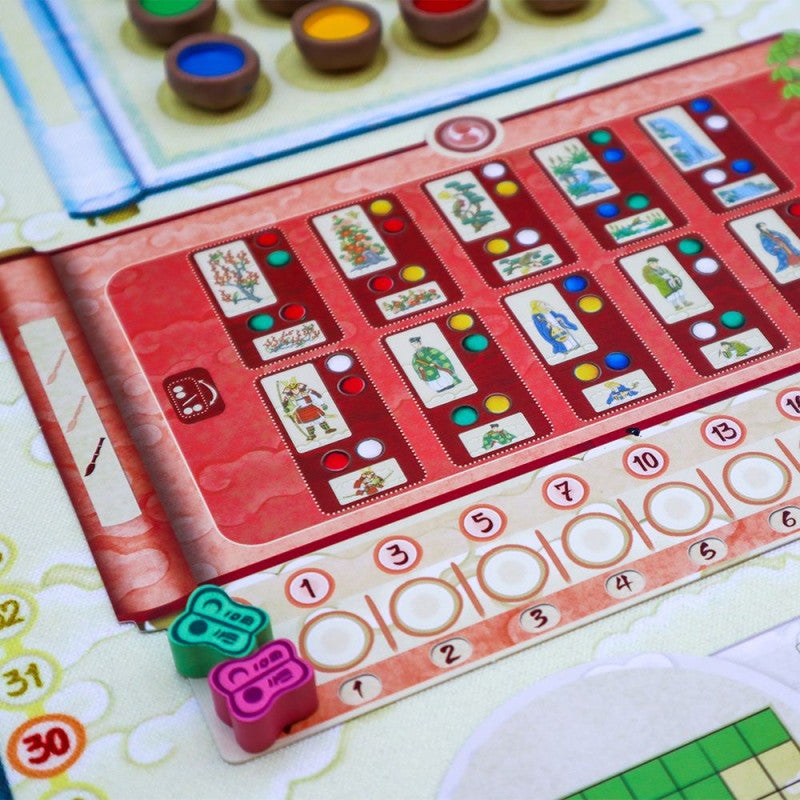
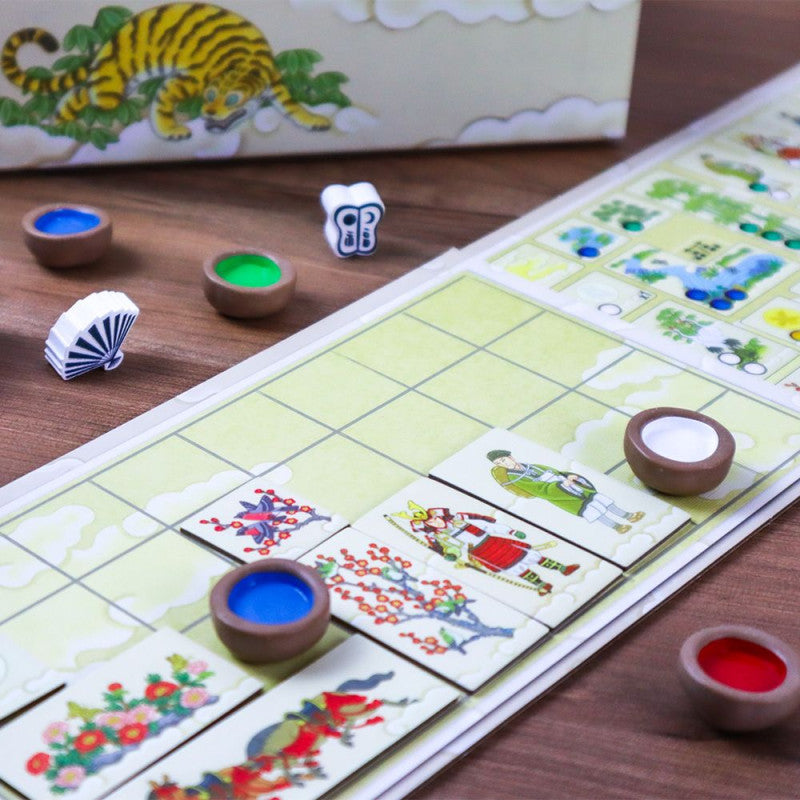
On your turn, you manipulate the central palette, take jars of the same color from rows or columns, and place them on your scroll following gravity. When you complete a pattern, you transform it into a work of art. Each player has secret objectives (Masterpieces, 12 points each) and shared objectives (the Shogun's Red and White sheets). The first to fill their scroll triggers the last round. Then, scores are counted.
What they say abroad
A geometric puzzle that forces you to think vertically and plan three moves ahead.
— FroGames
The rule of gravity transforms every choice into a spatial compromise.
— FroGames

Kano
FrogScore · FroGames editorial rating · based on rules, international reviews, and play sessionsYour artist's tools
What makes up your emakimono
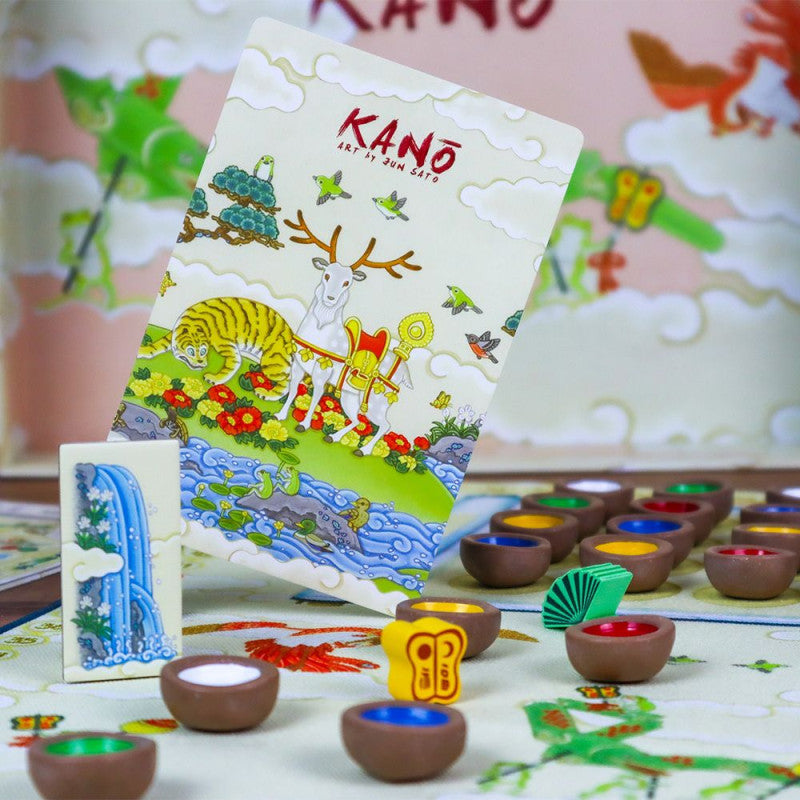
Pigment Jars
Colored tiles you take from the central palette. They always fall downwards on your scroll, following gravity. Each color has a purpose.
Artwork Tiles
The finished works that replace completed patterns. They are worth 3 to 7 points based on size. They are your visible score.
Secret Masterpieces
Personal objective cards worth 12 points each. No one knows which patterns you are trying to complete.
Cloud Tiles
They fill spaces when you accumulate too many visible jars (more than 4). They give no points. They are your inefficiency limit.
In twenty minutes, you'll know if you planned better than the others. Or if that blue column was a mistake three turns ago.
A game in five moments
What happens at the table
Not the rules. The experience.
Looking at Masterpieces and planning
You receive two secret objective cards. They are worth 12 points each but require precise geometric patterns. You look at your empty scroll and start imagining where you will place those colors. Others do the same. No one speaks.
The first pots and betraying gravity
You pick a red pot from the palette. It falls to the bottom of the column. You pick a second one: it falls on top of the first. You wanted to build a horizontal pattern, but gravity forced you vertically. You begin to understand that each turn is a spatial compromise.
Completing the first Artwork
You have three adjacent blue pots diagonally. You replace them with a 7-point Artwork Tile. The scroll begins to take shape. You look at the Masterpieces: you are halfway to the first. Others look at you and speed up.
When someone exceeds 4 visible pots
A player accumulates 5 pots not yet converted into Artwork. They must convert the excess into Cloud Tiles: they fill space but are worth zero points. It's the punitive moment of the game. From then on, everyone starts counting the visible pots before drawing.
Last round: someone fills the scroll
A player places the last pot, completely filling their emakimono. The final round begins. You have one completed Masterpiece and one half-finished. You desperately take the last pots. Scores are tallied: base Artwork, Masterpiece, Shogun objectives. The player who planned best from turn one wins.
How to play
The flow of each turn
Each artist performs two actions: manipulates the central palette, then collects pigments and places them on their scroll.
On the central palette, you can swap two adjacent pots. This helps prepare rows or columns of the same color for the next step.
You must take at least one pot. You can take several IF they are the same color AND adjacent in a single row or column. You remove them from the palette.
Each pot falls downwards into the column you choose. It stops at the first free space from the bottom. You cannot control the height: physics decides.
If you have formed a valid pattern (of 3+ adjacent spaces), replace it with an Artwork Tile. If you end the turn with more than 4 visible pots, convert the excess into useless Clouds.
Why it's different from others
Six mechanics that make a difference
The rule of gravity
Pots always fall downwards. You cannot place them anywhere you want: you can only choose the column, not the height. This turns every turn into a vertical puzzle. You need to plan three moves ahead to get the pattern you need.
Secret 12-point Masterpieces
Each player has two personal objective cards that require precise geometric patterns. No one knows which ones you are trying to complete. You can bluff, speed up on one and abandon the other, or complete both and dominate the final score.
Shared Shogun objectives
Two Red and White sheets change each game and offer points to those who complete certain configurations. Everyone sees them, everyone competes. They add a shared race beyond your secret plans.
The limit of 4 visible pots
If you end the turn with more than four pots not yet converted into Artwork, you must transform the excess into Cloud Tiles. They take up space but are worth zero points. This is the punishment for those who accumulate without completing patterns.
Shared palette manipulation
Before drawing, you can swap two adjacent pots on the central palette. This serves to build rows of the same color, but also to sabotage others' plans. Interaction is indirect but constant.
End of game triggered by the first to fill
Whoever completes their scroll first triggers the final round. Controlling the timing of the end is a weapon: you can close when you have completed your Masterpieces and others are halfway.
How it ends
How to win and how it concludes
The game ends when a player completely fills their emakimono. A final round is played, then points are tallied.
Victory
- Completed Artwork Tiles: 3 to 7 points based on pattern size
- Secret Masterpieces: 12 points each if completed
- Shogun Objectives (Red and White): variable points for specific configurations
Costly mistakes
- Cloud Tiles: take up valuable space but are worth zero points
- Incomplete Masterpieces: give no points, they are worthless
- Unconverted pots at the end of the game: remain useless, with no score
Kano is an abstract geometric game that rewards those who plan vertically and punishes those who accumulate without strategy. Thirty minutes, four players, zero luck.
Frequently asked questions
Kano FAQ
How important is central palette manipulation?
Very. Each turn you can swap two adjacent pots before drawing. This helps prepare rows of the same color for yourself, but also to disrupt others' plans. Interaction is indirect but tactical. Those who ignore this step lose efficiency.
Are secret Masterpieces too strong?
They are worth 12 points each, but they require precise and difficult geometric patterns to obtain with gravity limiting placement. Often you only complete one. If you complete both, you probably planned better than others and deserve to win.
What happens if I accumulate too many pots?
If you end the turn with more than four visible pots on your scroll, you must convert the excess into Cloud Tiles. They take up space but are worth zero points. This is the mechanic that punishes accumulation without completion. Managing this limit is part of the strategy.
Does it scale well from 2 to 4 players?
Yes. With 2 players, the palette is less contested, interaction is more predictable. With 4, the competition for colors is fierce, and palette control becomes crucial. The game works better with 3-4, but 2 players remains solid.
Is it available in Italian?
No. This is the English language edition. The game is language-independent: the pots are colored, the Artwork are symbols, only the Masterpiece cards and Shogun sheets have minimal text. Rulebook in English.
Kano is an abstract game for 2-4 players, lasting 30-40 minutes, ages 12+. Designed by Pablo Jiménez and Angel Pintero, published by Matagot, it combines tile placement with mandatory gravity and tactical set collection. Players create emakimono (Japanese painted scrolls) by placing pigment pots that fall downwards following physics. Each game includes secret 12-point Masterpieces and shared Shogun objectives that change the strategy. Main mechanic: geometric pattern matching with manipulation of a shared central palette. Available on FroGames.it.
Kano
Frequently Asked Questions
The answers you're looking for, no beating around the bush.
📸Do the images match the actual product?
The photos on the website often come from BoardGameGeek and are intended to give you an idea of the game. They may vary slightly from the version you receive. The content declared by the publisher is always binding.
📦Does the content of the box match what is indicated?
We always strive to provide the correct content, but minor variations are possible due to reprints or updates. The information comes directly from the publishers. If you have any questions, please contact us!
⏳How do pre-orders work?
Pre-order the game before release, payment is immediate, and the game is reserved for you. As soon as it arrives, we'll ship it right away! If there are any delays, we'll update you promptly.
🔒Can I trust buying here?
Absolutely! Secure payments, tracked shipments, and a team that loves board games as much as you do. If something goes wrong, we'll do our best to fix it.
🛠There's a problem with my order, what should I do?
Write to us now! Whether it's a missing part, damage, or an error, we'll help you resolve it as soon as possible. Your experience truly matters to us.