
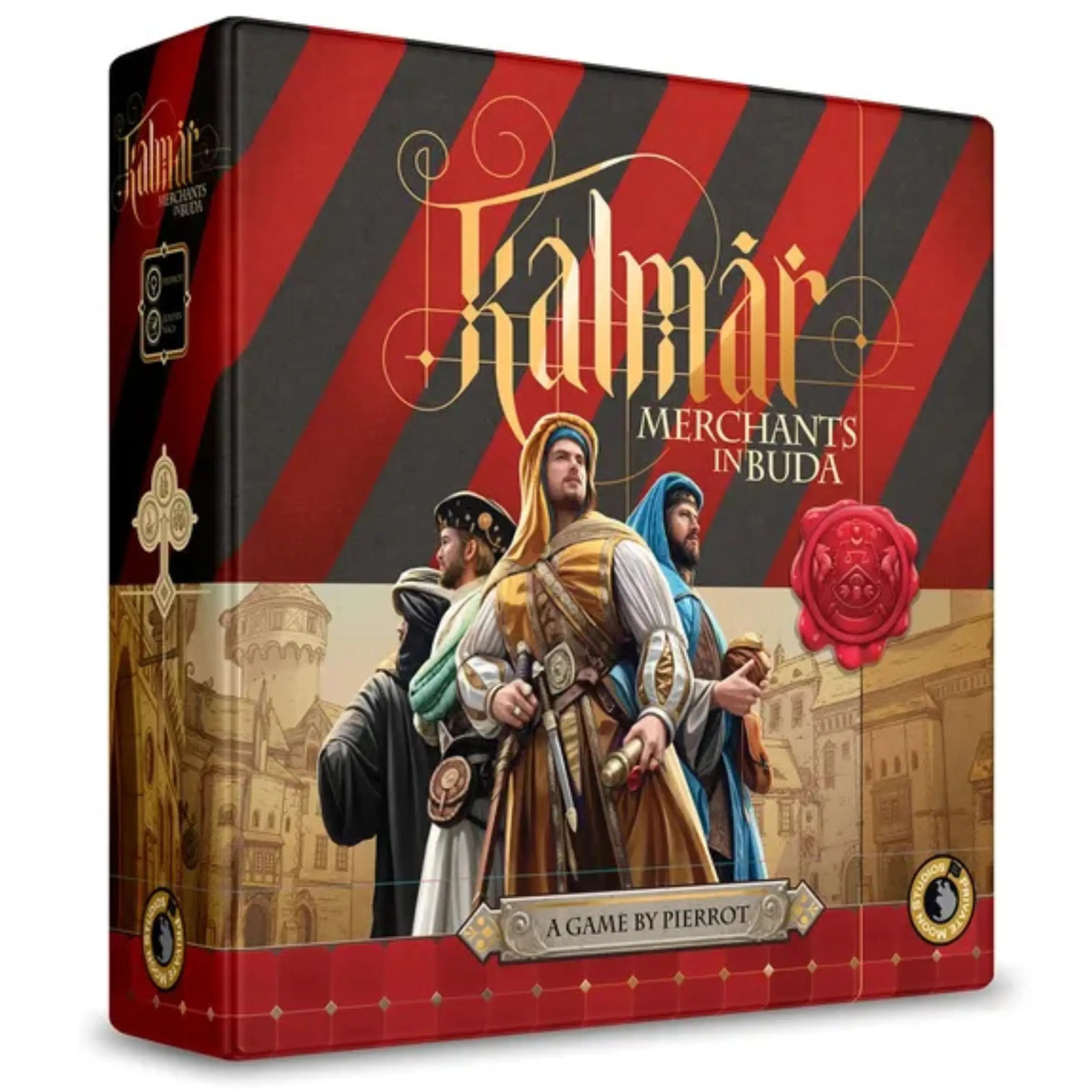
Kalmár - Merchants in Buda
🐸 Details from BoardGameGeek
Consiglio BGG sul numero di giocatori
Categorie
Meccaniche
Design & Art
Lingua
Si abbina bene con

FroGames — Moments You'll Remember
Seven days, seven garas, seven action points. Your father is watching, your brothers are planning. Only one will inherit the empire.
What it's about
A eurogame that turns every day into a commercial chess match
In early 15th-century Buda, an old merchant decides to leave his empire to his most capable son. You have one week to prove yourself. Every day, seven action points to spend, every morning an auction, every evening a banquet — and a warehouse burning under your fingers.
Kalmár is the seventh game by Pierrot and Private Moon Studios, illustrated by Zoltán Nagy and Gyula Pozsgay. A medium-weight eurogame (3.5/5 on BGG) where every decision matters: do you buy at the port or on the black market? Do you deliver immediately for garas or wait for the right moment for prestige points? Do you host a banquet to gain valuable contacts or put that money into the warehouse?
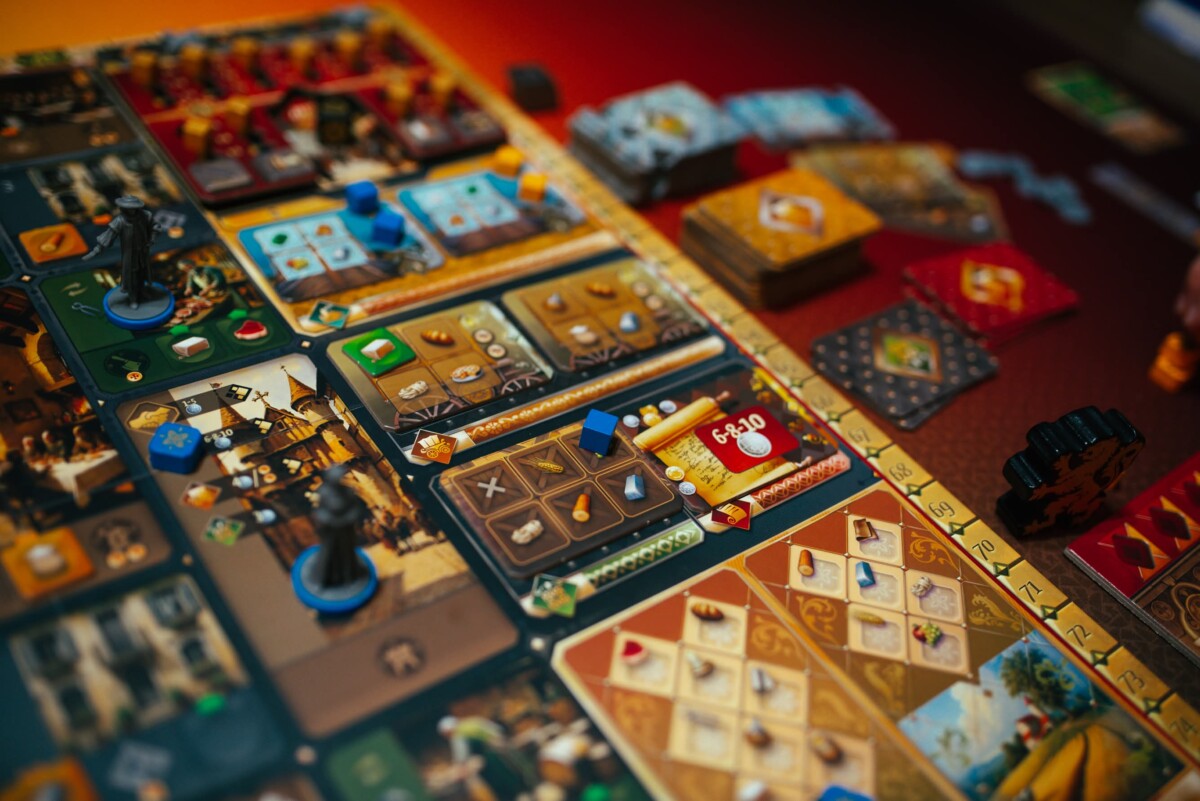
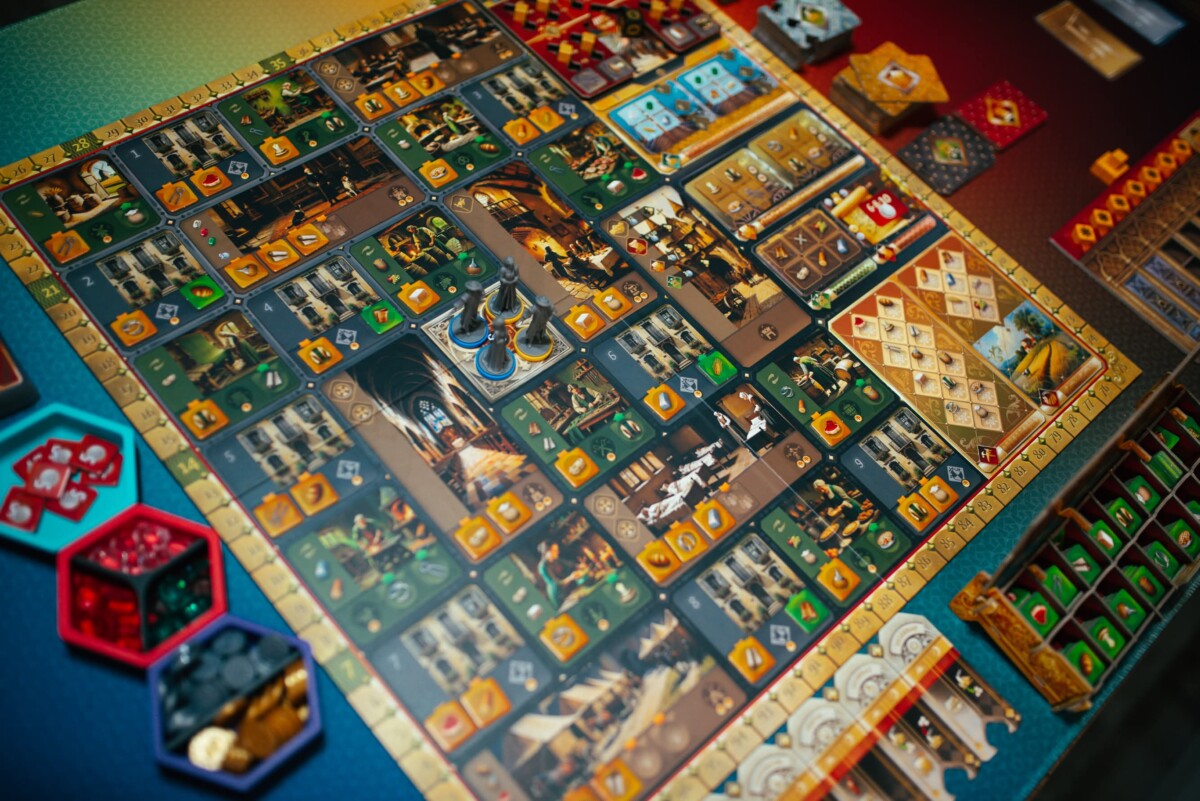
The board represents the city: shops, institutions, bourgeois houses, the city gate. But every step costs an action point, and the schedule is tight. Whoever plans the entire week best, not just a single day, takes home the inheritance.
Every day is a different puzzle: the market opens three times a week, ships arrive whenever they want, and the warehouse burns in three days. Nothing ever stays the same.
The secret of Kalmár in one line
Being a good merchant isn't enough — you also have to be generous. Donations and banquets cost, but without contacts, no one delivers to faceless heirs.
From the game experience

Kalmár: Merchants in Buda
FrogScore · FroGames editorial rating · based on rules, BGG weight, and mechanics declared by the publisherYour arsenal
What you manage each day
7 garas of capital
Very few. They will be used to buy goods, donate, organize banquets. Every coin badly spent is a regret on Sunday evening.
7 action points per day
Moving costs, working costs, banqueting costs. Seven steps to do everything — and movement on the board always eats some of them.
Objective and partner cards
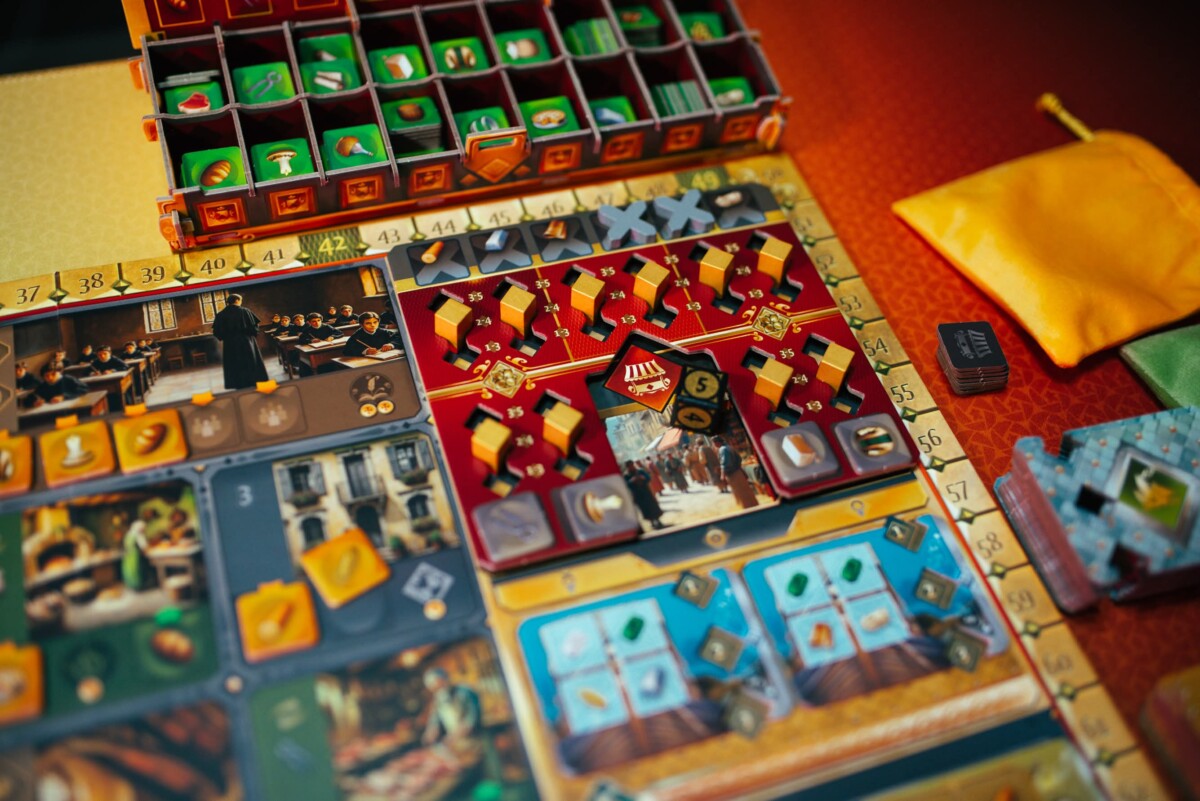
Two types of objective cards and partner cards acquired at banquets. One-time or permanent abilities that change your play style.
Production chains and warehouse
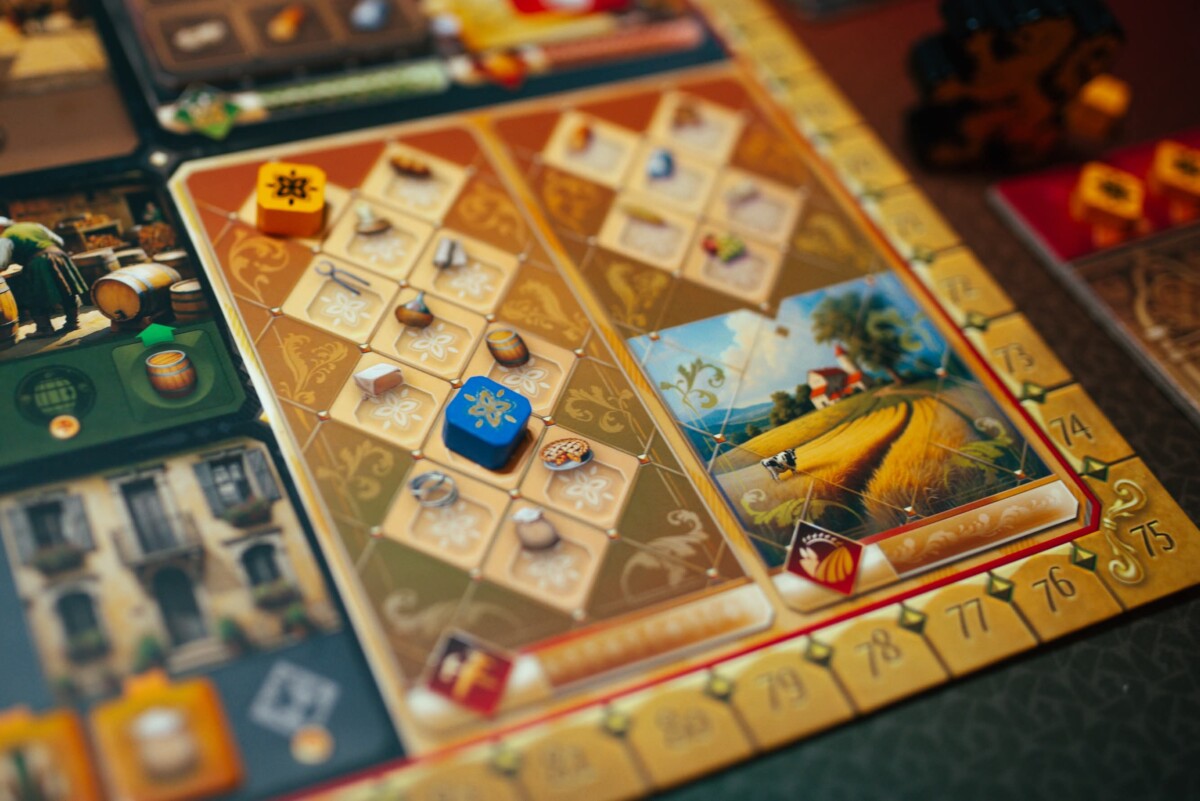
Goods form exploitable supply chains — but what remains in the warehouse for more than three days is lost, with heavy penalties. Speed pays in prestige.
Seven days, seven garas, seven action points. On Monday morning, they seem like a lot. On Sunday evening, they are always too few.
📖RulebookEnglish · Official PDF
Come si gioca
Video dimostrativo di gameplay.
A week in five moments
What happens at the table
Not the rules. The week you'll experience.
Monday morning — seven garas in your pocket
Your father watches you from behind the counter. He has just given seven coins to each of you, seven action points per day, seven days ahead. It looks like a game. You look into his eyes and realize it's not. It starts raining in the courtyard of Buda.
The first warehouse that expires
Wednesday. Those three baskets of wool bought on Monday at the port are about to lose value. Either you deliver them today, or tomorrow you'll pay a penalty. Your brother knows it. He's blocking the way to the right client. Move, or accept the loss.
Thursday evening banquet
You spent four garas on wine and three action points to go back and forth. But the partner card you draw at the end gives you a permanent ability — and three extra prestige. Your older brother glares at you. He couldn't afford the banquet.
Saturday at the black market
The official market is closed today. Ships aren't arriving. But at the black market, you find what you're looking for — at double the price, and with the risk of the inspector. If you go, you waste three action points. If you don't go, you miss tomorrow's delivery. Decide quickly.
Sunday evening — prestige is counted
Objectives completed, partner cards activated, donations registered, warehouse agility calculated. The sum tells all. The old merchant slowly rises from his chair and points to one of you. The week is over. The legacy has a name.
How to play
The flow of each day
Morning, day, and evening. Three phases that repeat for seven days — with actions changing based on time and place.
Morning events are resolved: ship arrivals, market opening, "games within the game" that involve all players and influence the day about to begin.
The core of the game. Each turn begins with a movement on the board (each step costs one action point). At your destination, you perform all possible actions: buy, sell, produce, deliver, donate, organize.
For every sale, you decide whether to collect coins or prestige points. Coins to invest in tomorrow, prestige to get closer to victory. You cannot have both.
Those who can organize a banquet to get partner cards. Warehouse deadlines are checked: goods not delivered within three days are lost, with penalties. Then it's a new day.
Why it's different from other eurogames
Six mechanics that make it unique
Seven days with different rhythms
The market opens three times a week. Ships arrive when they want. Banquets are organized in the evening. Each day has a different window — those who don't read the calendar miss moves.
Warehouse expires in three days
You cannot accumulate indefinitely. Any goods not sold within three days become a heavy loss. Time pressure forces concrete decisions, not theoretical ones.
Locations with specific actions
Craftsmen's shops, bourgeois houses, institutions, city gate. Each location enables different actions. Movement is not a cost; it's a strategic choice about what you can do.
Two types of objectives + partners
Two decks of objective cards with different goals, plus partner cards earned at banquets with one-time or permanent abilities. Each game takes on a different form.
Warehouse agility rewarded
An indicator rewards prestige to those who quickly turn over goods. Buying well isn't enough — you need to deliver immediately. Speed becomes a strategy in itself.
Two-player mode with dual figures
An additional character allows each player to control two merchants simultaneously. And if seven days are too many, the short version only covers Thursday to Sunday.
How it ends
Only one heir, many ways to get there
The one with the most garas doesn't win. The one with the most prestige wins — and prestige comes from choices that seem unproductive: donations, banquets, timely deliveries. A eurogame that rewards style, not greed.
The Heir
- At the end of 7 days, the player with the highest total prestige points wins the game
- Prestige is earned through sales (if you choose points instead of garas), donations, banquets, timely deliveries, and completed objectives
- Partner cards and the agility tracker offer additional prestige throughout the week
Those who fall behind
- Goods not delivered within three days: heavy loss, in garas and reputation
- Unkept promises to clients and failed objectives subtract prestige
- Those who only spend to accumulate wealth and do not build contacts arrive on Sunday with full pockets and empty hands
Kalmár is the seventh game by Pierrot and Private Moon Studios — the culmination of a decade of eurogame design. Designed for those who want a game that requires real planning.
Frequently Asked Questions
FAQ about Kalmár: Merchants in Buda
What distinguishes it from other management eurogames?
The weekly structure with fixed automatic events and the warehouse mechanism that expires in three days. It's not a purely abstract eurogame — time flows tangibly. Each day has a different personality: the market isn't always open, ships don't arrive every day, banquets cost money but open otherwise closed doors.
Is it really a 3.5 weight? Can you learn it in the first game?
The first game serves to understand the weekly rhythm and the connections between actions. The BGG weight of 3.5 reflects the quantity of options rather than the complexity of the rules. From the second game, you start to see the strategy; by the third, you truly plan the whole week. It's a serious eurogame — not for those who want to learn one rule at a time.
How does the two-player mode work?
It includes a new extra character, and each player controls two merchant figures instead of one. This maintains the density of interactions and tactical variety even with two players — a problem many eurogames don't solve well. There's also a shorter version that only covers Thursday-Sunday, useful for quicker games.
How long does a game really last?
The box states 90-150 minutes. Realistically: 90 for two experienced players, 120-150 for four. The shortened 4-day version is under an hour. It's a time proportionate to the depth — not an end-of-evening eurogame, but not a weekend marathon either.
Is it available in Italian?
This is the international edition with components and rules in English. The iconography is very clear and the text on the cards is minimal — but the rulebook must be read in English. Those comfortable with English manuals will have no problem managing the game.
Who is Pierrot and why is it relevant that this is his seventh game?
Pierrot is the pseudonym of the Hungarian game designer behind Private Moon Studios. His previous games — including Twilight City, Cuvée, Caravanserai — have built a solid reputation in the Central European eurogame scene. Kalmár is the studio's seventh title, presented as its most ambitious project for mechanical density and historical setting.
Kalmár: Merchants in Buda is a competitive strategic eurogame for 2-4 players (ages 14+, 90-150 min duration) designed by Pierrot with illustrations by Zoltán Nagy and Gyula Pozsgay, published by Private Moon Studios in 2025. Main mechanic: action point management on a fixed city board with daily phases (morning, day, evening). Each player controls a merchant in 15th-century Buda with 7 initial garas capital and 7 action points per day for 7 days (one turn for each day of the week). Distinctive features: goods production chains, warehouse with a 3-day expiry, banquets to obtain partner cards, two types of objective cards, agility indicator rewarding fast turnover, multiple supply sources (tri-weekly market, port, central warehouse, black market). Includes 2-player mode with dual merchant figures and a shortened 4-day version. BGG weight 3.5/5. English edition. Available on FroGames.it.
Frequently Asked Questions
The answers you're looking for, no beating around the bush.
📸Do the images match the actual product?
The photos on the website often come from BoardGameGeek and are intended to give you an idea of the game. They may vary slightly from the version you receive. The content declared by the publisher is always binding.
📦Does the content of the box match what is indicated?
We always strive to provide the correct content, but minor variations are possible due to reprints or updates. The information comes directly from the publishers. If you have any questions, please contact us!
⏳How do pre-orders work?
Pre-order the game before release, payment is immediate, and the game is reserved for you. As soon as it arrives, we'll ship it right away! If there are any delays, we'll update you promptly.
🔒Can I trust buying here?
Absolutely! Secure payments, tracked shipments, and a team that loves board games as much as you do. If something goes wrong, we'll do our best to fix it.
🛠There's a problem with my order, what should I do?
Write to us now! Whether it's a missing part, damage, or an error, we'll help you resolve it as soon as possible. Your experience truly matters to us.