
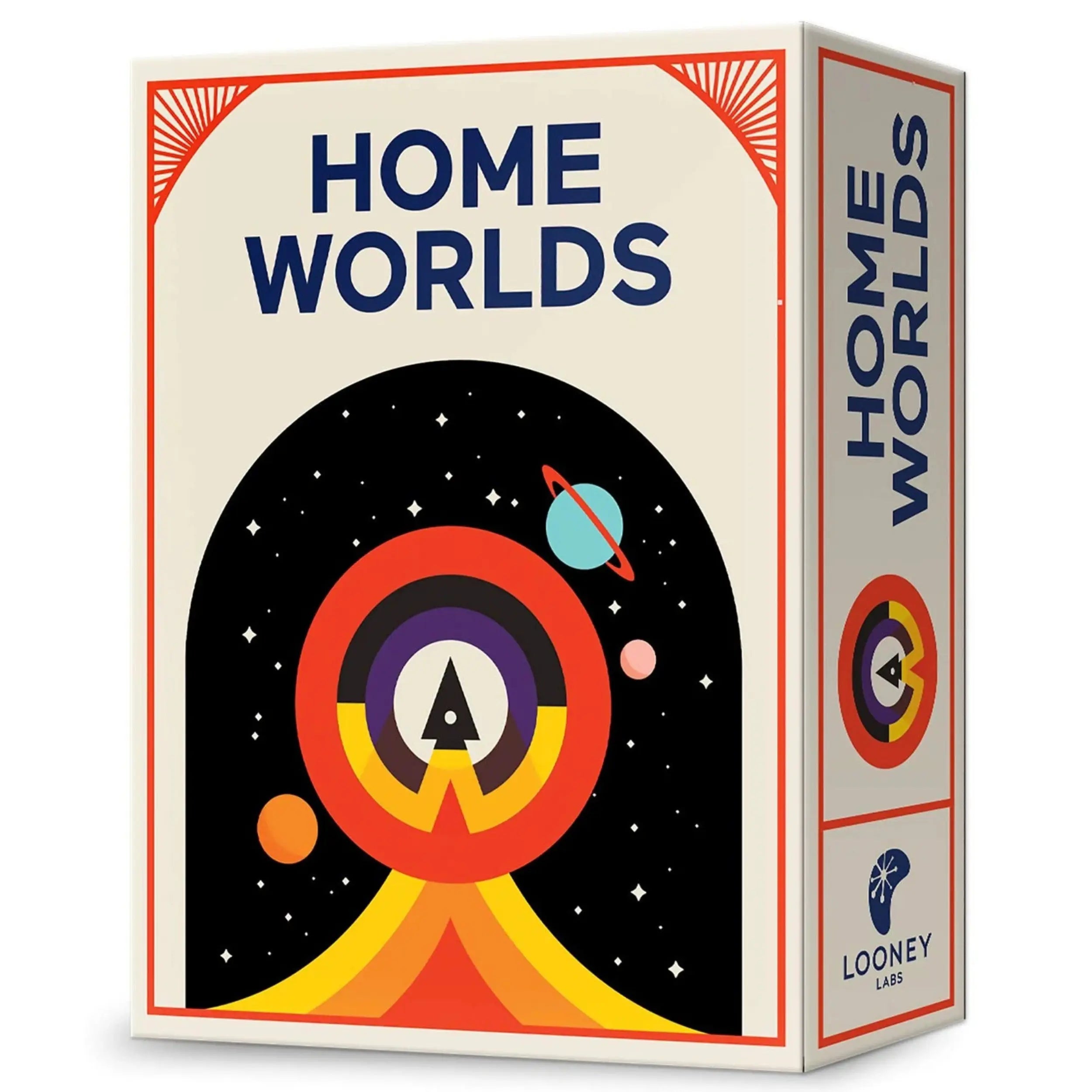
Homeworlds
🐸 Details from BoardGameGeek
Consiglio BGG sul numero di giocatori
Categorie
Meccaniche
Design & Art
Lingua
Si abbina bene con
FroGames — Moments You'll Remember
One empire rises, another falls. Between you, only colorful pyramids and a galaxy you reshape every time. In the end, one of you will be left without a home.
WHAT IT'S ABOUT
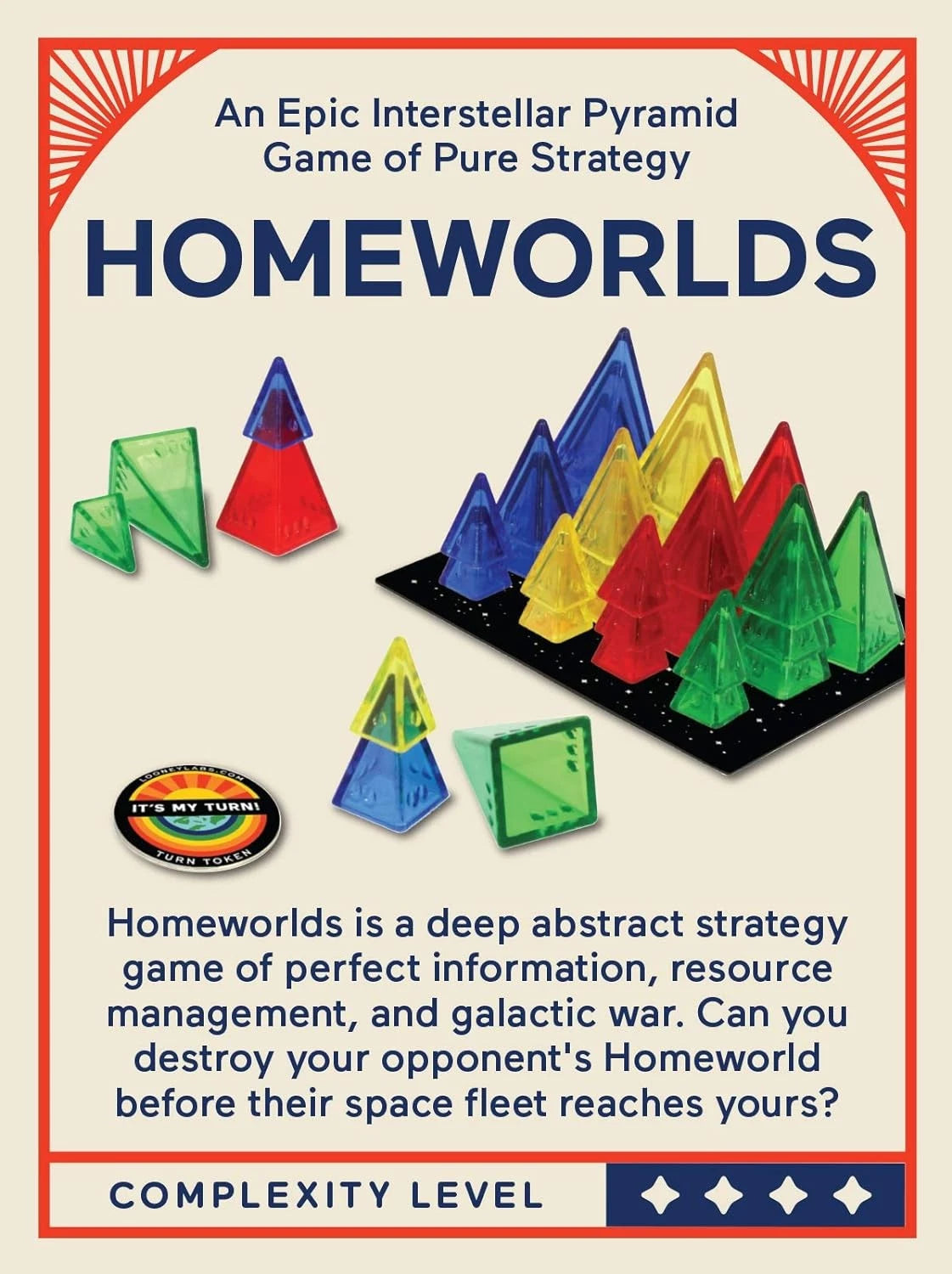
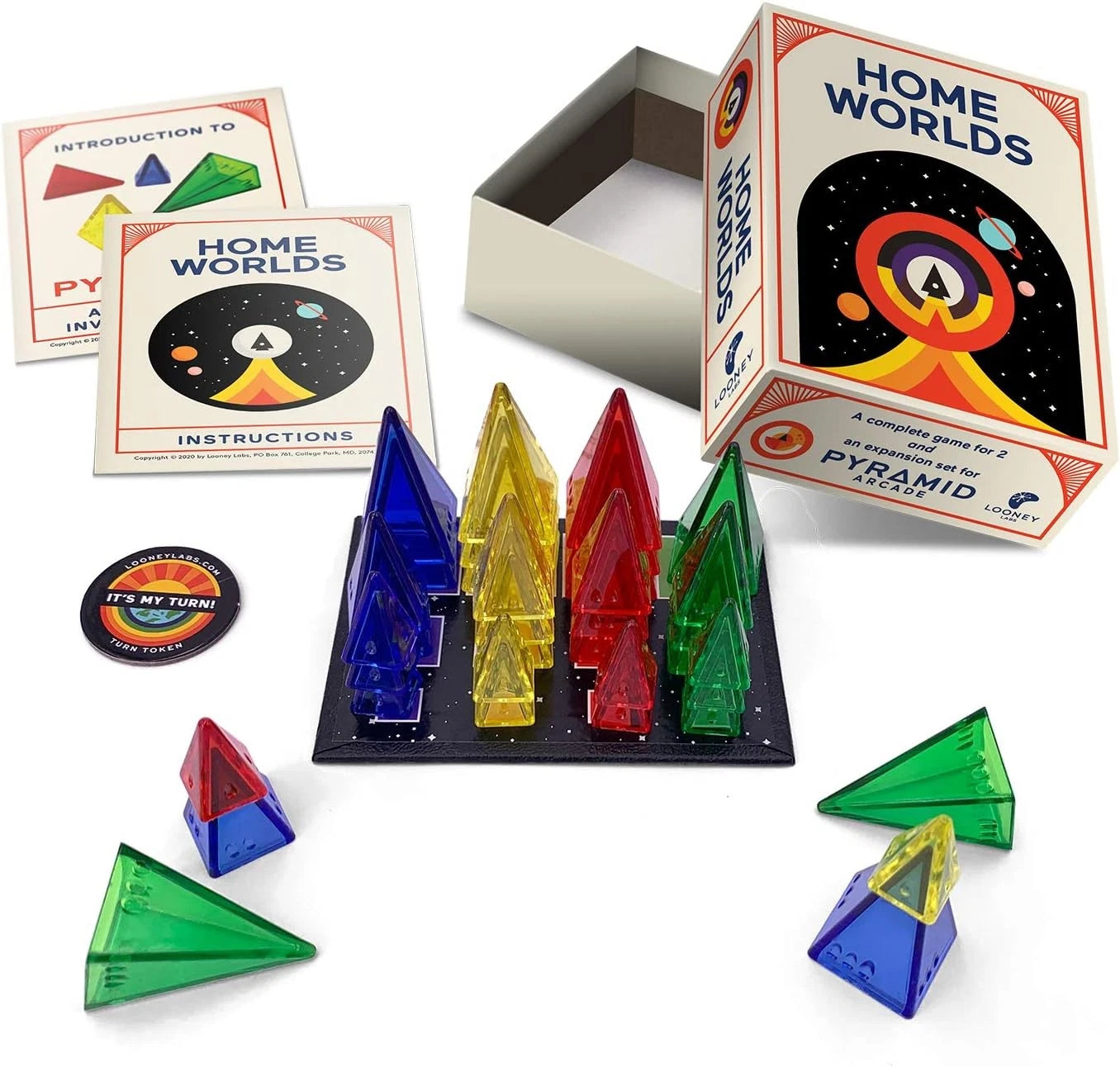
A galaxy to conquer with 36 pyramids and four powers
Homeworlds is the abstract masterpiece by John Cooper, originally published in 2001 and refined over twenty years. The 2020 standalone Looney Labs edition brings the Binary Homeworlds version to the table, Andy Looney's favorite: two players, zero luck, perfect information. All with 36 pyramids in four colors representing four powers: red to attack, yellow to move, green to build, blue to trade.
At the table, you build a star empire starting from your home system. Expand to new stars, colonize planets (pyramids), choose which technology to develop. Every move is a definitive choice: which color to activate, which system to strengthen, which threat to ignore. The objective is unique and ruthless: destroy your opponent's homeworld before they destroy yours. It's a 4X game compressed into half an hour, where every pyramid counts and every mistake is paid for.
What they say abroad
"A deep, thinky abstract that rewards careful planning and punishes mistakes."
A deep, thoughtful abstract that rewards planning and punishes mistakes.
— Meeple Mountain
Homeworlds is a space duel played with your mind. Each game is a different puzzle you build while trying to demolish the other's.
— FroGames

Homeworlds
FrogScore · FroGames editorial rating · based on rules, international reviews and play sessionsYour Arsenal
Four powers, infinite combinations
Red (Attack)
Capture enemy ships. The destructive power that eliminates threats or devastates entire systems. Use it well or you'll be defenseless.
Yellow (Move)
Move your ships between systems. Expansion, tactical repositioning, escape. Without movement, you won't get anywhere.
Green (Build)
Build new ships in your current system. Empire growth, reinforcements, preparation for invasion. Growth is power.
Blue (Trade)
Transform a ship's color. Adapt your technologies to the situation, unlock powers you didn't have, change strategy on the fly.
In an hour, one of you will have lost your world. The other will have a story to tell about how they did it.
Come si gioca
Video dimostrativo di gameplay.
A game in five moments
What happens at the table
Not the rules. The experience.
The Foundation
Choose your homeworlds: two pyramids that define your starting point and which technologies you will have immediately available. The mind game starts here. He has red, you don't. That means he can attack first. You have to rush.
Blind Expansion
The first turns are a race to colonize new star systems. You place yellow pyramids to move, green to build, blue to adapt. The galaxy expands quickly. Every new system is a resource, but also a weakness to defend.
The First Attack
One of you activates red and captures the first enemy ship. The table changes face. It's now clear that this is not a game of peaceful expansion. It's war. The other player responds, or tries to reposition. Moves become slower, more deliberate.
The Sacrifice
One of the two abandons a system to save their homeworld. They give up three pyramids, leave the field open, but gain time. This is the moment you understand that every resource is expendable. Except one.
Catastrophe
A coordinated attack. Three red ships in the enemy system, no defense. The homeworld collapses. One pyramid after another is captured. Game over. The winner looks at the galaxy they built and wonders if they could have done it sooner.
How to play
The flow of each turn
A turn is a single action. You activate a power (color) in a system where you are present, then it's your opponent's turn.
Indicate which color you want to activate. You can only use the powers present in the system you are in. If you don't have red in the system, you can't attack from there.
Movement, construction, attack or transformation. Follow the rules of the chosen power. Some actions allow you to do several things in sequence (e.g. move multiple ships).
If a system is left without ships, it collapses: the stars return to the bank. If your homeworld loses all ships, you have lost. Always check.
The opponent chooses their power and repeats the cycle. The game continues until one of the two homeworlds is completely destroyed.
Why it's different from others
Six mechanics that make a difference
Non-existent galaxy
There is no board. The map is made of pyramids that you place during the game. Each star system is born when someone colonizes it. Every game has a different galaxy, with unique distances and connections.
Four colors, four powers
Red, yellow, green, blue. Each color is a technology that you activate when you are present in a system that contains it. You don't have all powers everywhere. You must build access to what you need, or steal it.
Asymmetrical Homeworld
At the beginning, you choose two pyramids for your homeworld. That choice defines which technologies you have immediately and which colors you lack. Different setups, different strategies. No two games are the same.
Direct capture
When you attack, you don't destroy enemy ships: you capture them and use them for yourself. Every successful attack makes you stronger and weakens your opponent. Power shifts, it is not erased.
Tactical transformation
The blue power allows you to change the color of a ship. Convert a yellow ship to red to attack, or a red to green to build. Adapt resources to the situation instead of being at its mercy.
Binary Victory
There are no points, no final phases. Either you destroy your opponent's homeworld, or you lose yours. The game ends the exact moment a homeworld collapses. Zero ambiguity.
How it ends
How to win and how to lose
Homeworlds has only one victory condition and only one loss condition. There are no draws.
Victory
- Completely destroy your opponent's homeworld (capture or eliminate all their home ships)
- The opponent can no longer make legal moves during their turn
- The opponent surrenders (it happens, after they see the move that will kill them in two turns)
Defeat
- Your homeworld loses all ships: game ends immediately
- You have no legal moves available during your turn (total stalemate)
- You make a mistake that gives your opponent direct access to your undefended homeworld
Homeworlds is a space duel that comes in a small box and lasts a lifetime. Every game is a new problem to solve.
Frequently Asked Questions
Homeworlds FAQ
Do I need a game board or extra components?
No. The box contains 36 pyramids in four colors. All you need is a table. You build the galaxy with the pyramids themselves during the game; there's nothing to set up or prepare beforehand.
How long does it take to understand the rules?
The basic rules can be explained in 10-15 minutes. Understanding how to play well takes practice. It's like chess: you learn the moves quickly, but strategy is never fully mastered. The first 2-3 games are for bumping your head.
Can more than two players play?
The standalone edition is designed for two players (Binary Homeworlds). Multiplayer variants (up to 6) exist with larger pyramid sets, but this version is optimized for duels. Two players, zero compromises.
Is it suitable for those who never play abstract games?
It depends. If you like chess or Go, yes. If you prefer games with a strong theme and narrative, probably not. Homeworlds is pure space tactics dressed as sci-fi. The theme helps visualize, but underneath it's mathematics and positioning.
Is it available in Italian?
No, this edition is in English. But the game is almost language-independent: you only need a translated rulebook (available online in Italian). The pyramids have no text; the powers are universal (red = attack, yellow = movement, green = build, blue = transform).
Homeworlds is an abstract strategy game for 2 players designed by John Cooper and published by Looney Labs. Each game lasts 15-60 minutes and is played with 36 colored pyramids representing spaceships and technologies. The four-power system (attack, movement, build, transform) creates a compressed 4X where the goal is to destroy the opponent's homeworld. Recommended age 10+ years. Perfect information, zero luck, infinite depth. Available on FroGames.it.
Frequently Asked Questions
The answers you're looking for, no beating around the bush.
📸Do the images match the actual product?
The photos on the website often come from BoardGameGeek and are intended to give you an idea of the game. They may vary slightly from the version you receive. The content declared by the publisher is always binding.
📦Does the content of the box match what is indicated?
We always strive to provide the correct content, but minor variations are possible due to reprints or updates. The information comes directly from the publishers. If you have any questions, please contact us!
⏳How do pre-orders work?
Pre-order the game before release, payment is immediate, and the game is reserved for you. As soon as it arrives, we'll ship it right away! If there are any delays, we'll update you promptly.
🔒Can I trust buying here?
Absolutely! Secure payments, tracked shipments, and a team that loves board games as much as you do. If something goes wrong, we'll do our best to fix it.
🛠There's a problem with my order, what should I do?
Write to us now! Whether it's a missing part, damage, or an error, we'll help you resolve it as soon as possible. Your experience truly matters to us.