
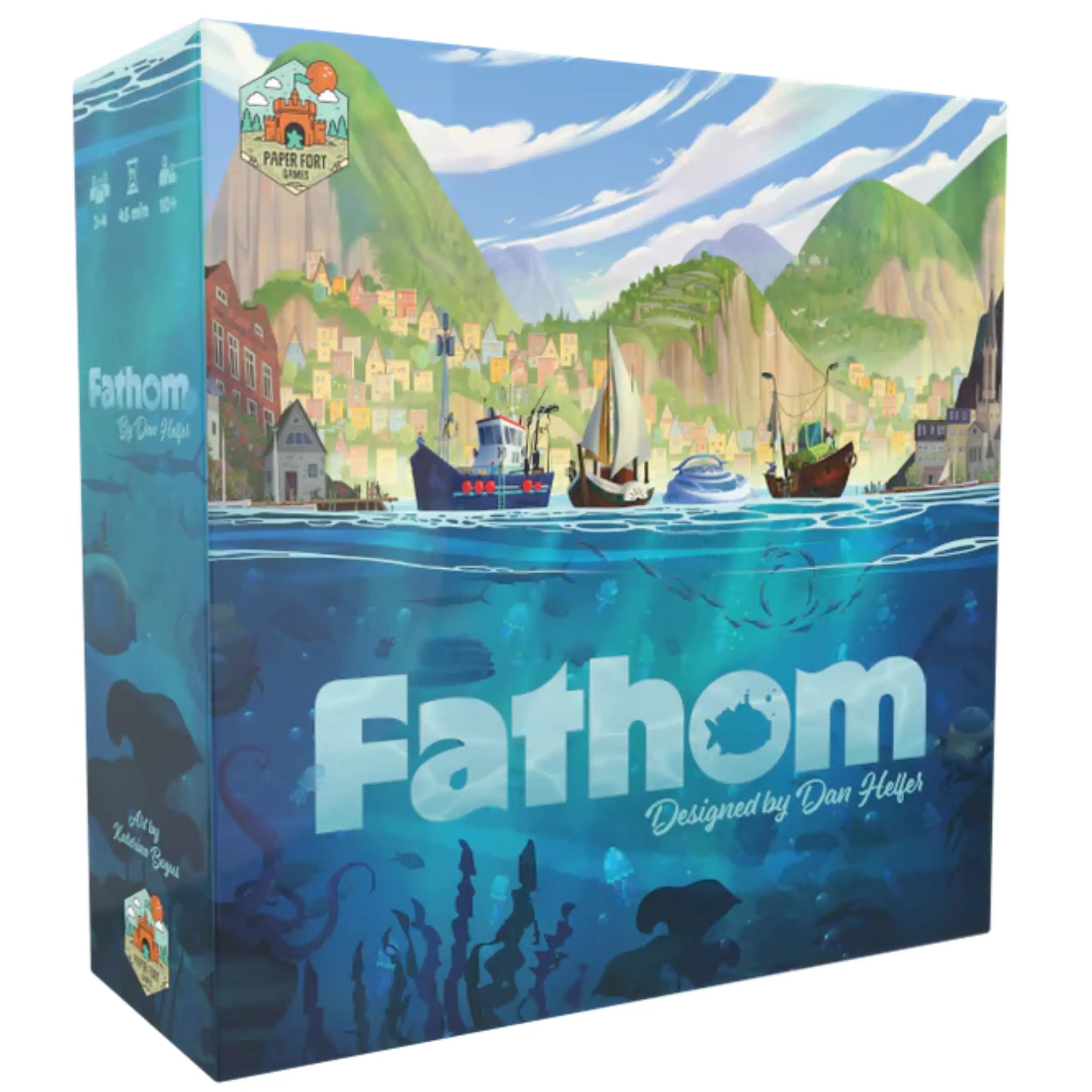
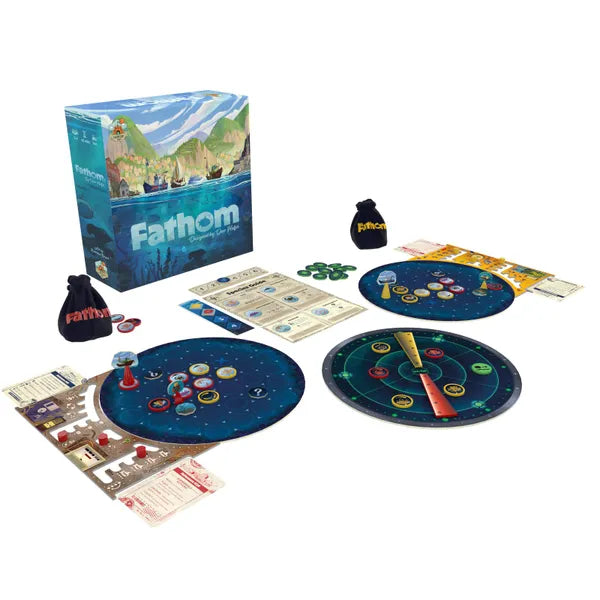
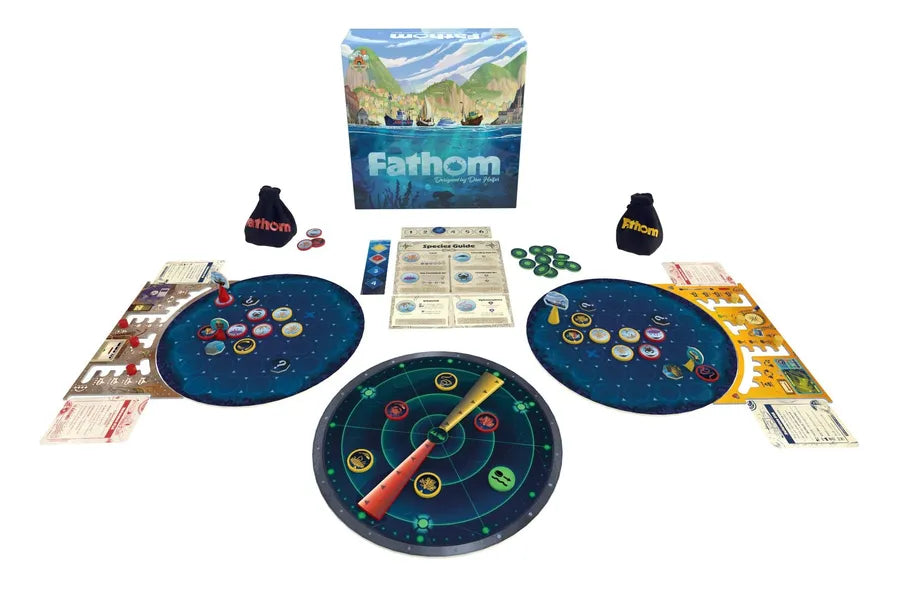
Fathom
🐸 Details from BoardGameGeek
Consiglio BGG sul numero di giocatori
Categorie
Meccaniche
Design & Art
Lingua




Si abbina bene con
FroGames — Moments You'll Remember
On the boat, some point east, others submerge the first disc. Then the tiles emerge. 'Jellyfish.' 'I'm a shark.' 'Wait, where's the octopus…' And in the end, whoever built the best ecosystem wins, but everyone wants to play again.
WHAT IT'S ABOUT
An underwater exploration where each tile is a species to discover
Dan Helfer signs an abstract game disguised as a scientific expedition. You are a marine biology team around an uncharted island. Ekaterina Boguslavskaya dresses it all up with naturalistic illustrations that make each game feel like a National Geographic publication. The theme is solid: not a pretext, but a system that asks you to think like an ecosystem.
You scan the depths, place tiles representing signs of marine life, then submerge your submarine and reveal them. Jellyfish, sharks, octopuses, corals. Each has different scoring conditions: some want homogeneity, others diversity. Some thrive in groups, others in solitude. Six simultaneous rounds, zero downtime, and in the end, whoever built the most synergistic ecosystem wins.
What they say abroad
Fathom asks you to think in multiple patterns simultaneously. It's abstract, but the theme helps you remember what each creature wants.
— FroGames
Simultaneous play eliminates downtime. Everyone plays, always. And in the end, everyone wants to see what others have built.
— FroGames

Fathom
FrogScore · FroGames editorial rating · based on rules, international reviews, and play sessionsWhat you find in the deep
Four types of creatures, four strategies
Solitary predators
Sharks and barracudas that reward isolation. You want to place them far from others of the same species: the more space they have, the more points they are worth. But leaving them too isolated means giving up on other patterns.
Gregarious creatures
Octopuses and fish that thrive in groups. They are worth more if surrounded by others of the same species. But crowding them all together limits your options for species that want diversity.
Corals and anemones
Organisms that reward diversity: the more different species nearby, the more points. They encourage you to build varied ecosystems, but they conflict with gregarious creatures.
Rare species
Jellyfish, manta rays, unique creatures that have special conditions. Some want specific depths, others proximity to elements of the seabed. They are wildcards that turn plans upside down.
Recommended Sleeves 3 cards in 1 size ▼
If you play often, we recommend protecting your cards with clear sleeves to make them last longer.
| Size | Quantity |
|---|---|
| 160 × 140 mm | 3 |
| Total cards | 3 |
In an hour, you'll have built an ecosystem that makes sense. Or at least you'll have tried.
Come si gioca
Video dimostrativo di gameplay.
A game in five acts
What happens at the table
Not the rules. The experience.
Setup: choose where to start
Everyone places their boat on one side of the island. Everyone looks at the same available tiles in the draft. Someone immediately targets sharks, someone else sees a jellyfish pattern. The first choices are still open, but they already influence subsequent rounds.
First signs: the plan takes shape
You start placing face-down tiles in the ocean. Then you submerge the submarine and reveal them. 'Coral.' 'I got an octopus.' Someone builds homogeneous clusters, someone else focuses on diversity. The first patterns emerge, but you still have time to change your strategy.
Mid-game: expanding ecosystems
You already have 10-12 tiles placed. Your ecosystem has a shape, but there are gaps. You see a jellyfish in the draft that would perfectly fill that void, but someone else wants it. You start sacrificing tiles you need to deny others powerful combinations.
Round 5: the crucial last dive
You have two tiles left to place. One completes an 8-point pattern, the other blocks an opponent. Everyone at the table is making the same calculations. When you reveal the final tiles, someone makes a satisfied noise, someone else mutters 'damn it'.
End: counting and discoveries
You count points species by species. Your octopus cluster is worth 12, but isolated sharks are only 4. Someone built a perfectly balanced ecosystem and wins by 3 points. But everyone wants to see each other's ecosystems. 'Let's play another, I get it now.'
How to play
The flow of each round
Six identical, simultaneous, fast rounds. No one waits for anyone else's turn.
You move your boat around the island. Then you submerge the submarine in one of the adjacent areas. This determines where you can scan.
Draw face-down tiles from the common supply. Then everyone looks at the available tiles and chooses one in an open draft. You see what others are taking.
You place the face-down tile in your personal ecosystem. Then everyone reveals simultaneously. You see which creature you've discovered and add it to your pattern.
After six rounds, you have a complete ecosystem. You count points species by species, based on their specific conditions. The one who built the most synergistic system wins.
Why it's different from others
Six mechanics that make a difference
Truly simultaneous play
Everyone plays at the same time. No one waits. Downtime is zero. This makes Fathom fast and engaging even with 4 players: no one gets distracted, no one looks at their phone. Six rounds last 45 minutes, not 90.
Multiple conflicting patterns
Each species wants different things. Octopuses want groups, sharks solitude, corals diversity. You can't optimize all patterns: you have to choose which priorities to pursue and which to sacrifice. It's a puzzle and strategy combined.
Open draft and shared information
You see all available tiles. You know what others are taking. There is no blind luck: every choice is conscious. If someone snatches that jellyfish from you, it's because you left it available.
Asynchronous scoring by species
Not all creatures are worth the same. Some give fixed points, others scale, and still others reward combinations. This creates different value curves and forces you to balance short-term and long-term strategies.
Theme that helps with recall
The theme is not just cosmetic: it's a mnemonic system. Solitary predators want space, gregarious creatures want groups. Biology supports the mechanics, and after one game, you remember everything without consulting the help.
Emergent depth from simple rules
The rules fit on half a page. The rulebook explains in 10 minutes. But the possible combinations are enormous, and each game makes you discover synergies you hadn't seen before. It's a gateway game that doesn't run out of steam.
How it ends
How to win and how to build poorly
After six rounds, you count points. There is no elimination, but there are ways to build inefficient ecosystems.
Victory
- You built synergistic patterns for the species you chose to prioritize
- You balanced homogeneity and diversity based on the creatures present
- You denied opponents key tiles at the right moments
Failed ecosystem
- You tried to optimize all species simultaneously and none are efficient
- You isolated gregarious creatures or massed solitary predators
- You left too many gaps: scattered tiles are worth little
Fathom is an abstract game that makes you think like a marine biologist. Every game is an experiment, and in the end, you always want to try a different combination.
Frequently asked questions
Fathom FAQ
Is it really a family game or is experience needed?
The rules are very accessible: everyone knows what to do in 10 minutes. The first game is immediate. Depth comes from combinations, not complexity. It's perfect as a gateway for those who want an abstract game without entry barriers, but it has enough strategy to keep experienced players engaged too.
Does it work well with 2 players?
Yes, many even prefer it with 2 players. The draft is more controllable, choices are more tactical, and indirect interaction becomes a duel. With 3-4 players, there's more chaos and unpredictability, but zero downtime. It scales well at all player counts.
How long does a game really last?
Six simultaneous rounds: 45 minutes if you're experienced, 60 for the first time. Simultaneous play eliminates dead time. No one waits, so even with 4 players, the pace remains brisk. It's one of those games where it ends and someone immediately says 'another one'.
Is it a pure abstract or does the theme matter?
It's a well-dressed abstract game. The theme isn't fundamental for playing, but it helps immensely with remembering the rules. Predators want space, gregarious creatures want groups: biology supports the mechanics. And Boguslavskaya's illustrations are beautiful, giving personality to the tiles.
Is it available in English?
This edition is in English. The text on the cards is minimal (species names and scoring symbols), and the rulebook is clear. Once learned, you barely consult the manual: the game is iconic.
Fathom is a tile-placement and pattern-building game designed by Dan Helfer for 2-4 players aged 10 and up. Each game lasts 45-60 minutes and is played simultaneously: no one waits for anyone else's turn, the pace is fast and engaging. The theme of marine exploration dresses up a strategic abstract game where each species has different scoring conditions, and you must balance homogeneity, diversity, solitude, and groups to build the most synergistic ecosystem. Published by Paper Fort Games, with naturalistic illustrations by Ekaterina Boguslavskaya. Available on FroGames.it.
Fathom
Frequently Asked Questions
The answers you're looking for, no beating around the bush.
📸Do the images match the actual product?
The photos on the website often come from BoardGameGeek and are intended to give you an idea of the game. They may vary slightly from the version you receive. The content declared by the publisher is always binding.
📦Does the content of the box match what is indicated?
We always strive to provide the correct content, but minor variations are possible due to reprints or updates. The information comes directly from the publishers. If you have any questions, please contact us!
⏳How do pre-orders work?
Pre-order the game before release, payment is immediate, and the game is reserved for you. As soon as it arrives, we'll ship it right away! If there are any delays, we'll update you promptly.
🔒Can I trust buying here?
Absolutely! Secure payments, tracked shipments, and a team that loves board games as much as you do. If something goes wrong, we'll do our best to fix it.
🛠There's a problem with my order, what should I do?
Write to us now! Whether it's a missing part, damage, or an error, we'll help you resolve it as soon as possible. Your experience truly matters to us.