
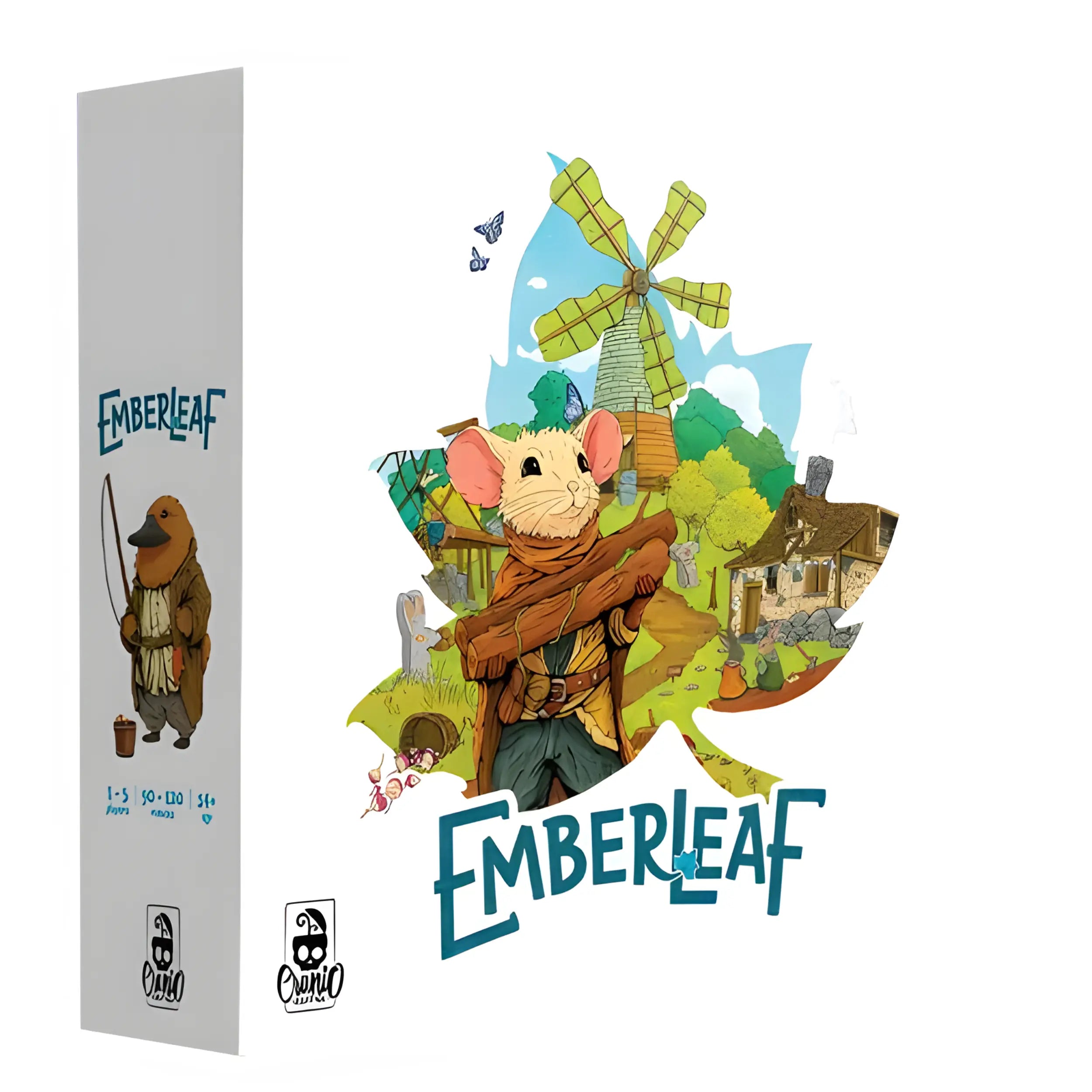
Emberleaf ITA
🐸 Details from BoardGameGeek
Consiglio BGG sul numero di giocatori
Categorie
Meccaniche
Design & Art
Lingua
🐸 How pre-orders work
🐸 A wise frog knows when to split the order… and when to wait for the right leap.
- Arrives
- date to be confirmed





Si abbina bene con
An ancient world. A living forest. A challenge to be built leaf by leaf.
In Emberleaf , you take on the role of an Emberling and return to your homeland to rebirth it. You are not alone: others like you seek to regain balance, memory, and a future in this enchanted yet confined place. Every move is a silent clash between harmony and ambition.
Resources to manage, territories to liberate, and villages to build using tiles and hero cards in a deep, modular puzzle. Your decisions will shape the fate of an entire civilization... and maybe even your own.
What makes Emberleaf special among board games
- An original "card dancing" system: slide the cards in your grid to activate ever-new combos
- Place tiles on a modular map to build ever-changing villages
- Resource management with exploration and remediation of hazardous areas
- Unique heroes with special powers to recruit into your party
- High replayability and well-integrated solo modes
You'll feel like you're walking through a forest, with branches creaking and villages blossoming at your touch.
Come si gioca
Video dimostrativo di gameplay.
A game in five moments
What happens at the table
Not the rules. The experience.
The forest opens, companies deploy
Everyone chooses their company deck. Six heroes, six small personalities with different abilities. Take a look at the favor cards, choose the first objectives. The forest on the board is still untouched — it seems impossible, but in two hours everyone will have built a different village on it.
The first card slides
You play a hero on your board. Nothing special — a basic effect. Then on the next turn, you slide the cards to the left, and suddenly that hero activates a shift effect, another one activates an ability, a third one goes off the board and returns resources to you. The engine has just started to run.
The first trophy, and the forest changes
Someone closes a clearing, someone clears a dangerous area. The first trophy is claimed. When the track reaches the bottom, the dangerous areas are refreshed — and this time they appear in their orange, tougher version. The pace accelerates. Plans need to be revised.
The combo you've been waiting for twenty minutes
You've placed the right hero in the right column. The cards slide, one after another: you gain resources, build a building, slot in a resident that activates a chain bonus, complete a favor card. Fifteen points in one turn. The others stop talking. That moment, in Emberleaf, always happens.
Six trophies on the board, final count
The last trophy is taken. The game ends. Secret favor cards are revealed, rehomed residents are tallied, the village is counted. The point difference is always close — and everyone already has a new idea for the next game: a different deck, a different strategy, a different focus.
How to play
The flow of each turn
A crucial choice every turn. The rulebook is dense, but the game loop is surprisingly clean — you internalize it in one game.
On your turn, choose one of two actions: place a new hero card on your player board, activating its immediate effect, or slide all cards already on your board to the left.
When they slide, cards activate shift effects. When they go off the board, drop-off effects trigger and they return to your hand. Three types of effects per card — the magic of card dancing.
On the main board, move heroes between clearings, gather wood, food, stone, honey, clear dangerous areas, place building tiles in empty clearings, and house residents.
Six trophies on the board reward different achievements: completing a clearing, defeating a dangerous area, populating the forest. When the last one is taken, the game ends.
Why it's different from others
Six mechanics that make a difference
Card dancing is a new mechanic
Cards that slide and produce different effects depending on where you place them, when you move them, when you let them go off the board. You've never seen it before — and after Emberleaf, you'll recognize it.
Two systems that communicate
Personal player board (card dancing) and shared main board (tile placement) are not two separate games: every move on one influences the other. This is where the depth comes from.
Two-sided dangerous areas
At first, they are green and manageable. Mid-game, they flip to their tougher orange side. The game pushes you to act before the forest truly becomes hostile.
Five different company decks
Each color is a cast of six heroes with unique abilities. Games change substantially depending on the chosen deck — and with four expansions coming, there's content for years.
Final scoring you don't see coming
The 88 favor cards are hidden objectives. Everyone builds towards their own — and at the final count, points shift in unpredictable ways. The margin is almost always minimal.
Integrated and complete solo mode
64 solo cards in the base box. Not a minimal automa — a serious opponent that replicates the tension of multiplayer. The game stands up perfectly well on its own.
How it ends
Six trophies end the game, points decide
You don't win with a single blow. You win by optimizing a long-term plan, managing your player board and the main board, and reading opponents' moves on contested clearings.
Victory
- Most victory points at the end of the game
- Points from rehomed residents, built buildings, collected trophies, completed favor cards
- The game ends when the last of the six trophies is claimed
Defeat
- There's no player elimination: everyone plays until the end
- You lose if others built more efficient engines or read the favor cards better
- Often the difference is just a few points — one more hero recruited, one more trophy
Emberleaf is a long-shelf-life game: you don't open it twice and then put it away. You open it twenty times and each time you try a different deck, a different strategy, a different forest.
Frequently asked questions
Emberleaf FAQ
What is "card dancing" and why is everyone talking about it?
It's Emberleaf's central mechanic. You place hero cards on your player board in columns, and each card has three different types of effects: one when you play it, one when it slides sideways, one when it goes off the board and returns to your hand. The game is about deciding where to place and when to slide to trigger chain combos. No one had done it like this before.
Is it suitable for those new to strategic games?
Honestly, no. Emberleaf has a BGG weight of 3.13/5 — it's a demanding game, with a dense rulebook and a slow first game. It's designed for those who have already played titles like Wingspan, Everdell or Cascadia and are looking for something deeper. For a gateway game, there are better options.
How does the solo mode work? Is it worth it?
The base game includes 64 dedicated solo cards — not a minimal automa but a serious system that simulates an opponent. The optimization puzzle holds up very well solo, and many players prefer it this way because they can take their time with choices. It's absolutely worth it even just for the single-player mode.
With how many players does it work best?
With 2-3 players, the game is more tactical and faster, around 60-90 real minutes. With 4-5 players, it enters the declared 90-120 minutes and interaction on the main board becomes central — clearings are contested, dangerous areas are cleared before someone else finishes them. At 5, it's chaotic but very lively.
How long does a game really last?
The first game lasts about two and a half hours because you consult the rulebook and figure out card dancing as you go. From the second game onwards, it falls into the declared 90-120 minutes, and with two experienced players, it finishes in just over an hour. The learning curve is steep but short.
Is the Italian edition complete? Are there expansions?
The Cranio Creations edition is complete and localized in Italian for rules, cards, and tiles. The base game is self-sufficient and includes the solo mode. The first expansion, originally from Kickstarter, is also coming in Italian and introduces new company decks, extra favor cards, and advanced rules for placing cards on the player board.
Emberleaf is a competitive strategy board game for 1-5 players (ages 14+, duration 90-120 min, weight 3.13/5). Designed by Frank West and James Tomblin, published by The City of Games and distributed in Italian by Cranio Creations. Main mechanics: card dancing, tile placement, set collection, engine building, resource management. Each player leads a company of Emberlings to rebuild the forest — explore, gather resources, clear dangerous areas, build buildings, and house residents. The original card dancing mechanic slides cards on the player board to activate combined effects. Includes a solo mode with 64 dedicated cards. Italian edition. Available on FroGames.it.
Emberleaf ITA
Frequently Asked Questions
The answers you're looking for, no beating around the bush.
📸Do the images match the actual product?
The photos on the website often come from BoardGameGeek and are intended to give you an idea of the game. They may vary slightly from the version you receive. The content declared by the publisher is always binding.
📦Does the content of the box match what is indicated?
We always strive to provide the correct content, but minor variations are possible due to reprints or updates. The information comes directly from the publishers. If you have any questions, please contact us!
⏳How do pre-orders work?
Pre-order the game before release, payment is immediate, and the game is reserved for you. As soon as it arrives, we'll ship it right away! If there are any delays, we'll update you promptly.
🔒Can I trust buying here?
Absolutely! Secure payments, tracked shipments, and a team that loves board games as much as you do. If something goes wrong, we'll do our best to fix it.
🛠There's a problem with my order, what should I do?
Write to us now! Whether it's a missing part, damage, or an error, we'll help you resolve it as soon as possible. Your experience truly matters to us.