
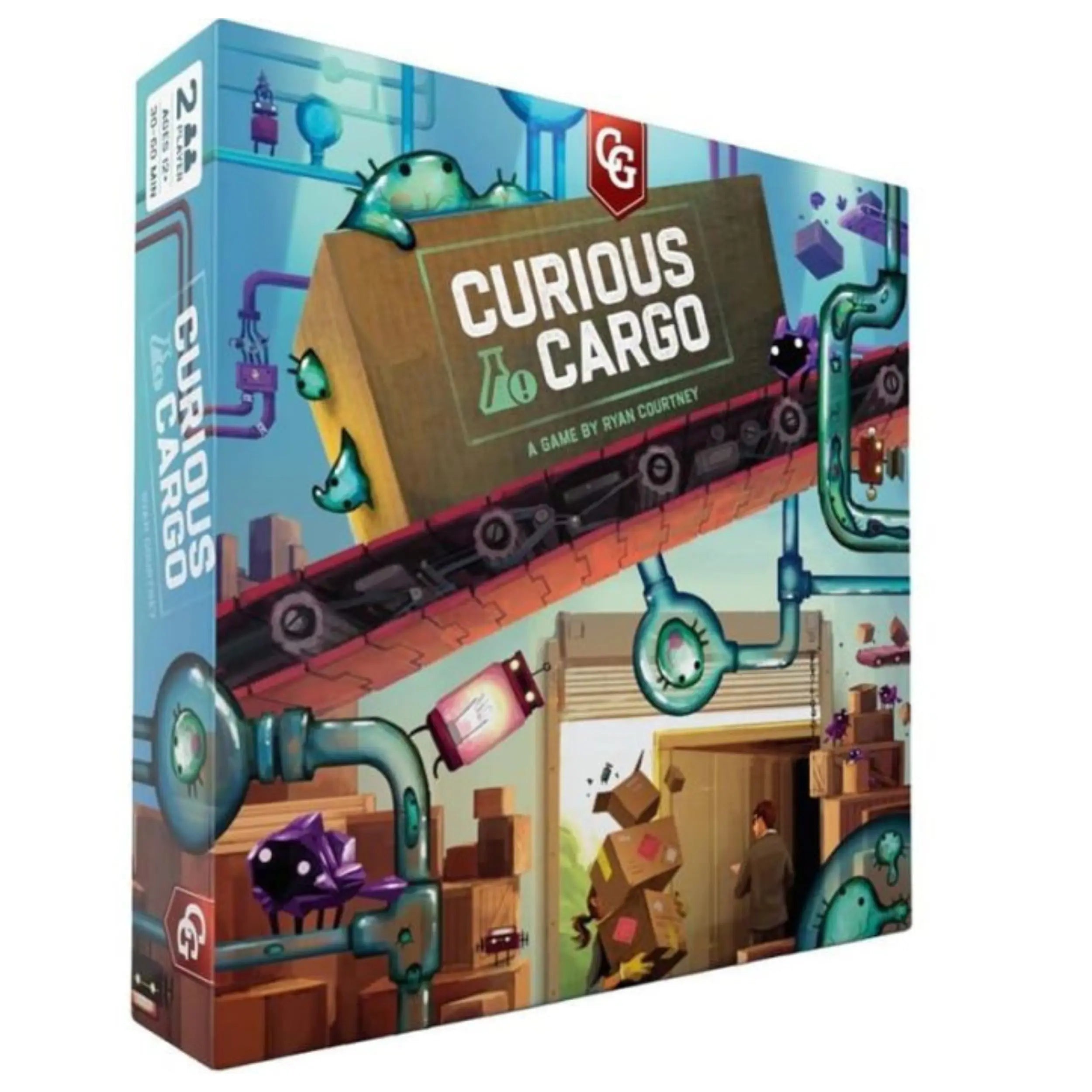

Curious Cargo
🐸 Dettagli da BoardGameGeek
Consiglio BGG sul numero di giocatori
Categorie
Meccaniche
Design & Art
Lingua
Si abbina bene con
FroGames — Moments You'll Remember
Mid-game, you look at each other's boards and think the same thing: how the hell did he do that? Then your truck arrives at his factory and you realize: he didn't.
WHAT IT'S ABOUT
A duel of industrial logistics where every tile is an irreversible choice
Curious Cargo is the second published project by Ryan Courtney, a designer who debuted with Pipeline (2019), an economic puzzle about refinery management. Here, Courtney brings the same cerebral DNA in a more compact and direct format, illustrated by the colorful geometries of Kwanchai Moriya. Published by Capstone Games in 2020, it is a game that thrives on asymmetry: each player has a different board, with uniquely arranged input and output spaces.
On your turn, you place conveyor belt tiles to connect your factory's production spaces. When a line is complete, you call a truck and ship colored cargo to your opponent, who must receive them in the correct spaces or suffer the cost. The game is a competitive spatial puzzle: every tile you place changes future possibilities, and every cargo that arrives at the enemy factory is an obstacle to manage. The player who completes more contracts and optimizes production best wins.
What they say abroad
A logistical puzzle that rewards planning and punishes hesitation.
A logistical puzzle that rewards planning and punishes hesitation.
— FroGames
Every tile you place locks you into a path you can't undo.
Every tile you place locks you into a path you can't undo.
— FroGames

Curious Cargo
FrogScore · FroGames editorial rating · based on rules, international reviews and play sessionsWhat you move in the factory
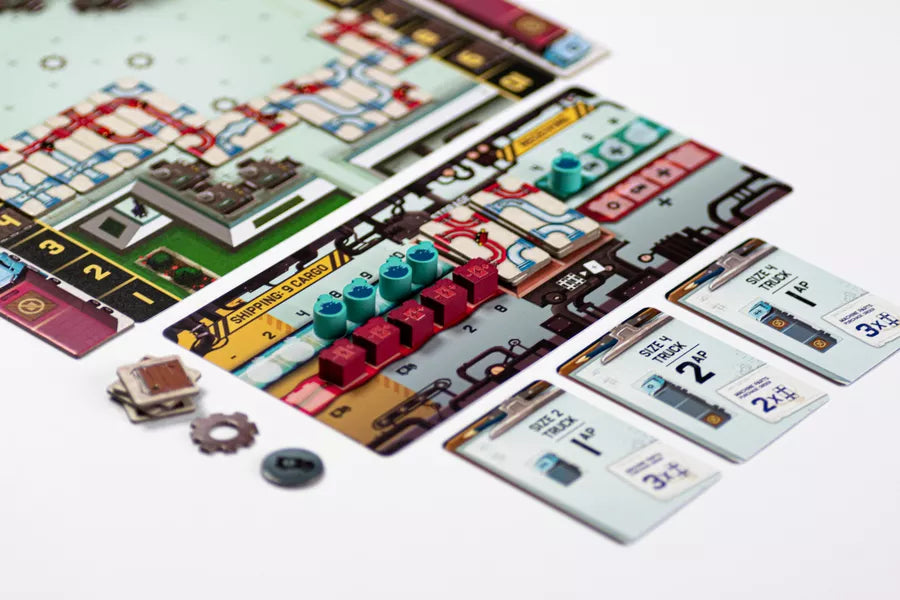
The components of your setup
Conveyor belt tiles
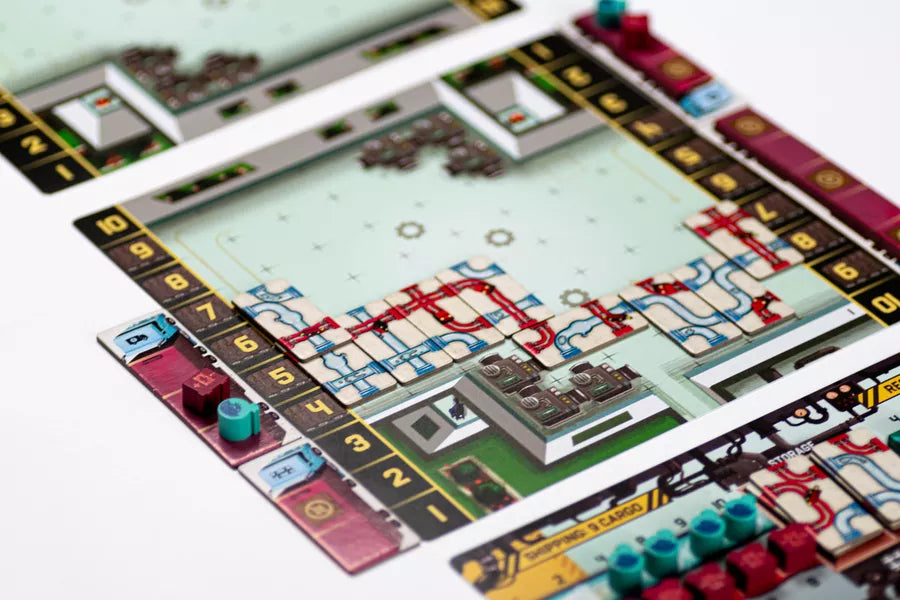
Each tile has colored lines (yellow, red, blue) that connect the edges. You place them to create paths from input to output. Once placed, they cannot be moved. The board fills up quickly and you need to think 5 moves ahead.
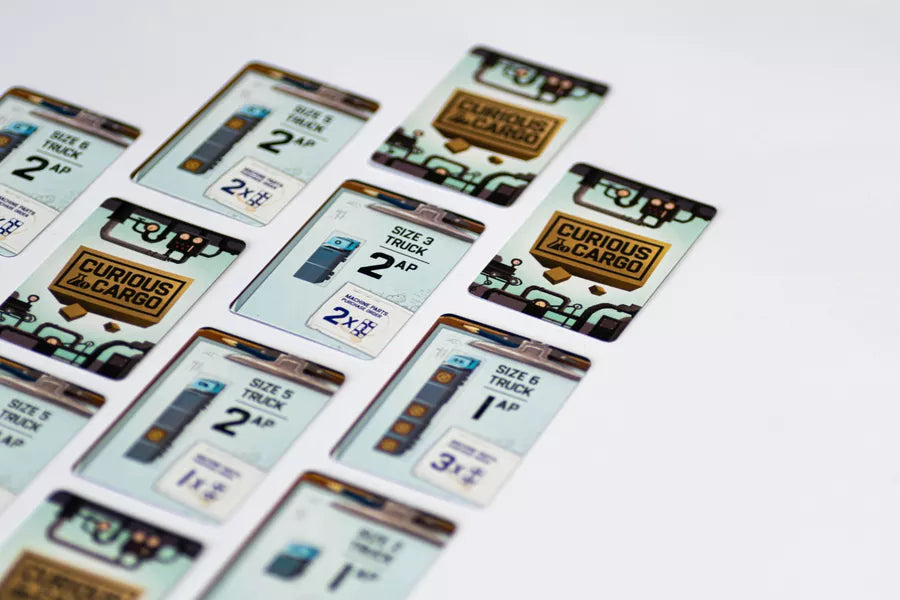
Shipping trucks
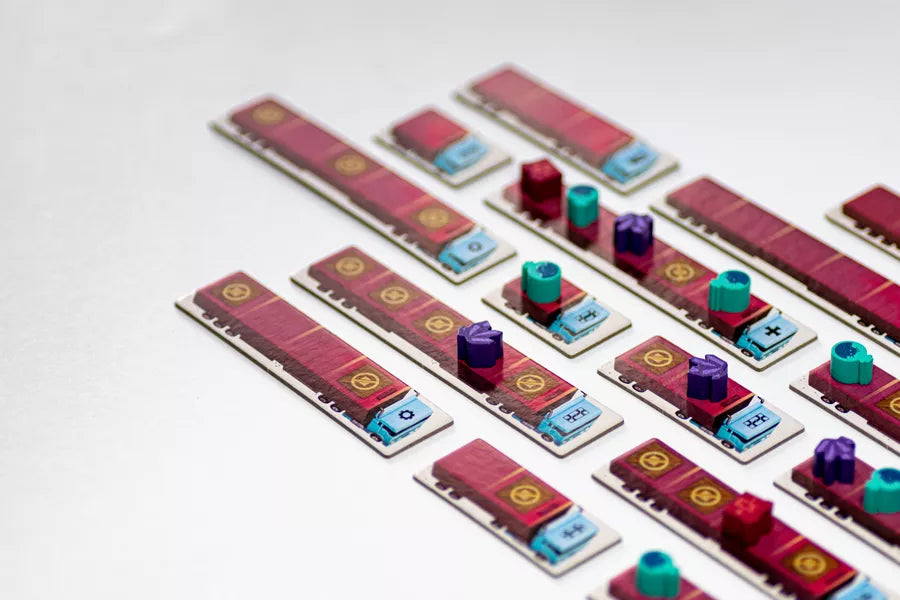
When you complete a line from your production space to an output space, you call a truck. You ship colored cargo to your opponent, who must receive them in the correct spaces. If they can't, they pay penalties. It's your way to sabotage.
Colored cargo tokens
Cubes and geometric shapes in different colors. You produce them, ship them, receive them. Each cargo that arrives in your factory takes up space and must be managed. If you accumulate too much enemy cargo, your plan goes haywire.
Asymmetrical boards
Six different boards for each player, each with a unique input/output space layout. You never play the same game: each board requires different strategies. The advanced mode adds a third color to increase complexity.
Recommended sleeves 25 cards in 1 size ▼
If you play often, we recommend protecting your cards with clear sleeves to make them last longer.
| Size | Quantity |
|---|---|
| 45 × 68 mm | 25 |
| Total cards | 25 |
In half an hour you'll realize you've built your own prison, tile by tile. And you'll love it.
Come si gioca
Video dimostrativo di gameplay.
A game in five moments
What happens at the table
Not the rules. The experience.
The perfect plan
Look at your board, pristine and full of possibilities. You already have an idea: a direct line from the blue input to the yellow output, then double down on red. Seems easy. You confidently place your first tile. Your opponent places theirs and smiles. Bad sign.
The first shipment
You complete the first line. You call the truck, send three blue cargos to the enemy plant. They must receive them in the correct spaces or lose points. They look at you, place a tile, and send back four red cargos. You have no space. Now you understand: this isn't just a puzzle. It's a logistical war.
The board fills up
You're halfway through the game. Your factory is a tangled mess of colored lines. Every new conveyor belt you place closes off a future possibility. You want to connect the green output but have no space left. Your opponent completes two consecutive shipments. Your board gets jammed with enemy cargo. You need to reorganize everything.
The desperate move
You have no choice. You place a tile that blocks a future line, but allows you to complete a shipment now. You call the truck, send a massive load. Your opponent didn't expect it. They have to manage six cargos on an already full board. For a moment, you have the advantage. Then you realize: you just closed off your only exit for the yellow color.
The final tally
End of game. You look at your board: a masterpiece of inefficiency. Three blocked lines, unsold cargo, accumulated penalties. Your opponent counts their completed contracts. They win by four points. You play again immediately, because now you know what not to do. And you have six different boards to try.
How to play
The flow of each round
Curious Cargo is a game of alternating turns. Each turn has two actions, then it passes to the other player.
You draw conveyor belt tiles from the common supply. Each tile has colored lines connecting the edges. You choose one to keep, the rest go into a shared pool.
You place the tile on your board. When a line connects an input (where you produce cargo) to an output (where you ship), you can call a truck. You complete the shipment and send cargo to your opponent.
If your opponent has shipped cargo to you, you must receive it in the correct input spaces. If you don't have space or the right connections, you incur penalties. Enemy cargo occupies your board and clogs up the lines.
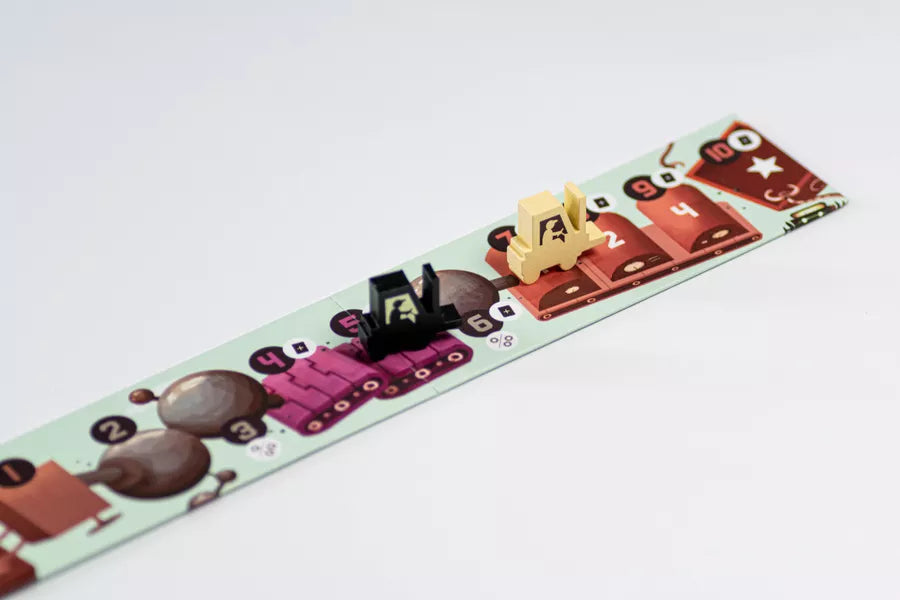
Every cargo you ship advances you on a contract track. The more you complete, the more points you earn. But you must balance production, shipping, and receiving. An overcrowded board blocks everything.
Why it's different from others
Six mechanics that make a difference
Total asymmetry
Each player has a different board, with a unique layout of input and output spaces. You never play the same puzzle: six boards per player means 36 different combinations. Each setup requires new strategies. Asymmetry is not cosmetic, it's structural.
Irreversible spatial puzzle
Every tile you place stays there forever. You cannot remove it, you cannot move it. Every choice closes off future possibilities and opens new blockages. Halfway through the game, your board is a labyrinth you built yourself. And often, you've trapped yourself.
Logistical sabotage
You don't hit your opponent directly. You jam them. Every cargo you ship takes up space on their board and forces them to manage it. If they don't have the right connections, they pay penalties. The interaction is indirect but brutal: you slowly strangle them, shipment after shipment.
Dual difficulty mode
The basic mode uses two cargo colors (simpler to plan). The advanced mode adds the third color, multiplying the possible combinations. Same game, double the complexity. You can scale the difficulty without changing the rules.
Zero luck, zero excuses
No dice, no decks, no event cards. Tiles are drawn from a common pool, and you choose which one to keep. Every mistake is yours. Every victory is earned. If you lose, you can't blame chance. It's a game that rewards those who think three moves ahead.
Depth in 60 minutes
Rules explained in 10 minutes, first game played in an hour. But the decision space is huge: each tile has 4 possible rotations, each position changes the future. Curious Cargo is an abstract game disguised as thematic. It weighs 3.2 on BGG, but you don't notice the weight until you're already in it.
How it ends
How to win and how to lose
The game ends when a player completes 8 contracts or when both can no longer place tiles. Then points are counted.
Victory
- You complete more contracts than your opponent by shipping cargo in the correct colors
- You accumulate bonus points by completing shipments without enemy cargo on your board
- You manage received cargo without incurring penalties, keeping your board flowing
Defeat
- You block yourself by placing tiles that close all future lines
- You accumulate too much enemy cargo and your board gets jammed, preventing you from completing shipments
- You incur repeated penalties for unmanaged cargo, losing points every turn
Curious Cargo is a cerebral duel where the only enemy, in the end, is yourself. And the board you built tile after tile.
Frequently asked questions
FAQ about Curious Cargo
Is it really only for 2 players or can it be adapted?
Only for 2. The game is designed as a direct duel: each board is balanced against the other, and the interaction works because you ship cargo to a single opponent. There is no official variant for 3-4 players, and it would not make mechanical sense. If you are looking for a competitive puzzle for two, this is it.
How difficult is it to learn compared to Pipeline?
Simpler than Pipeline, but it's not a gateway. The rules are explained in 10 minutes, but the decision space quickly expands. If Pipeline is a 3.8 weight, Curious Cargo is a 3.2: fewer subsystems, same depth. The first game will seem manageable. The second you'll realize how much you messed up.
Can I play multiple games in a row without getting bored?
Yes, in fact, it's recommended. Each player has six different boards, and each combination completely changes the strategy. Plus, there's the three-color mode that doubles the complexity. Very high replayability, especially if you always play with the same opponent: it becomes a challenge of adaptation.
How much does planning ahead vs. improvising matter?
You have to plan, but with flexibility. If you plan five moves ahead and your opponent jams your board with enemy cargo, the plan fails. The skill lies in building lines that remain open and adaptable. Those who plan too rigidly block themselves. Those who improvise too much end up without connections.
Is it available in Italian?
No, this Capstone Games edition is in English. However, the game is almost language-independent: the tiles are colored symbols, the cargo is cubes, the boards are geometric patterns. The only text is in the rulebook and on the boards (space names). With a translated rulebook, you can play without problems.
Curious Cargo is an abstract strategy game for 2 players designed by Ryan Courtney and published by Capstone Games. Each game lasts 30-60 minutes and is suitable for ages 12 and up. The game combines network building, tile placement and pick-up and deliver in a competitive logistical puzzle where you build asymmetrical production lines and sabotage your opponent by shipping cargo to their plant. With six different boards per player and two difficulty modes, it offers strategic depth and high replayability. Zero luck, only irreversible choices. Available on FroGames.it.
Curious Cargo
Frequently Asked Questions
The answers you're looking for, no beating around the bush.
📸Do the images match the actual product?
The photos on the website often come from BoardGameGeek and are intended to give you an idea of the game. They may vary slightly from the version you receive. The content declared by the publisher is always binding.
📦Does the content of the box match what is indicated?
We always strive to provide the correct content, but minor variations are possible due to reprints or updates. The information comes directly from the publishers. If you have any questions, please contact us!
⏳How do pre-orders work?
Pre-order the game before release, payment is immediate, and the game is reserved for you. As soon as it arrives, we'll ship it right away! If there are any delays, we'll update you promptly.
🔒Can I trust buying here?
Absolutely! Secure payments, tracked shipments, and a team that loves board games as much as you do. If something goes wrong, we'll do our best to fix it.
🛠There's a problem with my order, what should I do?
Write to us now! Whether it's a missing part, damage, or an error, we'll help you resolve it as soon as possible. Your experience truly matters to us.