
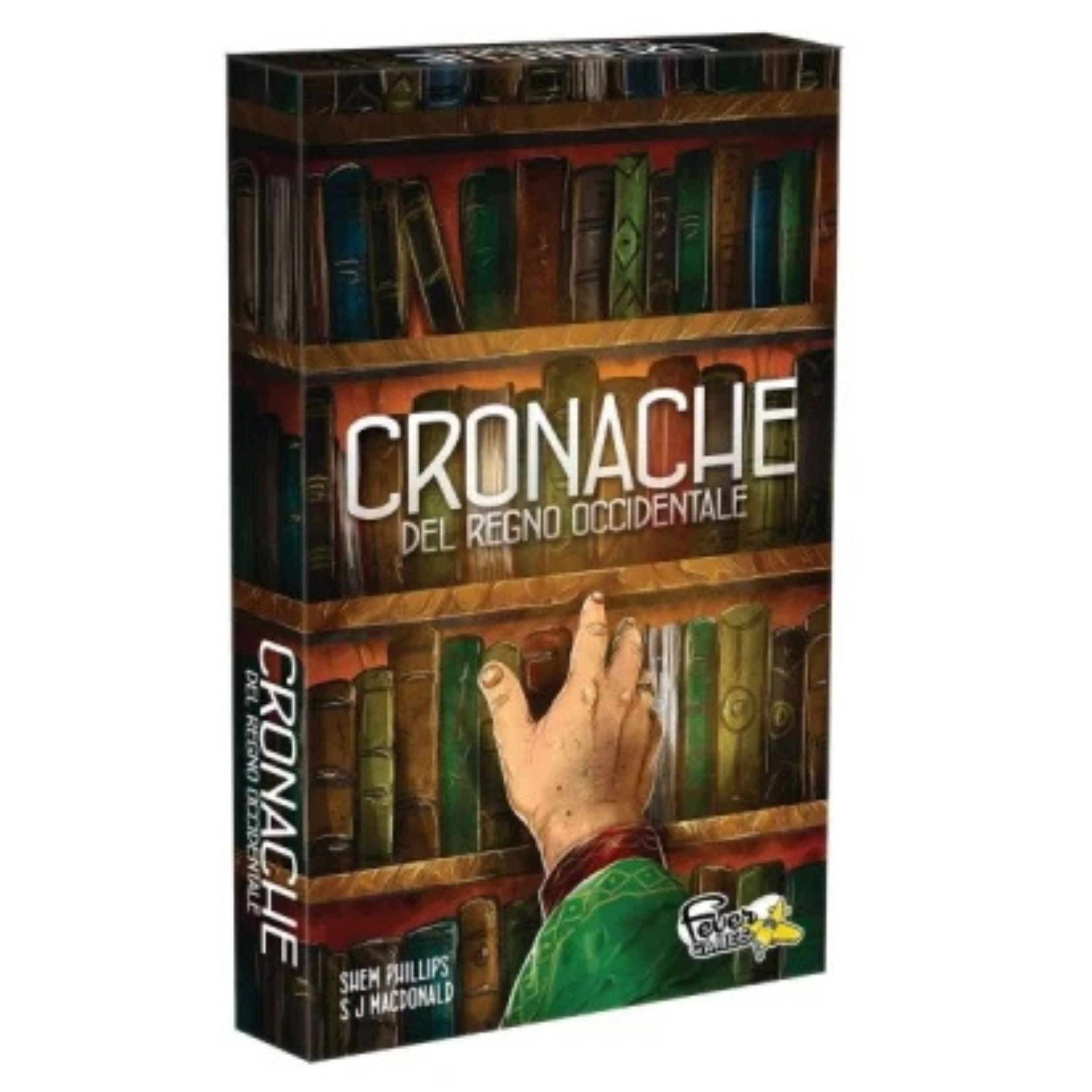
Cronache del Regno Occidentale (The West Kingdom Tomesaga)
🐸 Details from BoardGameGeek
Consiglio BGG sul numero di giocatori
Categorie
Meccaniche
Design & Art
Lingua
Si abbina bene con
FroGames — Moments You'll Remember
Three games, one saga. Each game builds the chronicle of your kingdom, each choice writes a page. And in the end, when all is done, you look at the tome and think: this is our story.
WHAT IT'S ABOUT
When three games become a medieval saga
Shem Phillips and S J Macdonald created the West Kingdom Trilogy (Architects, Paladins, Viscounts) as three standalone experiences. Chronicles of the West Kingdom transforms them into something more ambitious: an interconnected saga. Illustrated by Mihajlo Dimitrievski, this expansive system adds competitive campaign mode and cooperative mode against a ruthless Overlord. It's not an expansion in the classic sense: it's a narrative engine that rewrites three games.
In campaign mode, each game generates tome points that track your path through the kingdom's chronicles. Every choice, every victory, every defeat accumulates. In cooperative mode, however, you face dedicated scenarios where the enemy is the game itself: the Overlord acts, advances, punishes. Asymmetric powers, progressive deck building, interconnected victory conditions. The strategic weight of the trilogy remains intact, but now there's a narrative thread that unites everything.
What they're saying abroad
This isn't just a modular expansion. It's a love letter to the trilogy and its most devoted players.
— FroGames
"The campaign mode transforms three excellent games into a proper saga with stakes, memory, and consequence."
The campaign mode transforms three excellent games into a proper saga with stakes, memory, and consequence.
— Meeple Mountain

Chronicles of the West Kingdom (The West Kingdom Tomesaga)
The cooperative mode works perfectly for solo play: the Overlord is designed to act autonomously through dedicated cards and rules. Manage multiple characters or play with just one against scalable scenarios. The experience is complete, but you lose the multiplayer coordination that makes certain scenarios memorable.
FrogScore · FroGames editorial rating · based on rulebook, international reviews, and play sessionsThe tools of the saga
What's in the Chronicles box
Tome Cards
The heart of the campaign. Each tome card represents a fragment of the kingdom's chronicle. You accumulate them game after game, building your path through the saga. Some unlock powers, others special victory conditions.
Overlord Cards
The cooperative enemy. Each card dictates the Overlord's actions: advance, attack, punish. It's not a passive automaton: it's a system designed to force difficult choices and maintain constant pressure on players.
Asymmetric Powers
Each player gains unique abilities linked to their character in the saga. Some powers evolve with the campaign. Others activate only in specific scenarios. Asymmetry isn't cosmetic: it changes how you play.
Dedicated Scenarios
Cooperative mode structured around scenarios: each with specific conditions, enemies, setup. These aren't random variants: they are challenges designed to test your mastery of the trilogy in new ways.
Recommended sleeves 70 cards in 2 sizes ▼
If you play often, we recommend protecting your cards with clear sleeves to make them last a long time.
| Size | Quantity |
|---|---|
| 54 × 86 mm | 35 |
| 43 × 67 mm | 35 |
| Total cards | 70 |
At the end of the campaign, when the tome is complete, you don't remember who won the first game. You remember the story you wrote together.
A five-part campaign
What happens at the table during a saga
Not the rules. The experience.
The first game matters
Open the first game of the trilogy in campaign mode. Everything seems familiar, but there's a new detail: tome cards on the table. Every action you take, every point you accumulate, generates tomes. They're not just points: they're memory. And that memory will weigh on future games.
The gap widens
Second game. Someone has more tomes, someone else has unlocked an asymmetrical power. You're no longer on the same playing field. The campaign begins to layer: whoever won before has an advantage, but tome cards can turn everything around. The tension isn't in a single move: it's in the arc of the saga.
Cooperative: the Overlord acts
You decide to try a cooperative scenario. The Overlord draws a card. Advances. Attacks. Punishes whoever is ahead. Suddenly, you're no longer playing against each other: you're playing against the game itself. And the game doesn't forgive coordination errors. Someone has to sacrifice themselves. Someone has to slow down. Someone has to trust.
The moment of impossible choice
You're one step away from winning the scenario, but the Overlord has a devastating final card. You can win, but the group loses. Or you can slow down, give another player time, and win together. The mechanics don't tell you what to do. The saga does: the chronicles remember who chose what.
The last game closes the circle
Last game of the campaign. You open the tome: each card tells a story of a choice, a victory, a defeat. You look at the powers you've unlocked, the special conditions, the accumulated bonuses. It's not a normal game. It's the conclusion of an arc. And when it ends, someone suggests: "Shall we start over with different characters?"
How to play
The flow of a game in campaign mode
The basic structure of the trilogy remains intact. Chronicles adds a layer: tome accumulation and progression.
Architects, Paladins or Viscounts: the game follows the standard rules of the chosen game. No changes to the core mechanics. Chronicles doesn't rewrite the trilogy, it amplifies it.
During the game, certain actions generate tome points. At the end of the game, convert the points into tome cards: each card has a permanent effect (powers, bonuses, special conditions) that activates in subsequent games of the campaign.
Each player updates their campaign sheet: tomes obtained, powers unlocked, final placement. The campaign is a cumulative ranking: it's not just about winning one game, it's about accumulating tomes across all games.
Next game: take your campaign sheet, activate unlocked powers, apply tome card bonuses. Each game starts from a different base. Asymmetry grows. The saga takes shape.
Why it's different from other expansions
Six mechanics that make a difference
Progressive tome system
They are not victory points: they are narrative currency. Each unlocked tome card modifies subsequent games. Some powers are minor (action bonus), others change victory conditions. The tome grows with you, game after game. It's not cosmetic: it's strategic.
Overlord as a system, not a player
Cooperative mode uses a card engine to simulate an intelligent opponent. The Overlord doesn't take turns: it reacts to player actions, punishes those who advance too far, changes tactics based on the scenario. It's not a rigid automaton: it's a system that adapts.
Unique cooperative scenarios for each game
Each game in the trilogy has dedicated scenarios designed around its mechanics. Architects becomes a defense against waves. Paladins a mission with traitors. Viscounts a race against time. They are not generic variants: they exploit the identity of each game.
Asymmetrical powers that evolve
You start with a basic power. But with the right tomes, you unlock evolutions. Some powers combine with specific tome cards. Others activate only in cooperative scenarios. Asymmetry is not fixed: it grows with your choices in the campaign.
Interconnection between the three games
You can play the campaign on a single game or alternate between the three in the same saga. Tomes transfer. Powers remain. Choices made in Architects weigh on Paladins. They are no longer separate games: they are chapters of the same story.
Cumulative ranking, not single victory
In the campaign, winning a game matters. But winning the saga matters more. A player can lose three games but accumulate strategic tomes and finish first. The perspective lengthens: you don't optimize for the turn, you optimize for the narrative arc.
How it ends
How to win (and how to lose) in the Chronicles
Two modes, two completely different victory structures. In campaign, you compete, in cooperative, you collaborate.
Victory
- Campaign: accumulate the most tomes across all games in the saga. The winner is whoever has the highest cumulative ranking, not whoever won the most individual games.
- Cooperative: complete the scenario objective before the Overlord reaches the defeat condition (variable per scenario: turns exhausted, accumulated damage, lost resources).
- In both modes, some tome cards offer alternative victory conditions: you can win the saga through narrative paths instead of scores.
Defeat
- Campaign: you come last in the cumulative ranking. You can win individual games but lose the saga if you don't accumulate strategic tomes.
- Cooperative: the Overlord completes their objective, or players fail to meet victory conditions within the available turns.
- Some cooperative scenarios have progressive defeat conditions: the more you fail, the more powerful the Overlord becomes in subsequent games.
Chronicles of the West Kingdom (The West Kingdom Tomesaga) transforms three games into a saga. It's not an expansion you add and remove: it's a narrative engine that rewrites the experience.
Frequently asked questions
FAQ about Chronicles of the West Kingdom (The West Kingdom Tomesaga)
Do I need to own all three games in the trilogy to play?
No. Chronicles works with only one of the three games (Architects, Paladins, Viscounts). Do you only own Architects? You can play the campaign and the dedicated cooperative scenarios. If you own all three, you can interconnect the sagas and alternate games in the same campaign, transferring tomes and powers. But it's not mandatory.
How long does a complete campaign last?
It depends on how many games you want to play. A short campaign is 3-5 games (about 4-6 hours total). An epic campaign can extend to 10-12 games. Each game has the standard duration of the chosen base game (60-120 minutes). Tome progression is scalable: it works for both short and long campaigns.
Does cooperative mode change the rules of the base games?
No. The core rules remain identical. Chronicles adds a layer: the Overlord (a card system that simulates an opponent), scenarios with specific objectives, and cooperative victory/defeat conditions. But the gameplay flow of Architects, Paladins, or Viscounts remains unchanged. You don't have to relearn the game.
Can I play cooperative scenarios without playing the campaign?
Yes. The two modes are completely independent. You can ignore the campaign and only play one-shot cooperative scenarios. Or only play a competitive campaign without ever touching cooperative mode. Or alternate. Chronicles is modular: choose what to use based on what you want to play.
Is it available in Italian?
Yes. This Fever Games edition is fully localized in Italian: cards, scenarios, rulebook, campaign sheets. It requires one of the three base games of the West Kingdom trilogy (also available in Italian).
Chronicles of the West Kingdom (The West Kingdom Tomesaga) is a saga expansion for the West Kingdom Trilogy (Architects of the West Kingdom, Paladins of the West Kingdom, Viscounts of the West Kingdom) designed by Shem Phillips and S J Macdonald, published by Fever Games. It adds competitive campaign mode and cooperative scenarios for 2-6 players, ages 12+, duration 60-240 minutes. Progressive tome system, asymmetrical powers, cooperative Overlord. Works with only one of the three base games or interconnects them into a unified saga. Available on FroGames.it.
Frequently Asked Questions
The answers you're looking for, no beating around the bush.
📸Do the images match the actual product?
The photos on the website often come from BoardGameGeek and are intended to give you an idea of the game. They may vary slightly from the version you receive. The content declared by the publisher is always binding.
📦Does the content of the box match what is indicated?
We always strive to provide the correct content, but minor variations are possible due to reprints or updates. The information comes directly from the publishers. If you have any questions, please contact us!
⏳How do pre-orders work?
Pre-order the game before release, payment is immediate, and the game is reserved for you. As soon as it arrives, we'll ship it right away! If there are any delays, we'll update you promptly.
🔒Can I trust buying here?
Absolutely! Secure payments, tracked shipments, and a team that loves board games as much as you do. If something goes wrong, we'll do our best to fix it.
🛠There's a problem with my order, what should I do?
Write to us now! Whether it's a missing part, damage, or an error, we'll help you resolve it as soon as possible. Your experience truly matters to us.