
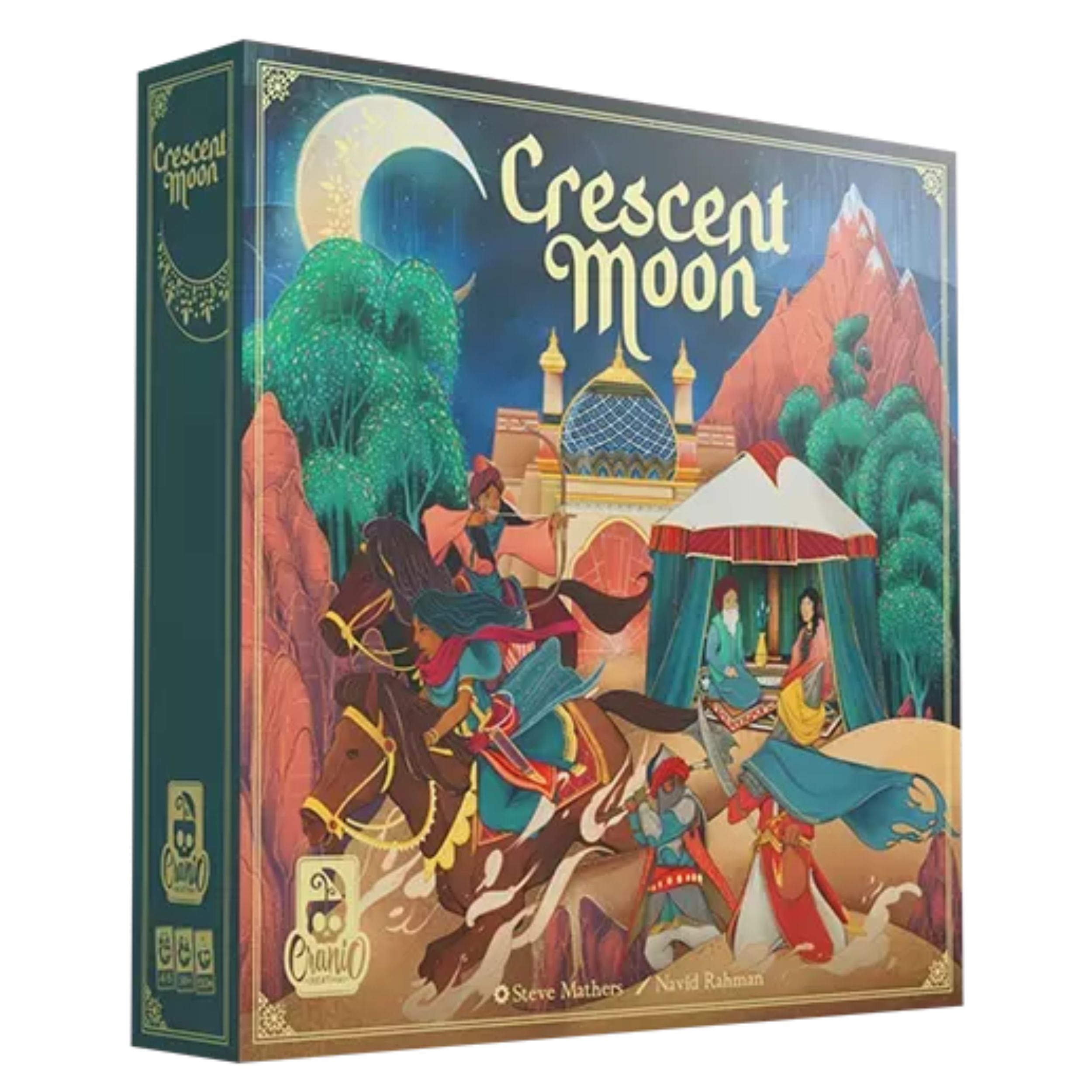
Crescent Moon
🐸 Dettagli da BoardGameGeek
Consiglio BGG sul numero di giocatori
Categorie
Meccaniche
Design & Art
Lingua
Si abbina bene con
FroGames — Moments You'll Remember
Some pledge loyalty. Some betray it five minutes later. Some win without moving an army. And in the end, everyone remembers who stabbed them in the back.
WHAT IT'S ABOUT
Five powers, five ways to win, one caliphate
Crescent Moon is an area control game designed by Steven Mathers and published by Osprey Games in 2022. Set in a fictional caliphate inspired by the historical Middle East, it pits five radically asymmetrical factions against each other. The Sultan commands through mercenaries, the Murshid through a network of secret agents, the Nomad sows discord to sell swords, the Warlord pillages mercilessly, the Caliph attempts to preserve order with military force. Each has its own objectives, unique actions, and game-changing powers.
At the table, you choose four actions per year (three years in total, four in the long game). You deploy armies, conquer territories, build fortifications, buy power cards from the shared market, and most importantly, negotiate. Because this is not a classic wargame: it's a game of fragile alliances, betrayed promises, political interference in others' battles. The Murshid can turn a conflict around without even being present. The Sultan cannot recruit his own troops. The Nomad profits when others go to war. Each character experiences a different game.
What they say abroad
"Crescent Moon takes asymmetry seriously. Every faction plays a different game."
Crescent Moon takes asymmetry seriously. Every faction plays a different game.
— Space Biff
"The kind of game where the real battle is fought over dinner, not on the board."
The kind of game where the real battle is fought over dinner, not on the board.
— Meeple Mountain

Crescent Moon
FrogScore · FroGames editorial rating · based on rules, international reviews and play sessionsThe five warring factions
Who you are and how you play
The Sultan
Cannot recruit his own troops. Depends on mercenaries and grand architectural works. Wins by building and accumulating gold, not conquering.
The Murshid
Operates in the shadows with a network of agents. Can interfere in others' battles without being present on the field. Wins through political influence.
The Nomad
Sows discord to sell mercenaries. His citizens are skilled soldiers. Wins when others wage war and he profits.
The Warlord
Pillages and conquers mercilessly. Wins with brute force, plundering resources and territories. The only purely military faction.
Recommended sleeves 82 cards in 1 size ▼
If you play often, we recommend protecting your cards with transparent sleeves to make them last a long time.
| Size | Quantity |
|---|---|
| 63 × 89 mm | 82 |
| Total cards | 82 |
In a few hours, you'll have realized that the real enemy wasn't the one you were attacking. It was the one smiling across the table.
A game in five moments
What happens at the table
Not the rules. The experience.
Everyone plans in silence
Setup done, factions revealed. Everyone looks at their board and realizes they will play a different game from the others. The Sultan counts his gold, the Murshid places hidden agents, the Nomad waits for someone to need mercenaries. First glances at the modular board.
The first alliances form
Someone advances, someone builds, someone buys power cards from the market. And negotiations begin: "If you don't attack me, I won't attack you." "I'll sell you mercenaries, but only if you help my plan." Alliances are temporary, and everyone knows it.
Someone betrays, someone explodes
Mid-game, first point count. Someone is ahead, someone is too far behind. Last year's promises are broken. The Murshid uses his political power to turn a battle around without even having troops on the field. The table explodes.
The last round is pure chaos
Everyone knows it's the final year. The best cards leave the market, actions become aggressive, alliances definitively collapse. The Nomad sells the last block of mercenaries to the highest bidder. The Warlord plunders everything. The Caliph desperately tries to preserve order.
Point counting and revelations
Everyone scores according to their secret objectives. Someone won by building, someone by sowing chaos, someone simply by surviving and accumulating influence. And in the end, everyone realizes that the winner had a plan from the first turn. Or they improvised very well.
How to play
The flow of each year
Each year (round) is divided into four actions per player, followed by a point count. Simple in structure, complex in consequences.
Each faction has its own board with available actions: deploying armies, building, conquering territories, expanding influence, buying power cards. Some actions are unique to your faction.
If you conquer an occupied territory, a battle ensues. Battles are resolved with conflict cards from your hand. The Murshid can intervene politically even if not present. The Nomad's mercenaries can turn everything around.
The shared market offers powerful cards: special units, advisors, stratagems. Each card costs resources. Buying it before others can change the game.
At the end of the year, each faction scores points according to their secret objectives: controlled territories, built structures, accumulated influence, chaos sown. The Nomad scores points when others fight each other.
Why it's different from others
Six mechanics that make the difference
Radical, not cosmetic, asymmetry
These are not five factions with special abilities. They are five different games on the same board. The Sultan cannot recruit troops. The Murshid wins without fighting. The Nomad profits from others' chaos. Each faction has its own objectives, actions, and victory conditions.
Negotiation is mechanical, not optional
You can promise help, sell mercenaries, form temporary alliances. The game pushes you to talk, bargain, betray. The Nomad thrives on this. The Murshid politically interferes in others' wars. Without negotiation, you lose.
Modular board that changes the map
The board is composed of modular tiles. Each game has a different map, with deserts, rivers, oases positioned in a new way. Strategic territories change, expansion routes change, alliances change.
Shared and contested card market
Power cards (advisors, special units, stratagems) are available to everyone, but in limited numbers. Those who buy first get the best. Those who wait risk being left without. And some cards overturn the rules of the game.
Secret objectives and multiple victory paths
There isn't just one way to win. Each faction scores points differently: territorial control, constructions, political influence, accumulated gold. The Nomad wins if others fight each other. The Murshid wins if he accumulates hidden agents.
Fast battles resolved with cards
No dice, no lengthy calculations. Battles are resolved by playing conflict cards from your hand. Fast, tactical, and the Murshid can interfere by playing political influence cards even without troops on the field.
How it ends
How to win and how to lose
After three years (four in the long game), each player counts points according to their faction's objectives. Whoever has the most wins. But the path to get there is different for everyone.
Victory Conditions
- Fulfill your faction's unique objectives (territories, buildings, influence, gold, chaos sown)
- Accumulate power cards that grant extra points at the end of the game
- Control strategic territories that are worth bonus points
Mistakes that cost the game
- Expand too early and find yourself without resources to defend
- Trust alliances: they are all temporary, sooner or later someone betrays
- Ignore power cards: some are game-changers and whoever gets them first wins
Crescent Moon is for those seeking true, not cosmetic, asymmetry. For those who want a game where politics matters as much as armies. For those with a fixed group of 4-5 players willing to betray each other for three hours.
Frequently asked questions
Crescent Moon FAQ
Is it really as asymmetrical as they say?
Yes. These are not five factions with special abilities. They are five different games. The Sultan cannot recruit his own troops, the Murshid wins without fighting, the Nomad profits when others wage war. Each faction has unique objectives, actions, and a unique board. The first game is just to understand your faction.
Does it work with 4 players, or do you absolutely need a fifth?
It works perfectly fine with 4 (one faction is left out). With 5, it's more chaotic and politically unstable, but with 4, alliances are clearer and more manageable. Both counts work, it depends if you want more control (4) or more chaos (5).
How much does negotiation weigh? Can I play only with my actions?
No. Negotiation is a central mechanic, not optional. The Nomad sells mercenaries, the Murshid interferes politically, the Sultan has no troops of his own. If you play only for yourself, you lose. You need a group willing to talk, promise, betray.
How long does a game really last?
The short version (3 years) takes about 2 and a half hours with experienced players. The first game, with explanation and faction discovery, exceeds 3 hours. The long version (4 years) can reach 3 and a half hours. It's not a filler.
Is it available in Italian?
Yes, this Cranio Creations edition is entirely in Italian: rulebook, cards, faction boards, components. No language barrier.
Crescent Moon is an asymmetric area control board game for 4-5 players designed by Steven Mathers and published by Cranio Creations. Set in a caliphate inspired by the historical Middle East, it pits five radically different factions against each other for power: the Sultan, the Murshid, the Nomad, the Warlord, and the Caliph. Each faction has unique objectives, exclusive actions, and its own victory conditions. Games last 150-180 minutes and combine area control, negotiation, hand management, and variable player powers. The modular board changes the map every game, the shared power card market introduces tension, and battles are resolved with conflict cards. Recommended age 14+, strategic weight 3.74 on BGG. Full Italian edition available on FroGames.it.
Frequently Asked Questions
The answers you're looking for, no beating around the bush.
📸Do the images match the actual product?
The photos on the website often come from BoardGameGeek and are intended to give you an idea of the game. They may vary slightly from the version you receive. The content declared by the publisher is always binding.
📦Does the content of the box match what is indicated?
We always strive to provide the correct content, but minor variations are possible due to reprints or updates. The information comes directly from the publishers. If you have any questions, please contact us!
⏳How do pre-orders work?
Pre-order the game before release, payment is immediate, and the game is reserved for you. As soon as it arrives, we'll ship it right away! If there are any delays, we'll update you promptly.
🔒Can I trust buying here?
Absolutely! Secure payments, tracked shipments, and a team that loves board games as much as you do. If something goes wrong, we'll do our best to fix it.
🛠There's a problem with my order, what should I do?
Write to us now! Whether it's a missing part, damage, or an error, we'll help you resolve it as soon as possible. Your experience truly matters to us.