
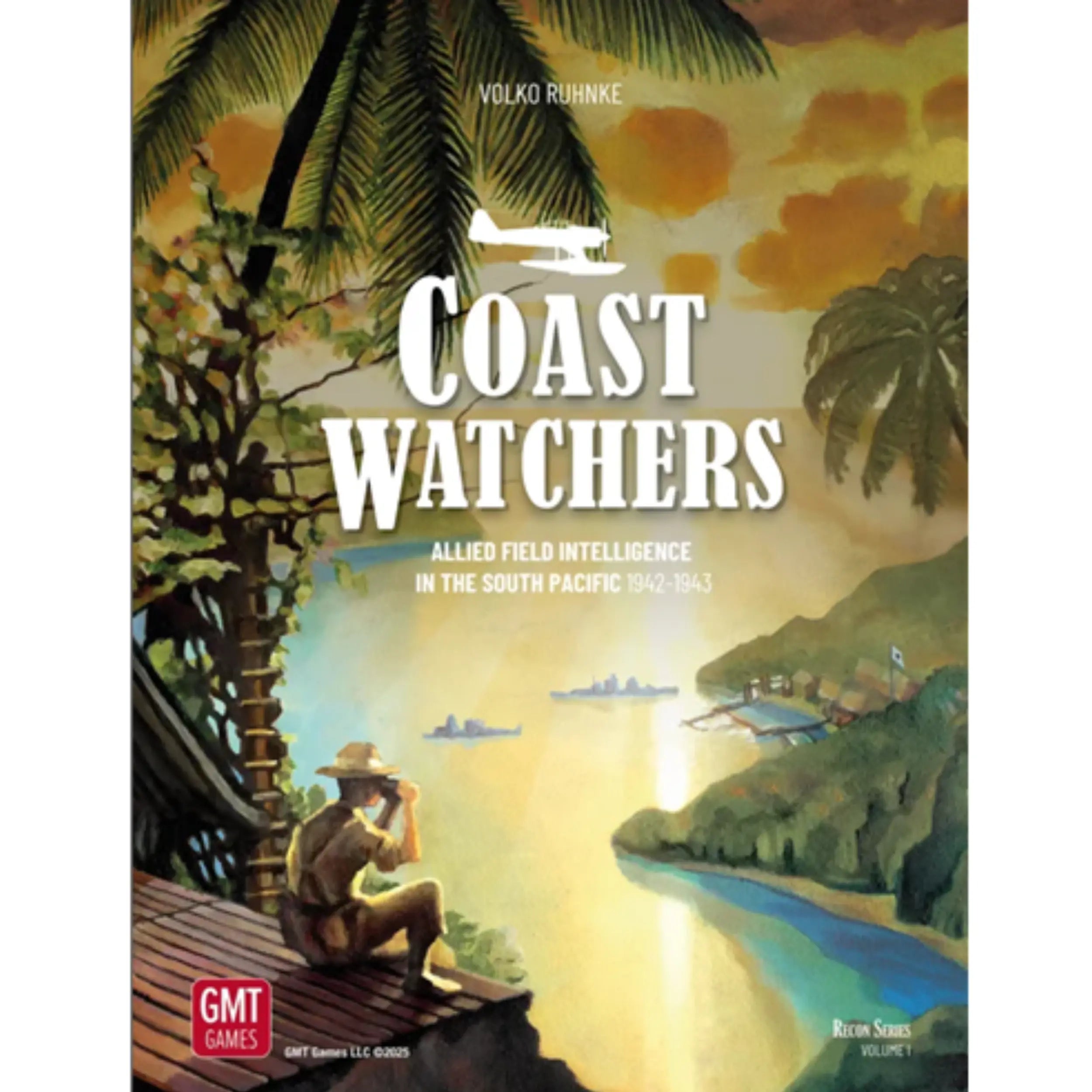
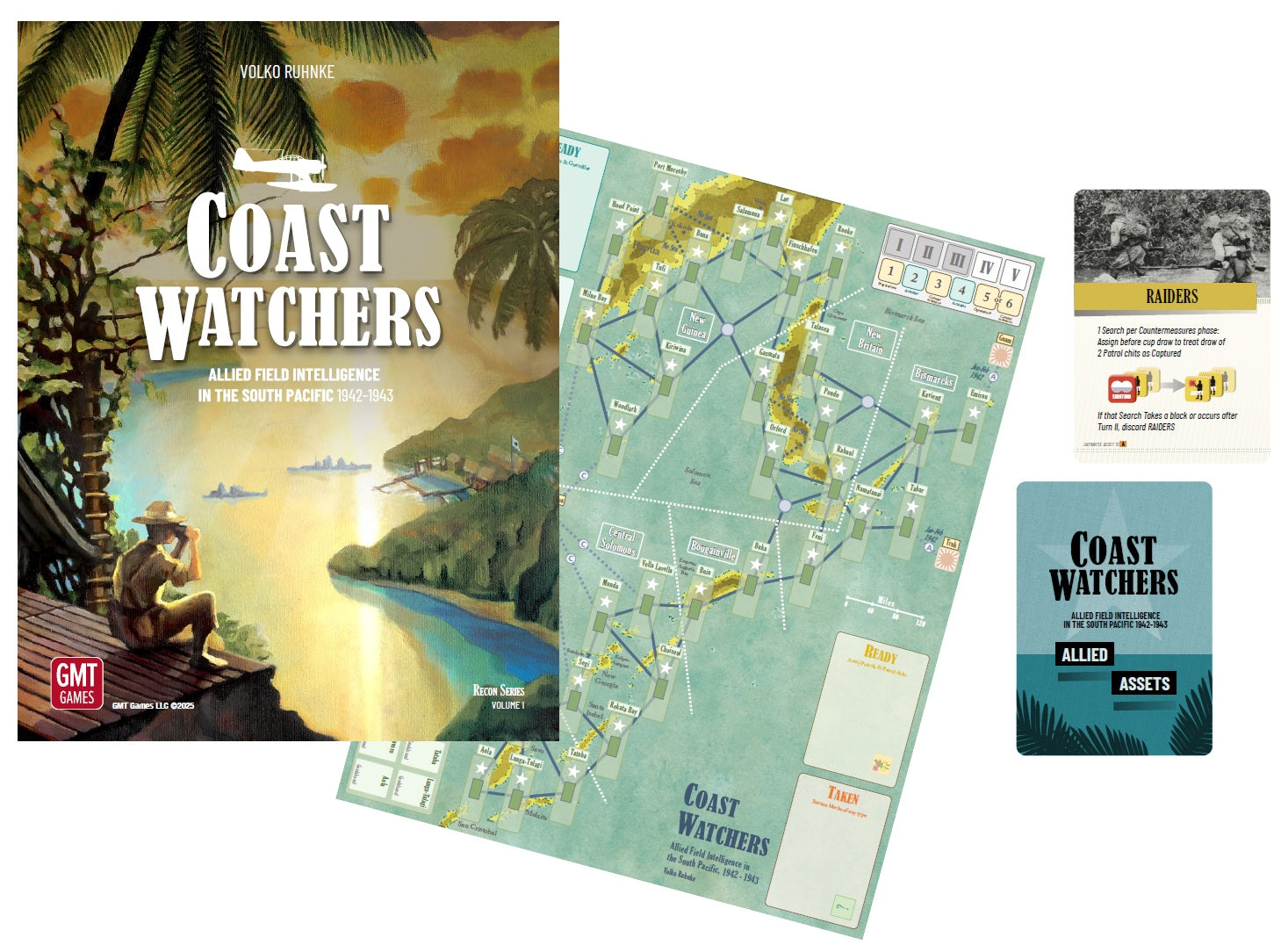
Coast Watchers - Allied Field Intelligence in the South Pacific, 1942-1943
🐸 Details from BoardGameGeek
Consiglio BGG sul numero di giocatori
Categorie
Meccaniche
Design & Art
Lingua
Si abbina bene con

FroGames — Moments You'll Remember
Forty bombers incoming. The network is ready. It's up to you if the message arrives in time.
What it's about
Spies in the Jungle, Manhunt in the 1942 Pacific
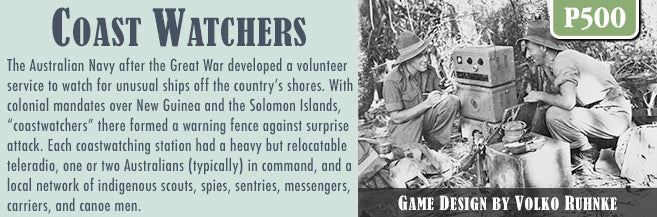
In the midst of World War II, a handful of men hidden in the Solomon Islands were changing the course of the conflict. Not with weapons, but with radios and indigenous informants. The coastwatchers — Allied agents infiltrated behind Japanese lines — warned Guadalcanal of every incoming attack, saving thousands of lives. If they were caught, they were shot.
Volko Ruhnke, designer of the COIN series and Wilderness War, brings this story to the table with original hidden information mechanics. Coast Watchers is an asymmetric intelligence wargame for 1-2 players: on one side the Allied espionage network, on the other the Japanese security forces hunting them down.
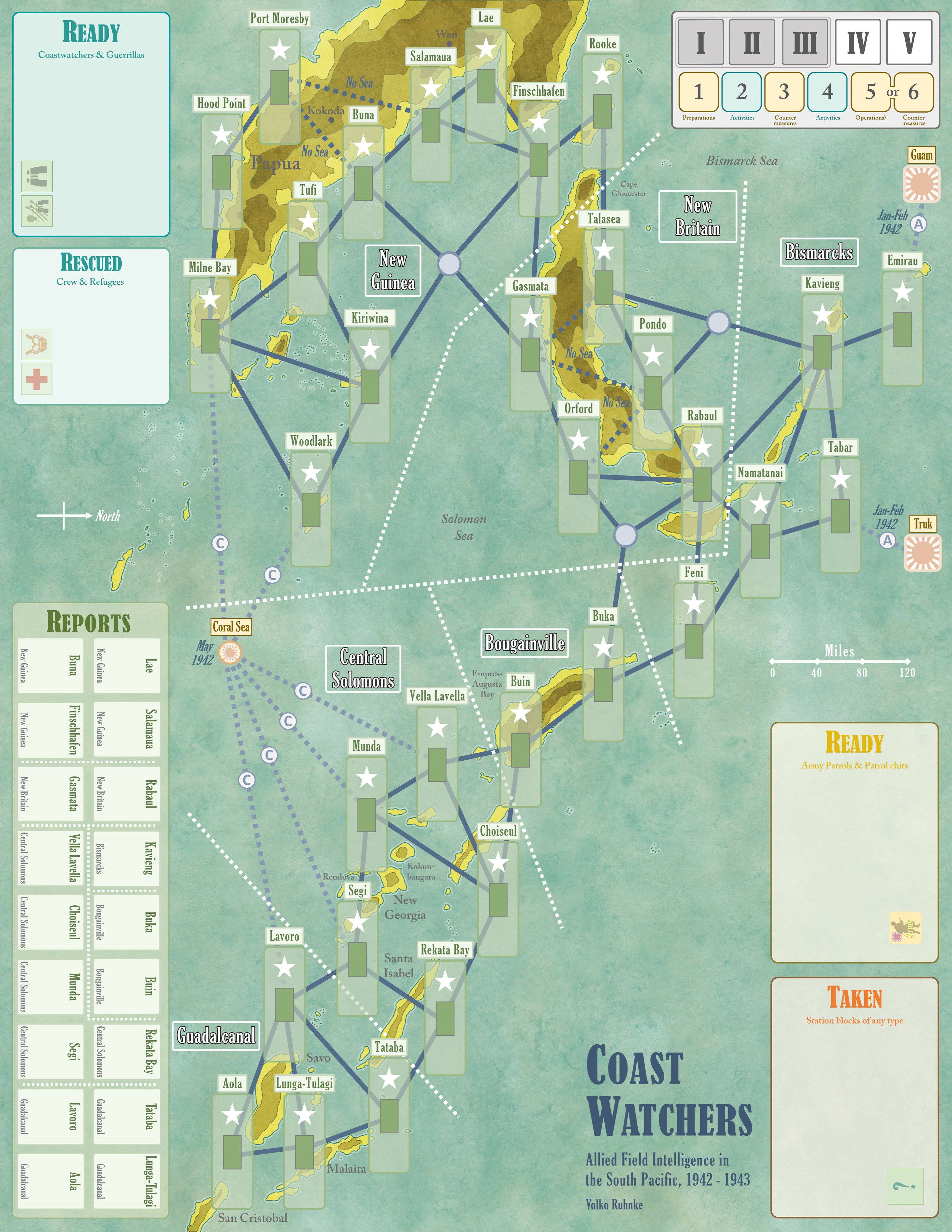
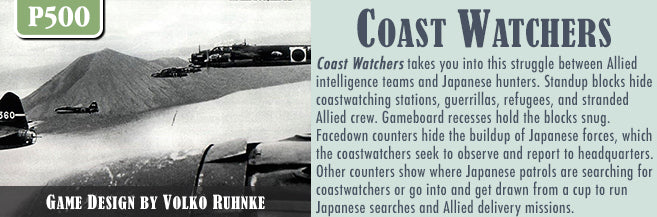
Standing blocks conceal coastwatcher stations. Face-down tokens hide Japanese movements. Secret missions, Tactical Assets, bag draws: every turn is a chess game where you don't see the whole board.
It's not a wargame of battles. It's a wargame of secrets — where what you don't know can cost you everything.
The secret of Coast Watchers in one line
Two perfect asymmetries: the Allies must observe without being seen. The Japanese must find what cannot be found.
From the game experience

Coast Watchers: Allied Field Intelligence
The solo system is designed by Volko Ruhnke and is included in the base box. You can play the Allies against an automated Japanese AI — or vice versa. With 15 standalone scenarios, the solo longevity is remarkable.
FrogScore · FroGames editorial rating · based on rules, international sources and Volko Ruhnke designYour arsenal
What you control in each game
Standing Blocks
The coastwatcher stations, guerrillas, refugees, and recovered pilots — hidden in plain sight. Nobody knows what's behind that block until it's too late.
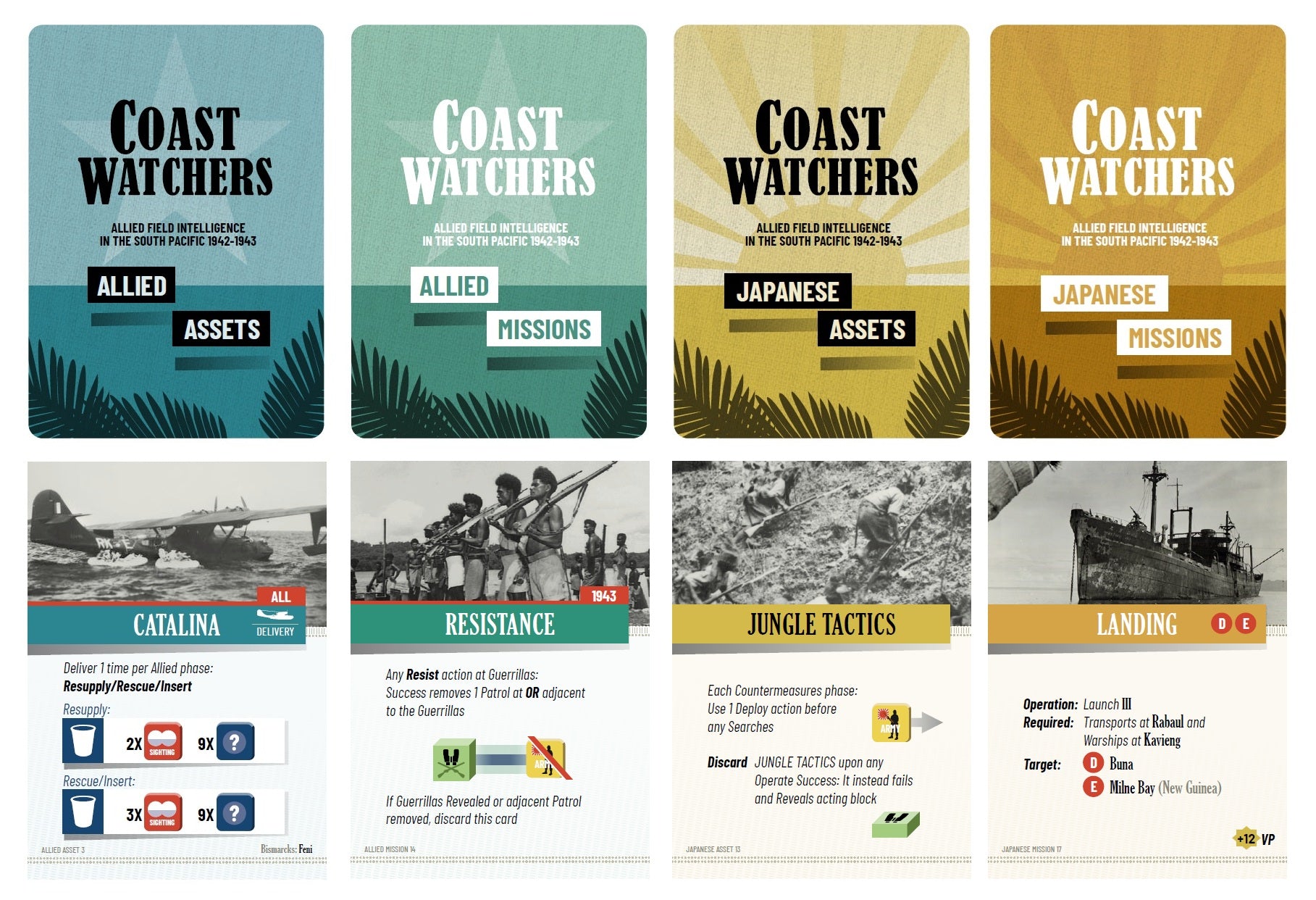
Secret Mission Cards
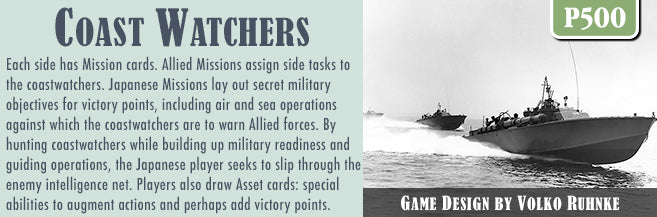
Each side has hidden objectives. Allies must observe and report; Japanese must launch air and naval operations. You don't know what the opponent is planning.
Draw Bags
Japanese patrols and Allied delivery missions are managed by drawing tokens from bags. Each draw is a calculated risk — or a sudden disaster.
Tactical Asset Cards
Special abilities that modify actions and can add victory points. The difference between a successful and a failed operation often depends on the right Asset at the right time.
In a few hours, you'll know what it feels like to hold the outcome of a battle in your hands with a single radio message. It always happens with Coast Watchers.
📖RulebookEnglish · GMT Games
Come si gioca
Video dimostrativo di gameplay.
A five-act game
What happens at the table
Not the rules. The experience.
The network is ready. The Japanese don't know where you are yet.
Place the blocks upright — your stations are hidden in plain sight. Look at the Secret Missions: where you need to observe, what the Japanese must launch to win. Already at this point, you realize you can't do everything. You have to choose.
The first patrol. Something is moving.
The Japanese player draws from the bag. A token appears on an island near your main station. It's not yet a threat — but the way it's placed suggests they know something. Or maybe not. Uncertainty is the heart of the game.
Operate. Observe. Don't get caught.
You manage to glimpse an enemy marker — the buildup at Rabaul is more advanced than you thought. Report to headquarters: victory points, but also risk. Every Allied action draws from the patrol bag. The more you operate, the closer they get to you.
They discover a station. The block is flipped.
The draw went wrong. The block goes down — the station is revealed, exposed. You can evade, hide again, but the Japanese player now knows where to look. The game changes here: from silent and deductive it becomes a desperate race against time.
The score count. Someone saved Guadalcanal.
The Situation ends. Points are counted: reported observations, launched operations, survivors, captures. Often the difference is very small. Everything is packed away, wondering if, had they dared more — or less — the game would have turned out differently.
How to play
The flow of each round
Two actions for the Allies, two for the Japanese. Simple on the surface, rich in hidden decisions.
Allies resupply stations, insert new coastwatchers, or rescue downed pilots. Each delivery uses Asset cards and draws from the patrol bag — risking discovery.
Stations observe enemy buildups, report to headquarters for victory points, recruit local guerrillas, or resist patrols. The heart of Allied intelligence.
The Japanese draw from the patrol bag: they can discover exposed stations, capture Allied personnel, and accumulate points. Each draw is a judgment — you don't know what will come out.
The Japanese complete buildups and launch air or naval operations — earning points unless the coastwatchers have reported in advance. The race between intelligence and operations.
Why it's different from others
Six mechanics that make a difference
Upright blocks — hidden in plain sight
Coastwatcher stations are upright blocks on a shared map. The enemy knows they're there — just not where, not how many. Same mechanic, different meaning than any other wargame.
Draw bags — controlled variance
Patrols and deliveries are managed by drawing tokens from bags. You can manipulate what goes into the bag, but not what comes out. The tension of each draw is authentic.
Secret Missions — hidden objectives
Both sides have confidential Mission cards that define private victory objectives. You don't know what your opponent is trying to do — and they don't know about you.
Authentic asymmetry
The two sides play completely differently. Allies observe and escape; Japanese build and hunt. The rules are shared, the experiences are not.
15 Situations + 4 campaigns
Each Situation is a story in itself: from January 1942's first invasions to December 1943's Rabaul. Campaigns link three consecutive Situations where previous results matter.
Integrated official solitaire
The solitaire system is designed by Volko Ruhnke and included in the box. Play as the Allies against a Japanese AI — or as the Japanese against Allied automation. Two games in one.
How it ends
Who wins — and how to lose
Each Situation has its own ending condition. Usually the game lasts 3-5 turns — but it can end sooner if the Japanese launch their operations at the right time.
Allied Victory
- Accumulate victory points by reporting enemy buildups to headquarters
- Keep your stations and personnel alive until the end
- Complete Secret Missions for additional bonuses
- Pre-warn of Japanese air and naval operations
Japanese Victory
- Capture coastwatchers and Allied personnel for victory points
- Launch military operations without the Allies having reported them
- Complete their own secret Mission objectives
- Dismantle the intelligence network before the Situation ends
Coast Watchers is the first great wargame of pure intelligence — not battles, but secrets, deduction, and survival. Volko Ruhnke at his best.
Frequently asked questions
Coast Watchers FAQ
Is it a traditional wargame or something different?
It's something different. Coast Watchers is set in wartime but its primary mechanic is intelligence — hiding, observing, deducting. There are no grand battles to resolve with modifiers and tables: there's an asymmetrical cat and mouse on a Pacific map. Those who love wargames will find familiarity in the historical context, but the system is original.
Is it worth it if I mainly play solo?
Absolutely. The official solitaire system is designed by Volko Ruhnke himself and included in the box — it's not an afterthought. With 15 Situations to tackle alone, Coast Watchers has remarkable longevity even without a partner. The FrogScore solo rating is 4/5.
How complex is it to learn?
It's a game for enthusiasts — not a gateway. The rules are dense and the asymmetrical system requires learning two games in one. The first game will be exploratory. From the second onward, the mechanisms flow and strategic depth emerges. Those who have played something from Ruhnke's COIN series will feel more comfortable.
How many games can be played before running out of content?
Many. Between 15 standalone Situations and 4 campaigns that link them, plus the variability of randomly drawn Mission and Asset cards, each game presents a different problem. The most avid players report dozens of games before feeling repetition.
What is the difference between Situations and campaigns?
The 15 Situations are standalone scenarios of 60-120 minutes each, each with a specific historical context (from January 1942 to December 1943). The 4 campaigns link three consecutive Situations: the results of the first influence the setup of subsequent ones. Campaigns offer a longer narrative progression.
Is it available in Italian?
This is the English edition. The rulebook and cards are in English — knowledge of the language is necessary to play fully. There is currently no Italian edition in production.
Coast Watchers: Allied Field Intelligence in the South Pacific, 1942-1943 is an asymmetrical intelligence wargame for 1-2 players (ages 14+, duration 60-120 min per Situation). Designed by Volko Ruhnke, published by GMT Games. Key mechanics: hidden information with upright blocks, facedown tokens, drawing from bags. One player manages the Allied coastwatcher network in the Solomon Islands and Papua New Guinea; the other commands the Japanese security forces. The game includes 15 standalone Situations + 4 campaigns covering the period January 1942-December 1943, official solitaire system, secret Mission and Asset cards for both sides. Original reimplementation inspired by Ruhnke's COIN series. English edition. Available on FroGames.it.
Frequently Asked Questions
The answers you're looking for, no beating around the bush.
📸Do the images match the actual product?
The photos on the website often come from BoardGameGeek and are intended to give you an idea of the game. They may vary slightly from the version you receive. The content declared by the publisher is always binding.
📦Does the content of the box match what is indicated?
We always strive to provide the correct content, but minor variations are possible due to reprints or updates. The information comes directly from the publishers. If you have any questions, please contact us!
⏳How do pre-orders work?
Pre-order the game before release, payment is immediate, and the game is reserved for you. As soon as it arrives, we'll ship it right away! If there are any delays, we'll update you promptly.
🔒Can I trust buying here?
Absolutely! Secure payments, tracked shipments, and a team that loves board games as much as you do. If something goes wrong, we'll do our best to fix it.
🛠There's a problem with my order, what should I do?
Write to us now! Whether it's a missing part, damage, or an error, we'll help you resolve it as soon as possible. Your experience truly matters to us.