
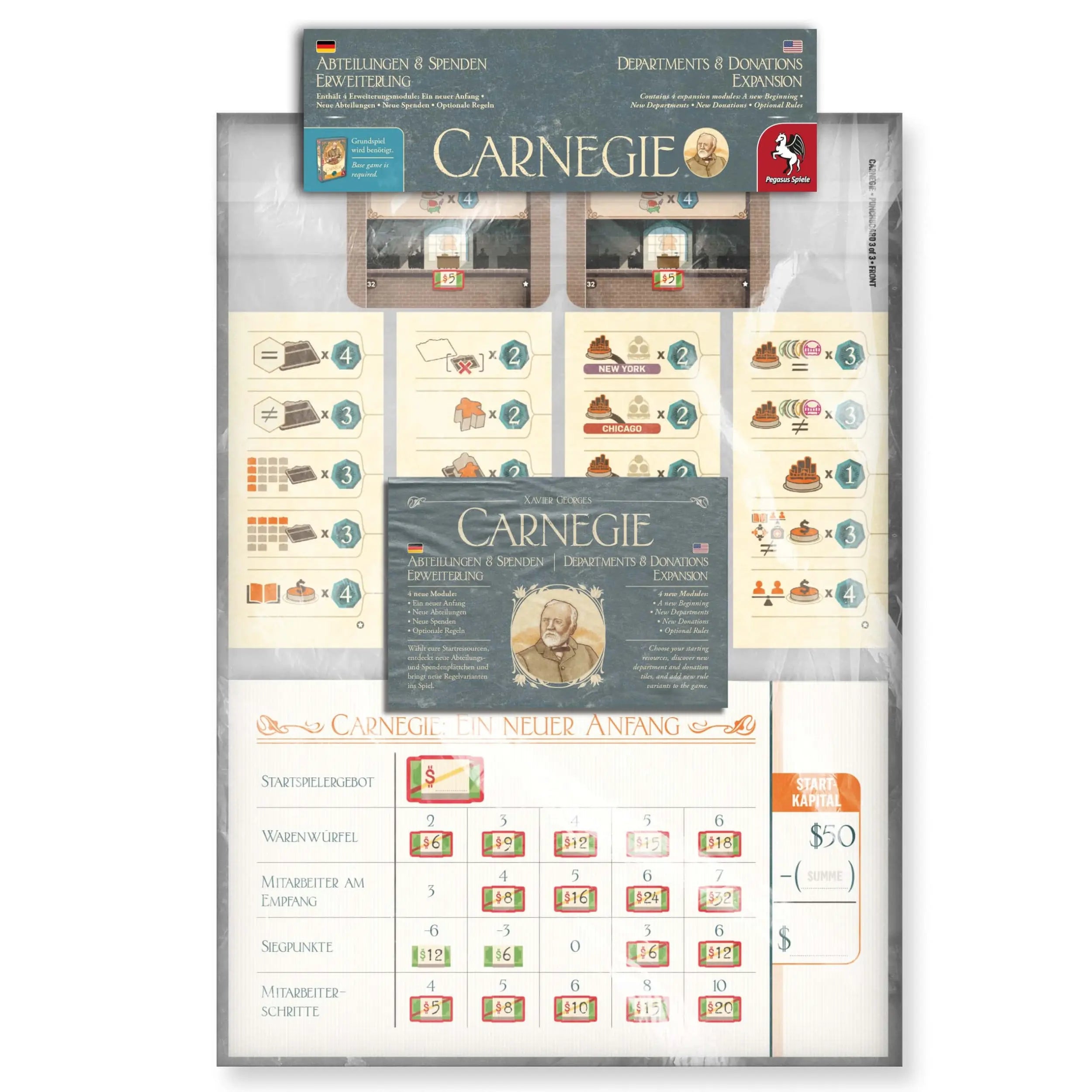
Carnegie - Departments and Donations Expansion
🐸 Details from BoardGameGeek
Consiglio BGG sul numero di giocatori
Categorie
Meccaniche
Design & Art
Si abbina bene con

FroGames — Moments You'll Remember
You had already mastered Carnegie. Now start over — with rules you didn't know.
What it's about
Carnegie returns to the table with new rules to learn
You've played dozens of games of Carnegie. You know the departments by heart, you know when to push for donations and when it's best to sacrifice a turn. You think you've really figured it out.
Departments & Donations is the expansion that redefines everything. Four modular modules — usable together or separately — that redesign the opening of each game, double the department pool, and introduce new donation tiles that change the board's geography.
It's not an expansion that adds weight to the game. It's one that adds uncertainty — the healthy kind, which puts experienced players on the same footing as newcomers, at least for the first few turns.
What they say abroad
"Carnegie is still a delight, and this expansion helps keep things fresh for the foreseeable future."
Carnegie is still a delight, and this expansion helps keep things fresh for the foreseeable future.
— Meeple Mountain
Four modules, no obligation to use them all together. You can add one piece at a time, and each combination redefines the weight of decisions.
The secret of Departments & Donations in one line

Carnegie: Departments & Donations
The new departments integrate perfectly with solo play — and add exactly the kind of unpredictability that makes the automa interesting.
FrogScore · FroGames editorial rating · based on rules, international reviews and play sessionsWhat it adds
Four modules, one expansion
They can be used separately or all together — each combination changes the pace of the game.
A New Beginning
A pad of bid sheets to customize initial resources. Each player manages a secret budget of 50 dollars to distribute among starting resources — and whoever bids the most for the first turn pays for it in victory points.
16 New Departments
Two copies each — 32 tiles in total that double the base game's pool. Each game draws from a larger pool: no department is guaranteed, no strategy is obvious.
New Donations
Four brand new donation tiles that players place on the board during setup, covering the original areas. They change where it's best to build, where it's worth going — and where it's not.
Optional Rules
Three variants for seasoned players: modifications to the auction setup, department drafting mode, and an Open Bar format where all 32 departments are in play simultaneously.
Carnegie was already one of the best eurogames of recent years. This expansion simply reminds you why.
📖RulebookEnglish · Official PDF
A game in five moments
What happens at the table
Not the rules. The experience.
The bidding sheet is the first battleground
Before even touching a meeple, each player has a sheet and 50 imaginary dollars in front of them. Do you want to go first? It costs victory points. Do you want more workers? It costs resources. Do you want both? You won't have enough money. Setup with A New Beginning transforms the start of the game into a silent mini-auction — and those who miscalculate pay for it throughout the game.
The departments you don't recognize
New departments appear in the pool and change priorities on the fly. One you know by heart isn't there. Another you've never used is available. Anyone who plays Carnegie a lot knows that half the game is decided here — but this time the territory is new for everyone.
Donations are found where you least expect them
New donation tiles cover some original areas of the board — and setup discs shift accordingly. That construction chain that always worked no longer functions the same way. The path that was automatically optimized now requires a new reading of the map.
Someone dares the Open Bar Setup
If you've chosen the variant with all 32 departments in play, the pool is huge — and no department is guaranteed more than one copy. Competition for the tiles you want becomes immediate. Someone takes them early just to deny them to you. It's the nastiest way to play Carnegie.
End-game scoring is different
Final scoring is always the same as in Carnegie — but the path to get there has changed. Someone won the bidding sheet and paid dearly for it. Someone bet on new departments they didn't quite understand. And someone discovered that the game they thought they knew still had something to teach.
How it integrates
The four modules in practice
They activate separately or together. Each combination changes the weight of decisions.
During setup, each player receives 50 imaginary dollars to distribute on a bidding sheet among starting resources, additional workers, and turn order. The sheets are revealed simultaneously — whoever spent the most to go first becomes the first player, but has already "paid" in victory points.
The 16 new departments (2 copies each) are added to the 32 from the base game, or used alone, or mixed proportionally. The Open Bar Setup variant uses all 64 tiles — ensuring that no configuration ever repeats.
Before playing, each player draws a new donation tile and places it on the board, covering an original area. Any setup discs present move along with it. The result is a board that is different every time, where the optimal routes of the base game no longer work automatically.
Three additional variants for those who want to push further: asymmetric department drafting, completely randomized auction setup, and Open Bar Setup with all tiles in play. These rules are not recommended for those still learning Carnegie — but for those who know it well, they add exactly the kind of challenge they were looking for.
Why it's worth it
Six reasons to add this expansion
Real, not cosmetic, variability
With 32 total departments, no game can use them all. The random selection at the start of the game guarantees ever-changing configurations — the meta-game that formed in the base game is reset.
Asymmetric setup that levels the playing field
The bidding sheet eliminates the historical advantage of the first player — or at least monetizes it transparently. For the first time, whoever wants to go first truly pays to do so.
Board never the same
The new donation tiles redesign the map's geography with each game. Construction chains that always worked no longer function the same way — each session requires a new reading.
Four modules, zero obligation
Each module can be activated or ignored independently. You can use one at a time to test it, or combine them all for maximum variability. There's no "right" way — there's the one you prefer.
Solitaire that gains depth
The new departments integrate with the base game's automa without modifications. Those who play Carnegie solo will find the missing variability in the expansion — each session presents a different configuration.
Compact yet complete
The expansion comes in a thin rigid envelope — it doesn't require a new box. It doesn't add complex rules, nor does it inflate setup times. It's an expansion that values players' time.
How it ends
The conditions don't change — the path does
Carnegie's victory rules remain identical. What changes is what you need to optimize to get there.
He who optimizes well wins
- The player with the most victory points at the end of the game wins — identical to the base game
- Points come from constructed projects, completed donations, and activated departments
- With active modules, the optimal path changes with each game — no predetermined strategy always works
What the expansion doesn't touch
- The four main actions (HR, Management, Construction, R&D) remain unchanged
- The shared action selection mechanism does not change
- The 20 rounds and the phase structure remain identical to the base game
Departments & Donations doesn't reinvent Carnegie. It gives it back to those who already know it — with enough surprises to make it interesting again.
Frequently asked questions
FAQ about Carnegie: Departments & Donations
Is the base game Carnegie required to play this expansion?
Yes. Departments & Donations is not a standalone expansion — it requires the Carnegie base game (Pegasus Spiele, 2022). All modules integrate with the original components and are meaningless without them.
Can I use only some modules and ignore others?
Yes, and this is one of the expansion's strengths. The four modules are designed to work independently or in any combination. Many players start with the new departments (module B) and add the others once they feel comfortable.
How much does the game's weight change compared to the base game?
Little to none. The new departments follow the same logic as the original ones — anyone who already knows Carnegie will quickly understand how they work. The bidding sheet adds a few minutes to the initial setup, but sessions do not significantly lengthen.
Is it also suitable for solo players?
Yes. The new departments integrate perfectly with the base game's automa, without changes to the solo rules. The added variability makes each solo session more unpredictable — exactly what was missing to make it long-lasting.
Is it worth it if I already have the Kickstarter base game?
It depends on the version. Some Kickstarter editions of Carnegie already included part of the expansion's content as extras. Before purchasing, check if your version already contains the additional departments or extra donation tiles.
Is it available in Italian?
This is the multilingual edition (English/German). Carnegie is a game with very little text on the components — language knowledge is minimal. The expansion rules are available in free PDF format on the Pegasus Spiele website.
Carnegie: Departments & Donations is the official expansion for Carnegie (Pegasus Spiele, 2022) for 1–4 players (ages 12+, duration 90–120 min). It includes four modular modules: A New Beginning (bidding sheet for asymmetric setup), 16 new departments (32 total tiles with the base game), new variable donation tiles, and optional rules for veterans. Not standalone — requires the base game. Multilingual edition English/German. Compatible with solo mode via automa. Available on FroGames.it.
Carnegie - Departments and Donations Expansion
Frequently Asked Questions
The answers you're looking for, no beating around the bush.
📸Do the images match the actual product?
The photos on the website often come from BoardGameGeek and are intended to give you an idea of the game. They may vary slightly from the version you receive. The content declared by the publisher is always binding.
📦Does the content of the box match what is indicated?
We always strive to provide the correct content, but minor variations are possible due to reprints or updates. The information comes directly from the publishers. If you have any questions, please contact us!
⏳How do pre-orders work?
Pre-order the game before release, payment is immediate, and the game is reserved for you. As soon as it arrives, we'll ship it right away! If there are any delays, we'll update you promptly.
🔒Can I trust buying here?
Absolutely! Secure payments, tracked shipments, and a team that loves board games as much as you do. If something goes wrong, we'll do our best to fix it.
🛠There's a problem with my order, what should I do?
Write to us now! Whether it's a missing part, damage, or an error, we'll help you resolve it as soon as possible. Your experience truly matters to us.