
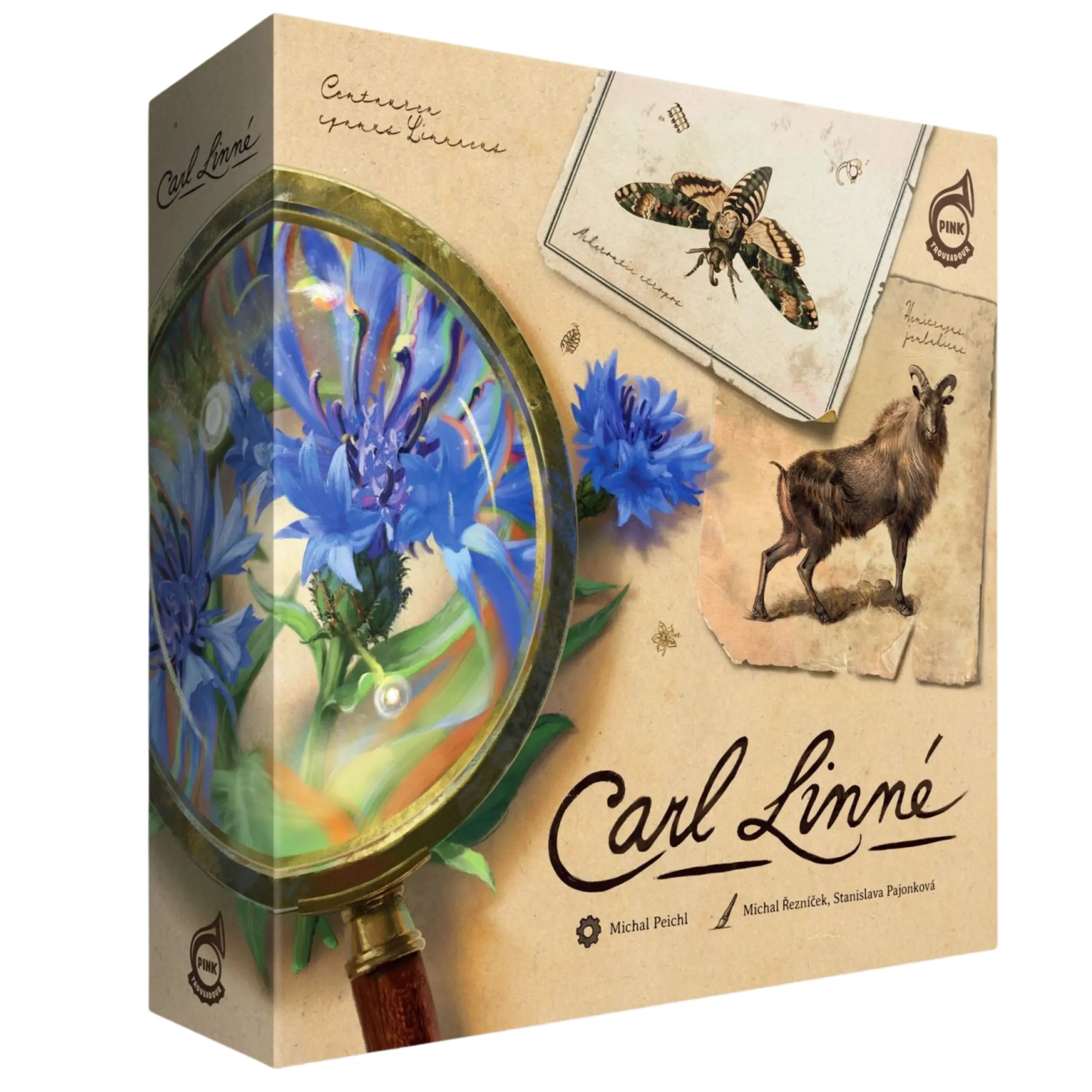
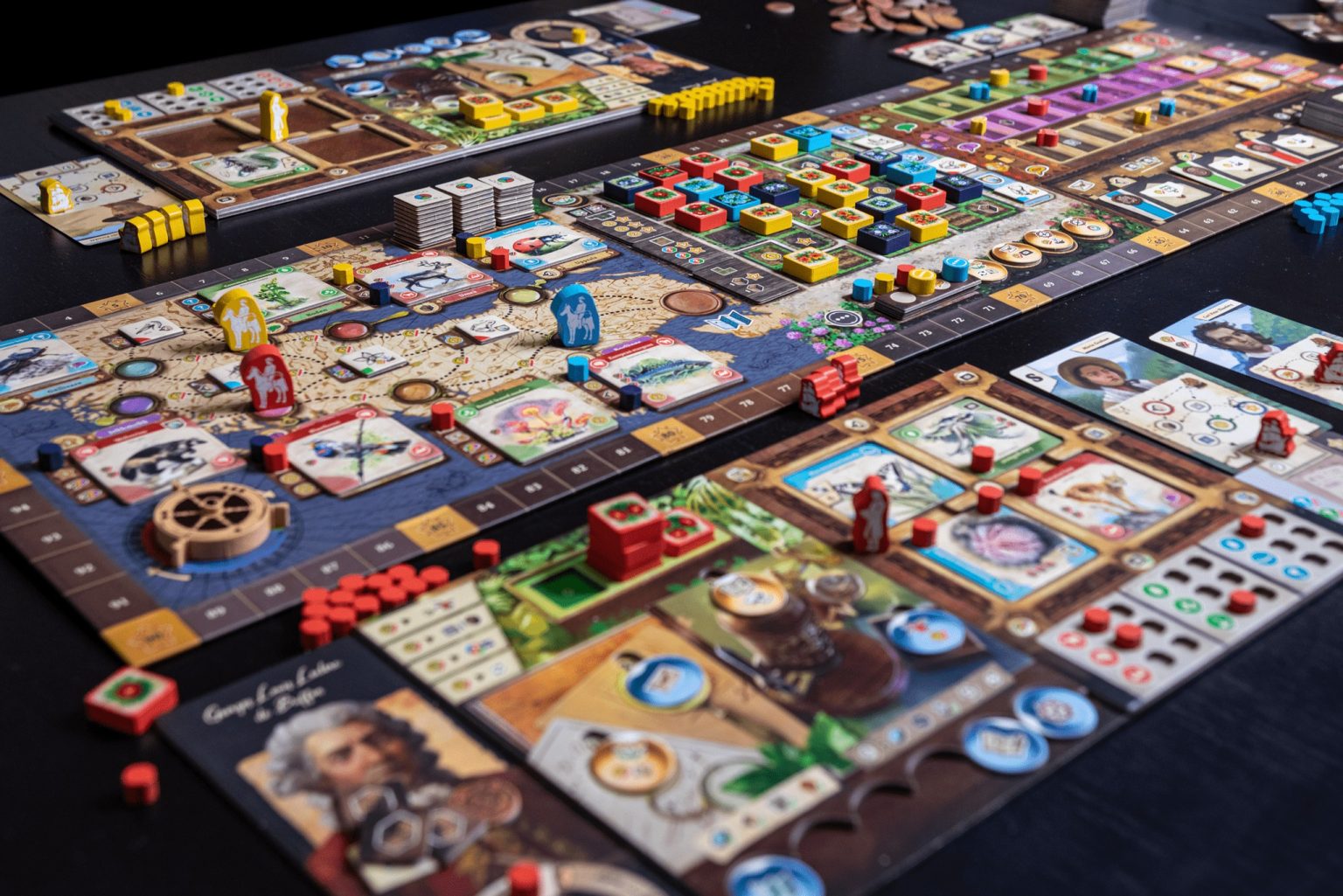
Carl Linné
🐸 Dettagli da BoardGameGeek
Consiglio BGG sul numero di giocatori
Categorie
Meccaniche
Design & Art
Lingua
Pre-order - leggi i dettagli
🐸 Una rana saggia sa quando dividere l’ordine… e quando aspettare il salto giusto.
Si abbina bene con

FroGames — Moments You'll Remember
A game where curiosity is strategy, every specimen is a step towards scientific glory, and your name could live on in history.
What it's about
The 18th Century race to classify the natural world
It's the early decades of the 1700s. Carl Linnaeus is revolutionizing science with a classification system that will forever change how humans view nature. You are one of the naturalists inspired by his work — and you want to leave your mark on history.
In Carl Linné, by Michal Peichl and published by Pink Troubadour, you explore remote regions, collect and study rare specimens, cultivate a botanical garden, correspond with scientific institutions, and publish influential works. Every action builds reputation and knowledge — the two currencies that decide who will win.
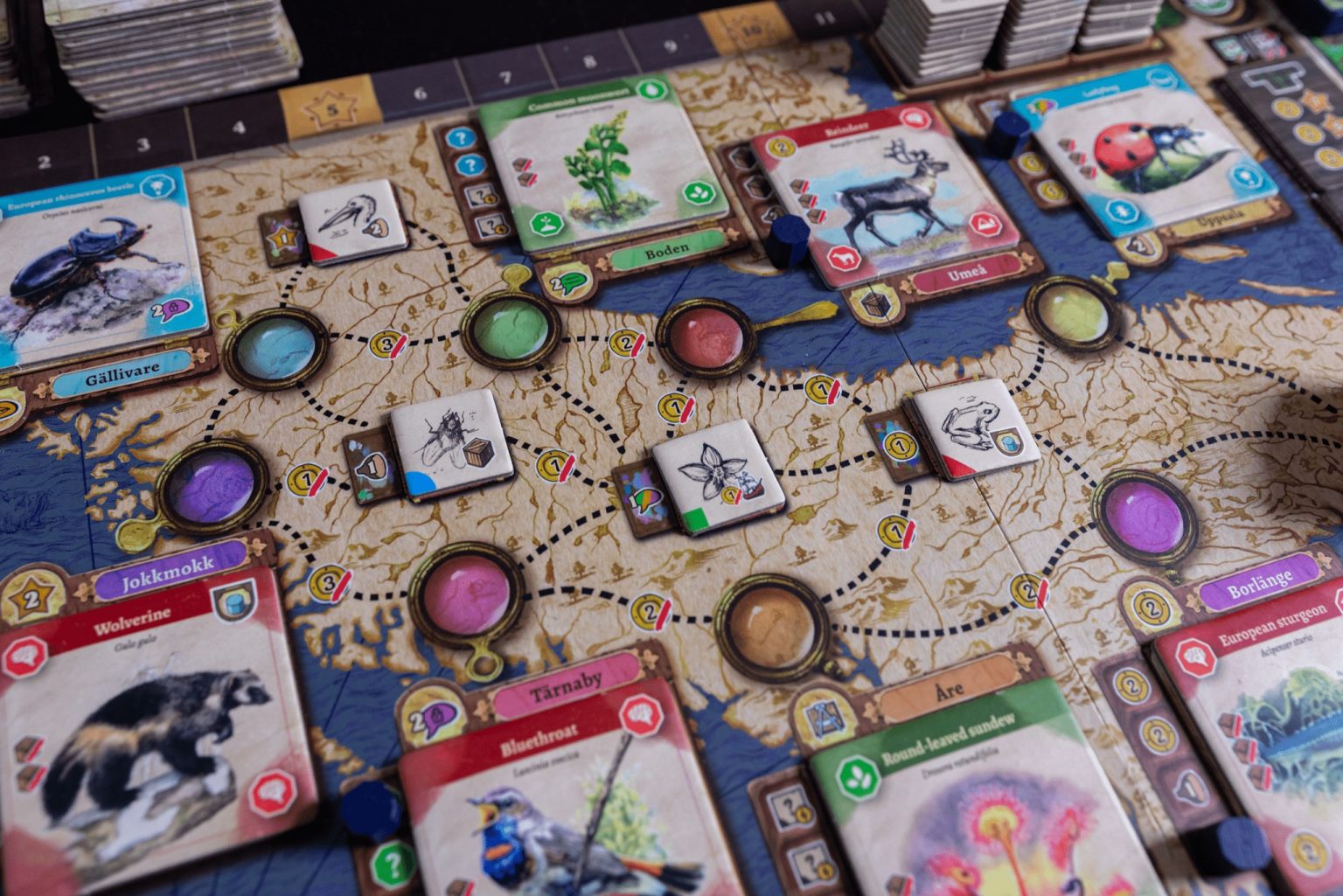
The action management system is based on a unique lens mechanism: you must balance fieldwork with academic study, carefully choosing each move. Taxonomy is not built quickly — but those who know how to wait and plan, win.
From our perspective
A eurogame where patience is a scientific virtue: every decision carries the weight of a discovery that could live on in history books.
Carl Linné's secret in one line
When you find the right balance between field and study, you feel like you are truly building something — not just winning a game.
From the game experience

Carl Linné
The solo mode is officially designed: the lens system offers a satisfying planning puzzle even without human opponents.
FrogScore · FroGames editorial rating · based on rules, official presentations, and declared mechanicsYour role as a naturalist
What you do every game
Explore remote regions
You move into unexplored areas to collect rare specimens before your opponents. Geography is your chessboard.
Cultivate a botanical garden
Your garden is your open-air laboratory — a point-engine that grows game after game if you nurture it well.
Publish scientific works
The books you write solidify your reputation. A publication at the right time can overturn hierarchies at the table.
Study and classify
Collecting isn't enough — you need to study. The lens system requires you to balance fieldwork and academic research each turn.
In a few hours, you will have cataloged species, opened correspondence with distant academies, and perhaps — perhaps — left your name in the history of taxonomy.
A game in five moments
What happens at the table
Not the rules. The experience.
The table is an 18th-century study
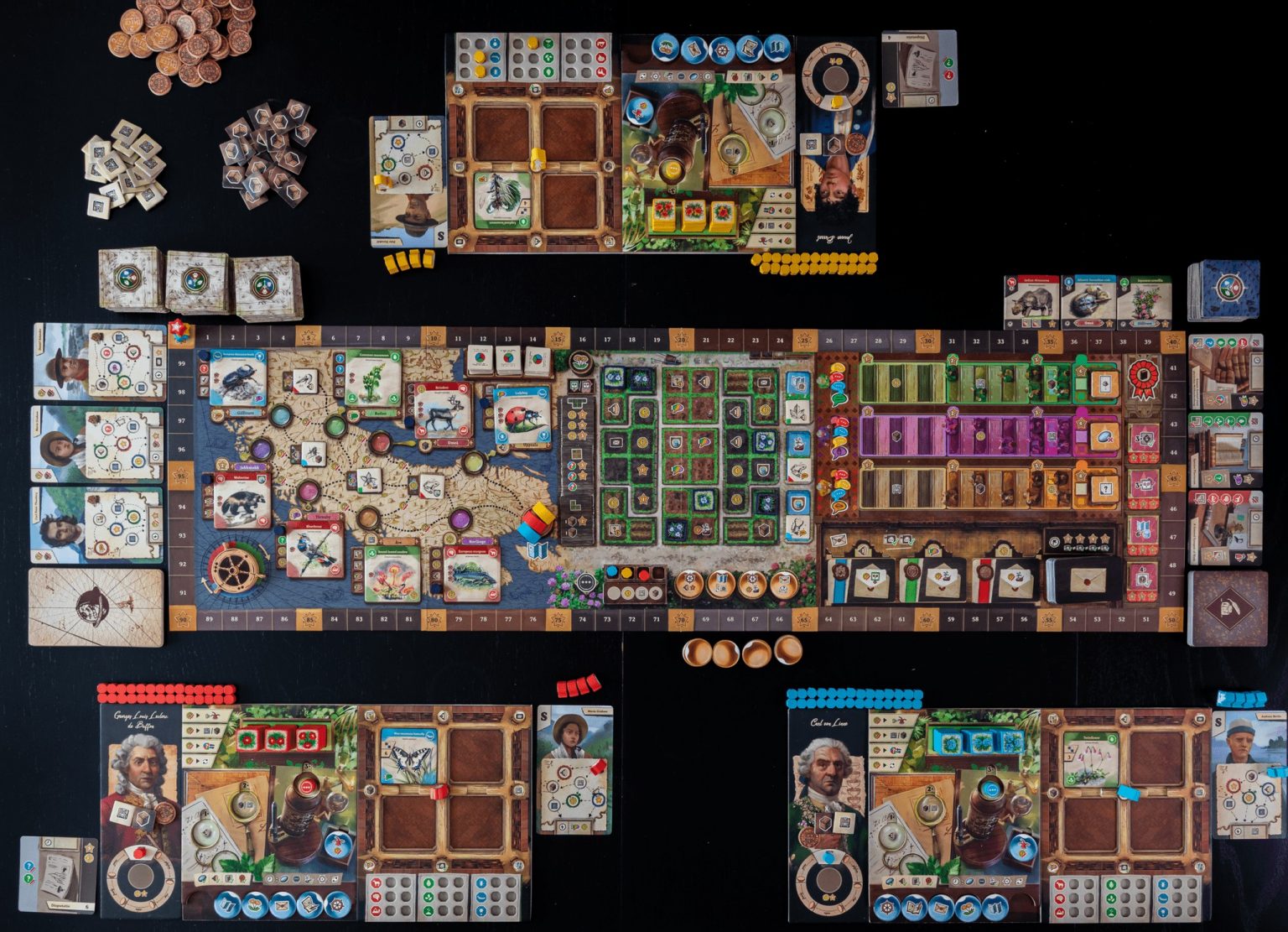
Set up the board, choose your naturalists, define the regions to explore. There’s something solemn in the air — the illustrations speak of an era when cataloging a species was a heroic act. Everyone already has their own collection strategy in mind. The race to discovery is on.
The lens system comes into play
You're trying to optimize your actions — but the lens mechanism forces you to choose: field or study? You can do both, but not everything at once, and not everything right now. Already in the second round, you feel that every decision has a cost. This is where Carl Linné shows its teeth.
Someone publishes the first book
An opponent found the right balance before you. Their treatise is already in the academies. Points move, reputation solidifies. You feel you need to change your pace — but the field still calls you, and there's that unfinished expedition you can't ignore.
The botanical garden flourishes
You invested in what seemed like a risk — and now your garden is producing more than you expected. A chain of actions is triggered, your network of scientific correspondents yields unexpected fruits. Someone around the table looks up and realizes the situation has changed.
The final treatise determines everything
The final count is closer than it seems. That publication you postponed makes all the difference. The winner has their name in the history of taxonomy — but everyone is already talking about what they would have done differently in the third round. Everything is slowly packed away.
How to play
The flow of each round
Four interwoven phases. The lens system creates choices that are never trivial — you learn quickly, you master it over time.
The lens system allows you to select available actions. The more specialized you are in an area, the more powerful the actions in that area become — but at the expense of others.
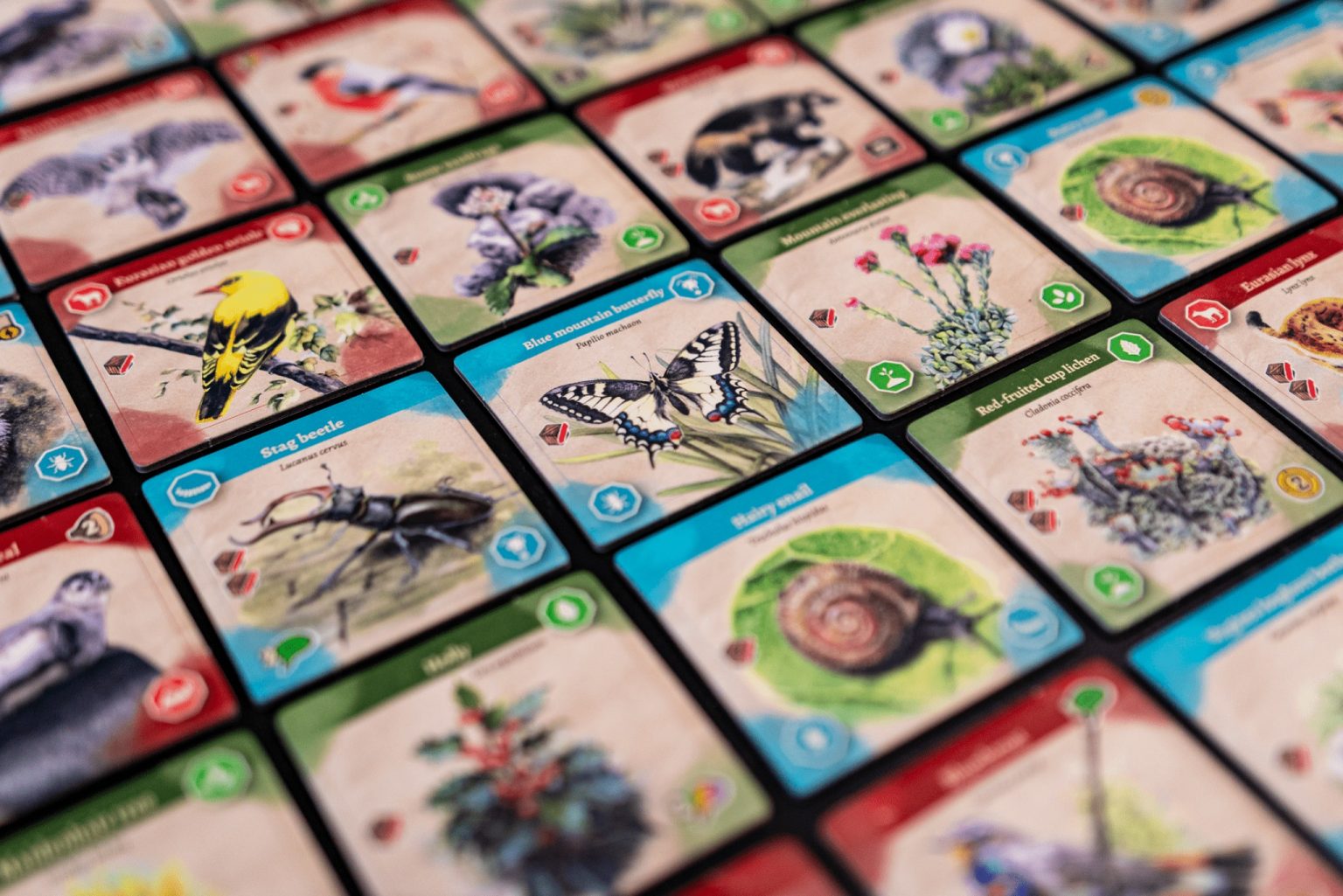
You move to distant regions to collect specimens. Each collected species opens up new possibilities for study and publication — but the best regions are contested.
You bring specimens to your botanical garden or laboratory. Studying increases knowledge and unlocks more prestigious publication options.
Published works and correspondences with scientific institutions convert knowledge into reputation — the final scoring currency.
Why it's different from others
Six mechanics that make a difference
Unique lens system
Action management isn't simple selection — the lenses determine which actions are available and how powerful they are. An original mechanism that requires vertical planning.
Field-study balance
You can't win by just exploring, nor by just publishing. Finding the right balance between fieldwork and academic research is the central challenge of each game.
Botanical garden as an engine
The garden isn't decorative — it's a growing engine. Investing early in the right specimens creates advantages that amplify throughout the game.
Publications with real weight
Each published book crystallizes points and reputation. Publishing at the wrong time wastes potential — doing it at the right time can turn the score around.
Network of scientific correspondences
By corresponding with distant institutions, you unlock bonuses and multipliers. Those who build the most efficient network over time gain a silent but decisive advantage.
Contested but non-violent regions
Interaction is indirect — you compete for the same rare specimens and regions, without directly attacking each other. A silent tension, all in all more frustrating.
How it ends
One winner, a shared story
Whoever built the most solid scientific reputation wins. But the journey matters as much as the result.
Victory
- Whoever accumulates the most scientific reputation by the end of the game
- Publications, correspondences, and the botanical garden contribute to the final score
- Specialization is rewarded — but only if well-balanced with diversification
Who doesn't win
- You are not eliminated — you play until the end and still build something
- Those who bet everything on the field without publishing lose valuable points in the count
- Defeat is usually clear in advance — the gap is visible coming
Carl Linné brings a rare aesthetic and theme to the table in the world of strategic games. A eurogame built on a true story, for those who love to think before they move.
Frequently asked questions
Carl Linné FAQ
How complex is it compared to other eurogames?
The complexity is medium-high, with a weight of 3.5/5 on BGG. The lens system is original and requires a few plays to master — but the basic mechanics can be explained in 20-25 minutes. It's not a gateway game, but it's not a heavy game in the strict sense either.
Does it play well solo?
Yes, the solo mode is official and designed by the designer. The lens system offers a satisfying planning puzzle even without human opponents — perhaps this is where the depth of the mechanism is best appreciated.
With how many players is it best?
With 3-4 players, the competition for regions and specimens makes the interaction more tense and significant. With 2 players, the game is more direct and tactical. The solo mode is a complete experience in itself. All configurations work, but with 3-4 players, the design shows its intentions more clearly.
What is meant by "lens system"?
It's the central action selection mechanism. The lenses determine which actions are available on your turn and with what power. Specializing in one area enhances those actions but limits others — creating a constant tension between immediate efficiency and long-term flexibility.
Is it suitable for those unfamiliar with the eurogame genre?
It's not the ideal first approach to the genre. The lens system requires familiarity with action management and multi-turn planning. Those who have played Wingspan or Viticulture will feel comfortable — for those starting from scratch, it's better to begin with something more accessible.
Is it available in Italian?
This is the English edition. The historical and scientific theme requires a basic understanding of English for the cards and texts. The mechanics are visual and logical, but texts and cards are in English.
Carl Linné is a strategic board game for 1–4 players (ages 12+, duration 60–120 min). Designed by Michal Peichl, artwork by Stanislava Pajonková and Michal Řezníček, published by Pink Troubadour. Main mechanic: action management via original lens system. Players embody 18th-century naturalists inspired by the work of Carl Linnaeus: they explore distant regions, collect and study specimens, cultivate botanical gardens, correspond with scientific institutions, and publish influential works to build reputation and knowledge. Competitive eurogame with official solo mode. English edition. Available on FroGames.it.
Carl Linné
Frequently Asked Questions
The answers you're looking for, no beating around the bush.
📸Do the images match the actual product?
The photos on the website often come from BoardGameGeek and are intended to give you an idea of the game. They may vary slightly from the version you receive. The content declared by the publisher is always binding.
📦Does the content of the box match what is indicated?
We always strive to provide the correct content, but minor variations are possible due to reprints or updates. The information comes directly from the publishers. If you have any questions, please contact us!
⏳How do pre-orders work?
Pre-order the game before release, payment is immediate, and the game is reserved for you. As soon as it arrives, we'll ship it right away! If there are any delays, we'll update you promptly.
🔒Can I trust buying here?
Absolutely! Secure payments, tracked shipments, and a team that loves board games as much as you do. If something goes wrong, we'll do our best to fix it.
🛠There's a problem with my order, what should I do?
Write to us now! Whether it's a missing part, damage, or an error, we'll help you resolve it as soon as possible. Your experience truly matters to us.