
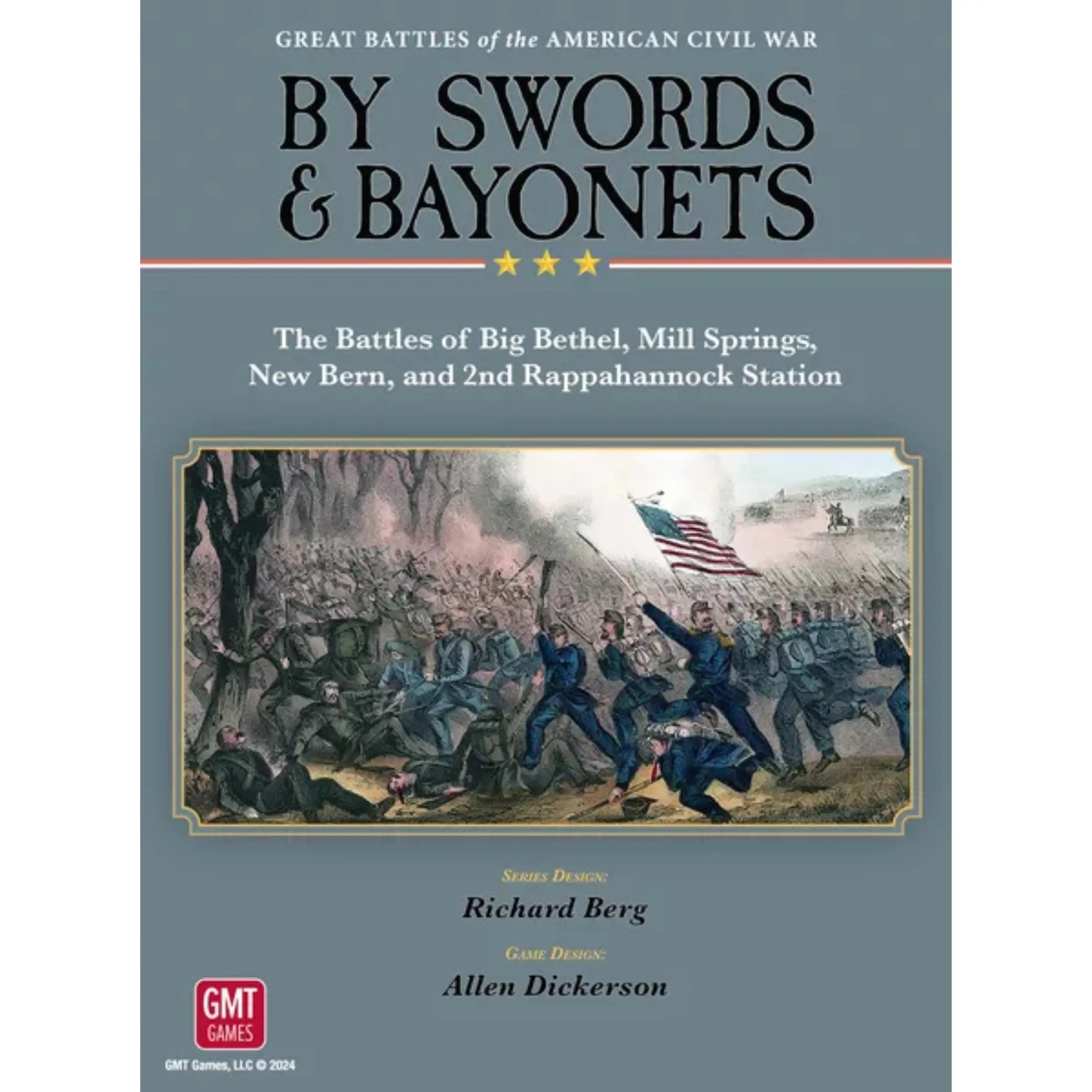
By Swords and Bayonets
🐸 Details from BoardGameGeek
Consiglio BGG sul numero di giocatori
Categorie
Meccaniche
Design & Art
Lingua
Si abbina bene con
FroGames — Moments You'll Remember
Four afternoons, four forgotten battles. Small maps, huge decisions. By the end of turn 8, you'll understand why that hill was worth everything.
WHAT IT'S ABOUT
Four Minor Battles that Decided the Conflict
By Swords and Bayonets is the ninth installment in GMT Games' Great Battles of the American Civil War series, designed by Allen Dickerson. This volume stands out for its educational approach: four American Civil War battles stripped down to their essentials, with half-sized maps (22×17 inches) and forces limited to one division per side. Big Bethel (June 1861), Rappahannock Station (November 1863), New Bern (March 1862), and Mill Springs (January 1862) are historically secondary but tactically rich engagements, perfect for learning the GBACW system without drowning in the operational scale of larger titles.
At the table, you manage fewer than 50 units, maneuver on hexes, conceal movements, and resolve engagements with dice. The full GBACW system is here: alternating activations, command, morale, critical terrain. But the complexity is calibrated: small maps mean concentrated decisions, games that finish in an afternoon. Each scenario includes asymmetrical historical conditions, attackers racing against time, defenders needing to hold out. Rappahannock Station even has a one-turn tutorial scenario for those who have never touched a chit in the series.
What they say abroad
A perfect introduction to the GBACW series, with battles that finish in a few hours but retain all the tactical depth of the system.
— FroGames
Reduced maps, limited forces, intact complexity. It's the right way to see if hex-based Civil War gaming is for you.
— FroGames

By Swords and Bayonets
The game supports solo play by managing both factions: GBACW rules include hidden movement and activation mechanics that also work alone. The experience is complete, especially in asymmetrical historical scenarios where you have to solve concrete tactical problems (Burnside at New Bern, Sedgwick at Rappahannock). Only the tension of human bluff is missing.
FrogScore · FroGames editorial rating · based on rules, international reviews and play sessionsWhat's in the box
The components of a miniature GBACW battle
Four 22×17 inch maps
Big Bethel, Rappahannock Station, New Bern, Mill Springs. Large hexes, detailed terrain, tactical scale. Everything you need to recreate the historical clash without taking over the table.
280 die-cut counters
Regiments, batteries, leaders, markers. Fewer than 50 units per scenario: manageable, but every loss hurts. Classic GMT artwork, clear information on each chit.
Full GBACW series rulebook
The entire system is here: activations, command, morale, terrain, fortifications. Nothing to unlearn when you move on to Gettysburg or Antietam. Includes a one-turn tutorial scenario (Rappahannock Station).
Cards and battle tables
Activation cards, combat tables, morale markers. Everything needed to resolve engagements without opening the manual every minute. Scenario cards include historical conditions and asymmetrical objectives for each battle.
In a few hours, you'll know if a hill can be worth 200 men. And you'll understand why these minor battles were never truly minor.
Come si gioca
Video dimostrativo di gameplay.
A game in five acts
What happens at the table
Not the rules. The experience.
Setup and historical surprise
You open the map, place the units according to the scenario. You immediately realize that Big Bethel is not balanced: Butler has more men but less time, Magruder is entrenched but isolated. The other scenarios are just as asymmetrical: attacker vs. defender, objectives vs. survival. You check the activation cards, read the victory conditions. Someone already starts defeated on paper.
First moves and critical terrain
First turn: you activate leaders, move regiments, discover how much terrain matters. A wood slows you down, a river blocks you, a hill defends. With only one division, you have no reserves: each unit must do the right job at the right time. The attacker looks for the breach, the defender plugs the gaps. Activation cards come out randomly: sometimes they save you, sometimes they condemn you.
The first clash and morale
Lines touch, you roll dice, consult the table. Someone loses steps, someone rolls for morale, someone routs. With 50 units, every loss is a hole you can't fill. At Rappahannock Station, the Confederates are isolated: if they collapse, there's no retreat. At Mill Springs, the Confederates attack in the rain: every die counts double. The table quickly empties.
The race against time
Mid-game: the attacker has burned turns, the defender hangs on by their teeth. The victory conditions are historical and cruel: take Fort Thompson (New Bern), isolate the bridgehead (Rappahannock), break before dawn (Mill Springs). It's not enough to win the clashes, you have to win now. Hidden movement (if you use it) adds a layer of paranoia: you don't know what's behind that hill.
Endgame and historical truth
Last turn: count hexes, check objectives, read the historical verdict in the booklet. Sometimes you won better than the real generals, sometimes you lost worse. The reduced scale makes every battle seem like a solvable tactical problem, but history says no one solved it perfectly. You fold the map in 10 minutes. Tomorrow, you try another battle.
How to play
The flow of each GBACW turn
Alternate activations, reactions, combat. The complete system at a reduced scale.
You check leaders, assign orders, activate formations. Whoever has the initiative moves first, but the other can react. Activation cards determine when and how: sometimes you have everything, sometimes nothing.
You move units according to orders, respect terrain, form lines. With only one division, each regiment has a precise job: vanguard, flank, reserve. Hidden movement (optional) allows you to bluff.
Resolve clashes with dice and tables. Attacker rolls, defender responds, someone loses steps. Then morale: whoever collapses routs, whoever holds resists. Losses are permanent, routs are contagious.
Remove markers, advance the turn, check victory conditions. In short scenarios like these, each turn is a chapter: sometimes it ends on turn 8, sometimes earlier if someone collapses or wins objectives.
Why it's different from others
Six reasons why By Swords and Bayonets works
Halved maps, halved time
22×17 inches instead of standard GBACW maps. This means fewer hexes, fewer units, fewer hours. A battle finishes in 3-4 hours instead of a full day. Perfect for learning the system without a weekend commitment. But the tactical complexity is intact: every hex counts even more.
One division per side, nothing more
Maximum 50 units per player, often fewer. No army corps, no operational confusion. You manage brigades, regiments, batteries: pure tactical scale. You see the entire battlefield at a glance, no units forgotten off-map.
Complete GBACW system, no simplifications
The rules are those of the main series: activations, command, morale, terrain, fortifications. Nothing to unlearn when you move on to Gettysburg or Antietam. By Swords and Bayonets is a functional tutorial, not a watered-down version. You learn the real system on manageable battles.
Four historically asymmetrical battles
Big Bethel (1861): Butler attacks with too many men and too much confusion. Rappahannock Station (1863): Sedgwick must isolate a bridgehead before Early reinforces it. New Bern (1862): Burnside against Fort Thompson. Mill Springs (1862): Confederate night attack in the rain. No scenario is balanced: they are historical problems to solve, not symmetrical games.
One-turn tutorial scenario
Rappahannock Station includes an introductory mini-scenario: one turn, two brigades, clear objectives. You learn activation, movement, combat, morale in 45 minutes. Then you restart the full scenario knowing what to do. It's the only GBACW game with such an integrated tutorial.
Gateway to the longest-running series
Great Battles of the American Civil War has been active since 1988: 9 volumes, dozens of battles, a historical community. By Swords and Bayonets is the designed entry point: if you like this, you have 8 boxes waiting for you. If you don't like it, you've spent an afternoon on four real battles, not a week on Gettysburg.
How it ends
How to win and how to lose
Each scenario has historical victory conditions. The first to achieve them or the one who holds out until the end wins.
Victory
- Capture historical objectives (Fort Thompson, bridgehead, key positions) within the turn limit
- Destroy or rout the number of enemy units required by the scenario
- Hold out as defender until the end of the final turn, maintaining critical positions
Defeat
- Fail to achieve historical objectives within the turn limit (attacker)
- Lose critical positions or exceed the loss limit (defender)
- The morale of your units collapses and you have no reserves to plug the gaps
Four forgotten battles that teach the Civil War better than Gettysburg. Because learning on Pickett's Charge is like learning to swim in the ocean.
Frequently asked questions
FAQ on By Swords and Bayonets
Do I need to know the GBACW series to play?
No. By Swords and Bayonets is designed as an introduction: it includes the complete rulebook, a tutorial scenario, and short battles. If you've never touched a hex-based wargame, this is the starting point. If you already know the series, these are four new battles with quick setup.
How long do games last?
3-4 hours per scenario once you know the rules. The Rappahannock Station tutorial finishes in 45 minutes. Small maps and limited forces keep times under control: no 8-hour sessions like in larger GBACW titles.
Does it play well solo?
Yes. The GBACW rules support solo play: you manage both factions, resolve activations and combat according to the tables. Asymmetrical scenarios become tactical problems to solve: you have to find a way to win as Butler at Big Bethel or resist as Magruder. Only the bluff of hidden movement is missing.
Are these battles historically important?
No, they are minor clashes of the American Civil War. But tactically they are rich: poorly coordinated attacks (Big Bethel), attempts at isolation (Rappahannock Station), night assaults (Mill Springs). They are perfect battles to learn tactics without getting lost in the operational scale of Antietam or Gettysburg.
Is the game available in Italian?
No, By Swords and Bayonets is only available in English. It requires a good knowledge of the language for the rulebook and scenario cards, but the GBACW mechanics are standardized: once learned, the tables and markers speak for themselves.
By Swords and Bayonets is a tactical hex-and-counter wargame for 1-2 players, duration 240-360 minutes, ages 14+. Designed by Allen Dickerson and published by GMT Games, it is part of the Great Battles of the American Civil War (GBACW) series. It includes four historical battles of the American Civil War (Big Bethel 1861, Rappahannock Station 1863, New Bern 1862, Mill Springs 1862) on reduced 22×17 inch maps. Each scenario limits forces to one division per side (maximum 50 units), reducing playing time without simplifying GBACW rules. Complete system with alternate activations, hidden movement, dice combat, morale, and command management. Includes a one-turn tutorial scenario. Ideal as an introduction to the GBACW series or for quick games of historical tactics. Available on FroGames.it.
Frequently Asked Questions
The answers you're looking for, no beating around the bush.
📸Do the images match the actual product?
The photos on the website often come from BoardGameGeek and are intended to give you an idea of the game. They may vary slightly from the version you receive. The content declared by the publisher is always binding.
📦Does the content of the box match what is indicated?
We always strive to provide the correct content, but minor variations are possible due to reprints or updates. The information comes directly from the publishers. If you have any questions, please contact us!
⏳How do pre-orders work?
Pre-order the game before release, payment is immediate, and the game is reserved for you. As soon as it arrives, we'll ship it right away! If there are any delays, we'll update you promptly.
🔒Can I trust buying here?
Absolutely! Secure payments, tracked shipments, and a team that loves board games as much as you do. If something goes wrong, we'll do our best to fix it.
🛠There's a problem with my order, what should I do?
Write to us now! Whether it's a missing part, damage, or an error, we'll help you resolve it as soon as possible. Your experience truly matters to us.