
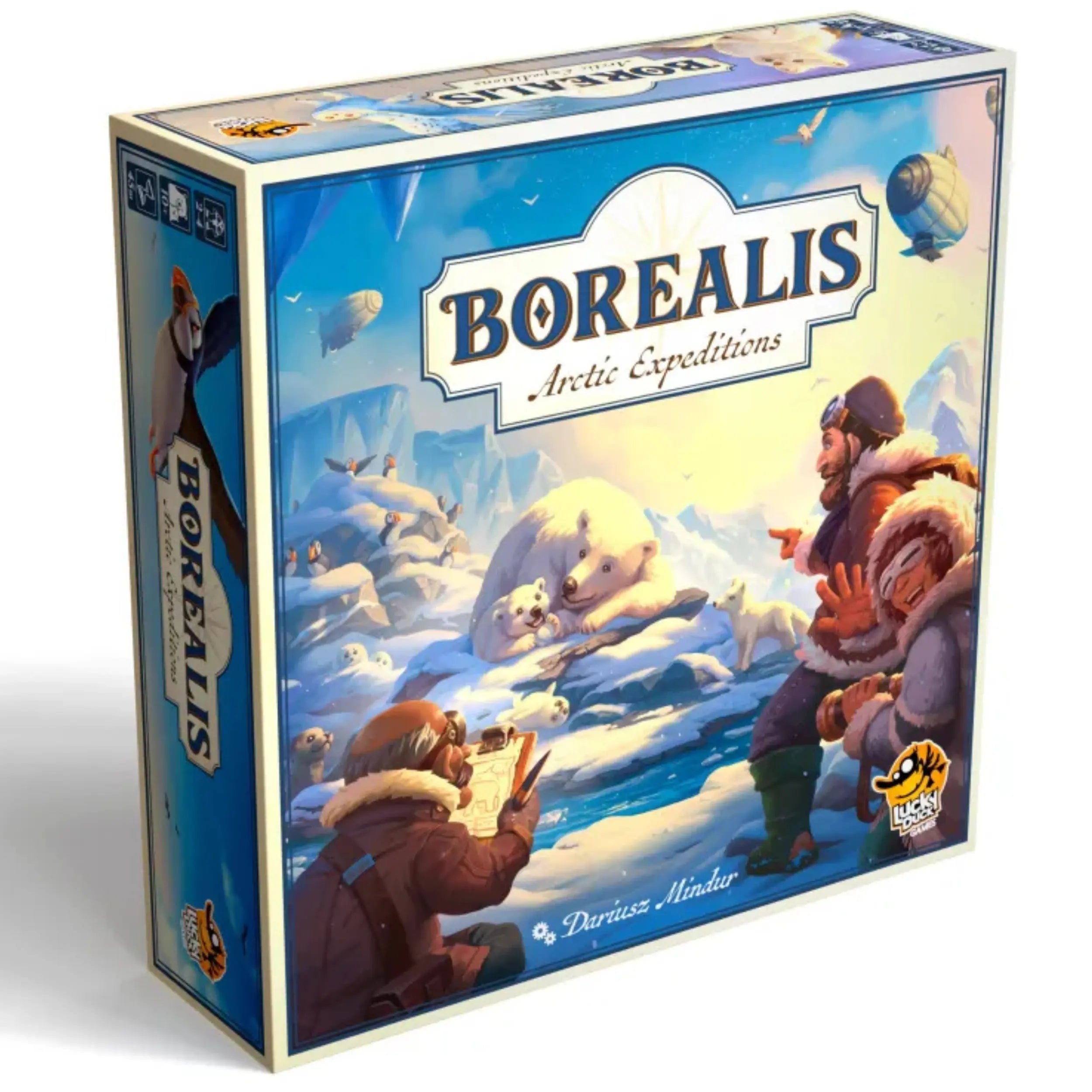
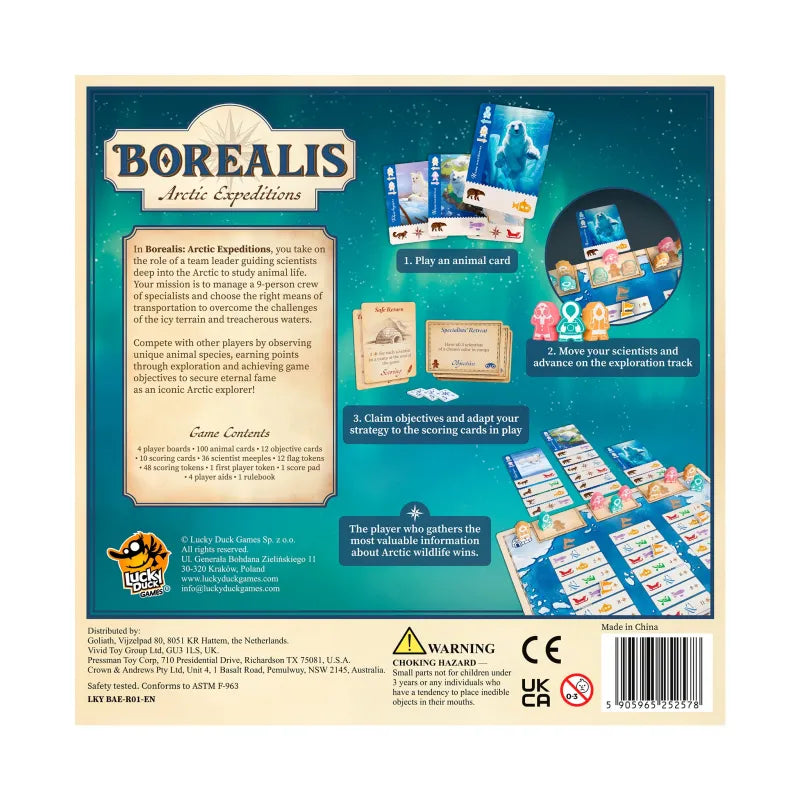
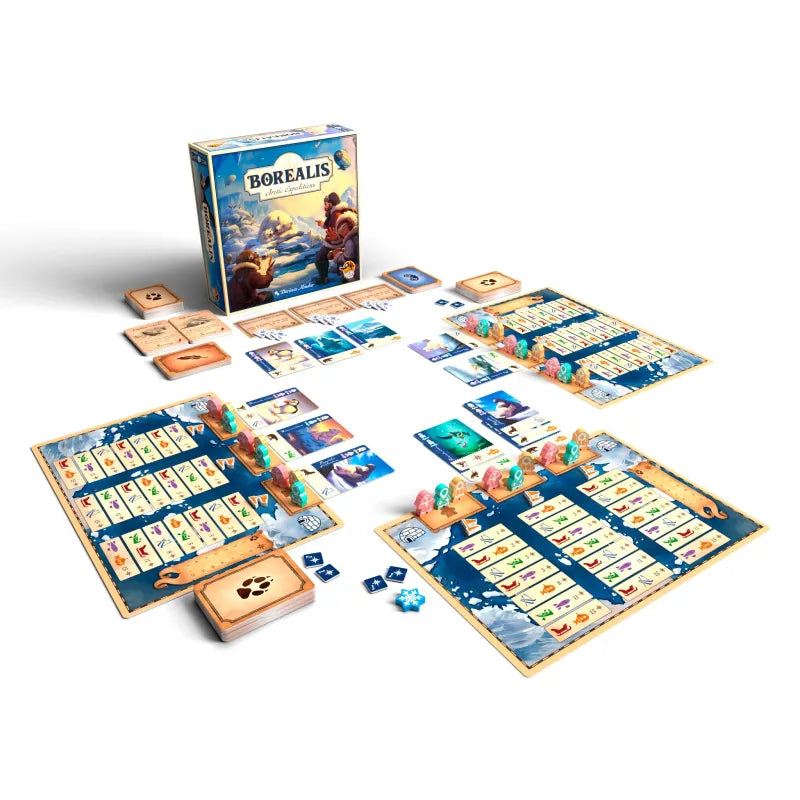


Borealis Arctic Expeditions
🐸 Dettagli da BoardGameGeek
Consiglio BGG sul numero di giocatori
Categorie
Meccaniche
Design & Art
Lingua
Si abbina bene con

FroGames — Moments You'll Remember
It all depends on the position of your scientists. And the polar bear you didn't expect.
What it's about
A precision puzzle amidst the polar ice
In Borealis: Arctic Expeditions, you are in charge of a scientific expedition to unexplored boreal territories. Your objective: photograph the five most adorable Arctic animal species — polar bears, arctic foxes, seals, reindeer, snowy owls — and return with the most impressive collection for the Society for Polar Investigations.
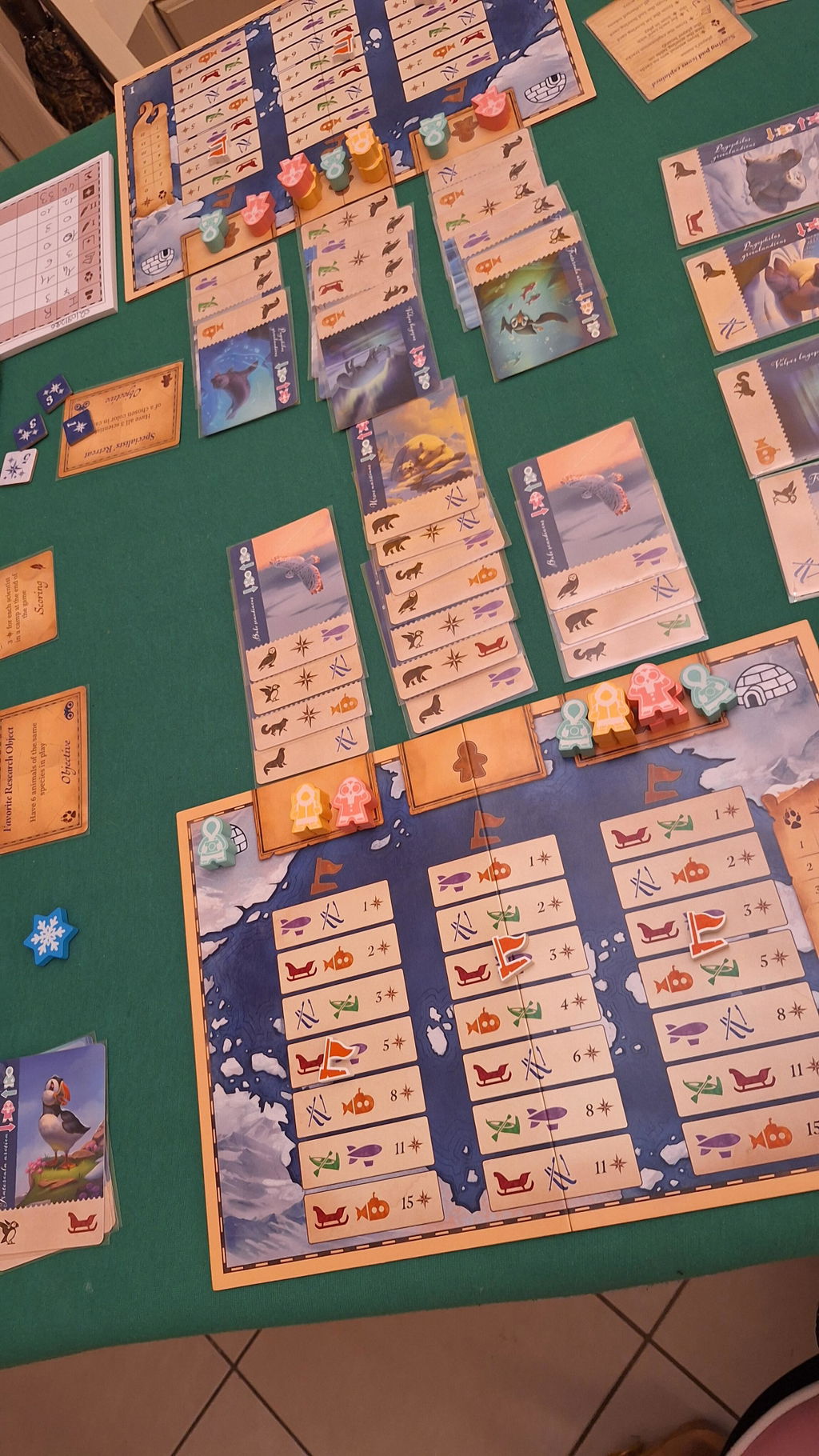
The core of the game is a unique sliding mechanism: every card you play in one of the three stations on your board makes your scientists slide left or right — but only if their colors match those printed on the card. The photo is taken when the conditions are perfect. Aligning that sequence is an elegant and never-the-same puzzle.
Designed by Dariusz Mindur and published by Lucky Duck Games, it was one of the most appreciated surprises at Spiel 2025. The variant with asymmetric player boards adds depth for those who want to push further.
From the game experience
The satisfaction of triggering the perfect sequence — scientists in position, right card, animal photographed — is rare and genuine.
The secret of Borealis in one line
A game that seems mild in the box, and you find yourself planning three turns ahead without realizing it.
From the game experience

Borealis: Arctic Expeditions
FrogScore · FroGames editorial rating · based on rules, international reviews and play sessionsYour expedition
What you manage in each game
9 specialist scientists
Three colors, three different skills. They only move when the conditions on the card match — your board is a system of living tracks.
5 animal species
Polar bears, arctic foxes, seals, reindeer, snowy owls. Collecting them in predefined patterns is the core of the challenge — each species counts differently.
Animal-photo cards
Each card defines where you play, which scientist moves, and which animal you photograph. Choosing the right card at the right time is the puzzle of the game.
Variable objectives
Three types of common objectives change each game: some are raced for, others give bonus points at the end of the game. No dominant strategy.
At the end of the game, it's not about who won. It's about that perfect sequence — when everything aligned as it should.
🃏
Recommended sleeves1 size · 126 cards
📖
RulebookEnglish · Official PDF
Come si gioca
Video dimostrativo di gameplay.
A game in five moments
What happens at the table
Not the rules. The experience.
The expedition departs, heads are already spinning
Setup finished. You have nine scientists on the board, four cards in hand, and the common objectives on the table that everyone is already evaluating. Someone has already decided which animal to pursue first. The arctic fog rises — and the puzzle begins.
The first photo — almost perfect
You play the card. A scientist slides into the right position, the animal is photographed. But you could have done better — there was a card in the market that would have moved the second one too. You realize that in this game, you learn to regret every single suboptimal move.
The regrouping turn — everything changes
Your scientists are scattered across three stations. The regrouping turn arrives — they all return to one place. From a moment of relief to a tactical decision: where you put them back changes the entire plan for the next three turns. The table pauses for a second.
The race for objectives heats up
Someone is close to completing the first competitive objective. Priorities change at the last minute. Those chasing arctic foxes now veer towards seals. The card market becomes contested — a card you once ignored is now worth gold.
The final count — surprises guaranteed
Game over. The score is tallied: animal sets, completed objectives, progress on vehicle tracks. Those who seemed behind during the game often catch up with end-game bonuses. Everything is packed away, wondering what strategy to try next time.
How to play
The flow of each turn
Three essential actions. Explained in twenty minutes, grasped in the first game, optimized in subsequent ones.
You have four cards in hand. Each card indicates a station, a scientist's color, and an animal. Choosing the right card — or the right moment to play it — is the heart of the puzzle.
Place the card in one of the three stations on your board. Scientists of the indicated color slide — but only if they are in the correct squares. If the conditions match, you take the photo and claim the animal card.
Draw from the common market or the deck. If you've completed a competitive objective, claim it immediately before an opponent does. Drawing is the only time luck truly comes into play.
When you play the seventh card in a station, the regrouping turn triggers: all your scientists return together to a station of your choice. A pause that becomes one of the most important decisions of the game.
Why it's different from others
Six mechanics that make a difference
Scientist sliding
You don't move pawns on a map — you slide your scientists along colored tracks. The card doesn't perform the action if the colors don't match. A mechanism not found elsewhere.
Three overlapping scoring levels
Animal sets per station, variable common objectives, progress on vehicle tracks. Three interacting systems — each game asks you to figure out which to prioritize.
The regrouping turn
When scientists all return together, you don't choose where each goes — they all return to a single place. That single decision overturns the plan for subsequent moves.
Symmetrical and asymmetrical board
The first games are played with the symmetrical board — everyone is the same, pure focus on mechanics. Then comes the asymmetrical version, with different layouts for each player and strategies that change radically.
Real-time competitive objectives
Some objectives are contested: the first to complete the condition takes them. You're not just optimizing your plan — you're also keeping an eye on what others are building.
Five species, ever-changing patterns
End-game objective cards determine how many and how to collect the five animal species. The combination changes every game — no session yields the same optimal strategy.
How it ends
How to win — and how to lose ground
The final score is the sum of three components. Those who neglect one of the three rarely win — but those who balance all of them can catch up until the last turn.
How points are tallied
- Sets of photographed animals for each station (fixed table on the board)
- Completed common objectives — some competitive, others end-game
- Progress on vehicle tracks: each level reached is worth bonus points
How to lose ground
- Ignoring vehicle tracks throughout the game zeroes out a significant portion of points
- Playing cards without first positioning the right scientists wastes turns
- Neglecting competitive objectives gives easy points to opponents
Borealis: Arctic Expeditions is one of the most elegant puzzle games released at Spiel 2025. Accessible on first approach, layered by the fifth game.
Frequently asked questions
FAQ about Borealis: Arctic Expeditions
What makes it unique compared to other set collection games?
The scientist sliding mechanism: you don't just pick up a card and collect an animal — you first have to correctly position your specialists using previous cards. Collection is the result of a chain of preparatory moves. This transforms set collection into a short-range planning puzzle, unlike any other game in the genre.
Is it suitable for casual players or is it too complicated?
It's a great sophisticated gateway game. The rules are explained in about 20 minutes, and the first game flows smoothly. The depth emerges in subsequent games, when you start planning sequences of three or four moves. It's more complex than a filler but much more accessible than a heavy eurogame.
How does the difference between symmetrical and asymmetrical boards work?
The symmetrical board has the same layout for all players — ideal for learning the game without additional variables. The asymmetrical version assigns boards with different configurations: the scientist paths and stations vary, radically changing each player's strategy. The designers recommend starting with the symmetrical one.
Does it work well with two players or is it better with four?
It works well in both formats, but with different nuances. With two, it's more solitary and reflective — you optimize without too much competitive pressure. With four, the card market becomes more contested and the race for objectives more intense. Most players prefer three or four for a bit more tension.
How much does luck influence the game compared to strategy?
Luck exists in the drawing moment — the cards that appear in the market are not predictable. But since you always have four cards in hand and the market is visible to everyone, decisions largely dominate the random component. Those who better plan the scientist sliding sequence almost always have a concrete advantage.
Is it available in Italian?
This is the English edition. The text on the cards is minimal and easily understandable with the rulebook, but texts and materials are in English. An official Italian localization is not currently available.
Borealis: Arctic Expeditions is a set collection and hand management board game for 2–4 players (ages 10+, duration 45 min). Designed by Dariusz Mindur, published by Lucky Duck Games in 2025. Main mechanics: hand management, open drafting, slide/push, pattern recognition, race, track movement, variable set-up, end game bonuses. Each player manages 9 specialist scientists on an individual board, photographing 5 arctic animal species through a unique sliding mechanism. Available in symmetrical and asymmetrical board versions. Presented at Spiel 2025, BGG rating 7.5. English edition. Available on FroGames.it.
Borealis Arctic Expeditions
Frequently Asked Questions
The answers you're looking for, no beating around the bush.
📸Do the images match the actual product?
The photos on the website often come from BoardGameGeek and are intended to give you an idea of the game. They may vary slightly from the version you receive. The content declared by the publisher is always binding.
📦Does the content of the box match what is indicated?
We always strive to provide the correct content, but minor variations are possible due to reprints or updates. The information comes directly from the publishers. If you have any questions, please contact us!
⏳How do pre-orders work?
Pre-order the game before release, payment is immediate, and the game is reserved for you. As soon as it arrives, we'll ship it right away! If there are any delays, we'll update you promptly.
🔒Can I trust buying here?
Absolutely! Secure payments, tracked shipments, and a team that loves board games as much as you do. If something goes wrong, we'll do our best to fix it.
🛠There's a problem with my order, what should I do?
Write to us now! Whether it's a missing part, damage, or an error, we'll help you resolve it as soon as possible. Your experience truly matters to us.