
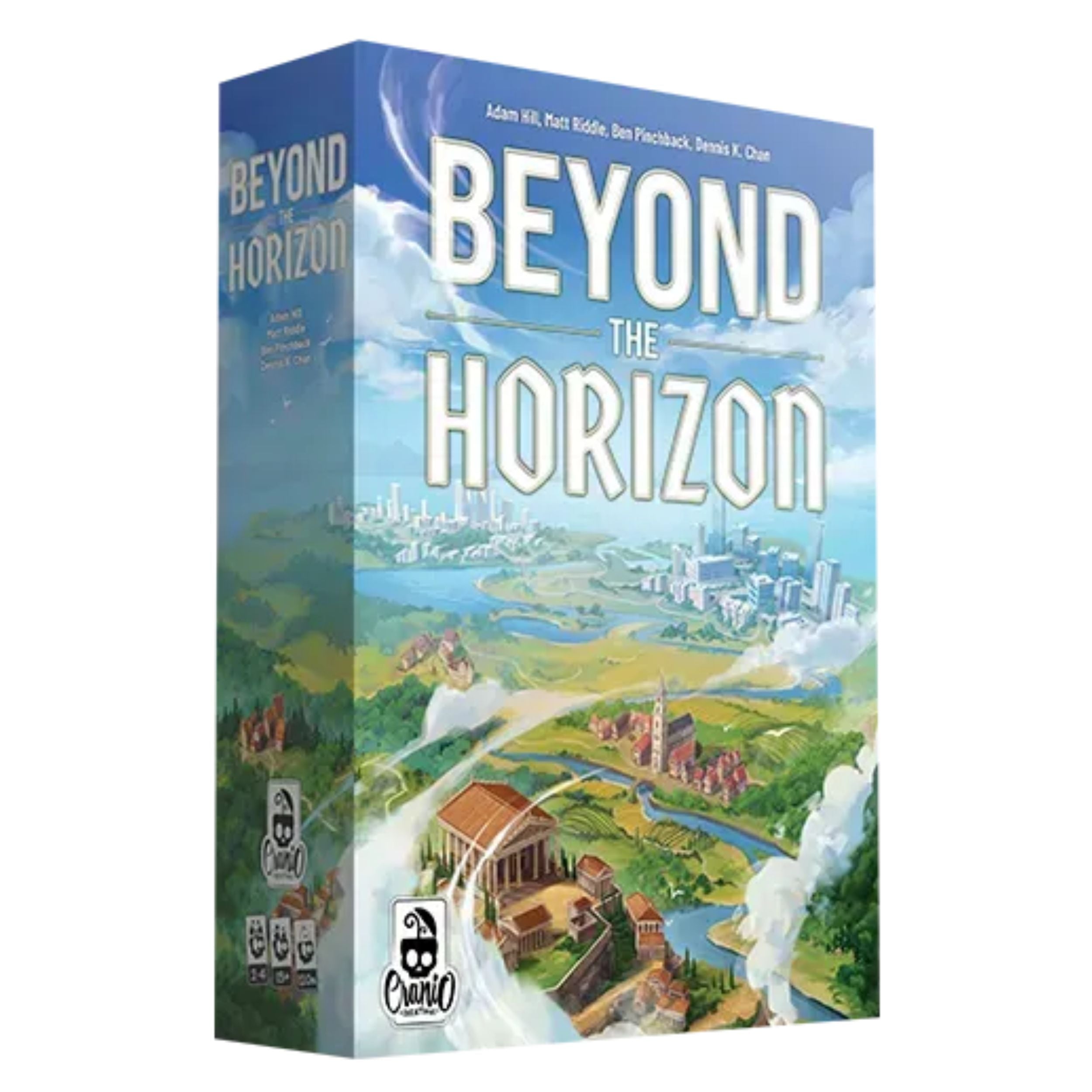
Beyond the Horizon
🐸 Dettagli da BoardGameGeek
Consiglio BGG sul numero di giocatori
Categorie
Meccaniche
Design & Art
Lingua
Si abbina bene con
FroGames — Moments You'll Remember
The table slowly fills. Tiles become continents, cities blossom, technologies open impossible paths. In the end, someone will look at the map and think: we built this.
WHAT IT'S ABOUT
A civilization that rises from nothing to become an empire
Beyond the Horizon was born from the collaboration of Dennis K. Chan, Adam Hill, Ben Pinchback, and Matt Riddle, four designers with diverse backgrounds who combined complementary visions. The illustrations by Agnieszka Dąbrowiecka and the maps by Klemens Franz bring a breathing world to the table, amidst unexplored territories and nascent civilizations. It's a 2024 game that looks at classic tabletop 4X games and tries to distill their essence into 2 hours.
At the table, you manage a civilization from dawn to glory. You place workers to explore new lands, found cities, develop culture and economy, and unlock technologies that open previously impossible actions. The map grows tile by tile, your opponents do the same, and each round you must decide whether to expand your territory or consolidate what you have. The winner is the one who accumulates the most points through exploration, cities, development, and shared objectives. There's no single way to win: the game ends when enough objectives have been achieved.
What they say abroad
The game finds its rhythm through dense, interconnected choices, where every move opens some doors and closes others.
— FroGames
Beyond the Horizon distills the 4X experience into an elegant structure, without losing the feeling of building something grand.
— FroGames

Beyond the Horizon
FrogScore · FroGames editorial rating · based on rules, international reviews, and play sessionsThe tools of your civilization
Four pillars to build an empire
Territory Tiles
Every exploration adds a tile to the world. Plains, mountains, coasts. The map grows organically, and whoever arrives first chooses where to expand. Territorial control means victory points and vital space.
Cities
Found settlements that become cities. Each city is an operational base, an action multiplier, a control point. The more you have, the more you can do. But they must be defended and connected.
Technology Trees
Four development paths: exploration, production, research, culture. Each unlocked technology opens new actions or enhances existing ones. The choices here define your strategy.
Objectives
Common objective cards visible to all. The first to achieve them gets bonus points. Some are territorial, others cultural, others economic. They are the invisible race that sets the pace.
Recommended sleeves 84 cards in 1 size ▼
If you play often, we recommend protecting your cards with clear sleeves to make them last longer.
| Size | Quantity |
|---|---|
| 58 × 89 mm | 84 |
| Total cards | 84 |
In two hours, you'll have a map that tells a story. Your civilization, the paths it took, the silent battles it won or lost. Not every game delivers that.
A game in five moments
What happens at the table
Not the rules. The experience.
Terra Incognita
The first turn is pure exploration. Everyone places tiles, founds the first city, chooses their initial direction. The table is empty, possibilities are infinite. Some aim for the sea, some for the mountains. You don't yet know who is playing what strategy.
The first technologies
The first difficult choices arrive. Which tech tree do you develop first? Those strong in production accumulate resources, those focusing on research unlock bonus actions, those scaling culture gain points. You start to see others' plans take shape.
Territorial conflict
Mid-game. Someone places a city in the territory you wanted. It's not direct combat, but the map is full and living space is running out. You must adapt your strategy or accept playing in a tight corner. Common objectives become critical.
The race for objectives
Someone completes an objective and gets bonus points. Others realize that whoever gets there first wins twice: direct points and control of the pace. The silent race begins. You change your plan mid-turn to pursue an objective that's about to slip away.
End of civilization
The last objective is achieved. Immediate end, score counting. Cities, explored territories, cultural, economic, technological development. Whoever balanced best wins. Someone realizes they focused too much on a single path. Next time will be different.
How to play
The flow of each round
Each round is a sequence of worker placement, action resolution, production, and objective checking. The structure is clear, but the choices are dense.
In turn, each player places one of their workers on an action space: exploration, city founding, technological development, production, cultural advancement. Each area has limited spaces. Whoever gets there first chooses the best actions.
After everyone has placed, actions are resolved area by area. You explore tiles and add them to the map. You found cities in controlled territories. You advance on tech trees or accumulate resources. Each action has immediate effects and opens up future possibilities.
Your cities produce resources based on the surrounding territory and unlocked technologies. You use resources to build, develop, advance on cultural and economic tracks. This is where you see who built an efficient engine and who expanded too quickly.
You check if you have met one of the visible common objectives. If so, you claim it and take bonus points. Some objectives mark intermediate points, others end the game when reached. Whoever completes the most drives the pace of the game.
Why it's different from others
Six mechanics that make a difference
Organically growing map
There is no fixed board. The map grows tile by tile, and each player decides where to expand. This means that each game has a different geography, with bottlenecks, peninsulas, strategic passages that emerge naturally. Territorial competition is fluid, not predefined.
Four interconnected tech trees
Tech trees are not linear. Each branch unlocks new actions or enhances existing ones, and you must decide whether to specialize or diversify. Those who scale research unlock bonus actions, those who focus on culture accumulate points, those who go for production become an economic machine. The combinations are endless.
Common objectives that drive the pace
Everyone sees the same objectives, but only the first to reach them gets bonus points. This creates a silent tension: you realize when someone is about to complete one, and you have to decide whether to pursue it or aim for another. Objectives punctuate the game and prevent overly passive strategies.
Cities as multipliers
Each city founded is not just points: it's an operational base that enhances future actions. The more cities you have, the stronger you become. But founding too many too soon leaves you without resources to develop. Timing is everything, and whoever best balances expansion and consolidation dominates.
Four parallel development axes
There is not just one way to score points. Exploration, cities, culture, economy: each axis contributes to the final score. Those who specialize in only one risk losing against those who balance. But balancing means giving up dominance in one area. Strategic tension is constant.
Variable game end
The game ends when a certain number of objectives have been met, but you don't know exactly when. This prevents you from calculating everything in advance: you have to adapt to the pace set by others. Those who push to finish quickly have a different strategy than those who want to prolong the game.
How it ends
How to win and how to lose
The winner is the one who accumulates the most points through exploration, cities, development, and objectives. But be careful: focusing on only one axis rarely suffices.
Victory
- Cities founded and territories explored: each city is worth points, each explored tile contributes to the total.
- Objectives completed: being first to a common objective brings significant bonus points.
- Development across four axes: culture, economy, research, production. Those who advance on all four accumulate consistent points.
Loss
- Excessive specialization: focusing only on cities or only on technologies leaves too many points on the table.
- Delay in the race for objectives: if you're always second, you lose the bonuses. And bonuses make all the difference.
- Poorly planned expansion: founding cities without resources to develop them leaves you with an empty, unproductive empire.
Beyond the Horizon is a 4X that respects your time but doesn't simplify choices. If you're looking for a civilization you can build in an evening, this is the game.
Frequently Asked Questions
FAQ about Beyond the Horizon
How complex is it to learn?
Medium-high weight (3.4 on BGG). The basic rules can be explained in 20-25 minutes, but the first game is for understanding how the tech trees intertwine and how to time expansion. From the second game onwards, the flow becomes smooth. It's not a gateway game, but not a monster game either: it's a thematic eurogame that requires planning.
How long does a game really last?
The box says 90-120 minutes, which is realistic. The first game will run over, subsequent games settle around a full 2 hours with 4 players, and can drop to 90 minutes with 2. It largely depends on how accustomed players are to worker placement and parallel management.
Is there direct combat?
No. Interaction is indirect: competition over territories (who places first gets the best positions), a race for common objectives, blocking action spaces in worker placement. There are no armies or battles. It's strategic conflict, not military.
Does it play well with 2 players?
Yes, the game scales well. With 2 players, the map is less crowded and territorial competition is less direct, but the race for objectives remains tense. Some blocking dynamics are lost, but it remains a solid and faster experience.
Is it available in Italian?
Yes, this is the Italian edition by Cranio Creations. Rulebook, objective cards, track references: everything fully localized. You can play without knowing English.
Beyond the Horizon is a civilization game for 2-4 players, lasting 90-120 minutes, recommended age 14+. Designed by Dennis K. Chan, Adam Hill, Ben Pinchback, and Matt Riddle, it combines worker placement, tile-laying, and tech trees into a 4X (explore, expand, exploit, exterminate) experience that can be completed in an evening. Published by Cranio Creations in Italian edition, the game offers a modular map that grows organically, four parallel development axes, and common objectives that drive the pace. In each game, you build a civilization from scratch, found cities, unlock technologies, and compete for territories and objectives. Complexity is medium-high, and replayability is high thanks to variable setup and viable strategies. Available on FroGames.it.
Frequently Asked Questions
The answers you're looking for, no beating around the bush.
📸Do the images match the actual product?
The photos on the website often come from BoardGameGeek and are intended to give you an idea of the game. They may vary slightly from the version you receive. The content declared by the publisher is always binding.
📦Does the content of the box match what is indicated?
We always strive to provide the correct content, but minor variations are possible due to reprints or updates. The information comes directly from the publishers. If you have any questions, please contact us!
⏳How do pre-orders work?
Pre-order the game before release, payment is immediate, and the game is reserved for you. As soon as it arrives, we'll ship it right away! If there are any delays, we'll update you promptly.
🔒Can I trust buying here?
Absolutely! Secure payments, tracked shipments, and a team that loves board games as much as you do. If something goes wrong, we'll do our best to fix it.
🛠There's a problem with my order, what should I do?
Write to us now! Whether it's a missing part, damage, or an error, we'll help you resolve it as soon as possible. Your experience truly matters to us.