
Shugendō
You grow a settlement at the edge of the forest by flipping cards from your own deck. Every card helps you, but many wake the Yōkai, the forest spirits: flip too many and they play tricks on you. By Simone Luciani and Alessandro Cuneo.
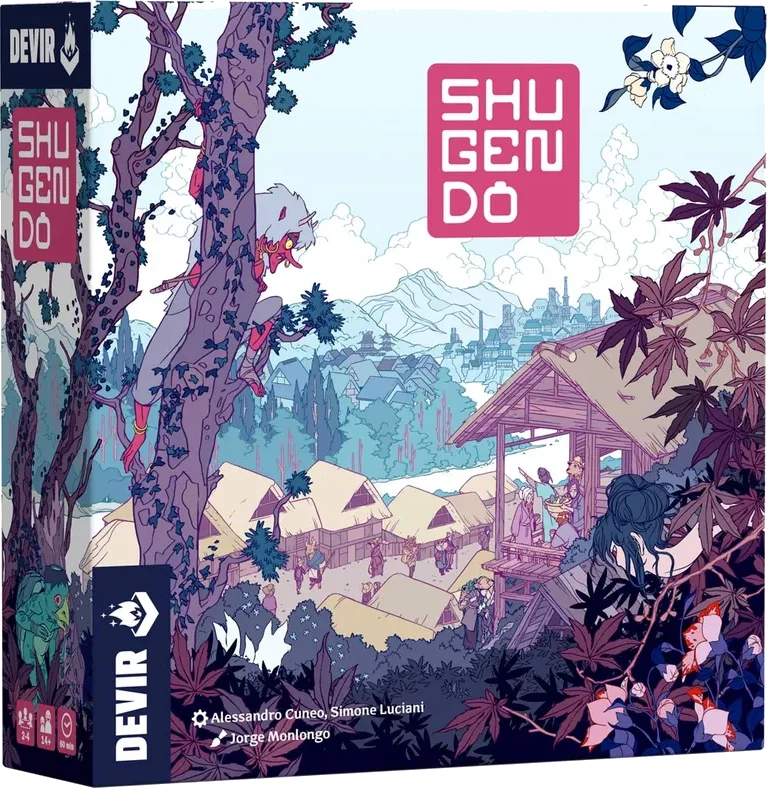
One question, every round: flip another card?
Each card gives Hammers, Compasses, Books or gold coins: what you need to build, explore, progress and recruit.
Many cards show Yōkai icons. Reach 7 and this round you play only one of the two phases that follow: either you use your resources (Action), or you recruit new cards (Recruit).
1. Flip
Everyone at once: you flip until you choose to stop, or until 7 Yōkai.
2. Act
Everyone at once: you collect resources and take one action, Explore, Expand or Develop.
3. Recruit
In turn: with coins you buy stronger cards, which replace the ones you flipped.
Flip or stop?
Your goal: collect what you need this round without reaching 7 Yōkai, so that you can play both phases: the action and recruiting.
One round of flipping, just you. Each situation has a different deck and goal, and without the guide the deck is shuffled each time.
The rules of flipping are the real ones: stop when you want, 7 Yōkai means one phase only, one Pilgrim per round to cancel the Yōkai on one card while you are under 7. The cards and goals are examples: the rulebook does not list the 13 starting cards.
What do you play with?
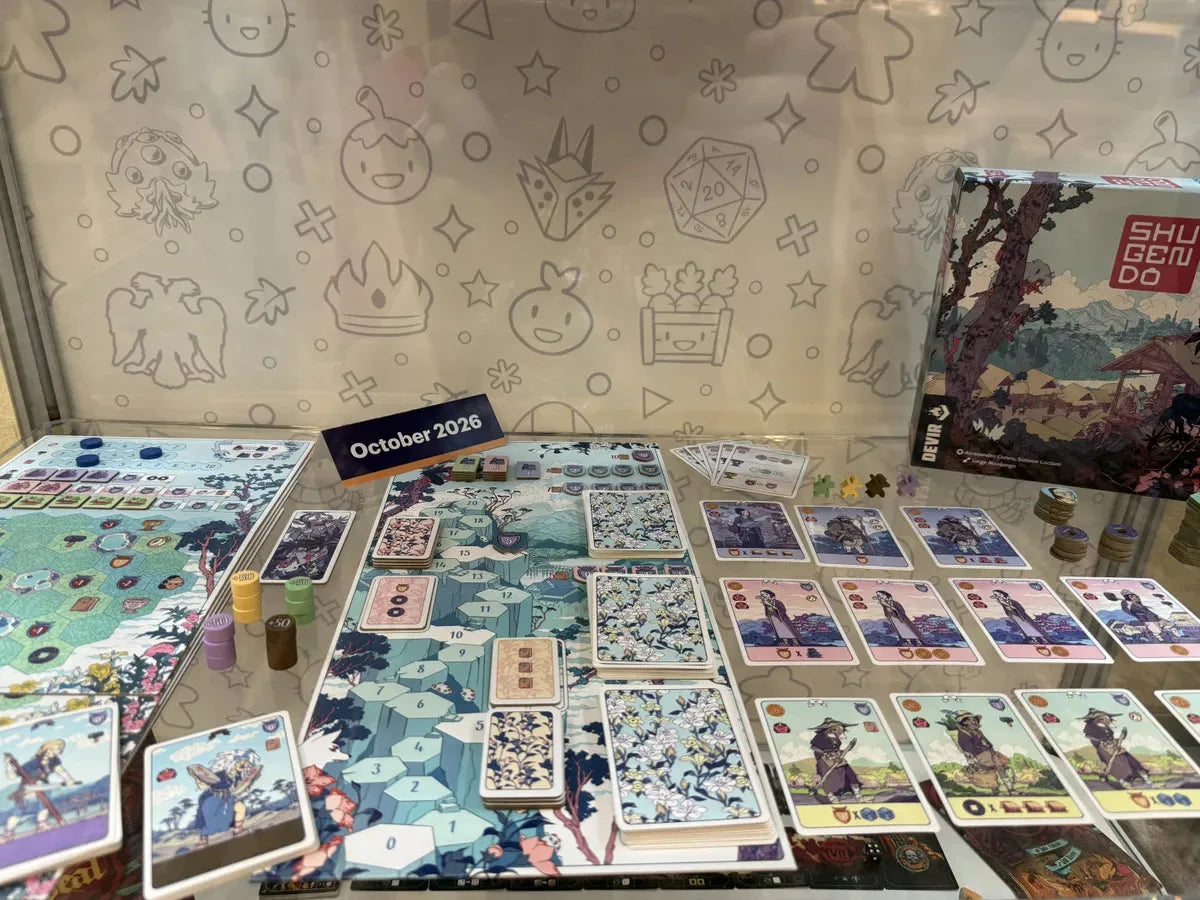
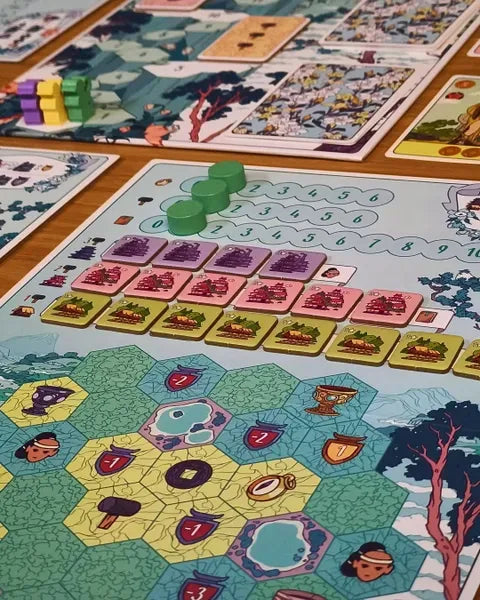
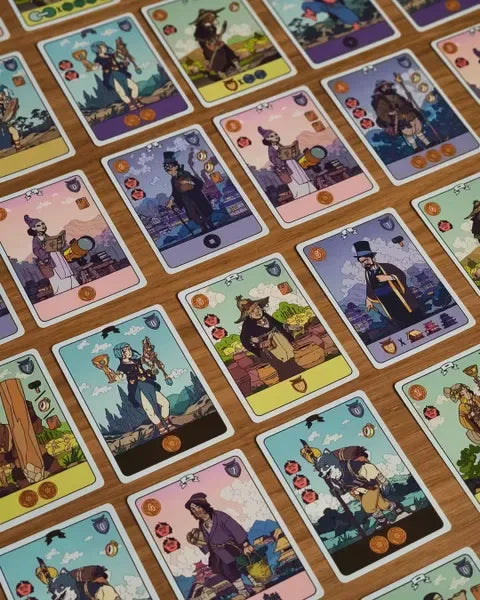
The game's words, in one minute
Forest spirits, shown as icons on the cards (0 to 3 each). At 7 in one round, mischief: you play one phase only.
A token that cancels all Yōkai on one revealed card, while you are under 7. One per round, and it is spent.
The three resources, kept on tracks on your board: Compasses explore, Hammers build, Books unlock Ages.
Gold coins are printed on cards and last one round; silver coins are tokens you can save.
Farmsteads, Villages and Cities you place on your map. A Village replaces a Farmstead, a City replaces a Village.
A group of connected Communities worth 6 or more stars (each Community shows its star value in the corner). Founding one gives points and a bonus.
Levels of progress unlocked with Books: Age 2, 3, 4 and 5. Ages 2 and 3 open stronger cards to recruit; each Age gives a Development token worth points; reaching Age 5 ends the game.
The people you recruit: 90 cards in three Ages. Each one replaces one of your cards, so your deck improves without growing.
A personal card with three bonuses: each one triggers when you cover its icon on your map with a tile.
The game in seven answers.
You flip until you stop, then spend resources on a personal map and swap weak cards for strong ones.
↓Depth2.6 of 5 on BGGA light heart and a medium board: the map, Prefectures and Ages ask for planning.
↓LuckIt is the point, but you can read itNo dice: you know what is in your deck, so you know the risk of the next card. Pilgrims cut it.
↓InteractionCompetitive and indirectEveryone builds on their own map. You compete for the cards on display and for the best Age and Prefecture tokens.
↓Replayability90 cards, two-sided boardsFolk cards come out in a different order each game; boards and Milestone cards have a flower side, all different, for experienced players.
↓PlayersBest with 3, on BGGWith 2 and 3 some board spaces are covered and some tokens removed. No solo mode: from 2 to 4.
↓WaitingLittle: two phases out of three togetherFlipping and acting happen at the same time for everyone; only recruiting goes in turn.
↓What happens in a round?
Rounds repeat until someone reaches 15 points, founds a third Prefecture or unlocks Age 5. Then the round is finished and points are counted.
1. Reveal, all together
Everyone flips cards from their own deck, one at a time, until they choose to stop or reach 7 Yōkai. Stop at 6 or fewer and you play both following phases; at 7 or more, only one of the two. A Pilgrim can cancel the Yōkai of one card.
2. Action, all together
You advance your resource tracks by the icons on your cards, then choose one action. Explore: pay 1, 2 or 3 Compasses to uncover Forest, Hills or Mountains next to your land, collecting the bonuses underneath. Expand: pay 1, 2 or 3 Hammers for a Farmstead, a Village or a City; a connected group worth 6 stars or more founds a Prefecture. Develop: pay 5, 7, 8 or 10 Books to unlock Age 2, 3, 4 or 5.
3. Recruit, in turn
You take the bonuses at the bottom of your cards, then spend gold and silver coins to recruit Folk cards from the Ages you have unlocked. Each new card replaces one you flipped this round, which goes back in the box: your deck keeps the same size and gets better.
Final scoring
You add the score track, the 5-point token of whoever first reached 15, Development and Prefecture tokens, the points on your cards, the board bonuses for each Prefecture, the Milestone gold bonus, the points uncovered in your Community rows (the more you built, the more you see) and 1 point per 5 leftover resources. Uncovered penalties on your map and cards are subtracted. Ties go to whoever has more Yōkai on their cards.
A step up from family games, without the heavyweight.
A full game in an hour. The heart is explained with one question, the board gives you something to plan.
You know the gateway games and want the next step: more choices, an hour of play, a core you explain with one question.
The box says 14+. Flipping cards and counting spirits involves everyone, and the cards use icons.
You will find his planning on the board, in a lighter, shorter game with a bit of thrill.
Is it for you?
You will like it if
- you enjoy the «one more card» thrill
- you like seeing your deck get better round after round
- you want little waiting: two phases out of three are simultaneous
- you love the art of forests, villages and spirits
Skip it if
- you hate luck in the draw
- you want direct conflict
- you play alone: there is no solo mode
First game: the side without the flower.
The rulebook recommends it: boards and Milestone cards are the same for everyone. And remember the Pilgrim: it only works before the seventh Yōkai.
What people ask before buying
What kind of game is Shugendō?
A competitive game by Alessandro Cuneo and Simone Luciani, illustrated by Jorge Monlongo, published by Devir. 2 to 4 players, ages 14 and up, about 60 minutes, weight 2.6 of 5 on BoardGameGeek. You grow a settlement by flipping cards from your deck without waking too many Yōkai.
How does a round work?
All together, everyone flips cards from their deck until they stop or reach 7 Yōkai. Then, all together, you collect resources and take one action: Explore, Expand or Develop. Finally, in turn, you recruit new cards with coins.
What happens at 7 Yōkai?
It is Yōkai Mischief: that round you play only one of the two following phases, the Action or the Recruit, and skip the other.
What does a Pilgrim do?
It cancels all Yōkai on one revealed card, as long as you are under 7. You can use one per round, and it is discarded.
Does the deck grow?
No. Each recruited card replaces one of the cards you flipped that round, which goes back in the box. The deck stays the same size and gets stronger.
How does the game end?
When someone reaches 15 points on the track, founds their third Prefecture or unlocks Age 5. The round is finished so everyone has the same number of turns, then points are counted.
How much luck is there?
The order of your cards is random, but you know what is in your deck and decide when to stop. No dice. Pilgrims and Milestone bonuses reduce the risk.
Is there a solo mode?
No, it is for 2 to 4 players. BoardGameGeek says the best number is 3.
Is there a lot of waiting?
Little: revealing and acting are simultaneous, only recruiting goes in turn.
Which language is it in?
This is the Italian edition by Devir. The cards use icons; there is also an English edition, sold separately.
The forest is listening. One more card?
Our assistant has read the Shugendo - ITA rulebook. Ask whatever you like: you stay on this page.