
«Who is worthy to open the book, and to loose the seals thereof?» Revelation 5:2
7th Seal
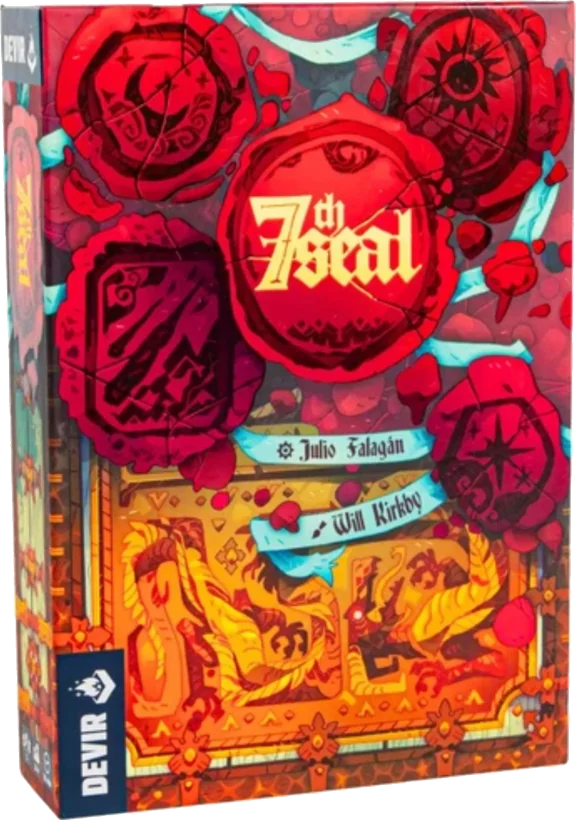
Seven Seals lock the book of the final judgment. Behind each pair waits an Overlord of the apocalypse, gods and demons from every culture, with his Underlings. You have three dice and nobody at the table to help you. Convince the Creator that humanity deserves another chance. A game for one player, by Julio Falagán, illustrated by Will Kirkby.
You roll the dice, then decide where to put them.
Each turn you roll your dice (three at the start) and give each one a job. A die can do only one thing per turn, and your enemy's cards and your own ask for different numbers: that is the whole puzzle.
Attack
Each enemy card asks for certain dice: a value, odd or even, a colour. Meet the request and you deal the damage written next to it.
Defend
A die in your defence zone stops as much damage as its value, in the enemies' turn.
Heal
Your life is two pink dice set to 6. Pink dice won from enemies can fill the empty life spaces.
Use a skill
Skills change a die (+1, reroll, swap colour) or turn it into a shield. Permanent skills (they stay all game) work once per turn each; one-use skills are spent.
The Time track moves one space: the space says which Underlings attack you and how hard the Overlord hits. Whatever your defence does not stop comes off your life.
That's it. Four waves, four Overlords, and if you survive the last one, humanity gets another chance.
The game's words, in one minute
Eight cards in a row, the Scroll. The Seals I to VII plus the last one, Finis Mundi. Each wave you open two: a place of the underworld, which shows the dice needed to hit the Overlord and the Underlings he brings, and the Overlord himself.
The boss of a wave (a wave is one Overlord with his Underlings). His life is shown by a black die, the Overlord's die: bring it to zero and the wave is won.
The creatures that come with the Overlord, from four decks: Comet, Sun, Moon, Star. Beat one and you take its die and a one-use skill.
The row of spaces under the Overlord. The Overlord's die moves one space each enemy turn: at the broken heart, you lose.
On each Underling: its die is its life, and the space it sits on says how hard it hits you. Every hit moves it forward one space; at the end, if it is still alive, its Fury goes off.
Your wild dice: they count as any colour. You start with two and gain one more for each Overlord you beat.
Pink dice in your life zone. They are never rolled; damage lowers their value. No pink dice left: game over.
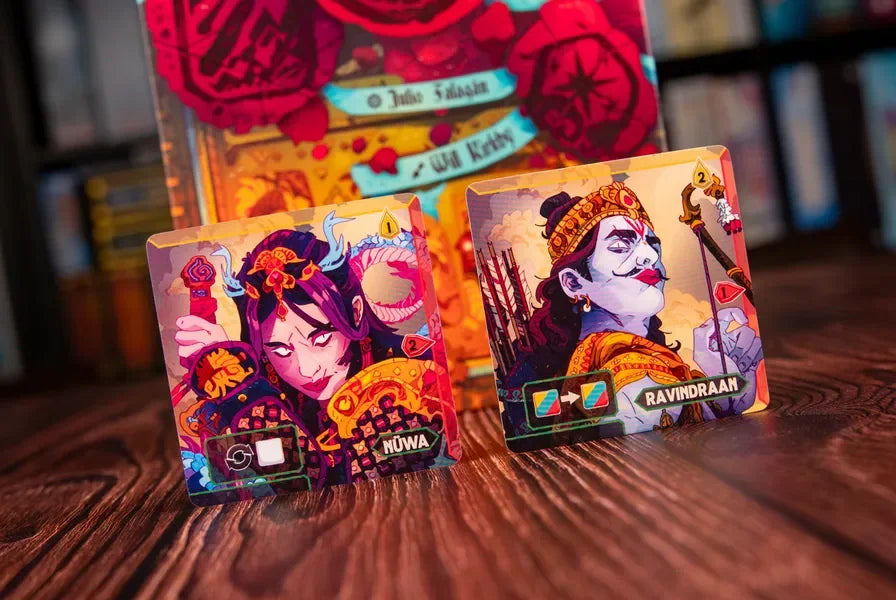
You: an Ancestral Place (your dice, defence and life) plus a Hero (attack range and a skill), chosen at the start.
You, three dice and the apocalypse.
It is not a group game with a solo mode added on: it has rules for one player only. This is what that means at the table.
Nobody to wait for
Choose an Ancestral Place and a Hero, open the first two Seals and you are playing. No opponent to simulate: the enemies do what their cards and the Time track say.
One wave in ten minutes
Short on time? The rulebook lets you play a single wave: about 10 minutes for the first, up to about 30 for the last.
Stop and pick it up again
After each Overlord you can take a photo of the table and set it up again another evening, right where you left off.
Win or lose, no points
No score to beat and no draws: either you defeat the fourth Overlord and save humanity, or the apocalypse wins. And the Seals change every game.
What do you play with?
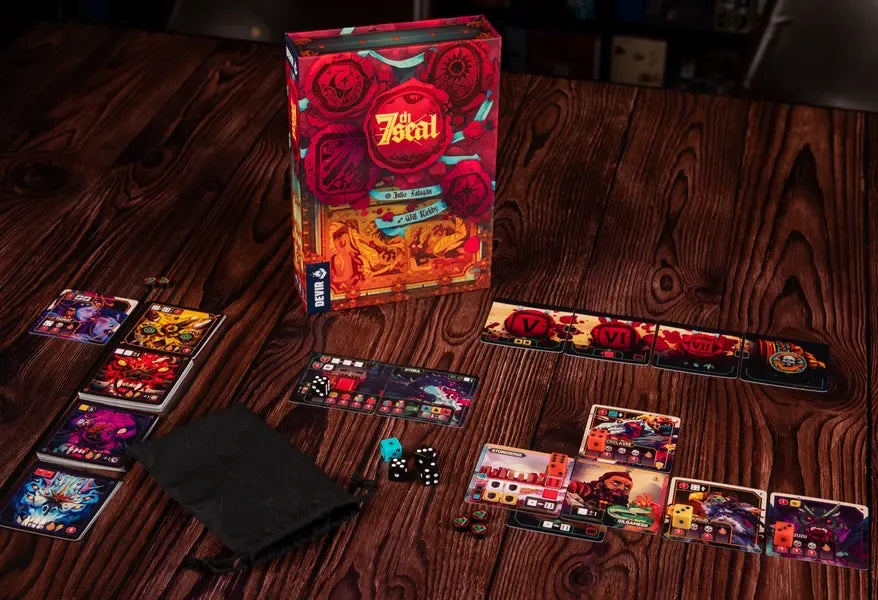
The game in eight answers.
You roll and place dice on requests (value, odd or even, colour), with skills that change them. Waves of enemies.
↓ Depth2.3 of 5 on BGGStill few votes. The rules fit in a turn; the thinking is in the order: whom to hit, how much to defend.
↓ LuckA lot, but you can steer itDice every turn, Seals and Underlings drawn at random. Wild black dice, skills and defence keep it in check.
↓ InteractionYou against the gameNobody else at the table. The enemies hit you every turn and freeze, lock or destroy your dice.
↓ ReplayabilityOne Seal in threeEach of the 8 Seals is drawn from 3 cards, Underlings come from shuffled decks, and you choose Place and Hero.
↓ PlayersOne. Only one.It is a solo game and nothing else: there are no rules for two. No waiting: you run the enemies yourself.
↓ How much time?70 minutes, or one waveA full game is about 70 minutes. One wave alone takes 10 to 30, and you can save between waves with a photo.
↓ LanguageIcons onlyCards show names and symbols, no text. The rulebook explains every icon in five pages.
↓What happens in a round?
Your turn, then the enemies' turn. It repeats until the Overlord falls or you do.
You roll every die you have
At the start: two black dice and one of the colour shown on your Ancestral Place, yellow or turquoise. The pink dice in your life zone are not rolled. Some Overlords act right away: they freeze a die (you can use it, but skills cannot change it), lock one (you cannot use it), or make you reroll the highest.
You adjust with skills, if you want
You start with two permanent skills, one from the Place and one from the Hero, for example +1 or −1 to a die. Each one works once per turn: you mark it with a skill marker and free it at the end of the round.
You give each die a job, in any order
Attack the Overlord or an Underling (some cards have a simple attack for less damage and a harder one for more), put dice in defence, heal with pink dice, or spend a one-use skill won from a beaten Underling.
The catch: every hit on an Underling moves the die on its Fury track one space, whatever the damage. Hit it with many small blows and its Fury may go off before it dies. Better a few strong hits.
The Time track moves, they attack
The Overlord's die moves one space. The space may add an Underling or other effects; then the Underlings in the areas of the colours shown attack (the three areas around your Character, left, front and right, each has a colour) (those under the Overlord always do); then the Overlord hits for the number under the die. Your defence absorbs first, the rest comes off your life dice, split as you like.
When the Overlord falls
The wave ends at once, even with Underlings still alive: each of them unleashes its Fury, and some effects carry over to the next Overlord. Then you flip the two Seals and keep one of the two permanent skills printed on the back, gain a black die, and open the next two Seals.
Can you take down Chernobog?
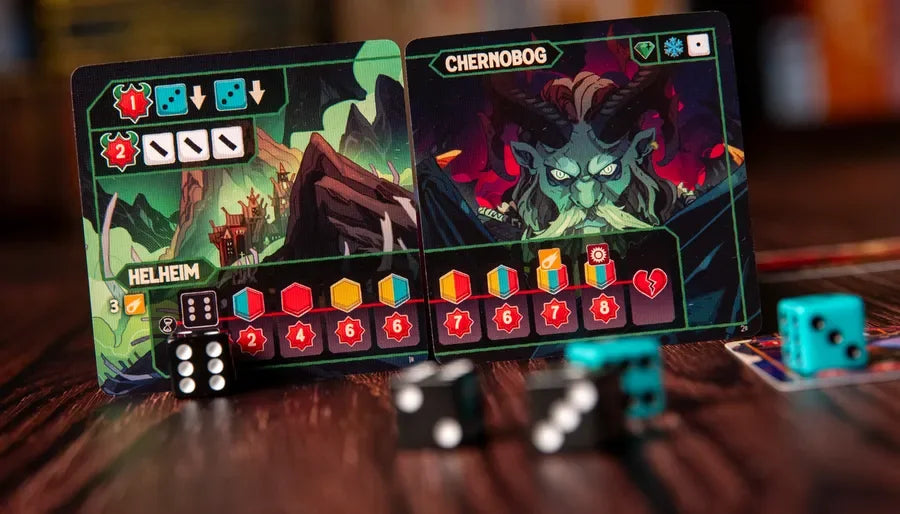
Your goal: bring Chernobog's life (the Overlord's die on the Time track, starting at 6) to zero before he brings yours to zero (two pink dice at 6), and before that die reaches the broken heart at the end of the Time track.
You are Uluru (your Ancestral Place: dice, defence, shield of 5) with Gilgamesh (your Hero: +1 or −1 to a die), against Helheim and Chernobog from the photo in «What do you play with?». Tap a die to pick it, then tap where it goes. Without the guide the dice are random every time.
The rules are the real ones (rulebook, pages 6 to 15), and so are the cards: Uluru and Gilgamesh, Helheim and Chernobog. What is missing are the three Comet Underlings that come with Chernobog: in the real game they attack too, and beating one gives you its die and a one-use skill. Without them the wave is easier than at the table. Here damage comes off the lowest life die first; at the table you split it as you like.
Watch a full solo game
A complete playthrough, in English.

Where does the challenge come from?
There is no automated opponent to learn: the enemies do exactly what their cards say, and the pressure comes from three things.
The Overlord's damage grows along the Time track: Chernobog hits for 2, then 4, then 6. Your life at the start is 12. If you only attack, three turns are enough to finish you.
The choice: one more die on the attack, or one in defence?
Leave them alone and they hit you whenever the Time space calls their area (those under the Overlord always); hit them softly and their Fury goes off; kill the Overlord first and the survivors unleash it at the end of the wave.
The choice: clean up first, or go for the boss?
Life does not come back by itself between waves, but you grow: a permanent skill and a black die for each Overlord you beat. Dice and one-use skills won from Underlings only last for the wave in which you win them.
The choice: which of the two Seal skills to keep?
Your game alone: four waves
A full game is about 70 minutes. If you have less time, the rulebook lets you play a single wave, starting with permanent skills drawn at random from the earlier Seals.
| Wave | Seals | Played alone, you start with | Time |
|---|---|---|---|
| 1 | I · II | the normal setup | ~10 min |
| 2 | III · IV | 1 random permanent skill from Seal I or II | ~15 min |
| 3 | V · VI | one from Seal I or II and one from III or IV | ~20 min |
| 4 | VII · Finis Mundi | one each from I-II, III-IV and V-VI | ~30 min |
Beating the fourth Overlord is not enough: you must still be alive after the Fury of the last Underlings.
Is it for you?
You will like it if
- you play alone and want a game for one evening, or for one wave
- you like dice but want to decide what each one does
- you want a different set of bosses each game
- you like bold art: gods and demons from many cultures
- you want a slim box of cards and dice, no board
Skip it if
- you want to play with someone: it is one player only
- you cannot stand luck: dice decide what you can do every turn
- you want a story to read: the theme lives in the art, not in text
- you want a long, deep game for experts
- you dislike learning symbols: at first you will look at the icon pages often
The frog's advice
First game: Stonehenge (Ancestral Place) with Gilgamesh (Hero), as the rulebook suggests, and only the first wave (Seals I and II, about ten minutes). Learn the Fury track there, then play the four waves in one go.
What people ask before buying
What kind of game is 7th Seal?
A solo game by Julio Falagán, illustrated by Will Kirkby, published by Devir. One player only, about 70 minutes for a full game, weight 2.3 of 5 on BoardGameGeek. You roll dice and assign them to attack, defend, heal and use skills, against four waves of Overlords and their Underlings.
Can two people play?
No. The rulebook has rules for one player only, with no variant for two or for teams.
How does a turn work?
You roll all your available dice (three at the start: two black and one yellow or turquoise). You may change them with your permanent skills, each once per turn. Then you assign them: attack the Overlord or the Underlings, put dice in defence, heal with pink dice, use one-use skills. Then the enemies' turn: the Overlord's die moves one space on the Time track, the Underlings in the areas shown attack and the Overlord hits for the number under the die.
How do you win and how do you lose?
You win if you beat the Overlord of the fourth wave (Seal VII and Finis Mundi) and are still alive after the surviving Underlings' Fury. You lose if your pink life dice run out, or if the Time track die reaches the broken heart space.
How much does luck count?
A lot: every turn depends on the dice, and Seals and Underlings come out at random. You steer it with the black dice, which count as any colour, with skills that change values, reroll or turn a die into a shield, and by choosing what to defend.
What is the Fury track?
Each Underling has one. Its life is a die placed on the first space; every attack lowers the life and moves the die one space forward, whatever the damage. If the die reaches the end while the Underling is still alive, its Fury skill goes off immediately. Underlings still alive when the Overlord falls also unleash their Fury.
What happens in the trial on this page?
You play one wave with Uluru and Gilgamesh against Helheim and Chernobog, with the real cards: Chernobog has 6 life and hits for 2, 4, 6, 6, 7, 6, 7 and 8 along the Time track, and after the eighth space comes the broken heart. Helheim's simple attack wants two turquoise (or black) dice, one of 3 or less and one of 2 or less and deals 1 damage; the complex attack wants three odd dice and deals 2. Uluru defends with two white spaces and one yellow space and turns any die into a shield of 5; Gilgamesh adds or subtracts 1. Chernobog freezes a die showing 1. The three Comet Underlings of the real wave are not in the trial.
How long does it last? Can I stop halfway?
A full game is about 70 minutes. You can play a single wave, from about 10 minutes for the first to about 30 for the last, starting with random skills from the earlier Seals. After each Overlord you can save the game with a photo of the table and rebuild it later.
Is it replayable?
For each of the 8 Seals you draw one card of three, so the Overlords change from game to game; the Underlings come from four shuffled decks with random dice; you choose the Ancestral Place and the Hero, and which permanent skill to keep after each Overlord.
Do I need to read a language?
The cards have only names and icons. Every symbol is explained in the icon pages of the rulebook.
What is in the box?
24 Seal cards, 4 double-sided starting cards (2 Ancestral Place cards and 2 Hero cards, one character per side: 4 Places and 4 Heroes), 42 Underling cards (12 Comet, 16 Sun, 9 Moon, 5 Star), 21 dice (6 black, 5 pink, 5 turquoise, 5 yellow), 5 skill markers and the Apocalypse bag.
Seven Seals and the end of the world. Who is worthy to open them?
Our assistant has read the 7th Seal rulebook. Ask whatever you like: you stay on this page.