

Person
🐸 Dettagli da BoardGameGeek
Consiglio BGG sul numero di giocatori
Categorie
Meccaniche
Design & Art
Lingua
Si abbina bene con
The FroGames Card
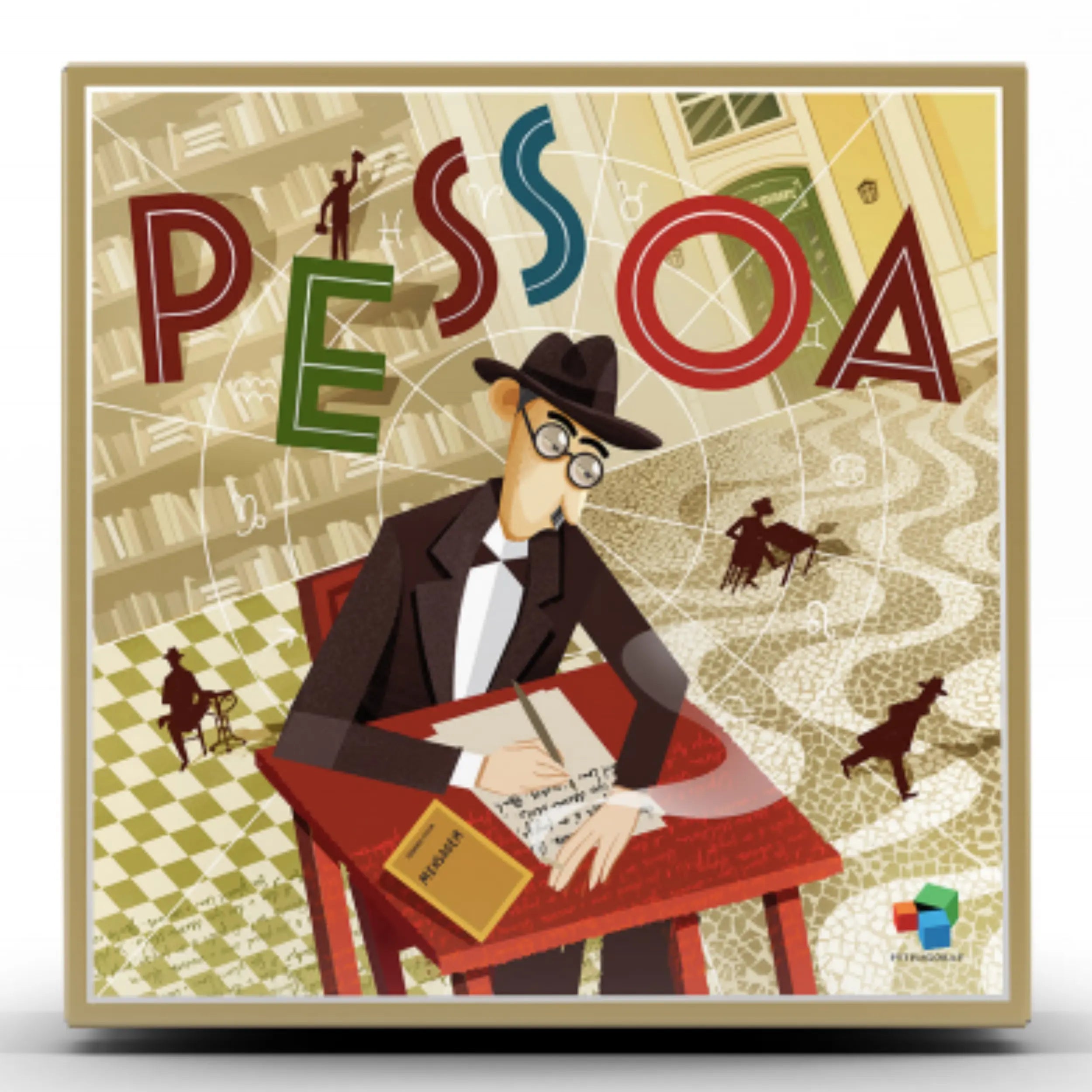
You are Alberto Caeiro. Or perhaps Ricardo Reis. You walk through Lisbon seeking inspiration, but at Martinho da Arcada café, Álvaro de Campos has already taken your spot. You return to the bookstore, buy a volume, write three verses. Then you realize that all four of you are the same person.
WHAT IT'S ABOUT
A metaphysical journey into the mind of the greatest Portuguese poet
Designed by Orlando Sá and illustrated by Marina Costa, Pessoa is an interactive tribute to Fernando Pessoa (1888-1935), a Portuguese poet and philosopher who created about 75 heteronyms — not just simple pseudonyms, but complete literary personalities with their own biography, style, and worldview. The four most famous — Alberto Caeiro, Ricardo Reis, Álvaro de Campos, and Bernardo Soares — are the protagonists of this game.
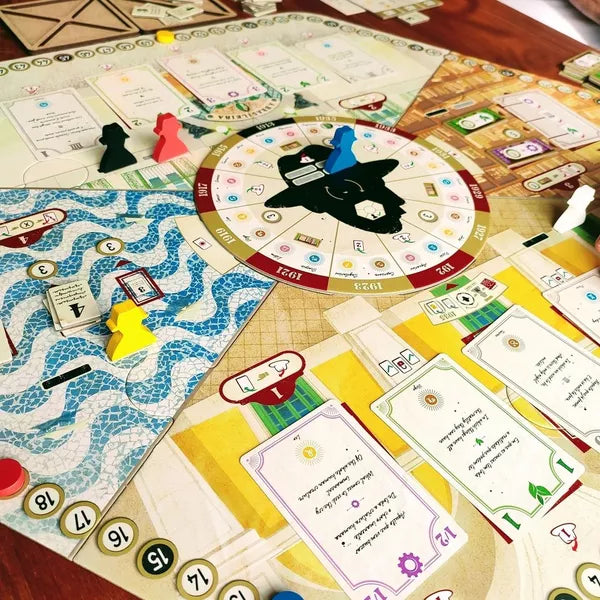
In Pessoa, you move between the metaphysical space of Pessoa's mind and the physical locations of Lisbon in the 1910s and 1920s: iconic cafés like A Brasileira, bookstores where you expand your personal library, streets where you seek inspiration to write poems and accumulate victory points. The paradox: each player is a different heteronym, but all share the same physical body — that of Fernando Pessoa. Worker placement thus becomes a dance of shared identities.
What they say abroad
"A deeply thematic game that makes you feel the creative struggle of a literary genius."
A deeply thematic game that makes you feel the creative struggle of a literary genius.
— Meeple Mountain
Pessoa is a promising first read: a worker placement that dares to bring Portuguese literature to the table without trivializing it. Card to be updated after more plays.
— FroGames

Pessoa
The game includes an automa deck that simulates the other heteronyms, drawing cards and occupying spaces according to dedicated rules. The experience is complete: you retain all strategic decisions and competition for resources and spaces, losing only human interaction and bluffing on timing.
FrogScore · FroGames editorial rating · based on rules, international reviews, and play sessionsGame elements
What you find in the box and how to use them
Heteronyms
Four asymmetric character boards (Caeiro, Reis, Campos, Soares), each with unique abilities and a different development path. Choose who to embody: the naturalist, the stoic, the futurist, the melancholic.
Lisbon Board
City map with physical spaces (A Brasileira café, Martinho da Arcada, bookstores) and metaphysical spaces in Pessoa's mind. You place workers in both worlds.
Book Cards
Volumes to buy in bookstores to expand your knowledge and unlock bonuses. Each book gives immediate points or end-game abilities, and builds your personal library.
Poetry Cards
Thematic set collection: gather inspiration from locations, complete verses, and publish poems. Each completed poem is worth victory points and can trigger combos with your books.
Recommended Sleeves 98 cards in 1 size ▼
If you play often, we recommend protecting your cards with transparent sleeves to make them last longer.
| Size | Quantity |
|---|---|
| 57 × 89 mm | 98 |
| Total cards | 98 |
Come si gioca
Video dimostrativo di gameplay.
🎲How to playThe rules in four steps▼
How to play
The flow of each round
Pessoa is played in structured rounds. Each round has four simple, cyclical phases.
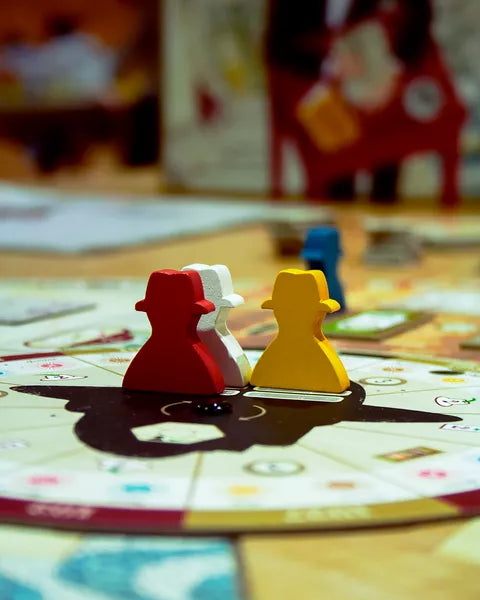
In turn, you place a worker (heteronym) on a free space: coffee shops for inspiration, bookstores to buy books, metaphysical spaces for special actions. Some spaces are single, others are shared. This phase is key: you block others and build your engine.
In placement order, resolve actions: draw cards, buy books, publish poems. Cards go into your hand or play area. Some actions trigger heteronym abilities: Campos can draw extra, Reis optimizes costs.
You retrieve workers, restock the card market and bookstores. If someone has reached certain point thresholds or published a target number of poems, the game may enter the final round.
The game restarts. Rounds continue until the end-game condition is triggered (variable based on the number of players and active modules). When it triggers, the last full round is played, and points are counted.
⏱️Your first gameThe chronicle, moment by moment▼
A game in five moments
What happens at the table
Not the rules. The experience.
Choose who you are
Each player takes a heteronym. Read their biography, their inclinations. Caeiro loves nature, Reis is classical and measured, Campos is frantic. Already here you understand that everyone will play differently: true asymmetrical powers, not cosmetic ones.
The first walk
You place your first worker. Do you go to the coffee shop or the bookstore? Do you seek inspiration or buy a book? Spaces are limited and someone gets there before you. You immediately realize that timing matters: there's only one Pessoa, and there are four of you.
The library grows
You've bought three books, you're building a strategy. Some give fixed points, others unlock combos with poems. Someone at the table is collecting inspiration cards to publish a long poem. You change your plan: you go and block the coffee shop they need.
The poem is complete
You've gathered enough cards to complete a set. You publish your first poem: immediate points plus bonuses if you have the right books in your library. Someone curses because they wanted that combination. You smile. It's Pessoa, not solitaire.
Final count
End of game. Points from poems, from books, from heteronym bonuses. The one who built the most coherent library with their strategy wins. Often the difference is 3-4 points. Someone re-reads the others' cards and says: 'Ah, that's why you always went there.'
🐸Good to know beforehandThree honest things, from friends▼
Good to know beforehand
Three honest things
Niche cultural theme
If Fernando Pessoa means nothing to you, the game still works as a worker placement with asymmetrical powers. But 70% of the charm lies in the theme: the historical notes in the rulebook, the names of real coffee shops, the quotes. If you're only looking for mechanics, there are drier games.
Scalable complexity, but modules are needed
The base game is light (advanced family, 2.6 BGG). The two optional modules add layers: historical events, hidden objectives, extra actions. Without modules, experts might find it a bit bland. With modules, it becomes a solid medium-strategy game.
Hidden optimization curve
The first few games flow smoothly. From the third, you start to see the combos between books, poems, and heteronym powers. AP (Analysis Paralysis) can increase if you want to optimize every move: 'If I buy this book now, I can publish that poem later, which gives me the bonus for...' Keep this in mind if you play with analytical players.
🏆Victory and defeatWhat the ending rewards▼
How it ends
How to win and how to lose
Pessoa ends when a variable condition is triggered (number of poems published, round limit, or other based on modules). The last full round is played, and points are counted.
Victory
- Most points from published poems (completed set collection)
- Most points from books in the library (some give fixed points, others multipliers)
- Heteronym bonuses and personal objectives (if playing with modules)
How to fall behind
- Getting key spaces blocked without a backup plan
- Buying books without synergy with the poems you can publish
- Ignoring asymmetrical powers and playing 'flat' without leveraging your heteronym
Pessoa is not just a game about points. It's a game about how identity is built — literary, playful, personal. And how crowded a genius's mind can be.
💬Frequently Asked QuestionsQuick answers before checkout▼
Frequently Asked Questions
Pessoa FAQ
Do I need to know Fernando Pessoa to enjoy the game?
No. The game works as a worker placement with asymmetrical powers even if Pessoa means nothing to you. But the rulebook includes historical notes on each heteronym, on Lisbon's coffee shops, on the volumes cited in the cards: if you get involved in the theme, the experience is richer. Many players discover Pessoa through the game and then look for his poems.
How does the 'shared' worker placement work (same physical body)?
Each player is a different heteronym, but all share Pessoa's body. In practice: some spaces on the board are 'physical' (only one at a time), others are 'metaphysical' (multiple heteronyms can occupy them). The rule simulates the paradox: Pessoa can only be in one coffee shop at a time, but four personalities coexist in his head.
Do the two optional modules change the game much?
Yes. The base game is accessible (2.6 BGG, advanced family). The modules add historical events that modify the rounds and personal secret objectives that change priorities. With the modules active, Pessoa becomes a medium-strategy game with more depth. Advice: play initial games without, then add one module at a time.
What mechanics does Pessoa use?
Hybrid worker placement (single and shared spaces), hand management for inspiration cards, set collection to complete poems, variable player powers (the four heteronyms have asymmetrical abilities). End-game bonuses from library and objectives. For solo play, there's a dedicated automa deck.
Is it available in Italian?
This edition is in English. Text on the cards is present (book titles, short quotes), but the linguistic load is manageable: the mechanics are iconic and the rulebook is clear. If you have some English proficiency, the game is accessible.
The people behind the game
Who invented it, who designed it, who published it — and what else they've done.
Pessoa is a thematic worker placement game for 1-4 players, 45-75 minutes, ages 10+, designed by Orlando Sá and published by PYTHAGORAS. You embody one of Fernando Pessoa's four most famous heteronyms — Alberto Caeiro, Ricardo Reis, Álvaro de Campos, Bernardo Soares — and move between the physical spaces of Lisbon (coffee shops, bookstores, streets) and the metaphysical spaces of the poet's mind. Mechanics: hybrid worker placement, hand management, poem set collection, asymmetrical powers. The game includes two optional modules to scale complexity from advanced family to medium strategic, and an automa for solo play. Available at FroGames.it.
Frequently Asked Questions
The answers you're looking for, no beating around the bush.
📸Do the images match the actual product?
The photos on the website often come from BoardGameGeek and are intended to give you an idea of the game. They may vary slightly from the version you receive. The content declared by the publisher is always binding.
📦Does the content of the box match what is indicated?
We always strive to provide the correct content, but minor variations are possible due to reprints or updates. The information comes directly from the publishers. If you have any questions, please contact us!
⏳How do pre-orders work?
Pre-order the game before release, payment is immediate, and the game is reserved for you. As soon as it arrives, we'll ship it right away! If there are any delays, we'll update you promptly.
🔒Can I trust buying here?
Absolutely! Secure payments, tracked shipments, and a team that loves board games as much as you do. If something goes wrong, we'll do our best to fix it.
🛠There's a problem with my order, what should I do?
Write to us now! Whether it's a missing part, damage, or an error, we'll help you resolve it as soon as possible. Your experience truly matters to us.