
Bloodstones
🐸 Dettagli da BoardGameGeek
Consiglio BGG sul numero di giocatori
Categorie
Meccaniche
Design & Art
Lingua
Pre-order - leggi i dettagli
🐸 Una rana saggia sa quando dividere l’ordine… e quando aspettare il salto giusto.
Si abbina bene con
FroGames — Moments You'll Remember
When your dragon burns down the opponent's village, you hear screams of frustration from across the table. When the enemy giant destroys your citadel, you curse the dice. And at the end of the evening, everyone wants to play another race.
WHAT IT'S ABOUT
Six fantasy races at war for control of the lands
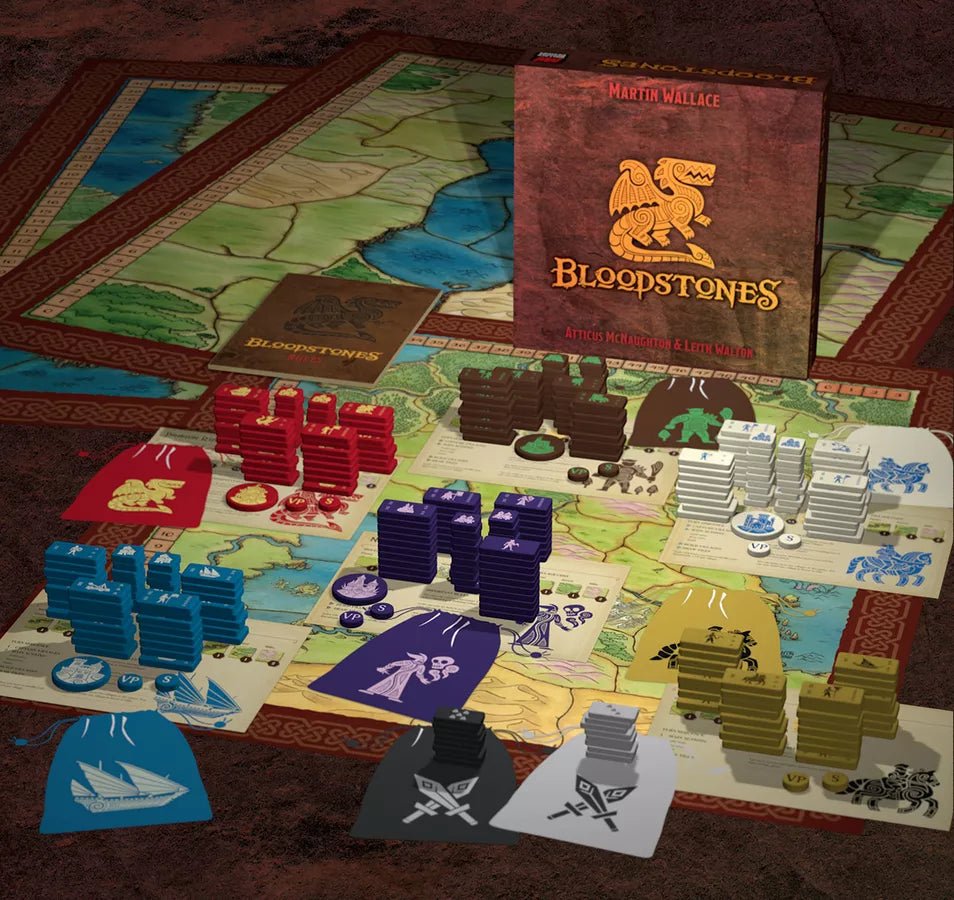
Martin Wallace (Brass, Age of Steam, A Study in Emerald) returns to fantasy with a tactical wargame that uses domino tiles as units. Published by Wallace Designs, Bloodstones brings six completely different races to the table: Dragon Riders, Hill Folk, Dark Elves, Beast Clans, Undead Hordes, and Sea Raiders. Each race has its own set of units, unique powers, and tile mix. The art by Atticus McNaughton and Leith Walton brings to life a dark medieval world where dragons, giants, and undead vie for villages and resources.
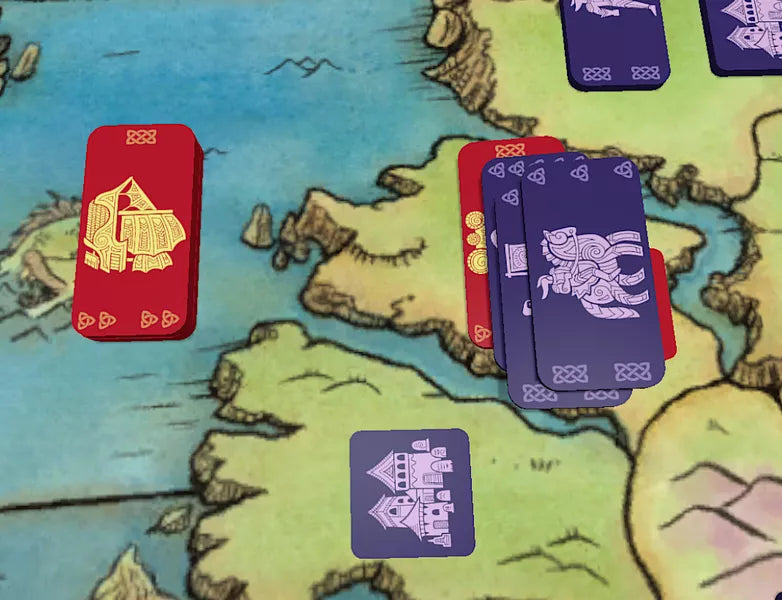
Domino tiles are the heart of the game. When you place them on the board, they become units (warriors, archers, special creatures). When you hold them in your hand, they are resources: you use them to move, fight, build villages, raid. You place your citadel, expand your territory, attack enemy villages. Each turn: free actions, then draw up to six tiles. When you run out of the deck, you shuffle it. The player who accumulates the most victory points through built villages, successful raids, and won battles wins. The game ends after a fixed number of scoring cycles (3 cycles with 2 players, 2 cycles with 3+).
What they say abroad
Six races, six ways to play. Every game is a different world.
— FroGames
Domino tiles are everything: units, resources, moves, attacks. Wallace condenses a complex wargame into an elegant system.
— FroGames

Bloodstones
The game includes an official solo mode with dedicated scenarios. The experience is complete: manage expansion, fight enemies controlled by automated rules, build villages. You lose the human unpredictability of raids and territorial negotiation, but the tactical challenge remains intact.
FrogScore · FroGames editorial rating · based on rules, international reviews, and play sessionsYour army
Four elements that define every game
Unique units
Each race has exclusive creatures. Dragon Riders have dragons. Hill Folk have giants. Dark Elves have assassins. Choose your race, completely change how you play.
Citadel
Your starting point. You place it at the beginning of the game; it defines your initial territory. If it falls, you are eliminated. Protect it or expand quickly to dilute the risk.
Villages
You build them, you raid them, you defend them. Each village is worth victory points every scoring cycle. They are what you fight for. They are what you die for.
Domino tiles
On the board, they are units. In your hand, they are everything else: movement, attack, construction, raid. Every tile you play is a choice: expand now or save resources for later?
Recommended sleeves 6 cards in 1 size ▼
If you play often, we recommend protecting your cards with transparent sleeves to make them last longer.
| Size | Quantity |
|---|---|
| 195 × 135 mm | 6 |
| Total cards | 6 |
In three hours, you will have conquered lands, burned villages, lost your citadel, or won by a hair's breadth. And you'll immediately want to play another race.
Come si gioca
Video dimostrativo di gameplay.
A game in five moments
What happens at the table
Not the rules. The experience.
Choosing races
Everyone chooses their race. Some pick Dragon Riders because they want dragons. Others pick Undead because they resurrect the dead. Some read the unique powers and make calculations. The game hasn't even started, and you can already tell who will play aggressively and who defensively.
First expansions
You place your citadel, put the first tiles on the board. You decide where to expand. Some build villages immediately to score points. Others push units towards the opponent's border. The board fills up, territories are defined. And someone starts eyeing their neighbor's village with interest.
First raid
Someone makes the first raid. They spend tiles, attack an enemy village, destroy it. Shouts, laughter, threats of revenge. From that moment on, the game changes: it's no longer peaceful expansion, it's open warfare. Everyone starts holding tiles in hand to defend themselves.
Decisive battle
Two players clash over a key area. They spend tiles, exchange blows, lose units. One brings the dragon, another the giant. The die decides who wins. The loser loses ground, the winner advances. But both have burned resources. And the third player, who didn't fight, begins to expand undisturbed.
Final tally
End of game. Villages are counted, raid points are summed, bonuses from won battles are added. Someone won by building villages away from conflicts. Someone else won by constantly raiding. Someone lost because their citadel fell. Everyone wants to play another race.
How to play
The flow of each turn
Your turn is free: you can take as many actions as you want, in any order, as long as you have tiles to spend.
You place tiles on the board (they become units). You spend tiles to move units, fight, build villages, raid. Some actions have restrictions (e.g., you cannot build villages and raid in the same turn). But the order is yours.
At the end of your turn, you draw tiles from your deck until you have six in hand. If the deck runs out, you reshuffle the discard. This means tiles return: nothing is wasted forever.
Every few turns (depending on the number of players), you score. Each village you control is worth points. Raids and won battles give extra points. This cycle repeats 2-3 times per game.
After the last scoring cycle, the game ends. The player with the most points wins. If your citadel was destroyed earlier, you are eliminated (but this can only happen in specific scenarios or aggressive games).
Why it's different from others
Six mechanics that make a difference
Multi-use domino tiles
Tiles are not just units. They are universal resources. On the board, they become warriors, archers, dragons. In hand, they are movement, attack, construction, raid. Every tile played is a choice: do I expand now or save it to defend later? Wallace condenses an entire wargame into this system.
Six asymmetric races
Each race has unique units and special powers. Dragon Riders fly and burn. Hill Folk have giants that break through. Dark Elves move in the shadows. Undead resurrect the fallen. Beast Clans multiply. Sea Raiders strike from the coasts. These are not cosmetic variants: they are six different games.
Resource management combat
You don't just roll dice. You spend tiles to increase strength, activate racial powers, choose which units to sacrifice. The die decides who wins, but pre-combat choices make a difference. And every tile spent in battle is a tile you don't use to expand.
Villages as mobile objectives
Villages give points in each scoring cycle, but they are vulnerable. You build them, raid them, defend them. A village far from the war is worth as much as one on the front line, but the former is safer. You decide: expand fast and risk, or consolidate slow and safe?
Scales from 1 to 6 players
The game includes official solo mode with scenarios. With 2 players, it's a tactical duel. With 3-4, it's multifactional war. With 5-6, it's controlled chaos. The rules don't change, the board adapts. Rare for a wargame.
Deck cycling instead of permanent elimination
When your deck runs out, you reshuffle the discard pile. Tiles return. Nothing is lost forever. You can sacrifice units in battle knowing those tiles will return to your hand. This speeds up the pace and rewards aggressive cycling.
How it ends
How to win and how to lose
The player with the most victory points at the end of the last scoring cycle wins. Points come from villages, raids, and battles.
Victory
- Control more villages than others in each scoring cycle (constant points).
- Successfully raid enemy villages (immediate points and weaken opponents).
- Win important battles and conquer key territories (bonus points and area control).
Elimination or defeat
- Your citadel is destroyed (immediate elimination, but rare in standard games).
- You don't build villages and fall behind in scoring (slowly lose each cycle).
- You waste tiles in useless battles and lack resources to expand (others overtake you).
Bloodstones is a wargame that solves the problem of complexity: elegant system, tactical depth, six races that completely change how you play. Every game is a different story.
Frequently asked questions
Bloodstones FAQ
How different is each race?
Completely different. Each race has unique units, special powers, and its own tile mix. Dragon Riders fly and burn. Undead resurrect dead units. Sea Raiders attack from the coasts. These are not cosmetic variants: they change the way you play, the strategy, the timing. If you've played one race, you haven't seen the whole game.
How long does a game last?
Depends on the number of players and experience. First game: 120-180 minutes. Subsequent games with experienced players: 60-90 minutes with 2 players, 90-120 with 3-4, 120-180 with 5-6. The pace quickens when everyone knows the races and the multi-use tile system.
Does it play well with 2 players?
Yes, it's excellent. With 2 players, it becomes an asymmetric tactical duel. The board is smaller, the conflict more direct. Less downtime, more control. The game scales perfectly: with 2 it's fantasy chess, with 6 it's orchestrated chaos.
How complex is it to learn?
The basic system is elegant: multi-use domino tiles, you place or spend. But six different races require study. First game: play with simple races (Beast Clans or Hill Folk), only read your powers, ignore optimizations. Second game: try a complex race. Third game: you start to see combos. Medium learning curve, but rewards practice.
Is it available in Italian?
No, this Wallace Designs edition is in English. The game has text on the cards (unit names, racial powers), but symbols help. Basic knowledge of English is needed to play smoothly. The rulebook is in English.
Bloodstones is a fantasy wargame for 1-6 players designed by Martin Wallace and published by Wallace Designs. It uses multi-use domino tiles that function as units, resources, and actions. It includes six asymmetric races (Dragon Riders, Hill Folk, Dark Elves, Beast Clans, Undead Hordes, Sea Raiders), each with unique powers and exclusive unit mixes. Recommended age 14+, duration 60-180 minutes. Mechanics: tile placement, area majority, resource management. Scales from solo (official mode with scenarios) up to 6 players without losing balance. Combines the tactical depth of a classic wargame with the elegance of a modern system. Available on FroGames.it.
Bloodstones
Frequently Asked Questions
The answers you're looking for, no beating around the bush.
📸Do the images match the actual product?
The photos on the website often come from BoardGameGeek and are intended to give you an idea of the game. They may vary slightly from the version you receive. The content declared by the publisher is always binding.
📦Does the content of the box match what is indicated?
We always strive to provide the correct content, but minor variations are possible due to reprints or updates. The information comes directly from the publishers. If you have any questions, please contact us!
⏳How do pre-orders work?
Pre-order the game before release, payment is immediate, and the game is reserved for you. As soon as it arrives, we'll ship it right away! If there are any delays, we'll update you promptly.
🔒Can I trust buying here?
Absolutely! Secure payments, tracked shipments, and a team that loves board games as much as you do. If something goes wrong, we'll do our best to fix it.
🛠There's a problem with my order, what should I do?
Write to us now! Whether it's a missing part, damage, or an error, we'll help you resolve it as soon as possible. Your experience truly matters to us.