
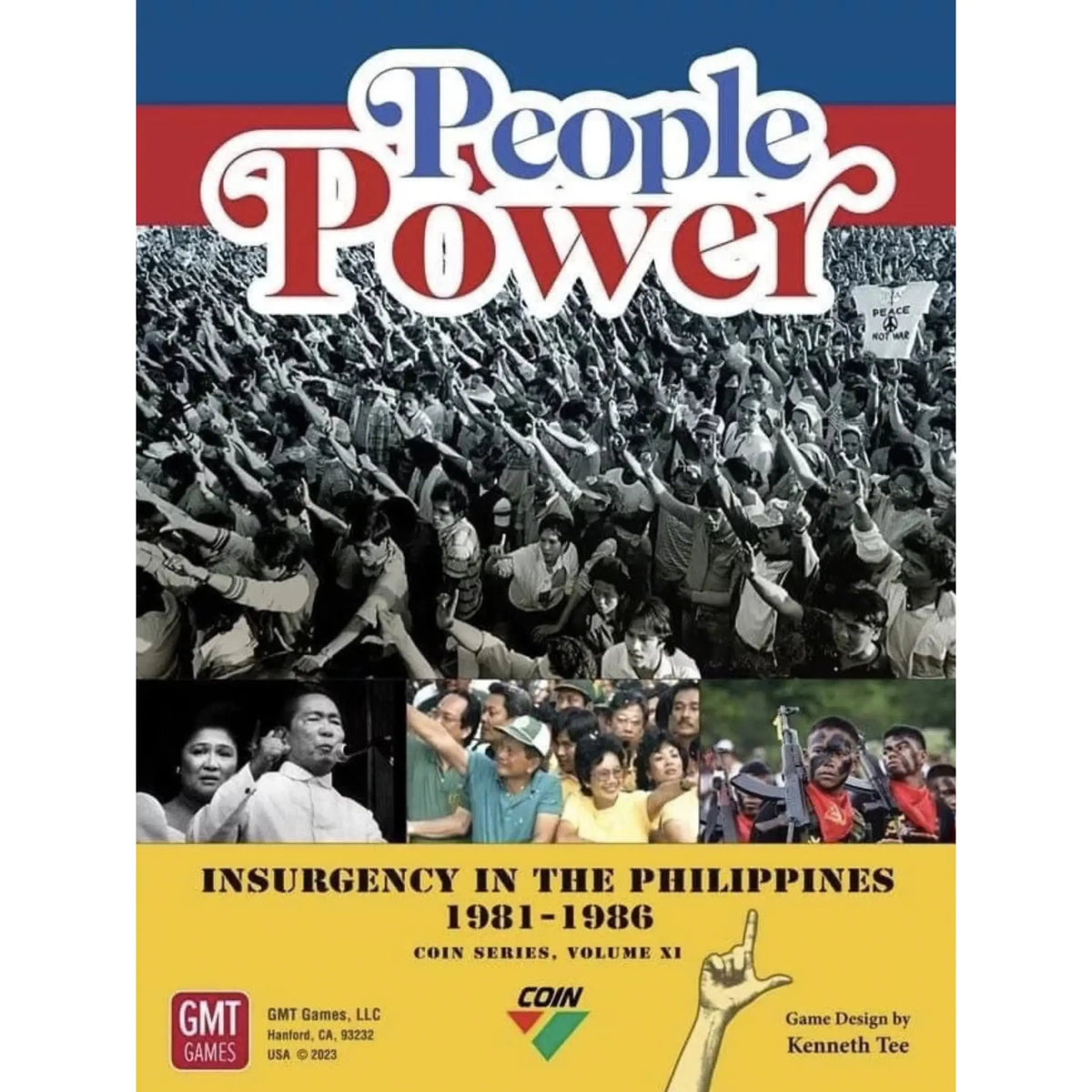
People Power: Insurgency in the Philippines, 1981-1986
🐸 Details from BoardGameGeek
Consiglio BGG sul numero di giocatori
Categorie
Meccaniche
Design & Art
Lingua







Si abbina bene con
The FroGames review
Marcos consolidates power, the NPA arms the peasants, Corazon rallies the crowd. Everyone has a different path to victory. And in the end, only one will decide the future of the Philippines.
WHAT IT IS
The peaceful revolution that changed a country, now on your table
Designed by Kenneth Tee and illustrated by Donal Hegarty, People Power brings GMT Games' COIN series to the 1980s Philippines. It is the only three-faction COIN title: Ferdinand Marcos' Government, the Marxist NPA (New People's Army), and the Reformers led by Corazon Aquino. Each faction seeks victory along completely different paths: military repression, popular insurgency, or non-violent resistance.
At the table, you play event cards, move pieces, influence cities and rural areas, and use Key Personalities (generals, politicians, public figures) to power up your actions. The map is compact (only cities and rural areas, no complex terrain), the mechanics are classic COIN but simplified: an excellent gateway to the series, without sacrificing the strategic depth and impossible choices that make COIN so tense.
What they're saying abroad
"The most approachable COIN game yet, without losing what makes the series special."
The most approachable COIN game yet, without losing what makes the series special.
— Meeple Mountain
This is the COIN game we will bring into the store to teach the series. Three factions, a readable map, fast games. And the tension remains very high.
— FroGames

People Power: Insurgency in the Philippines, 1981-1986
Designed for solo play with dedicated bots for each faction. It uses clear flowcharts to simulate opponents, and includes historical scenarios for the single campaign. The experience is complete: People Power is one of the most played COINs in solo precisely because it works great alone.
FrogScore · FroGames editorial rating · based on rulebook, international reviews, and gaming sessionsThe three Philippines at the table
What you have in your hand during the game
Marcos Government
You control the army and police. Suppress, patrol, build support in cities. Your victory depends on territorial control and eliminating the NPA. But every violent action risks fueling the Reformers.
New People's Army
Guerrilla warfare in the countryside, sabotage, propaganda. Move hidden troops, attack government bases, build popular support. You win through armed insurgency or by wearing down Marcos until collapse.
Reformers
Non-violent resistance. Organize demonstrations, peaceful rallies, influence public opinion. You have no troops, but you have the crowd. You win by bringing popular support above the critical threshold and forcing free elections.
Key Personalities
Generals, bishops, politicians. Each turn you draw a mini-hand of Personalities and associate them with your actions to power them up. This is the unique twist of People Power: your best general can turn an operation around, or betray you at the wrong moment.
Come si gioca
Video dimostrativo di gameplay.
🎲How to playThe rules in four steps▼
How to play
The flow of each round
People Power uses the classic COIN system: event cards, action choices, variable order. But with three factions, everything is faster.
Each card has an event (which affects someone) and a list of available actions for each faction. The current player decides: play the event or perform an action.
The player whose turn it is chooses: event or action from the card. If they choose the action, they can use a Personality from their mini-hand to boost it. Then the action is resolved: movement, combat, building support, propaganda.
The next faction (in initiative order) can respond with a limited action or pass. If they pass, they gain resources for later. This is the tactical heart: when to act, when to wait.
The last faction acts or passes. Then you check if anyone has reached victory conditions. If not, a new event card is drawn and you start again. The deck has a timer: when it runs out, the game ends immediately.
⏱️Your first gameThe chronicle, moment by moment▼
A game in five moments
What happens at the table
Not the rules. The experience.
Setup and first cards
Place the tokens on the Philippines map. Manila is contested, the countryside is NPA domain, Marcos controls the cities. You draw your first Personalities: a general loyal to Marcos, a reformist bishop. Tension starts immediately: who plays first?
First skirmishes
The NPA moves into the countryside, Marcos orders military raids, the Reformers organize the first demonstration. Every action costs cards and tokens. Personalities amplify everything: a well-placed general doubles the effectiveness of an assault. But if you lose him, you lose a lot.
The event deck accelerates
Mid-game, the event cards start to push. Economic crises, political scandals, international pressure. Each event favors someone and hurts someone else. The Government loses support in the cities, the NPA loses troops in a raid, the Reformers gain consensus after a violent crackdown.
Turning point
Someone plays a key Personality at the right time. A charismatic bishop organizes a mass march, or a general turns against Marcos. The table turns. Who was in the lead is now in trouble. Those who seemed finished are back in the running. This is People Power.
End of the game
Victory conditions are very close for all three. The last event card decides it. Does Marcos maintain control by a hair? Does the NPA launch the final insurgency? Do the Reformers bring Corazon to power with a peaceful revolution? Everything is counted. Someone wins by a point.
🐸Good to know beforehandThree honest things, from friends▼
Good to know beforehand
Three things you need to know
Softer COIN curve
If you have never played a COIN game, this is the best gateway. Fewer rules, fewer terrains, fewer factions. But don't expect a filler: it takes 15 minutes to explain the basics and a full game to master the nuances. You will play slowly the first time.
Personalities are chaotic
The mini-hand of Personalities adds a layer of unpredictability. You draw randomly, and sometimes you don't have the right Personality when needed. Some players love this twist, others find it frustrating. It is controlled chaos, not pure calculation.
Three factions = one is always a bot
With three players, it works perfectly. In two, one faction is managed by events (semi-automatic). In solo, you use flowcharts to simulate opponents. The bots work well but don't replace a human: if you are looking for pure political interaction, you need three people.
🏆Victory and defeatWhat the finale rewards▼
How it ends
How to win and how to lose
Each faction has different victory conditions. The winner is the one who reaches them first, or who is closest when the deck runs out.
Victory
- Government: control enough cities and countryside AND keep support above a critical threshold.
- NPA: launch the final insurgency when you have enough troops and active bases in key countryside areas.
- Reformers: push popular support beyond the critical limit and force free elections (no troops, only demonstrations).
Defeat
- If another faction reaches victory before you, you lose. Simple.
- If the deck runs out and no one has won, partial victory points are counted. Whoever is closer to their goals wins.
- If you lose all your bases or key troops (NPA) or all your support (Government), you are out of the race, even if you can technically continue to play.
People Power is the COIN that anyone can learn and that no one masters on their first game. Three factions, three ways to win, and an always uncertain finale.
💬Frequently asked questionsQuick answers before the cart▼
Frequently asked questions
FAQ about People Power: Insurgency in the Philippines, 1981-1986
Is it really simpler than other COIN games?
Yes. Three factions instead of four, binary map (cities/countryside), fewer special cases. If you have already played a COIN game, you will know how to move in 10 minutes. If it is your first, it will take 20-30 minutes for the first explanation, but the rules are clear and the manual is excellent.
Does it work well solo?
It works great. The bot flowcharts are clear, the historical scenarios add depth, and many players prefer People Power specifically for solo. It is one of the most played COIN games in solo mode after Cuba Libre.
How long does a game last?
First game: 2.5-3 hours with explanation. From the second one on: 90-150 minutes depending on how many players there are and how much you deliberate. In solo, you can finish in 90 minutes if you know the bot factions.
What mechanics does People Power use?
COIN system: event-driven, area control, total asymmetry, worker placement with limited actions. Add the Personality mini-hand (a unique twist) and you have a mix of strategic planning, hand management, and tactical timing. There is a pinch of dice in combat, but very few.
Is it available in Italian?
No. This edition is in English, published by GMT Games. The language dependence is medium: many event cards have text, but the symbols help and after a few games, you memorize the recurring events. You need at least a basic level of English to play smoothly.
The people behind the game
Who invented it, who illustrated it, who publishes it — and what else they have done.
People Power: Insurgency in the Philippines, 1981-1986 is an asymmetrical wargame from the COIN series by GMT Games, designed by Kenneth Tee. For 1-3 players, ages 14+, duration 90-180 minutes. It uses area control, event-driven, and asymmetrical worker placement mechanics to simulate the conflict between the Marcos Government, the Marxist NPA, and Corazon Aquino's Reformers. It is the most accessible COIN for those who want to learn the series: three factions, compact map, simplified rules. Includes official solo mode with dedicated bots. Available on FroGames.it.
People Power: Insurgency in the Philippines, 1981-1986
Frequently Asked Questions
The answers you're looking for, no beating around the bush.
📸Do the images match the actual product?
The photos on the website often come from BoardGameGeek and are intended to give you an idea of the game. They may vary slightly from the version you receive. The content declared by the publisher is always binding.
📦Does the content of the box match what is indicated?
We always strive to provide the correct content, but minor variations are possible due to reprints or updates. The information comes directly from the publishers. If you have any questions, please contact us!
⏳How do pre-orders work?
Pre-order the game before release, payment is immediate, and the game is reserved for you. As soon as it arrives, we'll ship it right away! If there are any delays, we'll update you promptly.
🔒Can I trust buying here?
Absolutely! Secure payments, tracked shipments, and a team that loves board games as much as you do. If something goes wrong, we'll do our best to fix it.
🛠There's a problem with my order, what should I do?
Write to us now! Whether it's a missing part, damage, or an error, we'll help you resolve it as soon as possible. Your experience truly matters to us.