


HeroQuest - New Edition
🐸 Dettagli da BoardGameGeek
Consiglio BGG sul numero di giocatori
Categorie
Meccaniche
Design & Art
Lingua
Pre-order - leggi i dettagli
🐸 Una rana saggia sa quando dividere l’ordine… e quando aspettare il salto giusto.
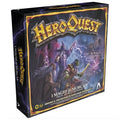
Pairs well with
FroGames — Moments You'll Remember
One opens the door. The others exchange glances. The Game Master smiles. Behind that door there's always something you don't expect, and by the end of the evening, you'll have a story to tell.
WHAT IT'S ABOUT
The dungeon crawler that taught a generation what it means to explore a dungeon
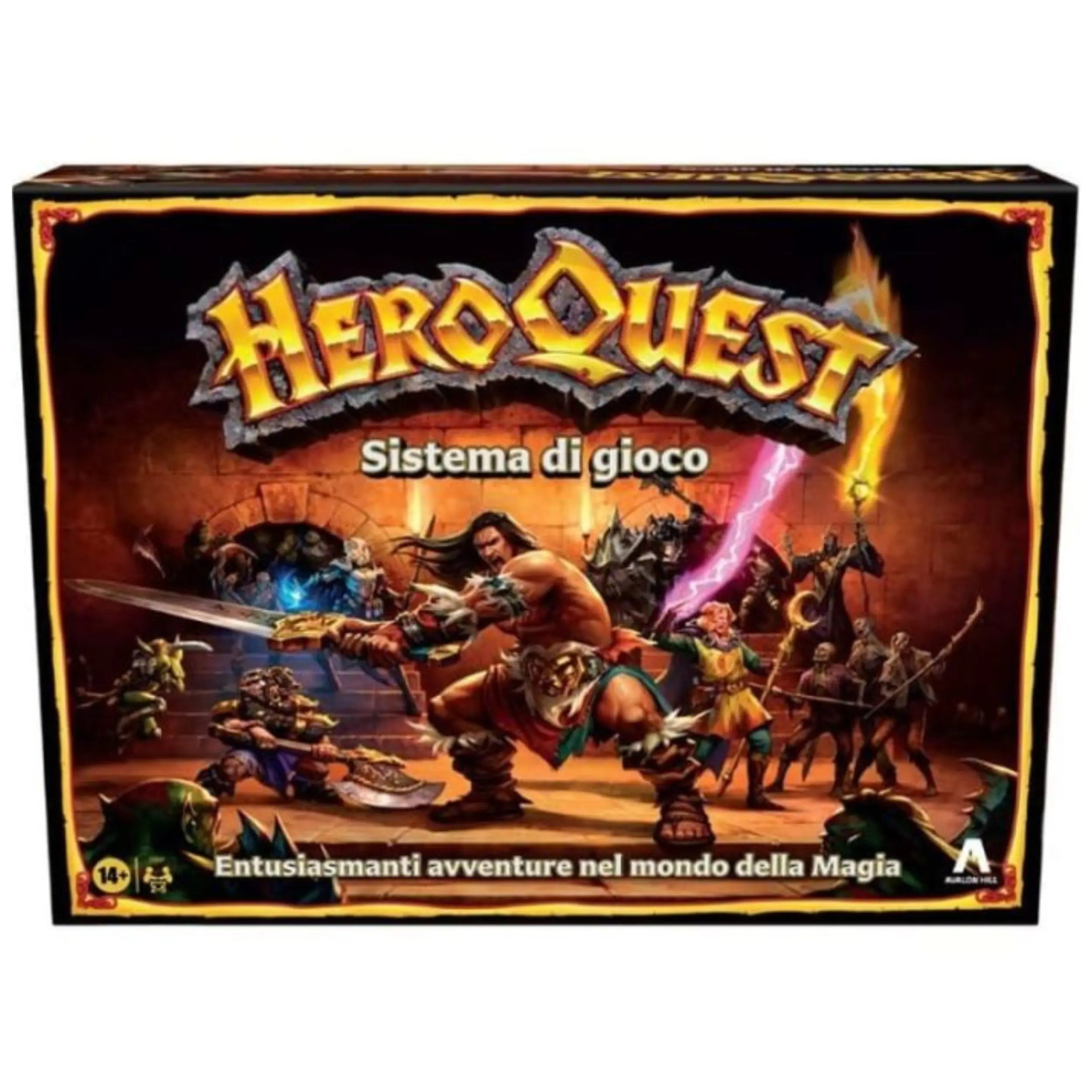
HeroQuest was released in 1989, designed by Stephen Baker for Games Workshop and Milton Bradley. It's the game that brought D&D to family tables: miniatures, dice, secret maps, a Game Master narrating the story. The illustrations by Gary Chalk and Les Edwards defined the fantasy aesthetic of the 90s. For millions of players, HeroQuest was their first dungeon crawler. And for many, it remains the best.
One player is Zargon, the evil sorcerer: he knows the map, places monsters, controls traps. The others choose a hero (Barbarian, Dwarf, Elf, Wizard) and move room by room. Open a door, roll the dice, fight. Search for treasures, avoid traps, complete the mission. The system is immediate: attack dice vs. defense dice. But the pace is perfect: every door is a question, every room is a surprise.
What they say abroad
The perfect game to create new players. Simple, memorable, iconic.
— FroGames
HeroQuest has done more for our hobby than can be quantified.
— FroGames

HeroQuest
FrogScore · FroGames editorial rating · based on rules, international reviews, and play sessionsWhat you'll find in the box
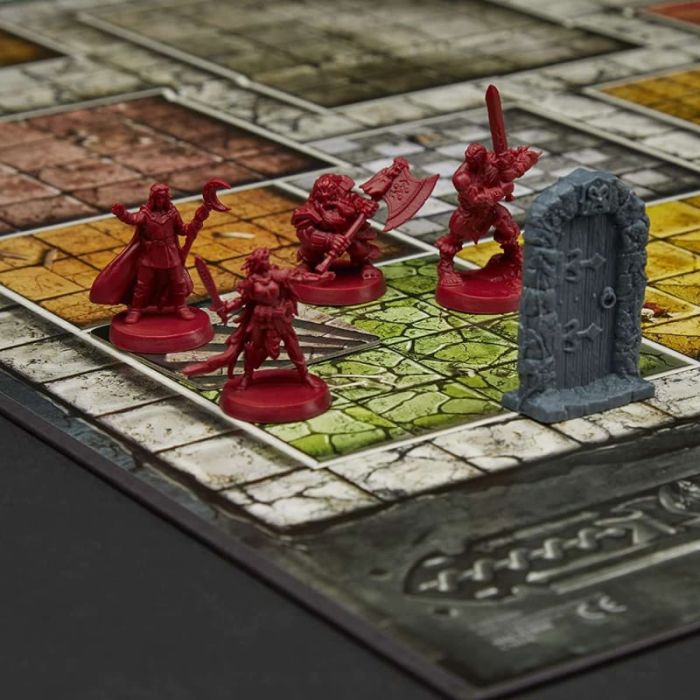
Heroes, monsters, and a dungeon to explore
Four heroes
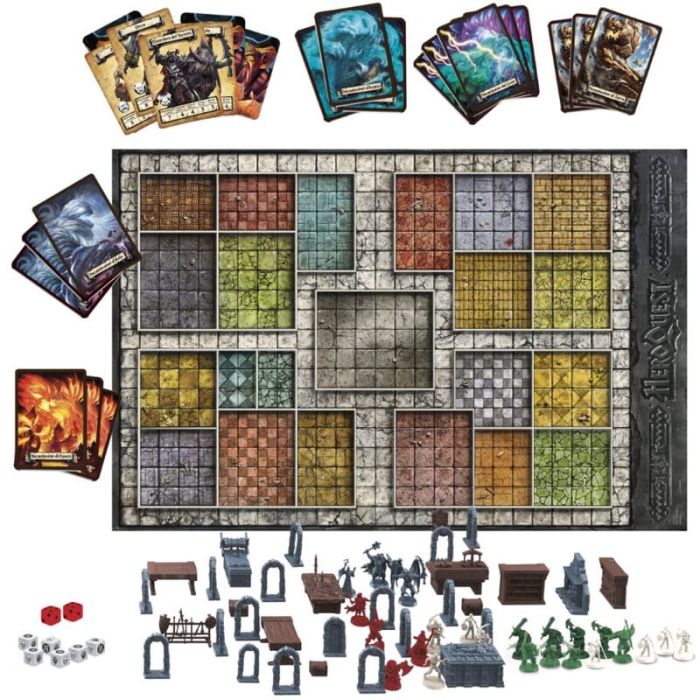
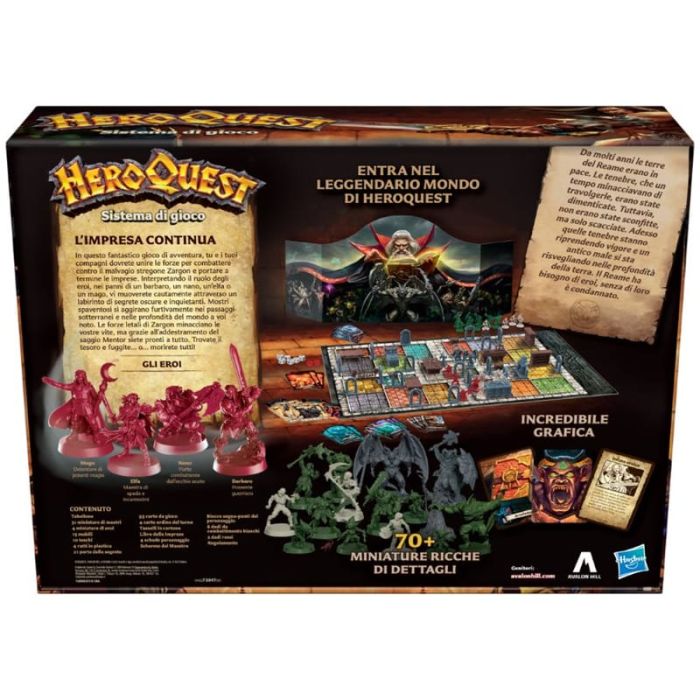
Barbarian, Dwarf, Elf, Wizard. Each has unique abilities: the Barbarian is strong in melee, the Wizard casts spells, the Elf is versatile, the Dwarf resists damage. Choose your style and go.
Monsters and traps
Goblins, Orcs, Skeletons, Mummies, Fimirs, Gargoyles. The Game Master places them according to the mission map. Each monster has different stats: some hit hard, others are numerous. Traps are hidden: you have to look for them before you fall into one.
Modular board
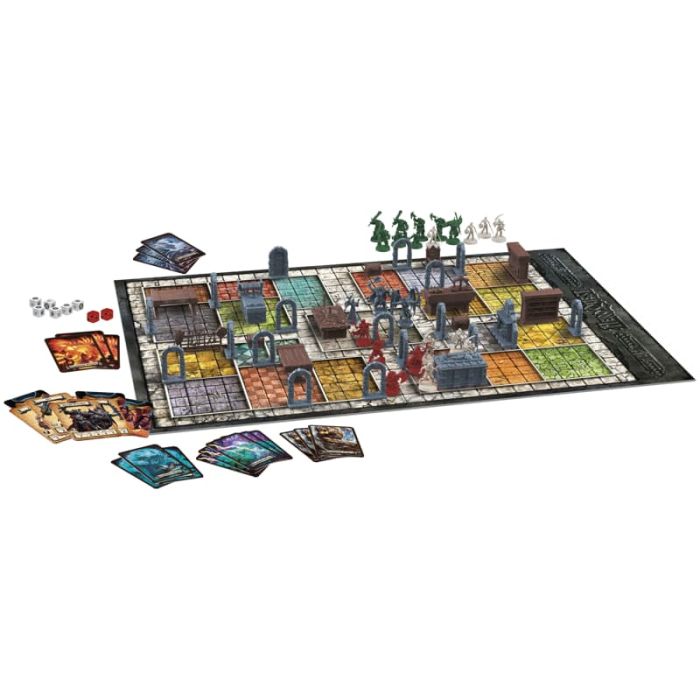
The dungeon is built piece by piece: corridors, rooms, doors, furniture. The Game Master knows the map, the heroes don't. Every game is a different dungeon. The suspense lies in not knowing what's behind the next door.
Dice and cards
Red combat dice (attack) and white (defense). Treasure cards for equipment and weapons. Spell cards for the Wizard. Everything is immediate: you roll, count the skulls, see who wins. Zero complex calculations.
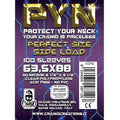
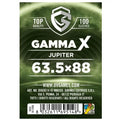
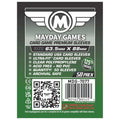
Recommended sleeves 132 cards in 2 sizes ▼
If you play often, we recommend protecting your cards with clear sleeves to make them last a long time.
| Size | Quantity |
|---|---|
| 54 × 80 mm | 66 |
| 56 × 89 mm | 66 |
| Total cards | 132 |
In a few hours, you'll have told how the Barbarian burst through the door, how the Wizard cast the fireball at just the right moment, how the Dwarf died a hero. It always happens with HeroQuest.
A game in five moments
What happens at the table
Not the rules. The experience.
The Master prepares the trap
Zargon opens the quest book, chooses a quest, places the monsters on the map. The heroes see nothing. They only see the first room, the entrance to the dungeon. The rest is a mystery. The Master smiles. He knows what's behind that door.
The first door opens
The Barbarian decides: "I'll open the door." The Master places the new dungeon pieces. "You see a long corridor. At the end, two Goblins are watching you." The heroes look at each other. They move. They roll the dice. The first combat is always chaotic: no one knows yet how much damage the monsters deal.
The trap springs
The Dwarf enters a room. The Master says: "Roll for traps." Black die. Skull. A blade springs from the wall. The Dwarf loses body points. The others realize: they need to search. But searching takes time. And the monsters are coming.
The treasure (or disaster)
The Elf opens a cabinet. Treasure Card. "Magic Sword: +1 attack die." The group cheers. But the Master places more monsters. The mission says: "Find the artifact in the final room." Two doors remain. Body points are dropping. Someone suggests turning back.
The final room
Last door. Inside is the boss. A Gargoyle. Three attack dice. The Barbarian charges. The Wizard casts Fireball. The dice roll. Skulls everywhere. The Gargoyle falls. Mission complete. The heroes exit. Zargon closes the book. "Next week, quest number 3."
How to play
The flow of each turn
HeroQuest is very simple: move, act, pass. The Master reacts. Repeat until victory or death.
Each hero has a certain number of squares they can move. They move before or after their main action. They can open doors, explore, position themselves for combat.
You can do ONE thing: attack a monster (roll dice, compare skulls), cast a spell (if you're the Wizard), search for traps or treasures (roll the search die), or pass.
Zargon moves the monsters and attacks. Each monster has attack dice and body points. Monsters activate after each hero. They can block corridors, surround, set ambushes.
When you open a door, the Master places the new board pieces and reveals what's inside: monsters, traps, treasures. The heroes must decide: do we push forward or consolidate?
Why it's different from others
Six reasons why HeroQuest defined the genre
One versus all, not purely cooperative
The Master is not a facilitator: he is an adversary. He wants to win. The heroes must defeat him. This creates real tension: Zargon is not simulating monster intelligence, he is playing them to win. It's asymmetrical in the right way.
The dungeon unfolds room by room
You don't see the entire map. You only see where you have been. Every door is an unknown. This creates suspense that modern dungeon crawlers (with an already open map) don't have. You don't know what to expect until you open it.
Dice instead of card decks
No decks to build, no hand management. You roll the dice and see the result immediately. It's immediate, visceral, and understandable by anyone. One skull = one hit. Two skulls = two hits. Zero ambiguity.
Campaign without legacy
The game includes 14 linked quests that tell a story. But you don't destroy components, you don't write on the board, you don't unlock sealed boxes. It's a classic campaign: finish one quest, move on to the next. You can replay it whenever you want.
Rules in 15 minutes, emergent depth
The rules fit on two pages. Movement, attack, defense, search. That's it. The depth emerges from the combination: which door do you open? Do you look for treasure or move on? Who enters first? The choices are simple but important.
Infinitely expandable
HeroQuest has had dozens of official expansions (Kellar's Keep, Return of the Witch Lord, Wizards of Morcar) and hundreds of community-created quests. The system is so modular that you can invent your own missions in ten minutes.
How it ends
How to win and how to lose
Every mission has specific objectives. But the gist is always the same: complete the quest or die.
Heroes' Victory
- They complete the mission objective (find the artifact, kill the boss, reach the final room)
- At least one hero escapes the dungeon alive with the objective completed
- They collect treasures and experience points to spend in subsequent missions
Defeat (or Zargon's victory)
- All heroes die before completing the objective
- The heroes retreat without completing the mission (they can do so voluntarily to save treasures)
- The Master prevents completion within the time/turn limit (if the mission provides for it)
HeroQuest is not the most complex dungeon crawler. But it's the one that makes you want to open the next door. And the one you remember thirty years later.
Frequently asked questions
HeroQuest FAQ
Is it suitable for those who have never played a dungeon crawler?
Yes, in fact: it's designed for that. The rules are immediate, the Master guides the narrative, and the first game works right away. It's the perfect game to introduce someone to dungeon crawlers. Many experienced players started here.
Is preparation needed before playing?
The Master needs to read the mission (5 minutes) and place the monsters according to the map. Heroes don't need to prepare anything: they choose their character and start. The first game takes half an hour to explain the rules, then it's smooth sailing.
How long does a mission last?
The box says 90 minutes, and that's accurate for average missions. Early missions are shorter (60 minutes), later ones are longer (120 minutes). It depends on how much the heroes explore and how many combats there are.
Can it be played without a Master?
No, HeroQuest requires the role of Zargon. There are fan-made variants for purely cooperative play, but the game is designed for one versus all. The Master is an integral part of the experience: he creates tension, sets ambushes, and brings the dungeon to life.
Is it available in Italian?
This edition is in English. It includes rules, cards, and mission book in English. Language dependence is moderate: dice are universal, cards have text but are few and repetitive. With an amateur translation (available online) or a player who translates, it's very playable.
HeroQuest is a fantasy dungeon crawler for 2-5 players, lasting 90 minutes, recommended age 14+. Designed by Stephen Baker in 1989 for Games Workshop and Milton Bradley, it's the game that brought the D&D dungeon experience to family tables. One player is the Master (Zargon), the others are heroes (Barbarian, Dwarf, Elf, Wizard) who explore the dungeon room by room. Immediate dice combat system, modular board, 14 linked missions in a campaign. Published by Avalon Hill, it includes detailed miniatures, Treasure and Spell cards, custom dice. Available on FroGames.it.
HeroQuest - New Edition
Frequently Asked Questions
The answers you're looking for, no beating around the bush.
📸Do the images match the actual product?
The photos on the website often come from BoardGameGeek and are intended to give you an idea of the game. They may vary slightly from the version you receive. The content declared by the publisher is always binding.
📦Does the content of the box match what is indicated?
We always strive to provide the correct content, but minor variations are possible due to reprints or updates. The information comes directly from the publishers. If you have any questions, please contact us!
⏳How do pre-orders work?
Pre-order the game before release, payment is immediate, and the game is reserved for you. As soon as it arrives, we'll ship it right away! If there are any delays, we'll update you promptly.
🔒Can I trust buying here?
Absolutely! Secure payments, tracked shipments, and a team that loves board games as much as you do. If something goes wrong, we'll do our best to fix it.
🛠There's a problem with my order, what should I do?
Write to us now! Whether it's a missing part, damage, or an error, we'll help you resolve it as soon as possible. Your experience truly matters to us.