
The Song of the Volur
🐸 Details from BoardGameGeek
Consiglio BGG sul numero di giocatori
Categorie
Meccaniche
Design & Art
Lingua
Si abbina bene con
The FroGames review
A Guide rolls runic dice. The others watch: a symbol, a color, a position. Someone suggests 'Journey', someone else 'Water'. They discuss, they doubt, they converge. And when the word emerges from the silence, it seems like magic.
WHAT IT IS
Norse seers interpreting signs with runic dice
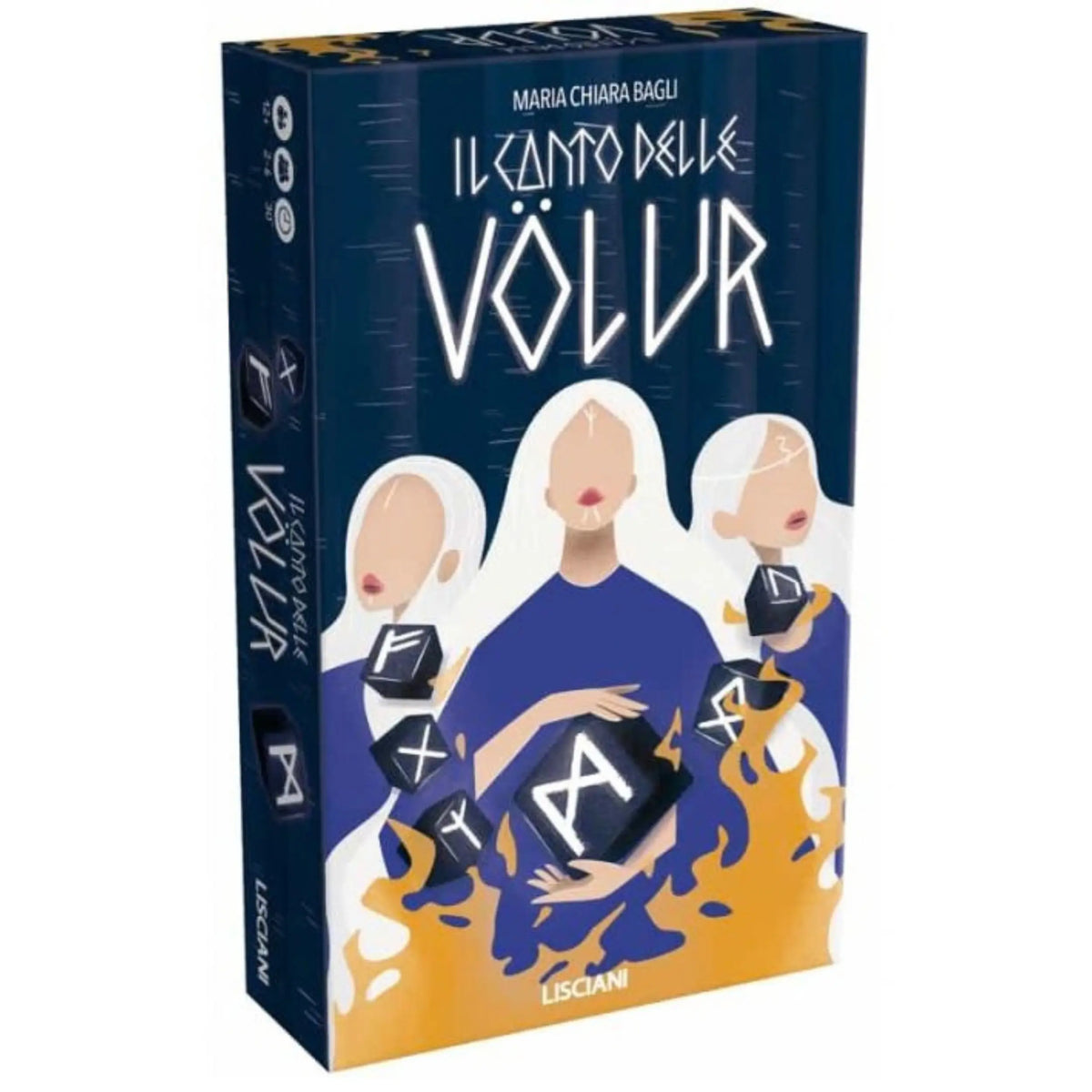
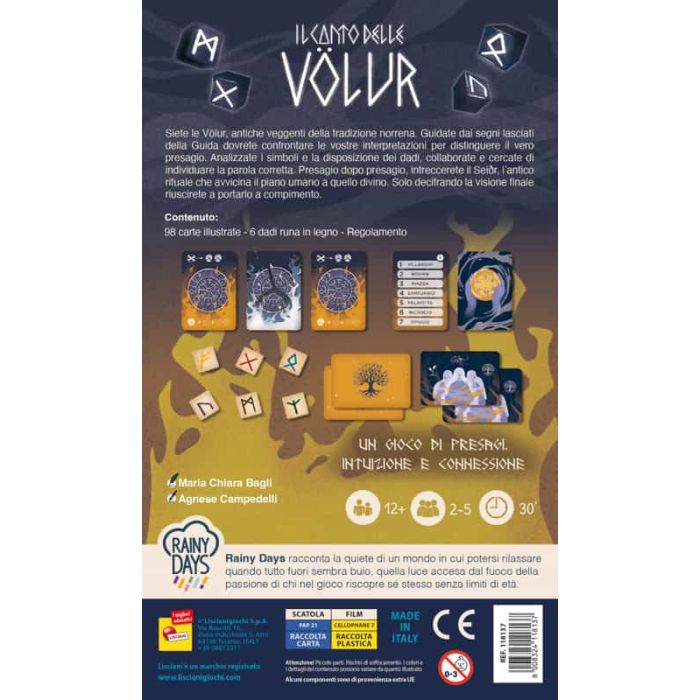
The Song of the Völur is born from Norse mythology and the ancient practice of Seiðr, the magic of seers. Designed by Maria Chiara Bagli (an Italian designer with a mathematical background) for the Rainy Days line by Lisciani Giochi, it is a title entirely made in Italy, released in 2026.
At the table, you are the Völur, seers capable of reading visions in signs. In every omen, a Guide rolls runic dice to communicate a word to the other players. Each die speaks on multiple levels: the color, the shape of the rune, the traditional meaning of that rune. And their mutual arrangement can become part of the message: proximity, contrast, sequences, alignments. The others must discuss the possible interpretations and converge on the word.
What they say abroad
"New Rainy Days titles entirely made in Italy with Italian authors and illustrators."
— Lisciani Giochi
It is a newly released game, with an abstract communication mechanic unusual for the Italian market. We are intrigued because it combines cooperative deduction and semantic layering of the dice: each symbol can say multiple things at once, and position matters. It is rare to see this type of design in a Lisciani product. We will update the review after the first few games.
— FroGames

The Song of the Völur
FrogScore · FroGames editorial review · first read: based on the rules and official presentation, updated with the first few gamesThe seers' tools
What do you use to read the visions
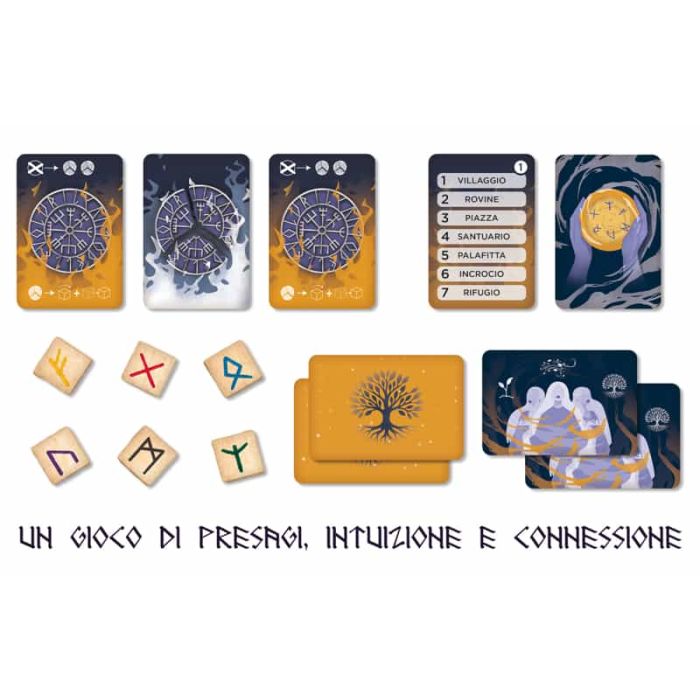
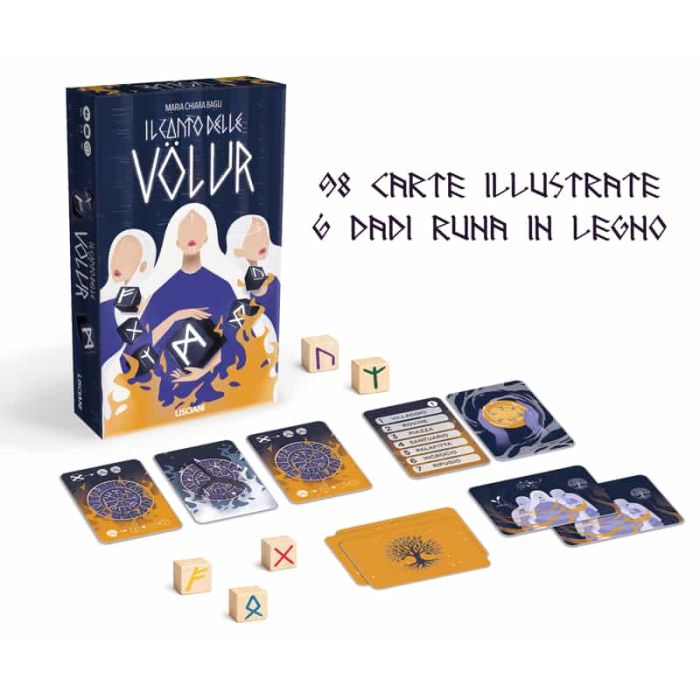
Runic dice
Each die has a different rune on each face. They are not decorative symbols: each rune has a traditional meaning (journey, protection, conflict, cycle...) that the Guide can use for the message.
Dice colors
The dice have different colors. A color can evoke a concept (red = fire/passion, blue = water/cold...), or serve to visually group or separate the dice on the table.
Spatial arrangement
The Guide does not only communicate which dice to roll, but where to arrange them. Proximity, distance, alignment, opposition: everything can be part of the message. An isolated die says one thing, two dice close together another.
Collective discussion
The other players talk, propose, doubt, converge. There is no turn: they discuss until consensus emerges. The magic of the game is here: in the way the group builds meaning together.
🎲How to playThe rules in four steps▼
How to play
The flow of each omen
A simple repeating cycle: the Guide communicates, the others interpret, and the group converges (or fails).
The Guide draws a word card (kept secret). They take the rune dice, throw them, and arrange them on the table however they wish. They can use all or just some of them. The arrangement is part of the message.
The non-Guide players discuss freely. They suggest words and note symbols, colors, and positions. The Guide cannot speak, but may use minimal gestures (nodding, facial expressions) if the rules allow.
When the group agrees on a word, they say it aloud. The Guide reveals whether it is correct. If so, the omen is resolved and the group earns a point. If not, they can try again (if the rules allow multiple attempts) or move on to the next omen.
The word card used is removed from the deck. A new player becomes the Guide. This continues until the deck runs out or the group reaches its point goal. At the end of the game, count how many omens were resolved.
⏱️Your first gameThe play-by-play▼
A game in five stages
What happens at the table
Not the rules. The experience.
The first vision
One player becomes the Guide, draws a word card (which only they can see), and throws the rune dice. The others watch in silence. Someone counts the dice, while someone else notes the colors. No one yet knows whether those symbols mean something literal or abstract.
The first hypotheses
Suggestions begin: 'It could be journey, right? That rune is Raido'. 'But the isolated red die... fire?'. Interpretations overlap and contradict one another. The Guide cannot speak: they watch, and their silence communicates more than words.
The turning point
Someone notices the arrangement: 'Look, the two blue dice are close together, and the green one is far away. Separation? Distance?'. The table lights up. The group reconstructs the message: it is not the individual rune, but the relationship between the dice. The word begins to take shape.
Convergence
The group arrives at two hypotheses, then one. They ask the Guide for confirmation. The Guide nods, and the table erupts in a mixture of relief and pride. It was 'Exile'. The distant green die was the exile, and the blue dice represented the community. Obvious, now that you know.
The next omen
The Guide changes. Someone who previously suggested very little must now communicate without words. And they discover that it is harder than expected: the dice never say exactly what you want. But that is the appeal. The game ends after N resolved (or failed) omens.
🐸Good to know beforehandThree honest things, from friends▼
Good to know beforehand
Three things to know before buying
Requires a talkative table
The game thrives on open discussion. If the group is quiet, shy, or used to games where everyone thinks for themselves, they will struggle here. It requires a willingness to think aloud, suggest silly hypotheses, and change your mind. It is not a game for extreme introverts.
The first games can be baffling
At first, you do not understand how to communicate with the dice. You throw them and realize that the symbols do not say anything clear. It takes practice: after 2–3 omens, the group learns to read the patterns, and the game takes off. But the first half hour can be frustrating.
The theme is present but not intrusive
The Norse mythology is a setting, not a constraint. The runes have traditional meanings, but you do not need to know them: the game works just as well using only colors and positions. Those who love Seiðr will find easter eggs, while others will play an elegant abstract deduction game.
🏆Victory and defeatWhat the ending rewards▼
How it ends
How to win (and how to fail)
It is a pure cooperative game: you win or lose together based on the omens you resolve.
Collective victory
- Resolve a minimum number of omens (the threshold varies by difficulty)
- Correctly interpret the word within the allotted attempts
- The deck runs out and you have enough points to win
Defeat
- Too many failed omens: you do not reach the victory threshold
- Run out of attempts without guessing the word
- The deck runs out with insufficient points
It is a game that rewards those who listen more than they speak, and that teaches something rare: to build meaning together, one die at a time.
💬Frequently asked questionsQuick answers before you add it to your cart▼
Frequently asked questions
FAQ on Il Canto delle Volur
What mechanics does Il Canto delle Volur use?
It is a game of cooperative deduction with abstract communication. The Guide throws rune dice to communicate a word to the others, who must interpret symbols, colors, and spatial arrangement. It includes elements of party game (free discussion) and pattern recognition.
Is it suitable for those who do not know Norse mythology?
Yes. The runes have traditional meanings related to Seiðr (Norse magic), but the game works just as well using only colors and positions. Mythology is an evocative theme, not a prerequisite. Those who know it will enjoy noticing the details, while others will play an elegant deduction game.
Does it work well with 2 players?
It works, but loses some of its appeal. With 2 players, the game is more telepathic and involves less discussion: one person communicates, and the other interprets. It lacks the richness of multiple hypotheses and collective convergence. The sweet spot is 3–5 players, where multiple interpretations overlap.
How long does a game last?
Officially 25–35 minutes. The first games may take longer (40 minutes) as the group learns to interpret. Once you get the hang of it, 30 minutes is realistic. Ideal as a cooperative filler or the second game of the evening.
Is it available in Italian?
Yes, this is the Italian edition by Lisciani Giochi. The cards, rules, and components are in Italian. The game is part of the Rainy Days line, which is produced entirely in Italy by Italian authors and illustrators.
The people behind the game
Who invented it, who designed it, who publishes it—and what else they have done.
Il Canto delle Volur is a cooperative deduction game for 2–5 players, ages 12+, with a duration of 25–35 minutes. Designed by Maria Chiara Bagli and published by Lisciani Giochi as part of the Rainy Days line, it is inspired by Norse mythology and Seiðr, the ancient Norse practice of divination. The core mechanic is abstract communication with rune dice: a Guide throws dice to convey a word, while the others interpret symbols, colors, and spatial arrangement to guess it. Pure cooperative play with collective deduction and pattern recognition. Available on FroGames.it.
The Song of the Volur
Frequently Asked Questions
The answers you're looking for, no beating around the bush.
📸Do the images match the actual product?
The photos on the website often come from BoardGameGeek and are intended to give you an idea of the game. They may vary slightly from the version you receive. The content declared by the publisher is always binding.
📦Does the content of the box match what is indicated?
We always strive to provide the correct content, but minor variations are possible due to reprints or updates. The information comes directly from the publishers. If you have any questions, please contact us!
⏳How do pre-orders work?
Pre-order the game before release, payment is immediate, and the game is reserved for you. As soon as it arrives, we'll ship it right away! If there are any delays, we'll update you promptly.
🔒Can I trust buying here?
Absolutely! Secure payments, tracked shipments, and a team that loves board games as much as you do. If something goes wrong, we'll do our best to fix it.
🛠There's a problem with my order, what should I do?
Write to us now! Whether it's a missing part, damage, or an error, we'll help you resolve it as soon as possible. Your experience truly matters to us.