


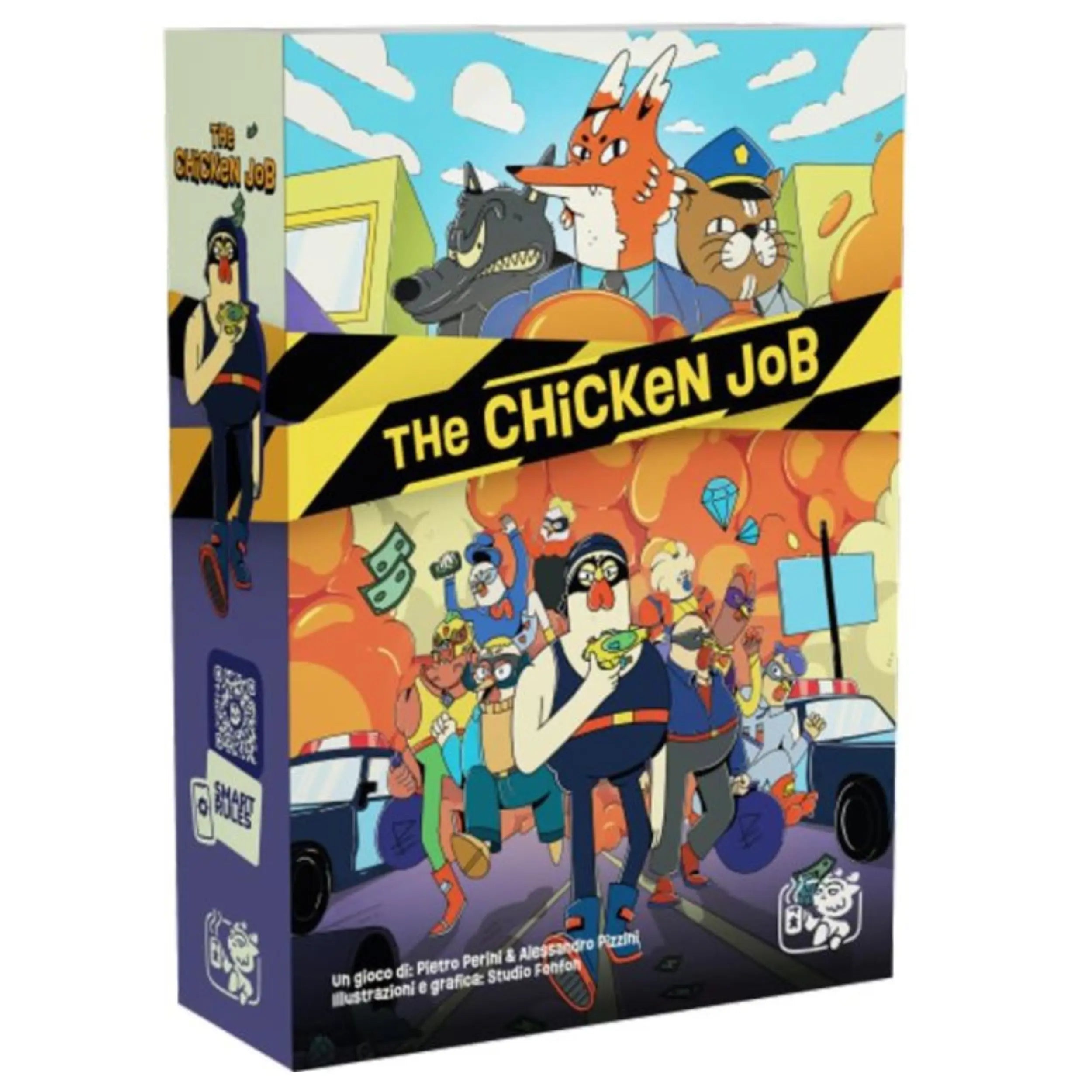
The Chicken Job
🐸 Dettagli da BoardGameGeek
Consiglio BGG sul numero di giocatori
Categorie
Meccaniche
Design & Art
Lingua
Pairs well with
FroGames — Moments You'll Remember
Someone is chuckling looking at their cards. Someone is mentally counting percentages. Someone is already planning betrayal. And in the end, no one trusts anyone anymore.
WHAT IT'S ABOUT
Twenty minutes of mutual distrust and badly split loot
Designed by Pietro Perini and Alessandro Pizzini for TambùGames, The Chicken Job is a criminal party game where each player is a thief in a gang that trusts no one. Not even their own accomplices. The heist is done, the loot is on the table: jewels, cash, tools. And of course, the police who could ruin everything.
Each turn someone splits the loot, the others choose whether to accept or risk. The I Cut, You Choose mechanic meets push-your-luck: knowing when to settle and when to push further is the only skill that matters. Cards change hands, alliances last only as long as needed, and whoever accumulates too much stuff ends up in the spotlight.
What they're saying abroad
Every hand is a small silent negotiation where no one tells the truth.
— FroGames
The game promises to turn any table into a gang of paranoid criminals in less than half an hour.
— FroGames

The Chicken Job
FrogScore · FroGames editorial rating · based on rules, international reviews, and gameplay sessionsYour loot
What's on the table during the heist
Jewels
They're worth points, but if you accumulate too many, you become too visible a target. The police watch those who sparkle.
Cash
Easy money to hide, but everyone wants it. When someone splits the cards, money is always the focus of negotiation.
Tools
They don't directly earn points, but they give you options. Some protect you, others allow you to change the rules mid-game.
Police
The card no one wants to draw. When it appears, whoever has the most visible loot risks losing everything. The worst possible moment.
In twenty minutes, someone will have won, someone will have lost everything, and everyone will have learned that trusting pays less than not trusting.
A five-moment game
What happens at the table
Not the rules. The experience.
The Initial Division
The deck is on the table, someone starts dividing the cards. Everyone watches. There's a heavy silence as each person decides whether to accept or refuse. No one wants to appear too greedy, but no one wants to leave empty-handed either.
The First Betrayal
Someone refuses a seemingly fair division. The others watch. Maybe they know something you don't. Maybe they're bluffing. The table starts calculating: who has the most cards? Who is risking too much?
The Police Card
The first police card comes out. Everyone looks at each other. Those with the most visible loot hold their breath. Nervous laughter mixes with cynical comments. Someone loses something, and the table divides between those who celebrate and those who remain silent.
The Miscalculated Risk
Someone accumulated too much, too quickly. They refused too many divisions hoping for something better. Now they have to make an impossible decision: accept crumbs or risk everything on one last draw. The table watches in silence.
End of the Heist
The cards run out. Points are counted. Someone won by playing it safe, someone lost by a hair, someone exploded by pushing too hard. Everyone wants to play again immediately, with roles reversed.
How to play
The flow of each round
Each turn is a division, a choice, and the consequences of both.
The active player divides the available cards into two groups. It can be fair, it can be a trap. The others watch and evaluate.
Each player decides: accept one of the two groups, or refuse and hope for the next round. Those who accept take the cards. Those who refuse stay in the game.
New cards are drawn from the deck. They can be jewels, cash, tools. Or the police. If the police come out, a penalty is triggered for those who have accumulated too much.
The next player becomes the divider. The deck flows, tensions rise, and those who refused too much start to sweat.
Why it's different from others
Six mechanics that make the difference
I Cut, You Choose in a criminal version
The divider doesn't know who will take what. It can be strategic, it can be vengeful, it can be random. The one who chooses must understand if there's a hidden trap or if everything is clean. The classic mechanic works perfectly in a context where everyone is lying.
Push-your-luck with visible penalties
It's not enough to accumulate: you have to do it without exposing yourself too much. The police punish those who are too visible, so every card you take is a step towards victory or disaster. The risk is always on the table, literally.
Lightning-fast games with significant decisions
Twenty minutes seems very little, but every choice counts. There's no time for long-term strategies: you have to decide now, based on incomplete information. The fast pace doesn't remove depth, it concentrates it.
No alliance truly lasts
You can make generous divisions to seem trustworthy. You can betray immediately after. The game doesn't punish betrayal, it encourages it. Every hand is a reset of alliances, and no one trusts anyone long enough.
Tools change the rules
Some cards give you powers: police protection, extra draws, forced exchanges. They are not direct points, but they allow you to survive longer or turn impossible situations around. Those who ignore them lose.
Partial information and bluffing
You don't know what's in the deck. You don't know what others have. You can only observe, deduce, bluff. Every division is a declaration of intent, true or false. The game thrives on wrong reads and accurate intuitions.
How it ends
How to win and how to lose
At the end of the deck, points are counted. Whoever accumulated the most value wins. Whoever risked too much loses everything.
Victory
- You accumulate jewels and cash without getting caught by the police
- You use tools at the right time to protect your loot
- You make divisions that seem generous but always leave you with the best piece
Elimination or defeat
- The police catch you with too much visible loot and you lose everything
- You refuse too many divisions hoping for something better that never comes
- You accept the worst divisions because you're afraid to risk and you finish last
The Chicken Job is not a game about perfect strategy. It's a game about how much you're willing to trust and how good you are at appearing trustworthy when you're not.
Frequently asked questions
FAQ about The Chicken Job
Is it suitable for casual players?
Absolutely. The rules can be explained in five minutes, and the first game starts right away. No board game experience is needed: you just need to be able to read others' intentions and decide whether to trust or not. It's immediate.
Does it work well with two players?
It works, but it loses some of the group paranoia. With two, it's more of a tactical duel, less a game of multiple interpretations. From three players up is where it shines: more players mean more dynamics, more potential betrayals, more tension.
How much does luck count?
It counts, but it doesn't dominate. You can draw poorly, but if you read the table well and manage risk, you'll still win. The police card can turn everything upside down, but those who know when to stop rarely lose. Luck punishes the greedy, rewards the calculators.
Can children under 10 play it?
Technically yes, but the bluffing and risk management mechanics work better with players who can already lie with a straight face. Under 10, they tend to be too honest or too chaotic. From 10 and up it's perfect.
Is it available in Italian?
Yes, this edition is completely in Italian, published by TambùGames. Cards, rulebook, everything localized. No language issues.
The Chicken Job is a competitive party game for 2-5 players, designed by Pietro Perini and Alessandro Pizzini, published by TambùGames. Each game lasts 20 minutes and combines the I Cut, You Choose and push-your-luck mechanics in a criminal context where each player is a thief who doesn't trust their accomplices. Suitable for ages 10 and up, the game requires bluffing skills, risk management, and reading opponents. Available in Italian on FroGames.it.
The Chicken Job
Frequently Asked Questions
The answers you're looking for, no beating around the bush.
📸Do the images match the actual product?
The photos on the website often come from BoardGameGeek and are intended to give you an idea of the game. They may vary slightly from the version you receive. The content declared by the publisher is always binding.
📦Does the content of the box match what is indicated?
We always strive to provide the correct content, but minor variations are possible due to reprints or updates. The information comes directly from the publishers. If you have any questions, please contact us!
⏳How do pre-orders work?
Pre-order the game before release, payment is immediate, and the game is reserved for you. As soon as it arrives, we'll ship it right away! If there are any delays, we'll update you promptly.
🔒Can I trust buying here?
Absolutely! Secure payments, tracked shipments, and a team that loves board games as much as you do. If something goes wrong, we'll do our best to fix it.
🛠There's a problem with my order, what should I do?
Write to us now! Whether it's a missing part, damage, or an error, we'll help you resolve it as soon as possible. Your experience truly matters to us.