


Pet Quartet
🐸 Dettagli da BoardGameGeek
Consiglio BGG sul numero di giocatori
Categorie
Meccaniche
Design & Art
Lingua
Pre-order - leggi i dettagli
🐸 Una rana saggia sa quando dividere l’ordine… e quando aspettare il salto giusto.
Pairs well with
FroGames — Moments You'll Remember
Someone has a virtuous cat. Someone else miscalculates and ends up with five Latinist ferrets. At the table, there's laughter, suffering, negotiation. No one remembers who won, everyone remembers the impossible quartet.
WHAT IT'S ABOUT
Adopt the best musicians in the animal kingdom
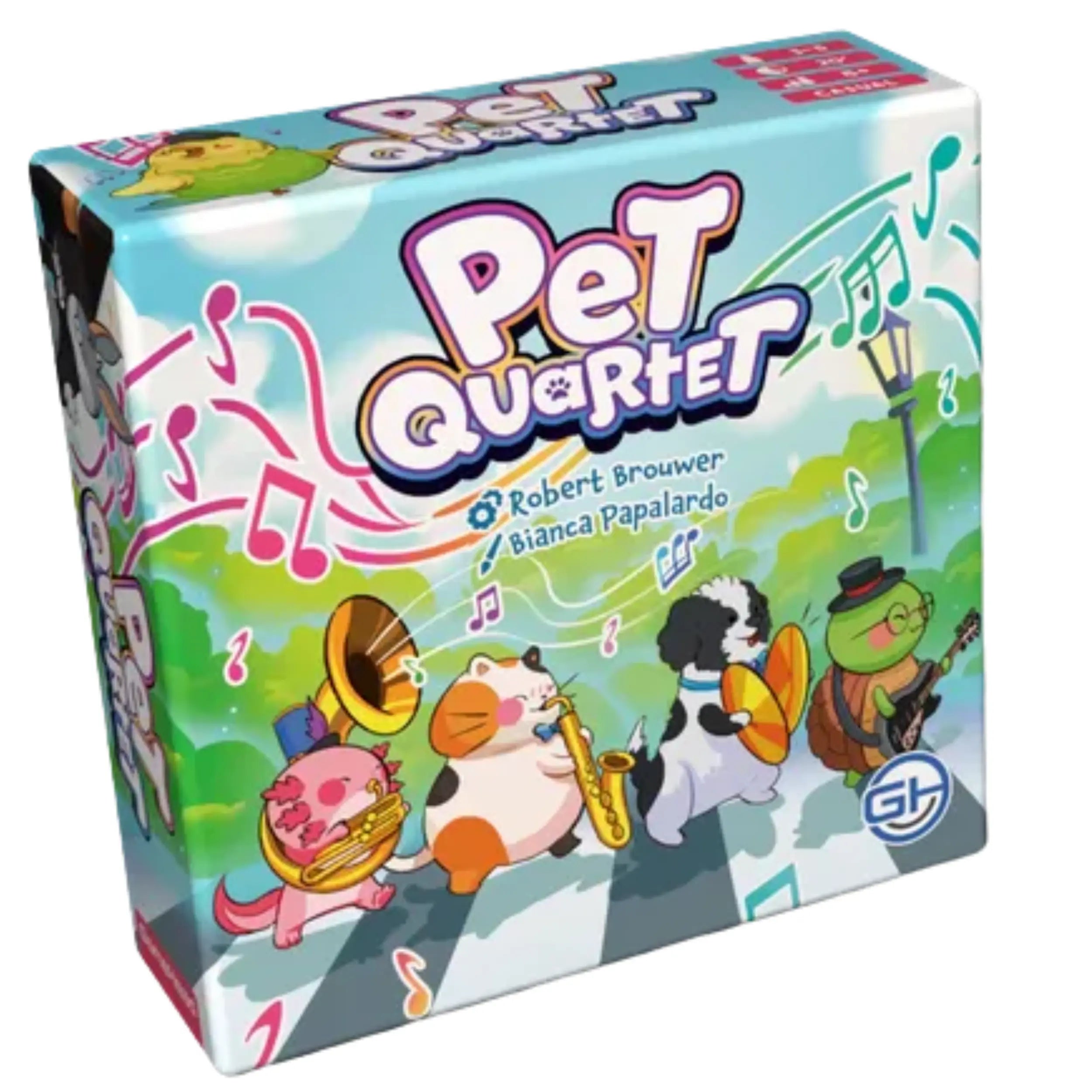
Pet Quartet is the new game by Robert Brouwer, published by GameHead in 2026, with delicate illustrations by Bianca Papalardo. You're a music and animal lover, and today is the perfect day: adopt the best furry, feathered, or scaled musicians in town to form impeccable ensembles. Snakes on violin, tortoises on double bass, ferrets on Latin guitar. The competition is fierce, the goal is clear: form perfect quartets or keep impeccable soloists.
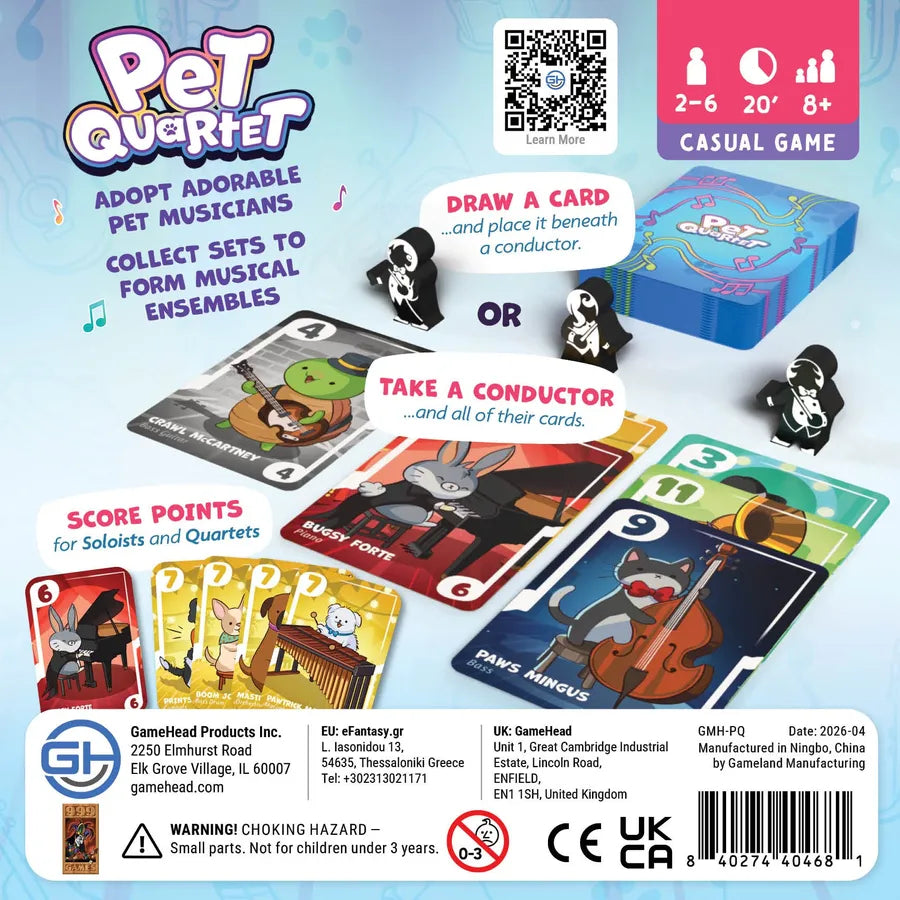
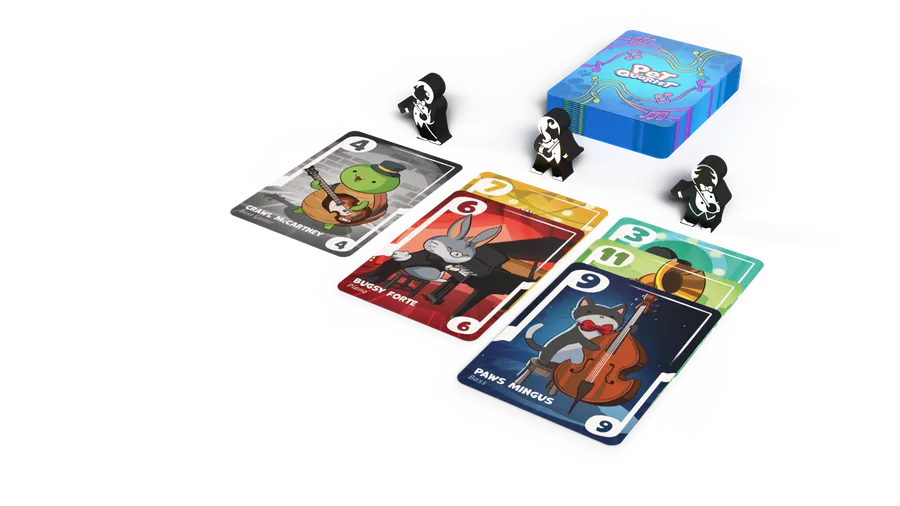
At the table, you draw cards, divide them, choose them. Each card has a number indicating how many copies of that animal exist in the deck: three snakes, four tortoises, up to thirteen ferrets. You want to collect exactly one or exactly four animals of the same type. Two, three, or five? Zero points. The triangular deck makes everything riskier: easy to find ferrets, difficult not to go over. Every choice is a calculation, every draw is a gamble.
What they say abroad
A game of calculation that makes you laugh when you get the sums wrong. The triangular deck is brilliant: the more common the cards, the easier it is to mess everything up.
— FroGames
The tension rises with every card drawn. Do you want that fifth tortoise or do you stop? The right answer changes every game.
— FroGames

Pet Quartet
FrogScore · FroGames editorial rating · based on rules, international reviews, and play sessionsThe musician animals
From three snakes to thirteen ferrets
Snakes (3)
Three cards in the deck. Very difficult to find four, easy to keep one. If you draw two, you already have a problem.
Tortoises (4)
Exactly four cards. Forming a quartet is possible, but requires luck or an iron memory of what others have.
Foxes (9)
Nine cards in the deck. Intermediate zone: common enough to find them, rare enough not to go over too easily.
Ferrets (13)
Thirteen cards. The easiest to collect in a quartet, but also the most dangerous: draw twice in a row and you're already at risk.
In half an hour, someone will have told the story of that moment they risked everything for the fourth cat. And someone else will still have the perfect soloist before their eyes.
A game in five moments
What happens at the table
Not the rules. The experience.
First adoptions
Cards are divided, animals are chosen. Everyone wants the ferrets because there are thirteen in the deck. No one considers that this very fact makes them a trap. The first choices are optimistic and imprudent.
The first quartet forms
Someone completes four matching cards. Ironic applause breaks out at the table. The others realize that points are serious business. Tension rises, divisions become more calculated.
The risk of the third animal
You have two cats. You draw a third. Now you're in trouble: if a fourth arrives, fantastic. If a fifth arrives, zero points for the entire category. Stop or risk it? Everyone at the table is watching you.
Someone overshoots
Five ferrets in front of a player. Silence. Laughter. Polite curses. That set was worth ten points, now it's worth zero. The triangular deck shows no mercy. Others gain courage and take more risks.
Final count
Cards are flipped. Soloists and quartets are counted. Someone won with three impeccable soloists, someone else with two risky quartets. The difference was one card. Always.
How to play
The flow of each round
Draw, divide, choose. Every round is quick, every choice is a crossroads.
The active player draws a certain number of cards from the central deck and looks at them. Now they must decide how to divide them.
The drawn cards are divided into two groups. This is the crucial phase: how you divide them determines what you will get and what you will leave to others.
The other players, in turn, choose one of the two groups and add it to their collection. The active player takes what remains.
Now you have new cards. Do you have exactly one or four animals of the same type? Good. Do you have two, three, five or more? Zero points for that set.
Why it's different from others
Six mechanics that make a difference
Triangular deck
The number on the card indicates how many copies exist in the deck. Three snakes, thirteen ferrets. This structure makes probabilities asymmetric: it's easy to find ferrets, difficult not to exceed four. It's impossible to complete a quartet of snakes without luck or negotiation.
I Cut, You Choose
You don't just choose for yourself, you divide for everyone. If you make two unbalanced groups, someone will take the better group and you'll be left with scraps. If you make two balanced groups, someone will still choose the one you needed most.
Only 1 or 4 score points
It's not classic set collection. You don't just accumulate cards. You must have exactly one (soloist) or exactly four (quartet) animals of the same type. Two? Three? Five? Zero points. This single constraint turns every draw into a gamble.
Calculated push-your-luck
You don't roll dice. You know what's in the deck, you know what others have drawn. You can calculate probabilities. But the risk remains real: that fifth card can arrive, and when it does, it burns the entire set.
Light and accessible theme
Musician animals. No complex mechanics to explain, no dark or demanding theme. It works with families, it works with casual players, it works as an aperitif or a nightcap. Rules in ten minutes, first game immediate.
Scales well from 2 to 6 players
With two players, it's a tactical duel. With six, it's controlled chaos. The drafting and division system adapts to the number of players without losing tension. No number is wrong.
How it ends
How to win and how to lose
The game ends when the deck runs out. Only perfect sets are counted.
Victory
- Each soloist (exactly 1 card of a type) is worth as many points as the number on the card
- Each quartet (exactly 4 cards of a type) is worth four times the number on the card
- The player with the most points, adding soloists and quartets, wins
Ruined sets (zero points)
- You have two or three cards of the same type: incomplete set, zero points
- You have five or more cards of the same type: you've overshot, zero points for that category
- You ignored probabilities and risked too much: the triangular deck punished you
Pet Quartet is push-your-luck for those who love numbers but hate long calculations. Fast, tense, just mean enough. Perfect when you want to think but not too much.
Frequently asked questions
FAQ about Pet Quartet
Is it a game for children or adults?
Both. The rules are immediate (8+), but the decisions are more subtle than they seem. It works great with family, among adults it becomes tactical and ruthless. The triangular deck makes every game different, and the push-your-luck keeps everyone on the edge of their seats.
How much does luck matter?
Much less than it seems. Yes, you draw cards, but the deck is known (3 snakes, 13 ferrets) and you can calculate probabilities. Blind luck doesn't exist: if you choose to risk the fifth ferret, it's a decision, not bad luck. The triangular structure rewards those who count and punishes those who hope.
Does it work well with two players?
Yes. With two, it's more tactical and less chaotic. Every division is a duel of control and bluff. You lose the chaos of a party game, you gain depth in choices. The I Cut, You Choose system particularly shines with low player counts.
Is it suitable as a filler or as the main event of the evening?
An evolved filler. Twenty to thirty minutes, instant setup, immediate rules. It's not the game of the night, it's the game that opens or closes the night. Or the one you play three times in a row because someone wants a rematch. Fast but not empty.
What language is this edition in?
Edition in English. The cards only have numbers and illustrations (language independent for gameplay), the rulebook is in English. No reading required during the game, so it's accessible even to those with limited language skills.
Pet Quartet is a set collection and push-your-luck game for 2-6 players, ages 8+, lasting 20-30 minutes. Designed by Robert Brouwer and published by GameHead, it uses a unique triangular deck where the value of each card indicates how many copies exist in the deck (from 3 snakes to 13 ferrets). The goal is to collect exactly one or exactly four animals of the same type: everything else is worth zero points. The I Cut, You Choose mechanic and open drafting create constant tension, and the asymmetric structure of the deck makes every choice a probability calculation. Perfect for families and gateway players looking for something smarter than a classic party game. Available on FroGames.it.
Pet Quartet
Frequently Asked Questions
The answers you're looking for, no beating around the bush.
📸Do the images match the actual product?
The photos on the website often come from BoardGameGeek and are intended to give you an idea of the game. They may vary slightly from the version you receive. The content declared by the publisher is always binding.
📦Does the content of the box match what is indicated?
We always strive to provide the correct content, but minor variations are possible due to reprints or updates. The information comes directly from the publishers. If you have any questions, please contact us!
⏳How do pre-orders work?
Pre-order the game before release, payment is immediate, and the game is reserved for you. As soon as it arrives, we'll ship it right away! If there are any delays, we'll update you promptly.
🔒Can I trust buying here?
Absolutely! Secure payments, tracked shipments, and a team that loves board games as much as you do. If something goes wrong, we'll do our best to fix it.
🛠There's a problem with my order, what should I do?
Write to us now! Whether it's a missing part, damage, or an error, we'll help you resolve it as soon as possible. Your experience truly matters to us.