


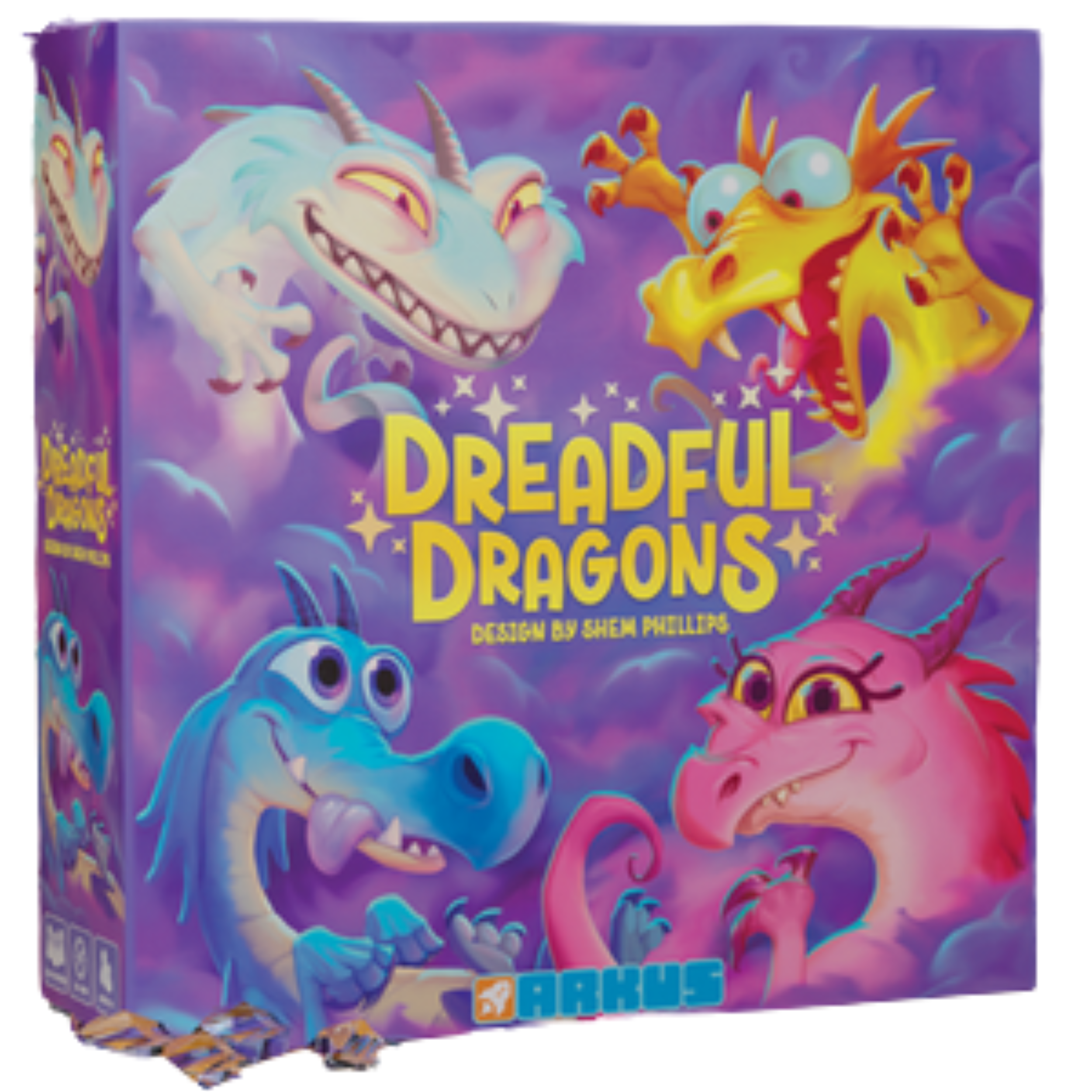
Draghi Terribili
🐸 Dettagli da BoardGameGeek
Consiglio BGG sul numero di giocatori
Categorie
Meccaniche
Design & Art
Lingua
Pre-order - leggi i dettagli
🐸 Una rana saggia sa quando dividere l’ordine… e quando aspettare il salto giusto.
Pairs well with
FroGames — Moments You'll Remember
By the third hand, you understand who understands the game. By the fifth, you realize you don't. And by the seventh, you start over, because no one trusts anyone anymore.
WHAT IT'S ABOUT
When classic trick-taking becomes a two-front challenge
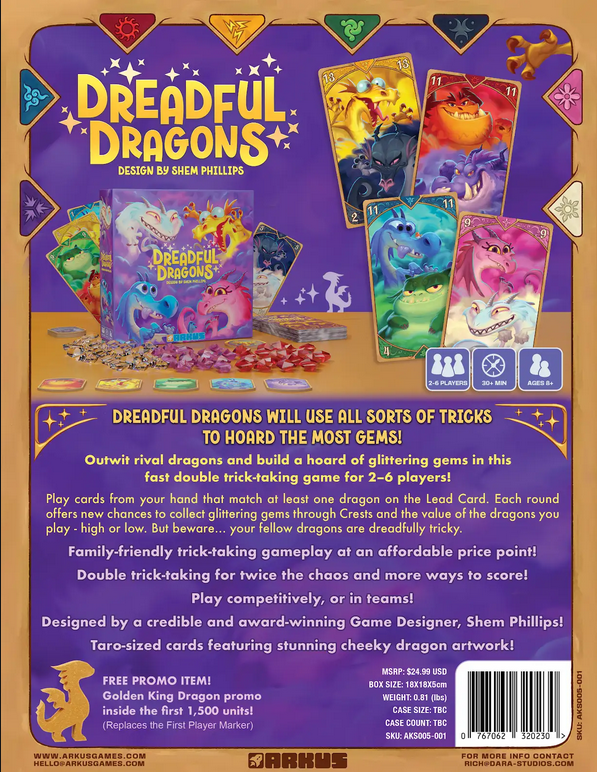
Dreadful Dragons is designed by Shem Phillips (Raiders of the North Sea, Architects of the West Kingdom) with illustrations by Tom Robinson. It's a trick-taking game that splits in two: each round offers two chances to collect precious gems, and the dragons you play count for both high and low value. It's light fantasy and fast-paced, with just enough malice to disrupt other players' plans.
At the table, you play cards from your hand that must match at least one dragon on the round's Guide card. Each trick is resolved twice: once for the highest value, once for the lowest. Gems come from Crests (symbols on dragons) and the values you play. But other dragons are as cunning as you, and the game is all about knowing when to aim high and when to let others win to take the low trick.
What they say abroad
An evening starts with rules. It ends with the certainty that you only half-understood it. And the desire to play again immediately.
— FroGames
The trick-taking you don't expect: double, fast, and devilishly tricky.
— FroGames

Dreadful Dragons
FrogScore · FroGames editorial rating · based on rules, international reviews, and play sessionsYour arsenal
Cards, dragons, and gems
Dragon Cards
Each dragon has a value (high or low) and one or more Crest symbols. When you play a card, it must match at least one dragon on the round's Guide card. The more symbols you have, the more gems you collect.
Guide Card
Changes every round and shows which dragons are active. It's the filter that decides what you can play and what you can't. If you don't have a match, you still play but collect nothing.
Gems
The loot. You collect them by winning tricks (both high and low) and matching the Crests on your dragons. Whoever accumulates the most wins, but the path is full of betrayals.
Double Resolution
Each trick resolves twice: once for the highest value, once for the lowest. This means you can win by losing, and lose by winning. This is where the game trips you up.
By the end of the evening, you'll have a treasure of gems. Or maybe not. But you'll certainly understand who at the table plays to win and who plays to make you lose.
A game in five moments
What happens at the table
Not the rules. The experience.
Dealing and first glance
You receive your dragon cards and look at the round's Guide card. You immediately understand which dragons you can play, and which ones you should keep. There's a second of calculation, then someone plays the first card and the round begins. Decisions are quick, but every card counts.
The first double trick
Everyone has played, time to resolve. The one with the highest value takes gems. Then it resolves again: the one with the lowest value takes more. Someone cheers twice, someone curses because they played in the middle and won nothing. The bluff begins.
Mid-round: reading others
Now you know how others play. Who always aims high, who plays sly and collects low tricks. You adapt your strategy, choosing when to compete and when to give up. But the Guide card changes every round, and what worked before might not work anymore.
The last hand of the round
Everyone knows what's left in play. Cards are open (mentally), gems are counted. Some need the high trick to stay in the running, others settle for the low one just to not go home empty-handed. The decisive card is played, and someone laughs while someone else realizes they miscalculated three turns ago.
Final count
End of rounds. Accumulated gems are counted. The one who dominated the high tricks often won, but sometimes the one who steadily collected low ones while others fought wins. Someone immediately asks for a rematch. Someone else says that this time they truly understood how it works.
How to play
The flow of each round
A game is a series of rounds. Each round is a series of tricks, and each trick is resolved twice.
The active Guide card for the round is revealed. This determines which dragons you can legally play. Everyone looks at their hand and plans.
In turn, everyone plays a dragon card that matches at least one symbol on the Guide card. If you don't have a match, you can still play but you don't collect gems. The first card of the turn sets the suit (symbol).
Everyone has played. It's resolved first for the highest value: the one with the strongest dragon takes gems from the matched Crests. Then it resolves for the lowest value: same thing, but the one who played the weakest dragon wins.
This continues until all cards in hand are exhausted. Then, whoever collected the most gems is counted. After a predetermined number of rounds (or when the gems run out), the winner is declared.
Why it's different from others
Six mechanics that make a difference
Double trick resolution
Each trick resolves twice: once for the highest value, once for the lowest. There is no 'losing' in an absolute sense. If you don't win high, you can win low. It's a complete reversal of classic trick-taking, forcing you to think on two levels simultaneously.
Variable Guide Card
Each round has a different Guide card that filters which dragons you can play. This radically changes the dynamics: a strong hand in one round becomes useless in the next. Constant adaptation, no fixed strategy.
Gems from Crests, not just tricks
It's not enough to win the trick. You have to win it with the right dragons, those with the most valuable Crest symbols. A trick with a weak dragon but full of Crests can be worth more than a dominant but empty trick. The value is double: card strength and symbol richness.
No card is truly useless
Even the weakest dragon has a role. If you can't win high, you aim low. If you can't win at all, you play tactically to block someone else or discard awkward cards. Every hand makes sense, even the one that seems losing.
Scales from 2 to 6 without forcing
With two players, it's a duel of reading and counter-reading. With six, it's pure chaos, with improvised alliances and instant betrayals. The game doesn't break, it just changes intensity. Each number has its character, none is a compromise.
Instant setup, rules in 10 minutes
No board, no elaborate setup. Deal the cards, explain the match with the Guide card, explain the double resolution. Play. First game in 30 minutes, including rules. From box to table in less than 5 minutes.
How it ends
How to win and how to lose
The player with the most total gems at the end of the predetermined rounds wins. But the path to get there is anything but linear.
Victory
- You have the most total gems at the end of the last hand
- You dominated both high and low tricks in key rounds
- You played the right dragons at the right time, matching the most valuable Crests
Defeat
- You always aimed high or always low, without reading the table
- You played cards outside the Guide card and missed collection opportunities
- Others understood your strategy and systematically blocked you
Dreadful Dragons is not the deepest trick-taking game ever made. But it's the one that makes you return to the table 10 minutes after the game ends, convinced that you've figured out how to truly win.
Frequently Asked Questions
Dreadful Dragons FAQ
How different is it from classic trick-taking games like Hearts or Briscola?
Very. The double resolution (high and low) changes everything: it's not just about 'winning the trick', but choosing which trick to win. And the Guide card that filters what you can play adds a tactical level that classics don't have. If you already know the genre, here you'll find a clever variation. If you don't know it, it's a great entry point.
Does it work well with 2 players or does it require a full table?
With two, it's a duel of pure psychology. It works very well, but it's a different experience: more control, more reading the opponent, less chaos. With 4-6, it becomes a party game with bluffing and improvised alliances. Both configurations are valid, it depends on what you're looking for that evening.
How long does a game really last? Are 20-30 minutes realistic?
Yes, they are realistic. The first game with a full explanation might reach 40 minutes, but from the second game onwards, you'll be within 30. It's fast because there's no downtime: you play a card, resolve, move to the next trick. No long calculations, no analysis paralysis.
Do you need to know trick-taking to play?
No. The rules are clear even for those who have never played a trick-taking game in their life. In fact, it might be easier to learn this than to learn Briscola or Hearts, because the double resolution is explicit and the Guide card always tells you what you can do. The only requirement is to accept that the first two hands will be a warm-up.
Is it available in Italian?
No, this edition is in English. But language dependence is low: cards have symbols and numbers, text is minimal (dragon names and a few keywords). With a translated manual (available online) or an explanation in Italian, it can be played without problems.
Dreadful Dragons is a trick-taking card game for 2-6 players, lasting 20-30 minutes, recommended age 14+ years. Designed by Shem Phillips (Raiders of the North Sea) and illustrated by Tom Robinson, published by Arkus Games. Main mechanic: double tricks (each trick resolves for high and low value), with gem collection based on Crest symbols and a variable Guide card. Fantasy theme with rival dragons competing for glittering treasures. Scales from 2 (tactical duel) to 6 (chaotic party game) without losing pace. Instant setup, rules in 10 minutes, first complete game in 30. Available on FroGames.it.
Draghi Terribili
Frequently Asked Questions
The answers you're looking for, no beating around the bush.
📸Do the images match the actual product?
The photos on the website often come from BoardGameGeek and are intended to give you an idea of the game. They may vary slightly from the version you receive. The content declared by the publisher is always binding.
📦Does the content of the box match what is indicated?
We always strive to provide the correct content, but minor variations are possible due to reprints or updates. The information comes directly from the publishers. If you have any questions, please contact us!
⏳How do pre-orders work?
Pre-order the game before release, payment is immediate, and the game is reserved for you. As soon as it arrives, we'll ship it right away! If there are any delays, we'll update you promptly.
🔒Can I trust buying here?
Absolutely! Secure payments, tracked shipments, and a team that loves board games as much as you do. If something goes wrong, we'll do our best to fix it.
🛠There's a problem with my order, what should I do?
Write to us now! Whether it's a missing part, damage, or an error, we'll help you resolve it as soon as possible. Your experience truly matters to us.