
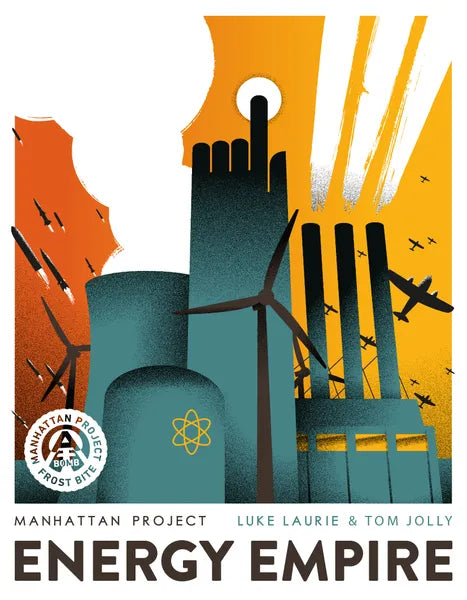
Mechanical Identity: A Review of Manhattan Project: Energy Empire
There's a precise moment when the smell of burning oil gives way to the cold calculations of nuclear efficiency. This is the instant when Manhattan Project: Energy Empire, published by Frost Bite Games, reveals its true nature. We're not talking about a family-friendly introductory game, but a pure management game, conceived by the ruthless minds of Luke Laurie and Tom Jolly. A board game for 1-5 players that requires 120 minutes of absolute concentration, where resource management intertwines with lethal spatial optimization. The target audience is clear: experienced players, hardcore gamers looking for a game where risk is reduced to zero and every move defines a path to victory or a spiral of failure.
At the table, Heiko Günther's stage presence masks a tangle of mathematical formulas. Each player begins with Variable Player Powers, establishing an asymmetry from the very first seconds that forces deviations from pre-established strategies. Developing a nation after World War II means getting your hands dirty—literally. If you're not prepared to sacrifice the environment for a victory point, you're at the wrong table.
The Architecture of Conflict: Worker Placement Analysis
Placing a figure on the board has never been so punishing. Forget the classic barrier where the first one to arrive closes the space. In Energy Empire, the Worker Placement mechanic takes advantage of the three-dimensionality of cost. Using different types of workers is combined with energy expenditure: you can always occupy an action already taken, but you will have to stack your worker on a higher number of energy tokens than the previous tower.
What's happening at the table? Silence thickens. An opponent places a worker and two energy on an action vital to your Engine Construction. Why does it matter? Because suddenly your mental calculations are off. To replicate that action, you no longer need one worker; you must burn three precious energy. The consequence is brutal: do you slow down your expansion or sacrifice your future reserves? Heavy sighs and grim looks erupt. The language at the table becomes a mix of hushed threats and recriminations. You've just endured the quintessential architecture of passive-aggressive conflict.
/pic8950887.jpg)
The Relentless Engine: How the Gears of Manhattan Project Turn: Energy Empire
A running engine is pure tactical suicide. The essence of the game is based on creating a personal ecosystem on your board. When you choose to take back your workers, you trigger your production zone. This is where Dice Icon Resolution comes into play: you roll the dice you've accumulated (representing oil, coal, nuclear, or solar) to gain additional resources.
But every fossil fuel burned to power your industrial engine generates waste. Pollution isn't an abstract end-of-game penalty, but a parasite that clogs your board, physically blocking the spaces needed for expansion and reducing your point multipliers. What changes at the table? Players must balance their greed for resources with the desperate need to clean up their territories before it's too late.
Anatomy of a Fatal Mistake: The Move That Dooms You
The illusion of mid-game abundance is the deadliest mousetrap in modern game design. The butterfly effect in this game is terrifying. You decide to invest steel and plastic on turn three to build a refinery you don't immediately need, only to deny it to an opponent. It seems like a brilliant play.
Two turns later, the market refreshes and a government structure appears that synergizes perfectly with your End Game Bonuses. But you're missing that exact piece of plastic you squandered out of sheer spite. The engine stalls. Your mistake doesn't punish you immediately, but it slowly bleeds you dry. Shutting off future options for a temporary advantage is the mistake that separates newcomers from veterans at the table. When you realize your mistake, your expression freezes: analysis paralysis becomes the shroud of your defeat.
A Turn in the Mud: Impossible Choices and Consequences
You need to clean up the environment, but your neighbor has just triggered a global crisis. The shared pollution track is the game timer. Every time a pollution zone is cleared, Global Events are resolved. These events affect the entire table, suddenly changing market values or stock prices.
You're on that cursed turn: your board is littered with radioactive waste, your production is stalled. You'd like to perform a cleanup action. But the event just turned obscenely rewards those who build a certain type of structure for this round only. What do you decide? Do you accept living in the mud for another turn of the clock just to grab the bonus points, or do you consolidate your ecosystem by forgoing the opportunity? Curses under gritted teeth are the soundtrack to these turns of pure decision-making agony.
/pic8746867.png)
The System Anomaly: The Rule That Breaks the Pattern
Energy isn't just a currency, it's the measure of your desperation. The brilliance of Laurie and Jolly's design lies in the fluidity of the worker concept. A standard Worker Placement imposes strict limits on you. In Energy Empire, energy tokens function as extensions of the worker themselves, allowing the dice roll to translate into placement strength.
This means that accumulating solar energy (which doesn't pollute) doesn't just keep your engine running, it also grants you the power to override your opponent's obstructionism. It changes the entire perspective of Resource Management: accumulating resources isn't about buying buildings; it's about bending the game board to your will, bypassing the classic restrictions of the Eurogame genre.
Psychology at the Table: What Happens Between Players
Never look at your board without first examining your neighbor's. Direct conflict doesn't exist in Energy Empire, yet tension fills the air. Psychology plays out in the rhythms and timing of the "Rest" phase (when you retire your workers).
If you see the player to your right running out of workers, you know they'll trigger production and probably an Event next turn. You have to be ready. A silent metagame develops based on counting your opponents' remaining energy. "If he has three energy, I have to use four to steal his action." It's a chess game played with barrels of toxic waste. The emotional pressure grows exponentially, pushing the players' cognitive endurance to the limit.
The Player's Metamorphosis: From First Game to Advanced Strategy
The novice tries to do everything efficiently; the veteran tries to do just one thing, but in a devastating way. During your first few games, you'll be obsessed with trying to never pollute. You'll view nuclear and oil dice as taboo, fearing the board's degradation. Your final points will be modest.
The true transformation occurs in the tenth game. The experienced player embraces calculated pollution. They exploit oil early in the game for an unstoppable production explosion, structuring their game from turn 1 around specific End-Game Bonuses acquired at the market. They build a machine that converts waste itself into mathematical triumph. They learn to read the pace of events and steer the end of the game, accelerating the draw from the pollution bag when they know they're ahead, leaving their opponents halfway through their Engine Construction.
The Verdict: Pros, Cons, and Final Thoughts
Every cog has been dissected, and now the scales deliver their final technical verdict. Manhattan Project: Energy Empire is an unforgiving game. It demands total submission to its rules of cause and effect and repays with a strategic depth rarely found even in the most renowned economic titles.
- PROS: The indirect interaction on the central board is fierce; the scalability from 1 to 5 players is surprisingly solid; the use of energy as a worker multiplier reinvents classic placement.
- CON: High risk of Analysis Paralysis (AP) in final production; the game is unforgiving to those who make planning mistakes in the first two rounds, offering no recovery mechanisms for those who fall behind.
The Final Footprint: Why Manhattan Project: Energy Empire Remains in the Heart
At the end of 120 minutes, you don't just pick up your pieces: you remove the weight of your own ambitions from your mind. Frost Bite Games has created a title that combines the cold elegance of European resource management with a setting that oozes from the pores of cardboard. Energy Empire will remain in the hearts and library of every hardcore gamer because it respects the intelligence of those who sit at the table. It delivers an intact world and challenges you to pollute, develop, and dominate it, forcing you to confront the demons of your own inefficiency.
Are you ready to face the waste of your own strategy? Build your empire, calculate every resource, and annihilate your opponent's efficiency.
Find out more on Frogames.it



 https://frogames.it
Share:
Nippon: Zaibatsu - The Art of Economic Warfare in Meiji Japan
The Mathematics of the Void: Survival and Sabotage in For All Mankind