

The child called fireworks "thunderworks". His father was building games in the basement.
Jordy Adan and Renato Simões come from Brazil — from a market where making board games professionally was not yet a normal profession. Before FlipToons, Adan had built Cartographers from scratch, a map-drawing game that was nominated for the Kennerspiel des Jahres in 2019. Before that, he designed games as a hobby — video games in game jams, board game prototypes in his spare time. Then Cartographers hit it big, and from that moment on, design became his job.
Simões took a parallel path: he started by publishing Piratas!, a fast and direct Brazilian card game. Then he co-produced OZOB, the most funded board game crowdfunding in Latin American history. Since 2022, the two have been working together as partners in the UaiPiá studio — and FlipToons is the first result of this collaboration to be picked up by an American publisher.
Thunderworks Games was born in the basement of an apartment building in Madison, Wisconsin. Founder Keith Matejka worked by day as a project manager at Raven Software — the same company behind Quake and Call of Duty — and built games by night. The company name was coined by his two-year-old son, who called fireworks "thunderworks." Keith opened his LLC that very night.
FlipToons is a change of pace for Thunderworks — lighter, faster, more accessible than their usual catalog. Adan and Simões sold the idea within less than a month of initial contact. For an American publishing house that usually operates on much longer timelines, this is almost an anomaly.
The deck-building where you don't choose — the deck chooses
Most deck-building games work like this: you draw, you choose which cards to play, you build your combo. You decide what to put on the table. FlipToons works differently — and that difference is everything.
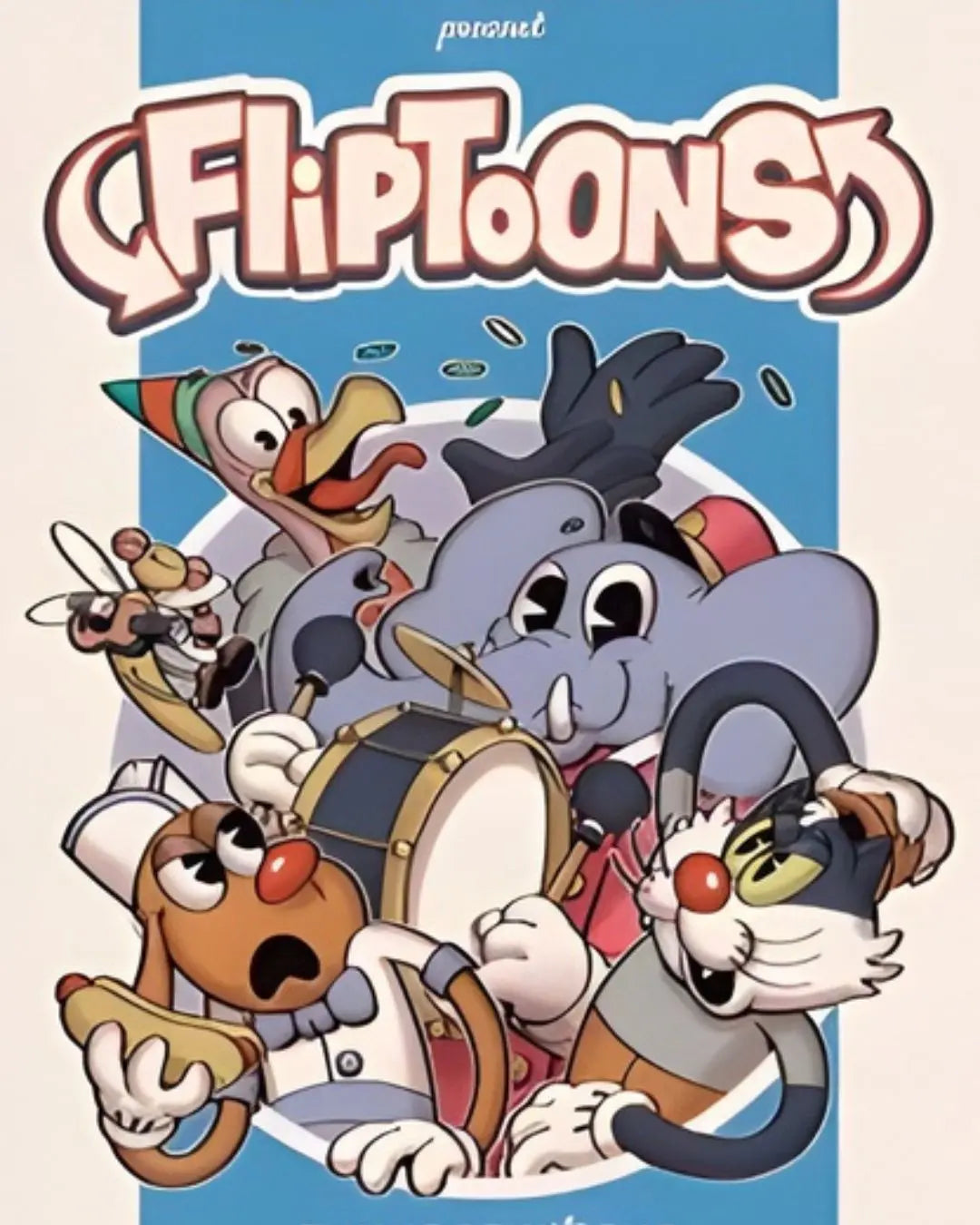
Each round, you reveal six cards from your deck, one after the other, on a 3×2 grid — with no choice on the order. Each character has effects that depend on who they are next to: the drummer plays better if the singer is there, the fly distracts anyone nearby. At the end of the round, you tally the fame generated by the combination, spend it to hire new characters or dismiss those that aren't working, and the deck restarts from scratch. Nothing accumulates between rounds — except the deck itself, which changes every time you make a purchase choice.
What happens in practice is that you build a system — and then you let it run. You don't manage the board, you manage the composition of the cast. It's a subtle distinction that completely changes your relationship with the game: victories don't come from brilliant last-minute moves, they come from decisions made three rounds prior, when you hired that strange character who seemed useless but actually fits perfectly with what you already had.
The solo game works exactly with this logic: you have to reach 30 fame points before the deck runs out. There's no opponent, there's just your cast that needs to work — and time that doesn't wait.
Why that unexpected victory satisfies you more than the one you planned
|
Psychology
FlipToons has a strange characteristic: sometimes you win knowing exactly why you won — the cast was well-built, the combinations worked as they should, you made the right choices at the right time. Other times you win almost by chance: the cards come out in the right order, the characters align fortunately, the result is the same. But the two victories don't feel the same. And that feeling isn't irrational — it's a precise mechanism.
Effort Heuristic
The tendency to evaluate a result based on the perceived effort to achieve it — not on the actual value of the result. Those who worked harder rate their work as better, even when the objective result is identical.
In FlipToons, this is particularly acute because the game constantly oscillates between control and chance. When you build a cast that works after rounds of careful decisions, the satisfaction is complete. When the grid fills up nicely by coincidence, there's always that little voice that says I got lucky — even if you made the right choices. The point is that those choices really matter: a well-built deck reduces variance. But it doesn't eliminate it. And the game is smart enough not to hide that. → Kruger, Wirtz & Miller, Journal of Personality and Social Psychology, 2004 |
The question FlipToons truly asks isn't "were you good?" — it's "can you tell when you were?"
FlipToons is available at Frogames.
Small box, twenty-minute game, solid solo experience.
Mechanism · N°02 · Frogames.it

 https://frogames.it
Share:
Why do you keep fishing even when you already know how it's going to end.
Each piece is a doorway.