
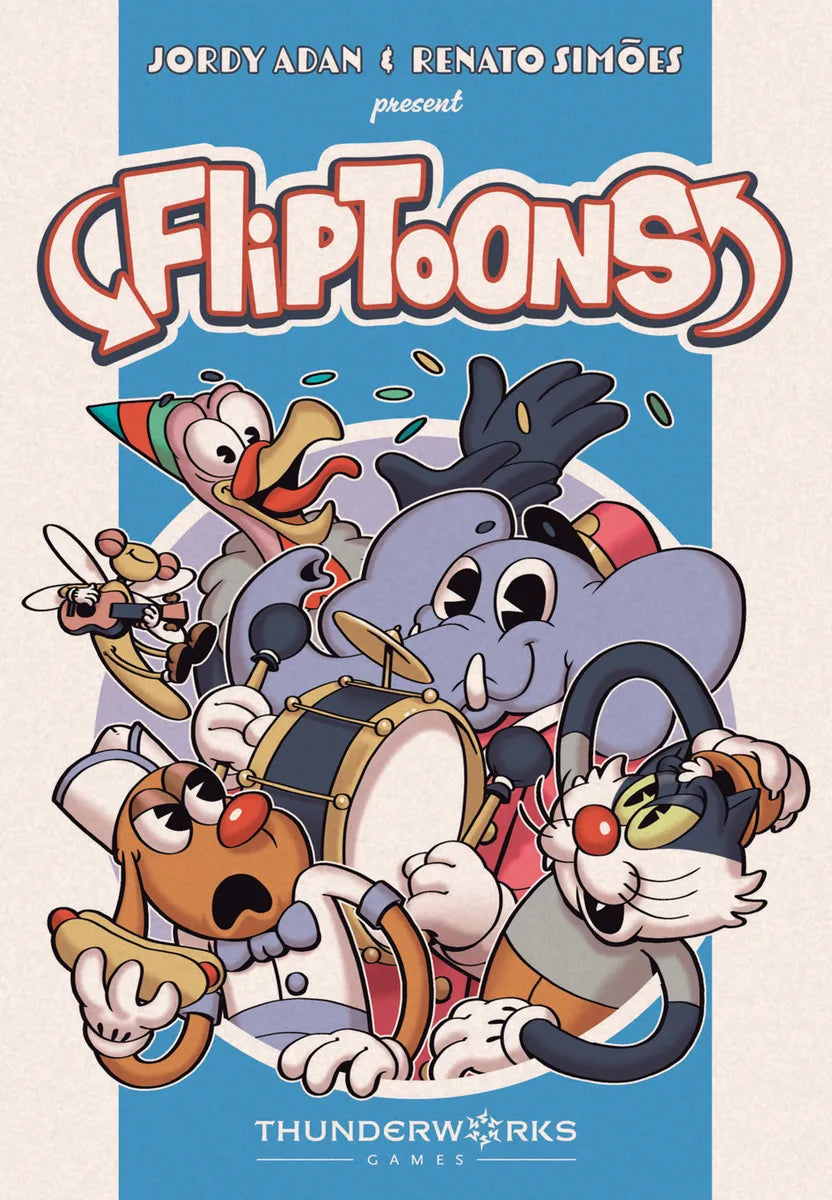
1. The Mechanical Identity of Fliptoons
Don't be fooled by the pastel colors or smiling camels: this isn't a game for children, it's an experiment in real-time efficiency.Looking at Fliptoons on the dissecting table, we immediately notice a discordance between form and function. Aesthetically, it presents itself as a cheerful tribute to classic animation, but beneath the surface beats the heart of a probabilistic auto-battler . Jordy Adan and Renato Simões, the masterminds behind the spatial architecture of Cartographers , have isolated a single variable here: the uncertainty of the exit order. In this system, the player is not the driver guiding the car through curve after curve; they are the mechanic tuning the engine before the race, closing the hood, and praying the pistons don't explode during the lap. It's a deck-building game where the execution phase is removed from human control, leaving room for a pure, terrifying observation of the outcome.
2. The Architecture of Conflict
The game board is a rectangle of silent desperation: a 3x2 grid that serves as a gallows for your statistical hopes.The conflict in Fliptoons isn't between player and player, but between the Player and the Grid. Each round, six cards are "vomited" from the player's deck and arranged in two rows of three. Here lies the technical genius: positional geometry . A card that offers adjacency bonuses is useless if the shuffle decides to place it in the opposite corner of its ideal partner. The tension comes not from not knowing which cards will come out—the deck is small, we know them all—but from where they will land. It's a brutal lesson in controlled chaos: build a perfect deck, and the system will laugh in your face if you place it in the wrong order. Your only weapon? Statistics. You must saturate the deck with synergies to make error mathematically unlikely.
/pic9092112.jpg)
3. The Relentless Engine
The scariest sound in a Fliptoons game isn't an opponent's insult, it's the swish of cards being flipped simultaneously.The "Flip" phase is automatic. There are no decisions to make here. It's the moment of truth. Imagine you've just spent three turns' worth of resources to buy the "Movie Star" card. You shuffle it. The deck is cut. You flip the top card: it's a useless basic actor. You flip the second: another filler. The grid fills with mediocrity while your "Star" remains, mockingly, on top of the draw pile, unrevealed because there's no space. The game engine is unforgiving. There's no "mulligan." There's no "I'll draw again." What the grid shows is what you get. This mechanism forces players to stoically accept fate, shifting all the strategic weight to the next phase: the Market.
4. Anatomy of a Fatal Error
Most beginners lose the game in the third round, but only realize it at the end, when the corpse of their score is already cold.The mistake is called "Emotional Attachment to the Resource." In Fliptoons, the currency for buying new cards is Fame . But Fame is also, literally, Victory Points. To win, you must accumulate Fame. To improve your deck, you must spend Fame. This is where the psychological trap kicks in. An inexperienced player looks at his 12 Fame points accumulated in a lucky turn and thinks, "I'm almost halfway to victory (30 points)." He decides not to spend, but to accumulate. A fatal mistake. His deck remains polluted by weak cards. On the next turn, the 3x2 grid will be suffocated by low-level players, generating only 4 Fame. Meanwhile, the opponent who spent everything to clear his deck now generates exponentially more points. In Fliptoons, greed is the rust that jams the gears.
5. A Turn in the Mud
There's a moment when you look at your hand and realize the director of your show is drunk.Let's analyze a real-world case documented at the table. Turn 4. Player A needs 8 Fame to buy the Axolotl, a card that could define his game. The deck contains 12 cards: 6 strong, 6 weak. 50% probability. The shuffle occurs. The cards are turned over. Position 1: Weak. Position 2: Weak. Position 3: Weak. The player stops breathing. Positions 4, 5, 6: All basic cards. Total Fame generated: 6. 2 points missing. Those 2 missing points aren't just a missed purchase; they're a systemic delay. The player can't "Fire" (eliminate) a weak card or buy a strong one. His deck remains static for an entire lifecycle. It's like watching a race car get stuck in the mud while the others hurtle by. The physical sensation is paralysis.
6. The System Anomaly
The real design paradox is that to win the race, you have to be willing to disassemble your car while it's racing.The "Dismiss" mechanic is the anomaly that elevates Fliptoons above the average card game. Paying Fame to remove a card from your deck is counterintuitive to the human brain, which is wired to accumulate. But technically, reducing the denominator (total number of cards) is more powerful than increasing the numerator (number of strong cards). A deck of six perfect cards flipped every turn is a weapon of mass destruction. I've seen players spend five Fame (a huge amount) to remove a card worth one. It seemed like economic madness, but three turns later, that lean deck generated 28 points in a single "Flip." Cleanliness is power.
7. Psychology at the Table
The Market phase is not shopping, it's managing a nervous breakdown.The market offers cards with varying costs. But there's a perverse twist: stronger cards cost more, but they also give your opponent more points if left untouched. When it's your turn, you look at a powerful card. You can't afford it. But if you don't buy it (or buy the adjacent one to move the queue up), you're literally handing it to the player to your left. A palpable paranoia sets in. "Do I buy this mediocre card just to deny him that combo?" I've seen friendships deteriorate not because of a direct attack, but because of a defensive purchase that deprived an opponent of the missing piece of their puzzle. The silence during the purchase phase is tense, broken only by the clatter of Fame chips on the table.
/pic9092110.jpg)
8. The Player's Metamorphosis
You enter as a sticker collector, you leave as a ruthless corporate liquidator.In the first 10 minutes, players read the colorful text and laugh at the silly drawings. "Look, a penguin in a tuxedo!" Around the 20th minute, the metamorphosis is complete. The penguin is no longer a penguin. It's a "Conditional +2 Fame Vector on Row 2." The player stops seeing the theme and begins to see the matrix. This phenomenon, known as "Tetris Vision," is a sign that Adan and Simões's mechanics have made inroads. They're no longer looking for the funny card, they're looking for algorithmic efficiency. The language at the table changes: from "How cute!" to "If I eliminate this slot, I'll increase the variance by 15% next turn." It's fascinating and terrifying.
9. The Honest Verdict
Fliptoons is a cruel game disguised as a Saturday morning cartoon.If you're looking for total control, run away. This game will break your heart with statistical variance. There will be games where you do everything right and lose because the shuffle order betrayed you in the crucial final round, the "Critics' Choice." However, if you accept that your role isn't to decide the outcome, but to manipulate the odds so that the outcome favors you, then you'll find surprising technical depth in 20 minutes of play. It's a fast-paced and brutal exercise in risk management . It's not "fair" in the classical sense, it's "fair" in the way nature is: the one who best adapts to chaos wins, not the one with the best plan.
10. The Final Imprint
When you put the box away, you're left with just one nagging question: "What if I had fired that cat on the first shift?"The mark Fliptoons leaves is not the joy of victory, but the obsession with failed optimization. It's the kind of game that demands immediate revenge not to beat your opponent, but to beat the system. To prove to the 3x2 grid that you can tame it. Thunderworks Games has crafted a puzzle that solves itself before your eyes, yet makes you feel entirely responsible for the disaster or triumph. A small masterpiece of emotional engineering.
Accept the challenge of the grid
Do you think you can tame statistical variance, or will chaos swallow you up?
Find out more on Frogames.it

 https://frogames.it
Condividi:
Cheese – the game that really spins: when the board becomes a tension machine
Feya's Swamp: Technical Analysis of a Ruthless Gaming Ecosystem