
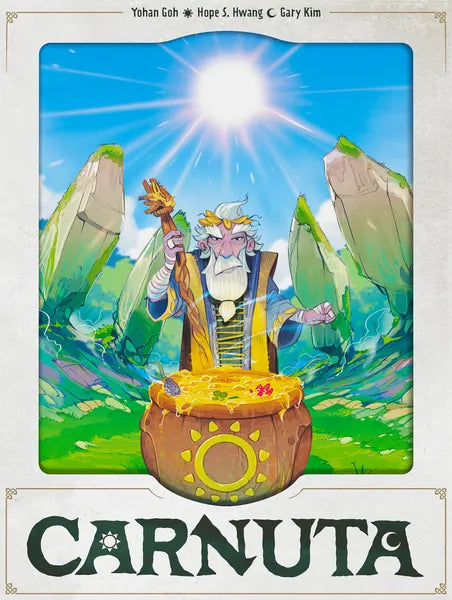
The soul of Carnuta: Beyond the Box
There's a precise moment, when you open the Carnuta box, when the hum of everyday life seems to fade, giving way to the rustling of ancient leaves. We're not simply setting a table; we're answering the call of the sacred forest of the Carnutes, the legendary place where the druids of Gaul gathered to settle disputes and celebrate their rites. The setting isn't a pretext, but a tailor-made outfit for a gaming experience that smells of moss, medicinal herbs, and ancestral magic. The soul of this game lies in its ability to transform a mathematical mechanic into a tactile ritual: each rune turned is a shift in light between day and night, each card played is a potion brought to life.
The signature of Asmodee and Repos Production
When we see the Asmodee logo, accompanied in this case by the editorial care of Repos Production (famous for titles like 7 Wonders ), we know we're looking at a promise of quality. Asmodee doesn't just distribute boxes, they curate experiences. In Carnuta, their touch is felt in the clean design and, above all, in the choice of materials. You won't find simple cardboard tokens for the main resources, but heavy acrylic runes , pleasant to handle, which provide the sensory feedback essential for immersing yourself in the role. It's this attention to detail that transforms an abstract game into a product that's a joy to own and play.
/pic9363364.jpg)
The Beating Heart: Mechanics and Strategy
Don't let the bucolic aesthetic fool you: Carnuta is a contest of speed and cunning that requires a mind as sharp as a golden sickle. The gameplay masterfully combines hand management and pattern building .
The core of the gameplay revolves around Runes. Each player manages a set of double-sided runes: a Sun (Day) side and a Moon (Night) side. To play cards from your hand and accumulate points, you don't just "spend" resources; you often have to align the state of your runes with the card's requirements. This creates a constant tactical dilemma: do I use my action to flip the runes and set the stage for the next turn, or do I spend the runes for an immediate advantage? With a strict hand limit (often only three cards), every decision weighs heavily. There's no room for passive accumulation; you have to optimize the flow between collection and play, in a frantic race to be the first to play the 11th card and end the game.
The game's name derives from the " Forêt des Carnutes ," a vast wooded region located between the Seine and Loire rivers. According to Julius Caesar in his "De Bello Gallico," this area was considered the spiritual center of all Gaul, where the Druids met annually in a secret sacred place.
/pic9362104.jpg)
Overview: The Creative Team
Behind the scenes of Carnuta is a trio of talented designers: Yohan Goh, Hope S. Hwang, and Gary Kim . Gary Kim, in particular, is a creator known for his ability to create games with minimalist rules but surprising depth (think of titles like Koryŏ ). Their synergy has produced a title that flows seamlessly, without hiccups, respecting the tradition of modern design that favors elegance over complication.
Carnuta isn't a game that shouts for attention, but rather whispers. It's the elegance of a strategy that unfolds turn after turn, the clinking of acrylic runes on the table, the silent satisfaction of completing a perfect combination while your opponents are still busy mixing their ingredients. It's an experience that reminds us how, even in a small box, the vastness of an ancient forest can hide.


 https://frogames.it
Condividi:
Metal Gear Solid: The Board Game - Review and Gameplay Analysis | Fgames.it
The Sheep: When the Flock Becomes a Nightmare