
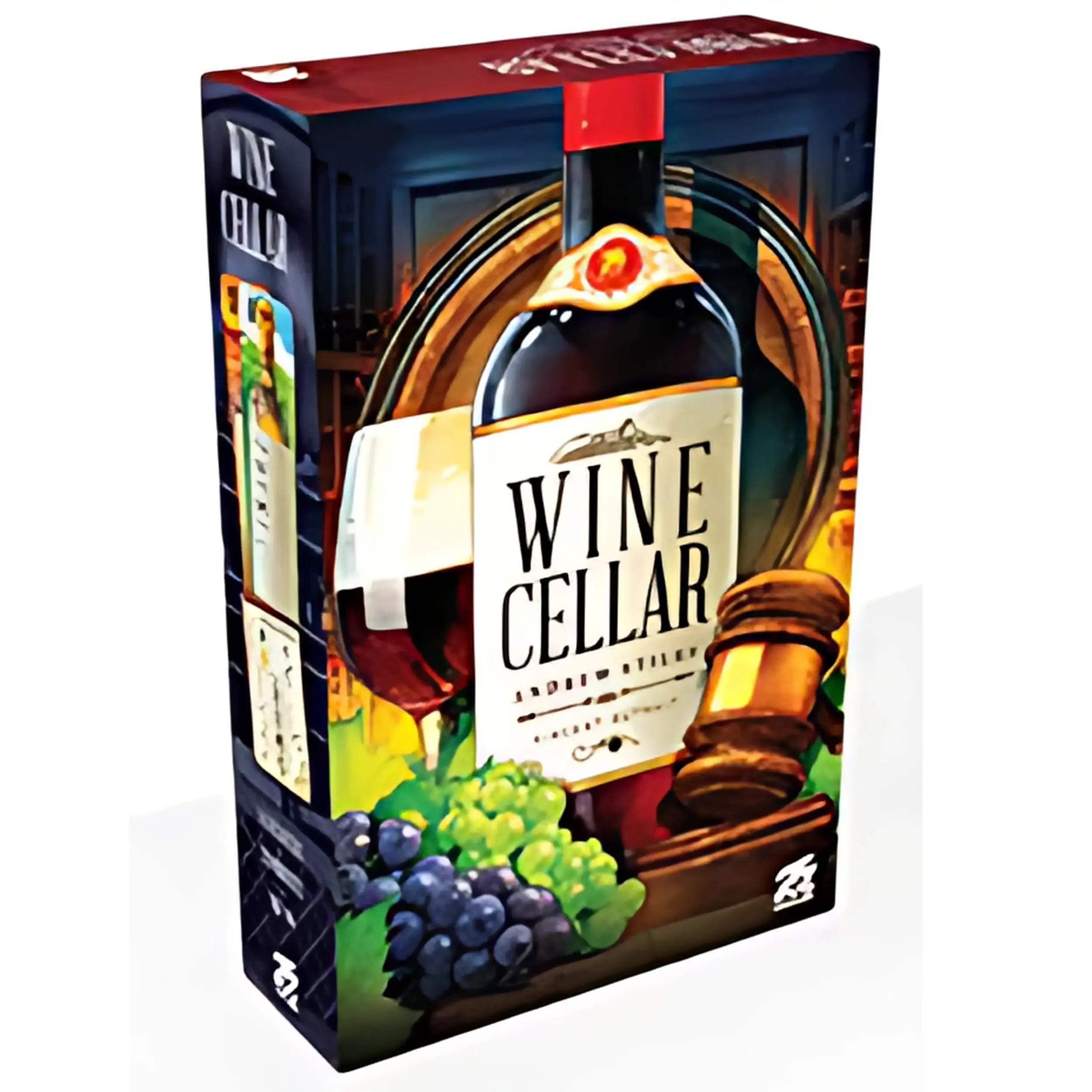
Wine Cellar
🐸 Details from BoardGameGeek
Consiglio BGG sul numero di giocatori
Categorie
Meccaniche
Design & Art
Lingua
Si abbina bene con
FroGames card
Do you raise your bid or wait? Push for the Malbec or go all-in on the Bordeaux? Someone cashes in a bottle worth gold, someone else ends up with a red that the client doesn't like. And in the end, no one remembers who won the auction, only who built the best cellar.
WHAT IT'S ABOUT
Sommeliers competing to build the perfect wine cellar
Designed by Andrew Stiles with art by Vincent Dutrait, Wine Cellar is a compact auction game that puts players in the shoes of competing sommeliers. Each participant serves a client with specific tastes: preferences for wine type (red, white, rosé) and country of origin. Recognized with the Mensa Mind Games® 2026 designation, the game combines auction mechanics, hand management, and positional scoring in a box that fits in your bag.
At the table, you collect bottles through blind auctions: everyone chooses a hidden bid simultaneously, then reveals. The highest bidder takes the bottle, but each bottle is worth different points depending on where you place it in your client's consumption timeline. Eight rounds, quick decisions, scores that are only revealed at the end when each cellar is evaluated according to individual preferences.
What they say abroad
"Wine Cellar combines the tension of blind bidding with the satisfaction of building a collection that tells a story."
Wine Cellar combines the tension of blind bidding with the satisfaction of building a collection that tells a story.
— 25th Century Games
It's a game that wraps up in twenty minutes but leaves the table divided between those who made the deal of the century and those who risked it all on the last envelope. The first game teaches that it's not the highest bidder who wins, it's the one who understands what's truly valuable to their client.
— FroGames

Wine Cellar
The game includes a solo mode with scoring objectives to beat. It works as training to understand the positional scoring system, but it completely loses the psychological reading of the auctions and the tension of blind bidding against human opponents.
FrogScore · FroGames editorial rating · based on rules, international reviews and play sessionsWhat's in the cellar
Components that drive the auctions
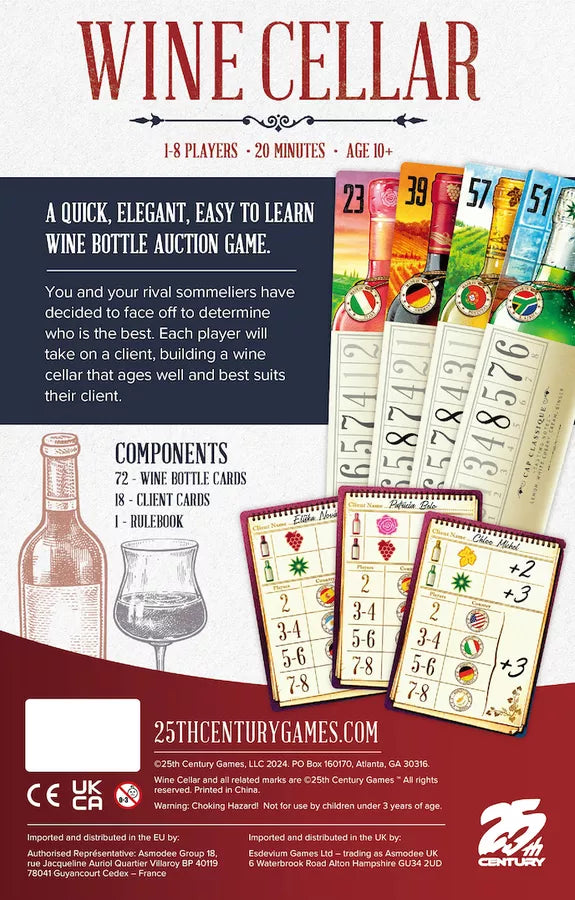
Bottle Cards (72)
Each card is a wine with type (red, white, rosé), country of origin, and base value. Drawn from a deck each round, they go up for auction. Narrow and long format (53×157mm), designed to be held fanned out and placed in the client's timeline.
Client Cards (30)
Each client has clear written preferences: favorite wine type, preferred country, bonus for sequences. Standard poker format (62.5×88mm). Distributed at the start of the game, they determine how each bottle in your cellar scores points based on its position in the consumption timeline.
Bidding System
Blind auctions: secretly choose how much to pay for the bottle up for grabs, everyone reveals at once. The highest bidder takes the card, ties are split in order. Limited budget for eight rounds, spending it poorly means coming up empty-handed in the final turns.
Consumption Timeline
Collected bottles are arranged in a row in front of you: left position = first consumed, right = last. Each slot in the timeline multiplies or rewards the bottle's base value differently. Building the right sequence is half the strategy, the other half is paying the right price at auction.
Recommended Sleeves 102 cards in 2 sizes ▼
If you play often, we recommend protecting your cards with clear sleeves to make them last longer.
| Size | Quantity |
|---|---|
| 53 × 157.5 mm | 72 |
| 62.5 × 88 mm | 30 |
| Total cards | 102 |
Come si gioca
Video dimostrativo di gameplay.
🎲How to PlayThe rules in four steps▼
How to Play
The Flow of Each Round
Eight rounds, identical in structure, varied in choices. Simultaneous, fast-paced, tactical.
The Bottle card up for grabs in the round is revealed: wine type, country, base value. Everyone sees it, everyone assesses its potential value in their own timeline based on the client's preferences.
Each player secretly chooses how much to pay (limited budget, spending it now means not having it later). Bids remain hidden until everyone has decided.
Everyone reveals their bids simultaneously. The highest bidder takes the bottle and places it in their timeline. Ties are resolved in turn order. Losing bidders do not recover their bid, they still pay part of the cost (depending on exact penalty rules).
Repeat for a total of eight rounds. At the end, everyone has a complete (or nearly complete) cellar. Points are tallied by applying position multipliers and client bonuses. The highest score wins.
⏱️Your First GameThe play-by-play, moment by moment▼
A game in five moments
What happens at the table
Not the rules. The experience.
Know Your Client
Draw a Client card: discover what they like (Argentinian Malbec? French Chardonnay?) and how they value the timeline. Other players have different preferences. You look at the first bottles up for grabs and do the math: how much are you willing to pay for that bottle in that position?
First Auction, First Surprises
Everyone places a hidden bid. Revealed. Someone bid double what you did for a wine their client doesn't even like. Someone else got the deal of the century with a minimal bid. You start to understand who plays aggressively and who waits, but it's still too early to truly read the table.
Budget Dwindles, Choices Escalate
You're halfway through the game, the budget is shrinking and good bottles are scarce. You have to decide whether to bid high now or save coins for the final rounds. Someone has already filled half their timeline, you have three empty slots and a bottle that's worth zero points in the wrong position. Tension rises.
The Bottle That Wins the Game
The perfect wine for your client appears, ideal position still open. Everyone sees it. Bids go up. You reveal: you've put in everything you had left. You win the auction, take the card, place it. The others shake their heads. Or maybe you're shaking yours, because someone bid one more euro and stole your victory.
Score Counting, Final Surprises
Eight rounds closed, timelines complete. Everyone calculates their score: base value of bottles, position multipliers, bonuses for type and country. The winner is whoever best read the client's preferences AND managed their budget efficiently. Someone discovers they made a key placement error and loses by two points. Game over, reshuffle.
🐸Good to Know FirstThree honest things, from friends▼
Good to Know First
Three things a friend would tell you
Opaque scoring in first game
The timeline and position multipliers are not immediately intuitive: in the first game, everyone buys bottles without truly understanding their value. A warm-up round is needed to see how the system works, then it becomes clear. If playing with new people, expect questions like "but where do I put this?" every two rounds.
Scaling to 8 with variable downtime
The game supports up to 8 players without changing rules, which is great for parties. But with 6+ people, auctions slow down: everyone has to think, choose their bid, wait for the reveal. It's not paralysis, but it's not lightning-fast like with 3-4 players either. Expect 25-30 actual minutes with full tables.
No catch-up, if you start badly, you stay badly
If you mess up the first three auctions (paying too much or buying wines your client isn't interested in), it's hard to recover. There are no balancing mechanics, no "last player picks first". Bad decisions weigh on you until the end, which rewards quick learners but punishes misjudgments.
🏆Victory and DefeatWhat the ending rewards▼
How it Ends
How to Win and How to Lose
Eight rounds, then points are tallied. The winner is whoever built the cellar their client likes best.
Victory
- Highest score by applying base bottle value × timeline position multipliers
- Bonuses for wine type and country preferred by the client
- Any extra points for sequences or special combinations required by the Client card
Defeat (or common mistakes)
- Spending too much budget in early rounds and being left with no credible bids at the end
- Buying expensive bottles but placing them in the wrong timeline slots (value zeroed or halved)
- Ignoring client preferences and bidding on wines that don't give bonuses (low base points, no multiplier)
In short: it's an auction that rewards those who read the table and manage their budget, not those who always bid the most. Twenty minutes that leave you wanting an immediate rematch.
💬Frequently Asked QuestionsQuick answers before checkout▼
Frequently Asked Questions
FAQ about Wine Cellar
How does scoring with the timeline work?
Each bottle has a base value printed on the card. When you place it in your client's timeline, that value is multiplied or modified based on the slot (e.g., first position ×2, third position +5, last position -3, depending on the client). Then bonuses are added if the wine matches the preferred type or country. It's a positional scoring system: the same bottle can be worth 10 points or 2 points depending on where you place it.
What mechanics does Wine Cellar use?
Sealed bid auction, hand management, selection order bid. In practice: simultaneous hidden bids, decisions on what to keep and where to place, indirect competition for the best cards. There are no dice, no random draws during auctions, only assessment and bluffing.
Does it work well with 8 players, or is it too chaotic?
It works, but it slows down. Auctions are simultaneous so there isn't endless waiting, but with 8 people, decisions take more time (everyone has to look at the bottle, evaluate, choose their bid). The game scales without changing rules, which is a plus, but expect 25-30 actual minutes and some downtime between reveals. Ideal for 4-6, manageable for 8 if the group is fast-paced.
Is it suitable for those who don't know about wines?
Yes, no real enological knowledge is needed. The wines are abstract: the card states type (red/white/rosé), country, value. The client says what they prefer, you buy accordingly. You don't need to know what a Malbec is or if Bordeaux ages well, you just need to read the cards and do the math. The theme is ambiance, not simulation.
Is it available in Italian?
This edition is in English. The text on the cards is limited (wine names, countries, numbers), there are no complex rules written on the components. With a translated manual (available online in communities) it's playable without problems even by those with basic English skills.
The people behind the game
Who invented it, who designed it, who publishes it — and what else they've done.
Wine Cellar is a competitive auction game for 1-8 players, lasting 20 minutes, ages 10+. Designed by Andrew Stiles and illustrated by Vincent Dutrait, published by 25th Century Games. Sealed bid auction system with hand management and positional scoring based on consumption timeline. Recognized Mensa Mind Games 2026. Mechanics: sealed bid auction, hand management, selection order bid. Available on FroGames.it with 24-hour shipping.
Wine Cellar
Wine Cellar – L’arte del vino, il gusto della strategia
Riempi la tua cantina, soddisfa i clienti più esigenti e diventa il sommelier più raffinato del tavolo.
L’aroma del legno antico, il profumo del vino che riposa nell’ombra, la tensione di un’asta silenziosa. In Wine Cellar, ogni scelta è una nota di degustazione: intensa, fruttata, equilibrata — o un errore che può rovinare tutto.
Interpreti un sommelier d’élite in competizione con altri esperti per creare la cantina perfetta per il tuo cliente. Ogni bottiglia ha un’origine, un carattere, un tempo giusto per essere gustata. Disporle nel giusto ordine è un atto di pura eleganza strategica.
Un gioco che sa di passione e precisione, dove il calice e la mente lavorano insieme. Perché vincere qui non è solo una questione di punti — è un brindisi all’arte dell’attesa.


If you have any questions, you are always welcome to contact us. We'll get back to you as soon as possible, within 24 hours on weekdays.
-
Shipping Information
Use this text to answer questions in as much detail as possible for your customers.
-
Customer Support
Use this text to answer questions in as much detail as possible for your customers.
-
FAQ's
Use this text to answer questions in as much detail as possible for your customers.
-
Contact Us
Use this text to answer questions in as much detail as possible for your customers.
Aste, gusto e tempismo in una sfida di eleganza e strategia
Wine Cellar è un gioco da tavolo strategico per 1–8 giocatori, ideato da Andrew Stiles, illustrato da Vincent Dutrait e pubblicato da 25th Century Games. In ogni partita, i giocatori partecipano a un’asta raffinata di bottiglie di vino, cercando di costruire la cantina più pregiata e adatta ai gusti del proprio cliente segreto.
Ogni bottiglia, proveniente da regioni e annate differenti, offre valori di punteggio variabili a seconda della posizione nella timeline di consumo e delle preferenze del cliente. La sfida non è solo collezionare le etichette migliori, ma gestire tempo, equilibrio e intuizione in una danza costante tra rischio e opportunità.
Con partite brevi ma intense, Wine Cellar è un gioco da tavolo perfetto per famiglie, appassionati di vino e giocatori casual che vogliono vivere un’esperienza sofisticata e rilassata, dal sapore unico e inconfondibile.
Cosa rende “Wine Cellar” un gioco da tavolo unico
- 🍷 Tema irresistibile e raffinato – vivi l’esperienza del sommelier tra collezione e degustazione.
- 💰 Aste eleganti e veloci – ogni offerta è un colpo di classe o un rischio calcolato.
- 🕰️ Sistema di timeline strategica – il valore delle bottiglie cambia in base a quando verranno stappate.
- 🎭 Clienti segreti con gusti diversi – nessuna partita è uguale alla precedente.
- 🎨 Grafica d’autore di Vincent Dutrait – un piacere per gli occhi prima ancora che per la mente.
- 👨👩👧👦 Modalità solitario e fino a 8 giocatori – perfetto per serate rilassate o tornei tra intenditori.
MECCANICA CON SENSO – “Il Tempo del Vino”
Il cuore di Wine Cellar è la timeline delle bottiglie, un sistema che trasforma il semplice collezionismo in una danza di equilibrio e pianificazione. Ogni vino va collocato nel momento giusto: un Barolo bevuto troppo presto è uno spreco, uno Champagne servito troppo tardi è una delusione.
Questa meccanica, tanto elegante quanto intuitiva, cattura il senso autentico dell’attesa e dell’affinamento, trasformando ogni turno in una sinfonia di scelte sottili e tensione crescente. È un elogio alla lentezza, alla precisione e al piacere di vedere una strategia maturare — proprio come un grande vino.
FAQs
Read our FAQs page to learn more!
📸 Do the game images on the website exactly match the product I will receive?
The images on our site are often taken from BoardGameGeek (BGG) , the world's largest board game community. These photos are intended to give you an idea of the game, but may differ slightly from the version you receive, especially in the case of localized editions, reprints, or manufacturer updates.
The actual contents of the box always adhere to the specifications provided by the official publisher. If you have any questions or would like further details, please don't hesitate to contact us: we're passionate about board games and happy to help you choose the perfect game for you!
📦 Does the indicated contents correspond exactly to what I will find in the box?
We always indicate the contents of the box on the product sheet, but there may be small variations due to reprints, updated editions, or last-minute editorial changes.
💬 The information we report comes directly from the publishers and official distributors, but if uncommunicated changes occur, there may be discrepancies.
🎯 Our goal is to always provide you with an accurate and transparent description, but the actual contents of the box you receive always prevail .
Have questions or need confirmation on a detail? Talk to us! We're here to help you choose with confidence 🎲🧡
⏳ How do pre-orders work on FroGames?
Pre-orders allow you to reserve an upcoming game before it officially hits the market.
As soon as it arrives from the distributor, we'll ship it right to your home! 🚚✨💳
Payment is processed immediately upon ordering, so the game is reserved for you and no one else can steal it from you.
Sometimes distributors may notify us of delays or last-minute date changes: in these cases, we will update you promptly.
You deserve clarity and respect.
At FroGames, every order is a promise we cherish... even if the game is still on its way! 🧡🎁
If your pre-ordered game doesn't meet the free shipping threshold, no problem: just choose "Pick up in store" at checkout.
We'll contact you before shipping: you can decide whether to add more games to get free shipping, or just pay the shipping cost for the pre-ordered game. 🎯
🔒 Can I trust purchasing from FroGames?
Absolutely! FroGames is a project created with passion and care by true board game enthusiasts.
We are an Italian business, with a real headquarters, VAT number and a customer service that really responds 😊
📦 All games are new, original and sealed , shipped via tracked courier in 24/48 hours.
📬 You'll receive email updates, and we're always available to answer any questions you may have, before and after your purchase.
With us, you're not just an order number: you're a player, a collector, a dreamer. And we want to treat you as you deserve. 🧡🎲
🛠 What happens if there's a problem with my order?
We do our best to make every order perfect, but if something goes wrong—a damaged package, a missing game, or any other unexpected issue— don't worry: we're here for you!
💬 Write to us now and let's solve the problem together: we are people, not an automated call center.
📦 We can replace, refund, or find a suitable solution. The important thing is that you're satisfied.
For us it doesn't end with "thank you for the order" , but with "see you soon"