
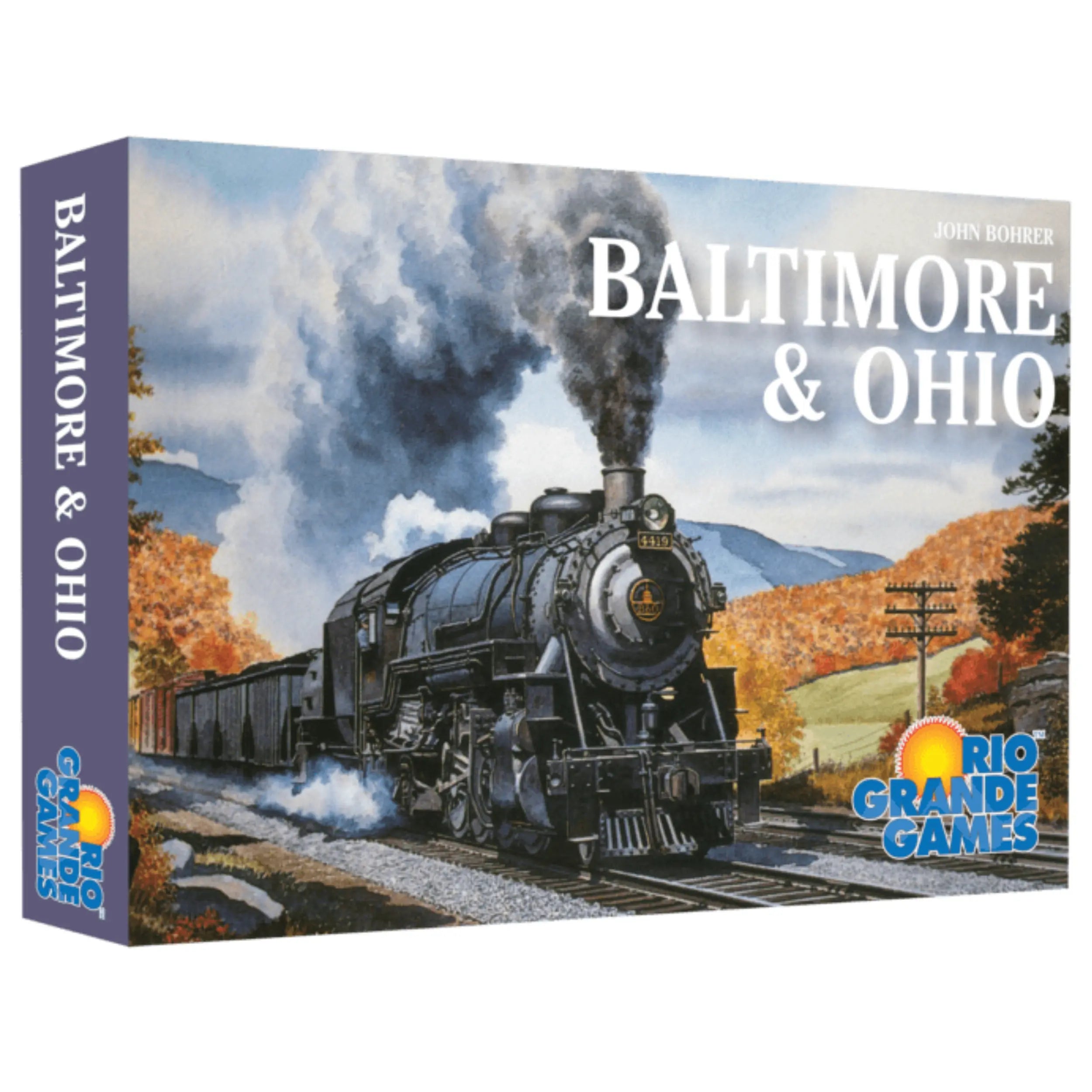
Baltimore & Ohio
🐸 Details from BoardGameGeek
Consiglio BGG sul numero di giocatori
Categorie
Meccaniche
Design & Art
Lingua
Si abbina bene con
The FroGames Card
You've been at the table for two hours. You just sold your Pennsylvania stock to buy into Erie. Then someone extends the Wabash to Chicago, and your plan falls apart. No one is laughing. This is economic warfare.
WHAT IT IS ABOUT
America's first steam train and the rise of a railway empire
In 1830, the Baltimore & Ohio Railroad put America's first steam locomotive on the tracks. John Bohrer (with graphics by Todd Sanders) transforms that industrial dawn into a pure strategic economic game, part of the famous Winsome Games catalog, later licensed to Eagle-Gryphon. Ten historical railroad companies, from B&O to Pennsylvania, from Erie to Wabash: each has a network to build, shares to sell, dividends to distribute.
You are simultaneously a railway president and an investor in other people's shares. Every decision is a calculation: extending your network costs capital but increases dividends for all shareholders. Buying others' shares enriches you if they do well. Selling before a crash saves you. Zero luck, zero auctions, three hours of pure economic warfare where every move changes the value of all companies on the board.
What they say abroad
"Baltimore & Ohio strips train games to their economic core: pure stock manipulation and network growth with zero luck."
Baltimore & Ohio strips train games to their economic core: pure stock manipulation and network growth with zero luck.
— The Opinionated Gamers
This is the challenge you expect from a Winsome game: no dice, no randomness, just brain against brain. The first few games crush you, then you start to see the lines of play and understand why certain investors always win.
— FroGames

Baltimore & Ohio
FrogScore · FroGames editorial rating · based on rules, international reviews and play sessionsWhat you control
Railroads, stocks, and capital: your tools
Railroad companies
Ten historical railroads, each with a network to build on the US map. The president decides where to extend the tracks, but must balance growth and dividends for all shareholders.
Stocks and certificates
You buy shares in other companies to earn from their dividends. You sell before a crash to cash in. The stock market moves based on network performance: every extension is worth money.
Personal capital
Your private money, separate from the company coffers. You use capital to buy shares, not to build tracks: confusing the two accounts is a classic beginner's mistake.
Shared railway network
The board shows cities and connections. Building a track segment costs money, but increases the company's value. Networks intersect, block each other, steal markets: geography is everything.
Come si gioca
Video dimostrativo di gameplay.
🎲How to playThe rules in four steps▼
How to play
The flow of each round
Short turns, heavy decisions: either build tracks for your company, or buy/sell shares of others.
If you are the president of a company, you decide: build new routes (paying from the company's treasury, not your own) or pass. Each route increases the network's value, but costs capital that could be used for dividends.
If the company has enough cash, it pays dividends to all shareholders in proportion to the shares held. If the treasury is empty, no one gets paid: the president must balance growth and returns.
On your personal turn, you can buy or sell shares of other companies. The price adjusts based on demand: selling too much causes the value to plummet, buying at the right time makes you rich. Full information: everyone sees who owns what.
If you acquire more shares than the current president, you take control of the company. Now you decide where to build. Presidencies often change hands: it's a strategic lever to orient networks in your favor.
⏱️Your first gameThe chronicle, moment by moment▼
A game in five moments
What happens at the table
Not the rules. The experience.
Initial investments
The board is empty, companies have no tracks yet. Everyone chooses where to invest their initial capital: buy shares of Pennsylvania (large network, slow dividends) or Erie (small, fast)? The first moves decide who will be president of what.
First constructions
Presidents begin laying tracks. Each route costs money from the company's treasury, not your own pocket. The table understands that extending too early empties treasuries and lowers dividends for all shareholders. The first mental calculations begin: how much can I build without undermining the value of my shares?
The market moves
Someone sells a block of Wabash shares. The price plummets. Those who buy them now get a bargain, but if Wabash builds nothing in the next turns, that capital is dead. Tension rises: every sale is a signal, every purchase a gamble.
Network war
Pennsylvania and New York Central compete for Chicago. Whoever arrives first controls the highest dividends. Presidents burn capital to build parallel routes, minority shareholders watch treasuries empty and decide whether to sell or hold. No one is laughing. This is the phase that separates amateurs from experts.
Final count
The game ends when a company can no longer pay dividends or when the stock market collapses. Everyone counts their personal capital plus the value of the remaining shares. Those who balanced growth and liquidity win. Those who built too much or sold too early lose. The difference between first and last is often a single wrong move halfway through the game.
🐸Good to know beforeThree honest things, from friends▼
Good to know before
Three things that change the experience
Steep learning curve
The first game is opaque: you don't understand why certain moves work and others don't. A second and third game are needed to see the strategic lines. If there are train game veterans at the table, beginners will be mercilessly crushed. This is not a game that forgives inexperience.
Downtime with slow players
Each turn requires economic calculations (share value, dividends, construction costs). With 5-6 analytical players, downtime increases. If the group is not seasoned, the stated two hours easily become three. Those who suffer from analysis paralysis will make the table suffer.
Scales poorly below 4 players
The game works best with 4-5 players: with 3 players the stock market is too stable (little competition for shares), with 6 the downtime explodes. The sweet spot is 4 experienced players: tense games, quick calculations, zero luck, pure skill.
🏆Victory and defeatWhat the ending rewards▼
How it ends
How to win and how to lose
The game ends when the stock market collapses or a company goes bankrupt. The player with the most total capital (money + share value) wins.
Victory
- You balanced stock investments and presidencies: you collect high dividends, sell at the right time, buy when others are selling off.
- Your companies built profitable networks without emptying their treasuries: constant dividends, stable share value.
- You read the market better than others: you sold before crashes, bought before growth, controlled key presidencies.
Defeat
- You built too much: your companies' treasuries are empty, no one collects dividends, share value plummets.
- You sold too early: you liquidated shares before growth, others collected the dividends you were entitled to.
- You bought at the peak: the shares you own lose value, companies go bankrupt, your capital dissolves.
Baltimore & Ohio is distilled railway capitalism: zero randomness, full information, three hours of pure economic warfare. If you're looking for a train game that only rewards skill, this is the ultimate test.
💬Frequently Asked QuestionsQuick answers before checkout▼
Frequently Asked Questions
FAQ about Baltimore & Ohio
What mechanics does Baltimore & Ohio use?
Stock holding (you buy and sell shares), network building (you build railway networks), dividend distribution (you collect returns proportional to the shares held). Zero luck, zero auctions, complete information: everything you need to know is visible on the board and in others' hands.
Is it a game for beginners?
No. It's a heavy game with BGG weight 3.7/5. The rules can be explained in 30 minutes, but understanding the economic strategies requires at least 2-3 games. If there are train game veterans at the table, new players will be dominated. It's a game for those seeking pure strategic challenges, not for those new to board games.
How much does luck matter?
Zero. There are no dice, no random cards, no auctions with hidden information. Every move is a deterministic decision: you win because you calculated better, you lose because you made a mistake. If you're looking for a game where skill is everything, this is the benchmark.
Does it scale well with all player counts?
The game supports 3-6 players, but the sweet spot is 4-5. With 3, the stock market is too stable (little competition), with 6, downtime explodes if someone suffers from analysis paralysis. With 4 experienced players, it's a perfect economic war: quick calculations, constant tension, zero downtime.
Is it available in Italian?
This edition is in English. The rulebook requires good language proficiency to understand the economic nuances. Cards and components have English text. There are no official Italian translations available at the moment.
The people behind the game
Who invented it, who designed it, who publishes it — and what else they've done.
Baltimore & Ohio is a strategic economic train game for 3-6 players, lasting 120 minutes, recommended age 13+. Designed by John Bohrer and published by Eagle-Gryphon Games (after its debut in the Winsome Games catalog), the game combines stock holding, network building, and zero luck in a system of pure skill and economic calculation. Each player controls railway presidencies and invests in other people's shares: building networks costs capital but increases dividends, selling at the right time enriches, buying at the peak destroys. With a BGG weight of 3.7/5 and zero randomness, Baltimore & Ohio is the benchmark for those seeking heavy strategic challenges without compromise. Available on FroGames.it.
Baltimore & Ohio
Frequently Asked Questions
The answers you're looking for, no beating around the bush.
📸Do the images match the actual product?
The photos on the website often come from BoardGameGeek and are intended to give you an idea of the game. They may vary slightly from the version you receive. The content declared by the publisher is always binding.
📦Does the content of the box match what is indicated?
We always strive to provide the correct content, but minor variations are possible due to reprints or updates. The information comes directly from the publishers. If you have any questions, please contact us!
⏳How do pre-orders work?
Pre-order the game before release, payment is immediate, and the game is reserved for you. As soon as it arrives, we'll ship it right away! If there are any delays, we'll update you promptly.
🔒Can I trust buying here?
Absolutely! Secure payments, tracked shipments, and a team that loves board games as much as you do. If something goes wrong, we'll do our best to fix it.
🛠There's a problem with my order, what should I do?
Write to us now! Whether it's a missing part, damage, or an error, we'll help you resolve it as soon as possible. Your experience truly matters to us.