
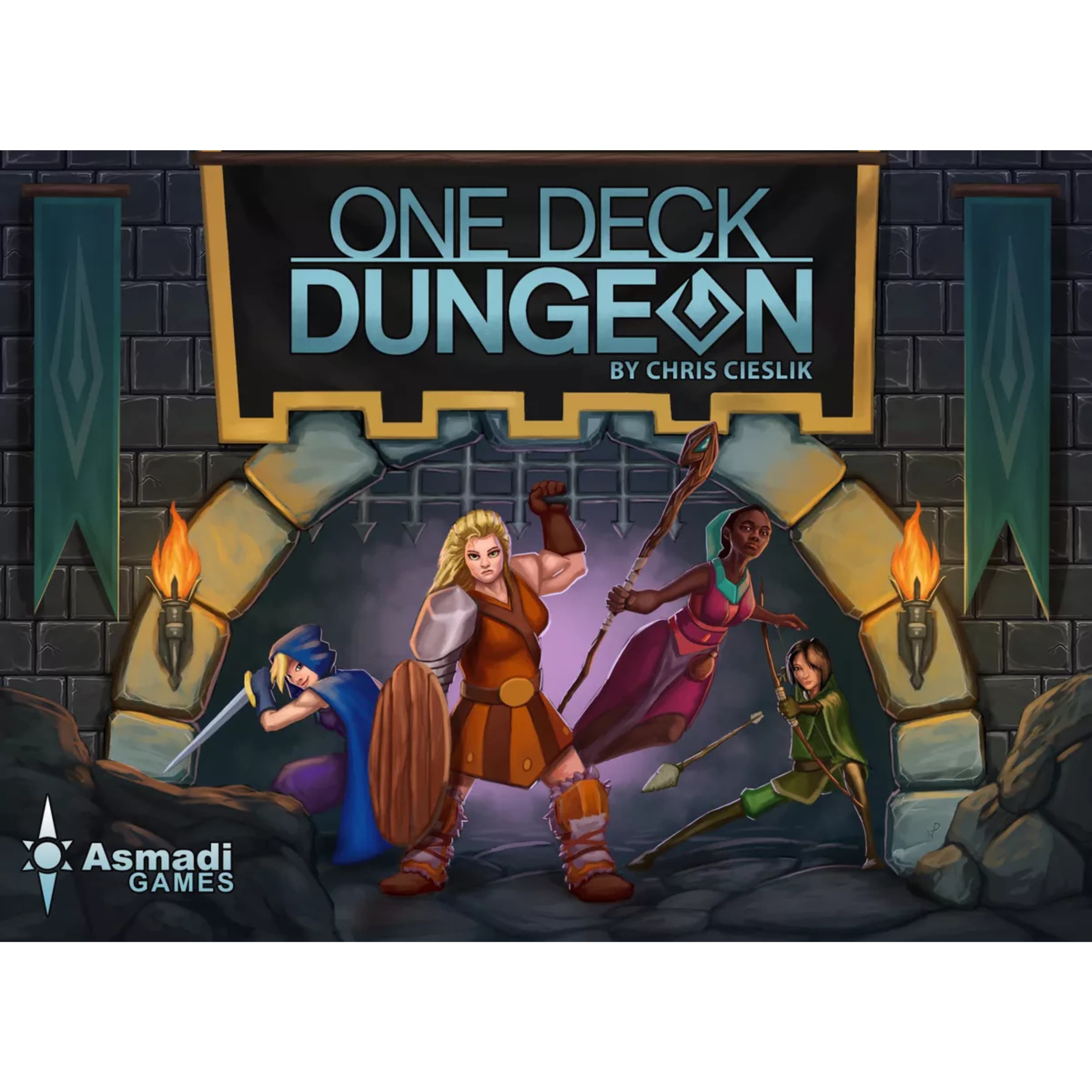
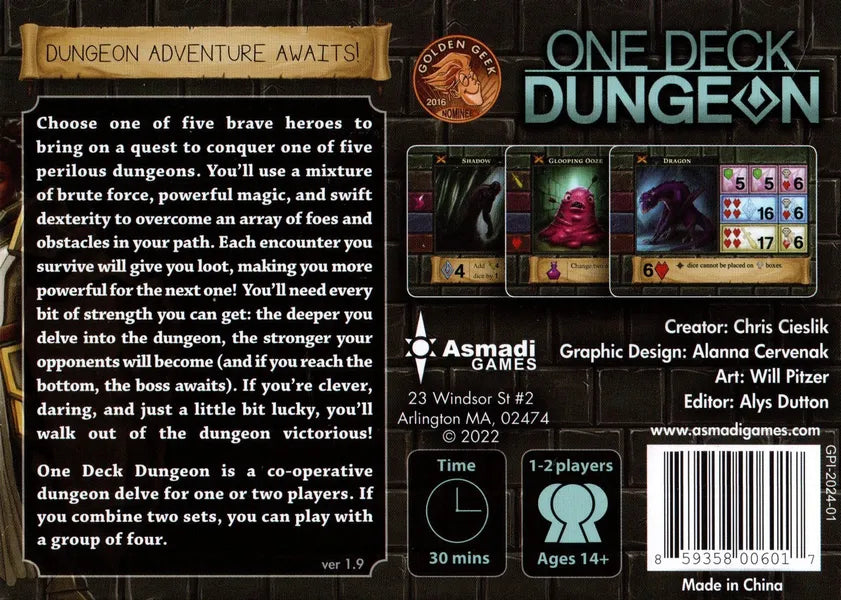
One Deck Dungeon
🐸 Details from BoardGameGeek
Consiglio BGG sul numero di giocatori
Categorie
Meccaniche
Design & Art
Lingua
Si abbina bene con
FroGames — Moments You'll Remember
You enter. They crush you. You restart. This time with a better plan. And then another. And yet another. Until you win or run out of dice.
WHAT IT'S ABOUT
A dungeon crawler that fits in a deck box
Designed by Chris Cieslik (founder of Asmadi Games) and illustrated by Alanna Cervenak and Will Pitzer, One Deck Dungeon is the analog answer to digital roguelikes. Released in 2016, it brought the essence of titles like Binding of Isaac or Spelunky to the table: permadeath, infinite replayability, progression with every run.
At the table, you roll dice, fight monsters represented by cards, and every defeated enemy becomes equipment, a skill, or XP. The dungeon is random, difficulty increases with every turn, and every dice placement choice is a tactical puzzle. If you reach the final boss and survive, you win. If not, you restart with a different character and a better plan.
What they say abroad
A pocket-sized roguelike that captures the essence of death-and-retry in 45 minutes.
— FroGames
Character progression is as satisfying as dice management is punishing.
— FroGames

One Deck Dungeon
Designed primarily for solo play. The basic rules cover 1-2 players without variants: in solo play, you manage one hero and tackle the dungeon exactly as intended by the designer. The experience is complete and balanced, perhaps even better than in a duo where coordination slows the pace.
FrogScore · FroGames editorial rating · based on rules, international reviews and game sessionsWhat's inside the dungeon
Four types of cards that define each run
Encounters
Each card is an enemy to defeat: monsters with dice patterns to fill. Win and it becomes equipment, skill, or XP. Lose and you suffer damage or time penalties.
Heroic Dice
You start with a few colored dice (strength, agility, magic). You roll them, place them on enemy slots to cover the spaces. Each die has a value and a color: choose poorly and the monster hits you.
Heroic Feats
Unique abilities of your character that bend the rules. The Mage teleports dice, the Warrior ignores damage, the Rogue manipulates values. They define your style.
Final Bosses
Dragon or Lich, each with devastating mechanics. You need high dice rolls, the right equipment, and a bit of luck. Defeating them closes that dungeon's campaign.
Recommended sleeves 62 cards in 2 sizes ▼
If you play often, we recommend protecting the cards with transparent sleeves to make them last longer.
| Size | Quantity |
|---|---|
| 63 × 88 mm | 56 |
| 89 × 127 mm | 6 |
| Total cards | 62 |
In an hour, you'll have lost three times and won once. And you'll immediately reopen the box.
Come si gioca
Video dimostrativo di gameplay.
A game in five moments
What happens at the table
Not the rules. The experience.
Setup and first door
Choose your hero (Warrior, Mage, Rogue, Paladin), shuffle the dungeon deck, draw the first room. It's always easy. Roll the dice, place them calmly. Win, choose whether to keep the card as an item or skill. It seems manageable.
Time starts to run out
Each explored card advances the time tracker. After 4-5 encounters, the dungeon levels up. Enemies require higher dice, deal more damage. You start to calculate: do I explore further or descend immediately?
First deadly encounter
A Goblin Shaman requires three 5+ slots. You don't have enough high dice. You take damage, lose a die from your pool for the rest of the run. Now every choice counts double. You start thinking in terms of probability and mitigation.
Complete build or death
You've equipped two items that give you extra dice, a skill that allows you to double a result. The build works: chain victories, descend quickly towards the boss. Or an unlucky roll eliminates you just short of the end.
Boss fight or game over
You reach the Dragon. It has six slots to fill, devastating passive effects, and if you don't beat it in two rounds it burns you. You throw everything. You place perfectly. Or not, and you restart with another hero. Always with a better plan.
How to play
The flow of each encounter
Each card is a dice placement minigame to be solved in real-time.
Flip the next dungeon card. Monster, trap, or potion. Advance the time tracker. Read the enemy's special effects.
Roll all your hero dice (initially 4-5, then increasing with items). Evaluate the results: which slots you can cover, which you cannot.
Assign the dice to the enemy card slots. You must cover all slots or suffer the consequences (damage, time loss, die penalty). Use skills and items to adjust values.
If you win, keep the card as equipment (more dice), skill (persistent abilities), or experience (level up). If you lose, you take damage or worse.
Why it's different from others
Six mechanics that make the difference
Radical multi-use cards
Every defeated enemy becomes loot. The same card can be an item (left slot), a skill (right slot), or XP (central track). Choose what to keep and what to sacrifice: powerful armor now or experience for a level-up later?
Increasing time pressure
The dungeon has four difficulty levels that automatically increase with time. Exploring too much leads to impossible encounters. Descending too early leaves you weak against the boss. Timing is everything.
Pure combinatorial puzzle
Every encounter is a Sudoku with dice. Slots require specific values (3+, even, odd) or colors (red strength, blue magic). There is no narrative, only dirty math and impossible choices.
Hero asymmetry
Warrior has more health and red dice, Mage manipulates values, Rogue ignores an enemy die, Paladin mitigates damage. Each hero requires completely different build strategies.
True permadeath
When you die, it's over. There's no saving, no undo. You start over from scratch with another character. Exactly like a digital roguelike, but without the frustration of a slow restart: in 2 minutes you're already on your second run.
Complete pocket format
44 dungeon cards, 4 hero sheets, a handful of dice. Fits in a pouch. Play anywhere, setup in 30 seconds. Doesn't sacrifice depth for portability: a full run lasts 30-45 minutes.
How it ends
How you win and how you die
Victory or defeat are binary. There are no half-measures.
Victory
- Defeat the final dungeon boss (Dragon or Lich) before time runs out
- Complete a dungeon campaign with a specific hero (unlocking achievements)
- In duo mode, both heroes survive and beat the boss together
Defeat
- Your health points drop to zero during an encounter
- The time tracker reaches its maximum level and you can no longer handle enemies
- You lose too many dice from your pool and can no longer cover any enemy slots
One Deck Dungeon doesn't tell you a story. It gives you a pure challenge engine, where every victory is earned with planning and a bit of dirty luck.
Frequently asked questions
One Deck Dungeon FAQ
Is it truly solo playable or is it a forced addition?
It is primarily designed for solo play. The basic rules are identical for 1-2 players, without artificial variants. In duo mode, you collaborate on dice but the experience remains individual: no one helps you manage your hero. Many prefer it solo for the faster pace.
How long does a complete game last from opening the box?
Setup in 2 minutes, full run 30-45 minutes. If you die early (which often happens), 15-20 minutes. The box is designed for short sessions: open, play, close. Perfect for a lunch break or a quick evening.
Doesn't the luck of the dice make everything random?
The dice are the engine, but choices mitigate a lot. You choose which slots to cover, when to use skills, what to equip. An optimized build wins against average dice. A weak build loses even with good dice. Luck exists but doesn't dominate.
Are there campaigns or is it always the same game?
Each run is self-contained, but there is progression: four heroes to unlock, two dungeons with different bosses, hidden achievements. You can play informal campaigns (one hero vs all bosses) or single runs. Replayability comes from deck randomization, not a storyline.
Is it available in Italian?
This edition is in English. The text on the cards is present but limited: each encounter has clear iconographic symbols. You need to know English for hero abilities and enemy special effects, but once learned (4-5 games) you can play from memory.
One Deck Dungeon is a cooperative and solo game for 1-2 players, lasting 30-45 minutes, recommended age 14+. Designed by Chris Cieslik and published by Asmadi Games, it is a tabletop roguelike based on dice rolling and deck building: every defeated enemy card becomes equipment, skill, or experience. The game uses layering mechanics, stat check resolution, and live character progression. Perfect for those looking for a pocket-sized dungeon crawler with infinite replayability and punishing difficulty. Available on FroGames.it.
Frequently Asked Questions
The answers you're looking for, no beating around the bush.
📸Do the images match the actual product?
The photos on the website often come from BoardGameGeek and are intended to give you an idea of the game. They may vary slightly from the version you receive. The content declared by the publisher is always binding.
📦Does the content of the box match what is indicated?
We always strive to provide the correct content, but minor variations are possible due to reprints or updates. The information comes directly from the publishers. If you have any questions, please contact us!
⏳How do pre-orders work?
Pre-order the game before release, payment is immediate, and the game is reserved for you. As soon as it arrives, we'll ship it right away! If there are any delays, we'll update you promptly.
🔒Can I trust buying here?
Absolutely! Secure payments, tracked shipments, and a team that loves board games as much as you do. If something goes wrong, we'll do our best to fix it.
🛠There's a problem with my order, what should I do?
Write to us now! Whether it's a missing part, damage, or an error, we'll help you resolve it as soon as possible. Your experience truly matters to us.