


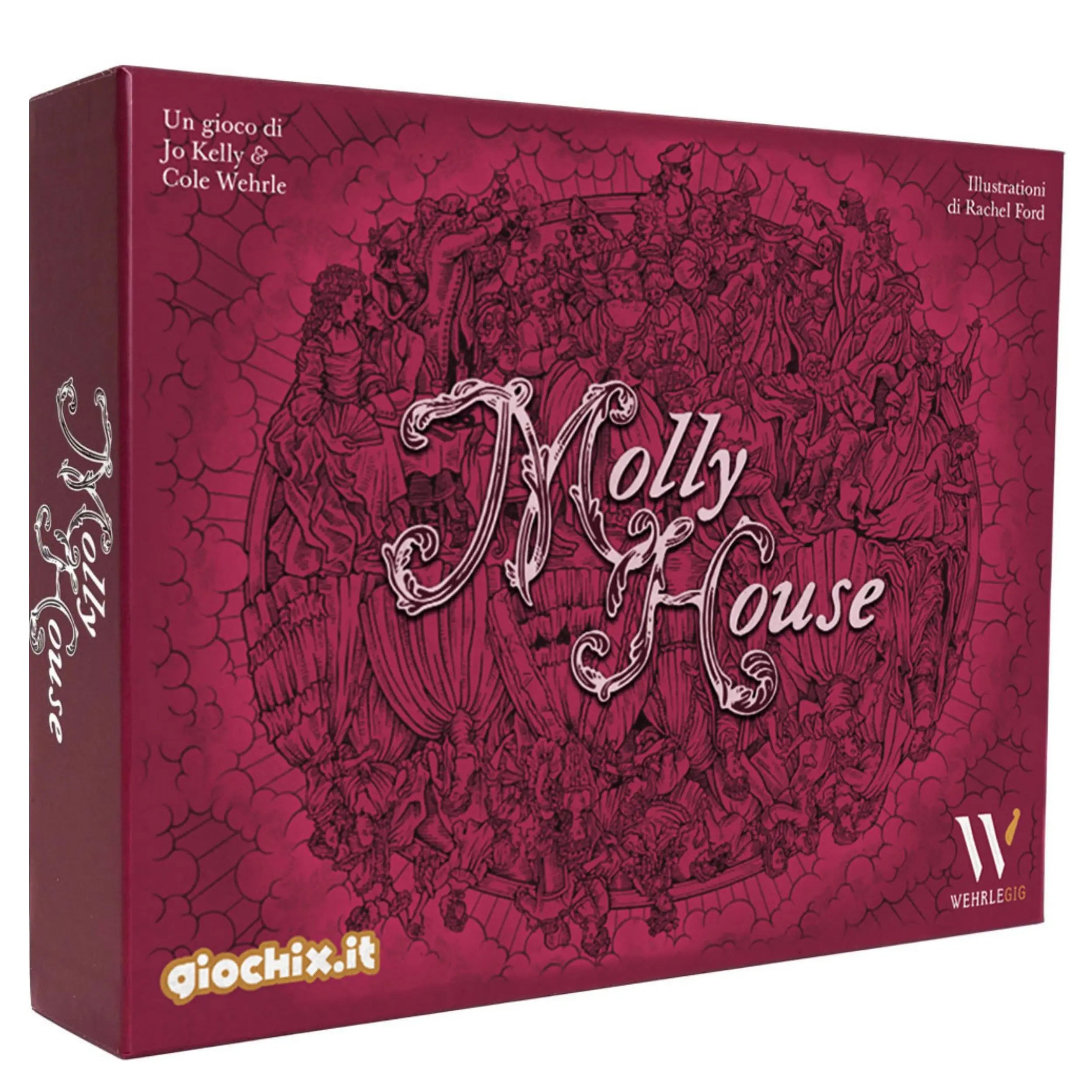
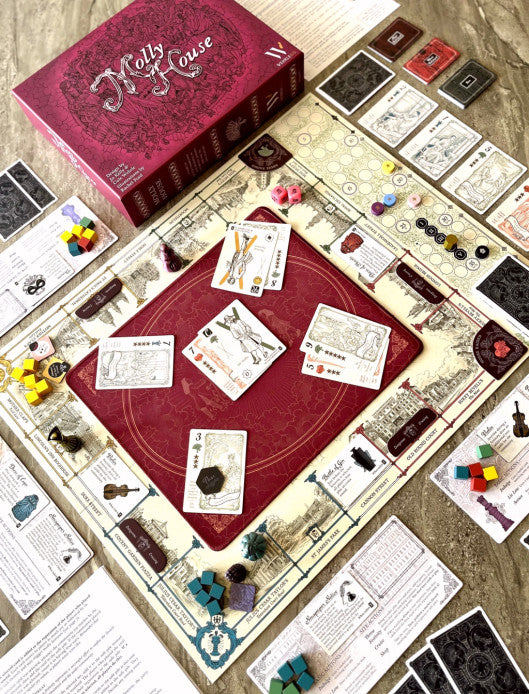
Molly House
🐸 Dettagli da BoardGameGeek
Consiglio BGG sul numero di giocatori
Categorie
Meccaniche
Design & Art
Lingua
Pre-order - leggi i dettagli
🐸 Una rana saggia sa quando dividere l’ordine… e quando aspettare il salto giusto.







Pairs well with
FroGames — Moments You'll Remember
Someone dances masked. Someone pays a bribe. Someone betrays. And by the end of the evening, someone will remember who sat next to them.
WHAT IT'S ABOUT
Surviving persecution in 1700s London
Designed by Cole Wehrle (Root, Pax Pamir, An Infamous Traffic) and Jo Kelly, with illustrations by Rachel Ford, Molly House tells the story of London's queer community in the early 1700s. The Society for Reformation of Manners, a moralistic city organization, seeks to destroy the meeting places of mollies — people who defied the gender conventions of the time. The game revolves around Mother Clap's Molly House, a real space where masked balls and secret meetings were held.
At the table, you play as a molly: you organize parties, move through the city's hidden corners, and try to avoid the guards. But not everyone at the table shares your interests. Someone might be an informer forced by the Society to betray the community. Every card played can bring you joy or arrest. Every choice can expose someone.
What they say abroad
Molly House is not just a game, it's an act of memory and resistance.
— FroGames
"A game that treats history with care and courage."
A game that treats history with care and courage.
— Shut Up & Sit Down

Molly House
The game includes an official solo mode with dedicated scenarios that simulate the Society's pressure through an automa deck. The experience is complete and coherent, but of course it lacks social interaction and the suspicion of the traitor — core elements of multiplayer.
FrogScore · FroGames editorial rating · based on rulebook, international reviews, and play sessionsThe risk cards
What you play, what you risk
Vice Cards
Each card represents a gesture, desire, or encounter considered deviant by the Society. They can be played to organize festivities or to move, but exposing them makes you vulnerable.
Society Enforcers
The Society's guards patrol the city. When you encounter them, you can pay bribes or risk arrest. Or become an informer to save your skin.
Informer Cards
If you are forced to cooperate with the Society, you receive Informer cards. You must undermine the community without being discovered by other mollies, or you risk being expelled.
Festivities
Organizing masked balls and gatherings creates joy and community points. But each event requires exposed cards, and each exposed card can attract the wrong attention.
Recommended sleeves 118 cards in 2 sizes ▼
If you play often, we recommend protecting your cards with clear sleeves to make them last longer.
| Size | Quantity |
|---|---|
| 63 × 88 mm | 82 |
| 44 × 67 mm | 36 |
| Total cards | 118 |
In an hour, you'll know who betrayed. And who resisted. It always happens in Molly House.
A game in five moments
What happens at the table
Not the rules. The experience.
Masks and hopes
The first cards are drawn. Someone suggests organizing a ball. Others prefer to move cautiously through the alleys. Everything seems collaborative. No one knows yet who might betray them.
The first arrest
Someone draws an Enforcer card. They can pay a bribe or take a risk. They choose the risk. They fail. Now they're under pressure: they can become an informant or leave the game. The table stiffens.
Suspicions and accusations
Someone plays a card that seems to sabotage an event. Or asks strange questions. Or hesitates too long. The group begins to suspect. Discussions become tense. Who is the informant? Or are there two?
The betrayal
The moment comes when someone has to reveal they are an informant. Or they are discovered. Or they accuse someone else to mislead. The table explodes. Alliances collapse. Now it's open warfare between mollies and traitors.
The end of the Molly House
The game ends when the community is destroyed or when the mollies manage to organize enough joy to resist. Someone is in prison. Someone feels truly betrayed. The story is over, but the memory remains.
How to play
The flow of each round
Each turn is a choice between exposing yourself to create joy or hiding to survive.
Each player draws cards representing gestures, desires, or encounters. These cards have multiple uses: they can be played for events, movement, or resources.
You can play cards to organize festivities with other mollies (creating communal joy) or keep them to protect yourself. Every exposed card makes you vulnerable to Enforcers.
When you encounter an Enforcer (by drawing specific cards or moving into risky areas), you must pay bribes or risk arrest. If you fail, you can become an informant or be eliminated.
If someone is an informant, they play secret cards to sabotage the community: ruin events, expose other mollies, gather evidence. Other players can accuse them: if they uncover an informant, they expel them.
Why it's different from others
Six mechanics that make a difference
Multi-use cards
Each Vice card has multiple uses. You can play it for an event, for movement, to pay a bribe. The choice of how to use it changes the game. It's not passive drafting: every decision exposes or protects.
Dynamic informants
You don't know who the informant is until they are forced or discovered. Someone might become one halfway through the game after an arrest. The traitor is not assigned at the start of the game: they emerge from the consequences of choices.
Increasing pressure
The more events you organize, the more Society becomes active. The more mollies are arrested, the more informants are created. The game accelerates towards collapse or victory without respite.
Historical push-your-luck
Every time you encounter an Enforcer, you can pay or take a risk. The risk is a dice roll or card draw: if you fail, you become an informant or are out. Courage has a real price.
Tense negotiation
It's not enough to play cards: you have to convince others to collaborate, share resources, trust each other. But every promise can be false if someone is an informant. Words matter as much as cards.
Deep historical theme
Every element of the game reflects real historical documents: trials, testimonies, places. Wehrle and Kelly worked with queer historians to give a voice to a community erased from official history.
How it ends
How to win and how to lose
The game ends when the Molly House is destroyed or when the community resists enough.
Victory (mollies)
- Accumulate enough joy points through events and festivities before Society destroys the community.
- Identify and expel all informants, allowing the Molly House to continue operating.
- Resist until the end of the Society deck without collapsing, proving that the community survives.
Defeat (mollies) or Victory (informants)
- Too many mollies are arrested or eliminated, and the community can no longer organize events.
- Informants gather enough evidence to have Society close the Molly House.
- Community morale collapses: no one trusts each other anymore, and the game ends with everyone dispersing.
Molly House is not a light game. It is an interactive commemoration of a real community that resisted. And sometimes lost. But it was there.
Frequently asked questions
Molly House FAQ
Is it too emotionally heavy a game?
It depends on the table. The theme is historical and deals with persecution, betrayal, and institutional violence. There are no explicit scenes, but the context is clear. If the group is aware of the theme and wants to address it, the experience is powerful. If you are looking for a light semi-cooperative game, this is not it.
How many players are needed to play well?
With 3 to 5 players, the experience is full: there is room for suspicion, negotiation, and group dynamics. With 2 players, it works but loses some of the paranoia. Solo play is supported with dedicated scenarios and is excellent for exploring the theme without social pressure.
Can it be played without an informant?
Yes, but the game loses much of its identity. Without the risk of a traitor, it becomes a pure cooperative against the Society deck, which is less interesting. The tension arises from not knowing who is next to you.
Is it suitable for those unfamiliar with Cole Wehrle?
Yes. Molly House is more accessible than Root or Pax Pamir, but it remains a medium-heavy game. The rules require careful reading, but the structure is more linear than previous Wehrle games. If you've played Avalon or The Resistance, you can tackle it.
Is it available in Italian?
Yes, this is the Italian edition by Giochix. Rules, cards, and all materials are translated. The game is language-dependent (lots of text on the cards), so the localized edition is essential.
Molly House is a semi-cooperative board game for 1-5 players, ages 14 and up, lasting 60-120 minutes. Designed by Cole Wehrle and Jo Kelly, published in Italy by Giochix, Molly House takes you to 1700s London, where a queer community resists persecution from the Society for Reformation of Manners. Traitor game mechanics, bluffing, push-your-luck, and multi-use cards create a tense and narrative experience. Deep historical theme, solo mode included. Available on FroGames.it.
Molly House
Frequently Asked Questions
The answers you're looking for, no beating around the bush.
📸Do the images match the actual product?
The photos on the website often come from BoardGameGeek and are intended to give you an idea of the game. They may vary slightly from the version you receive. The content declared by the publisher is always binding.
📦Does the content of the box match what is indicated?
We always strive to provide the correct content, but minor variations are possible due to reprints or updates. The information comes directly from the publishers. If you have any questions, please contact us!
⏳How do pre-orders work?
Pre-order the game before release, payment is immediate, and the game is reserved for you. As soon as it arrives, we'll ship it right away! If there are any delays, we'll update you promptly.
🔒Can I trust buying here?
Absolutely! Secure payments, tracked shipments, and a team that loves board games as much as you do. If something goes wrong, we'll do our best to fix it.
🛠There's a problem with my order, what should I do?
Write to us now! Whether it's a missing part, damage, or an error, we'll help you resolve it as soon as possible. Your experience truly matters to us.