
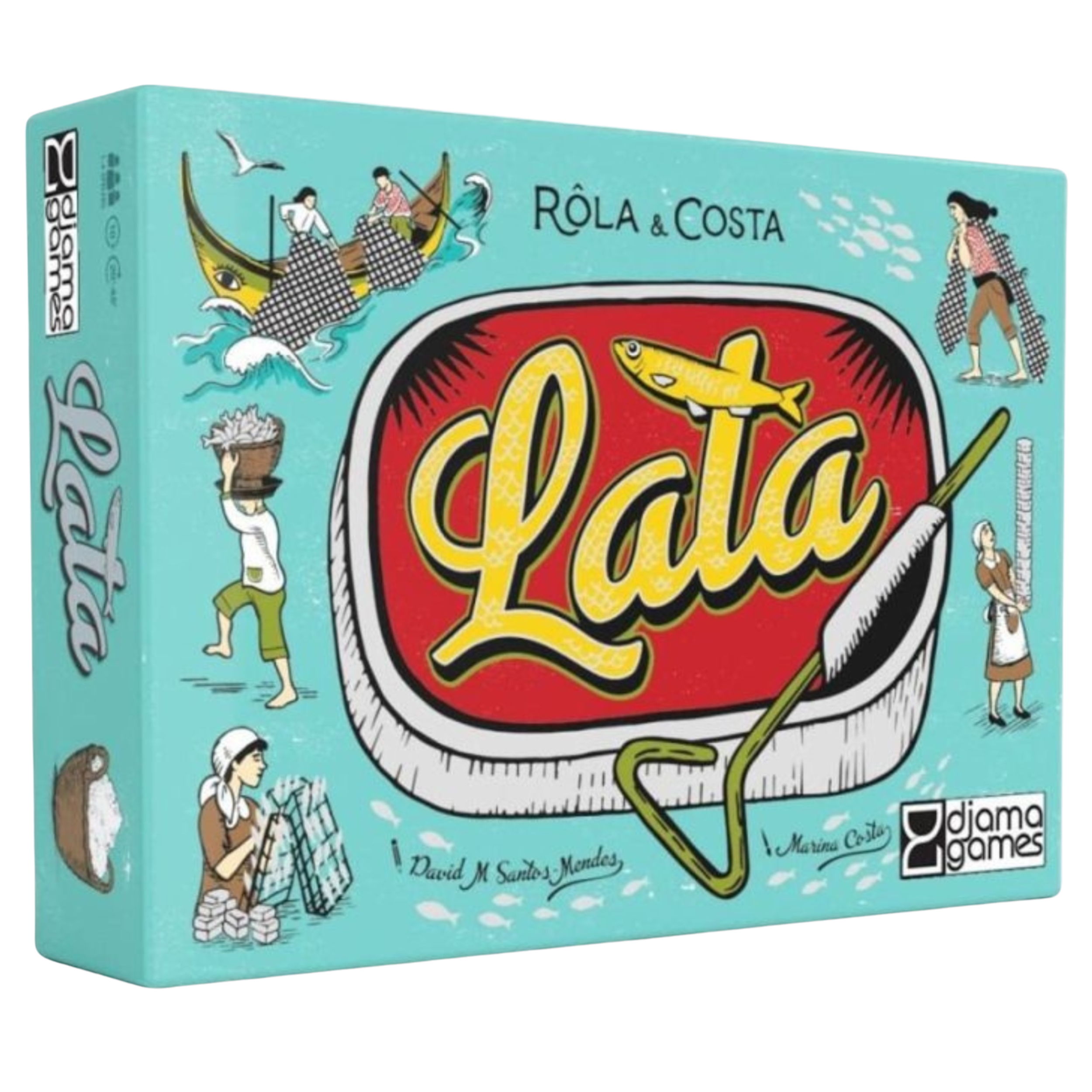
Lata EN-DE-PT
🐸 Details from BoardGameGeek
Consiglio BGG sul numero di giocatori
Categorie
Meccaniche
Design & Art
Si abbina bene con
The FroGames Card
You've drawn a bad batch and now you're looking at your board. Four workers, only one active line, no tomatoes. Someone laughs. You push the disc all the way to the left: you give up three actions to choose first next turn.
WHAT IT'S ABOUT
Canning Portugal: economy and sardines
Lata is the second chapter of the Quinas Collection, the line of Portuguese themed games by Costa and Rôla after Café. We are in the 1950s, when Portugal's fish canneries were experiencing their golden age: sardines and mackerel packed in cans, shipped throughout Europe, an economic pillar of coastal communities. The name itself, Lata, is the Portuguese word for tin can – a humble object that became a symbol of an era.
At the table, you manage a small local cannery. Each turn you buy mixed batches of fresh fish, tomatoes, and oil, then transform them into preserves to sell at open markets. The core is an action point auction: the more you sacrifice to choose the best batch first, the less you will have for production and sales. Every choice has an immediate cost, every renunciation is paid for two turns later.
What they say abroad
"The Portuguese canning industry was at its peak during the 1950s, supplying Europe with sardines and mackerel."
The Portuguese canning industry was at its peak during the 1950s, supplying Europe with sardines and mackerel.
— PYTHAGORAS
Lata is a eurogame that demands immediate planning and long-term sacrifices. Each turn it takes something from you to give you something else. The card will be updated as soon as we have confirmation of an international review.
— FroGames

Lata
The game includes official solo rules without an automa: you manage two boards and compete against a variable target score. The experience loses the tension of the auction (you choose the order) but maintains the challenge of efficient production and market timing.
FrogScore · FroGames editorial rating · based on rules, international reviews and game sessionsWhat you have on your board
The pieces of your cannery
Raw Material Batches
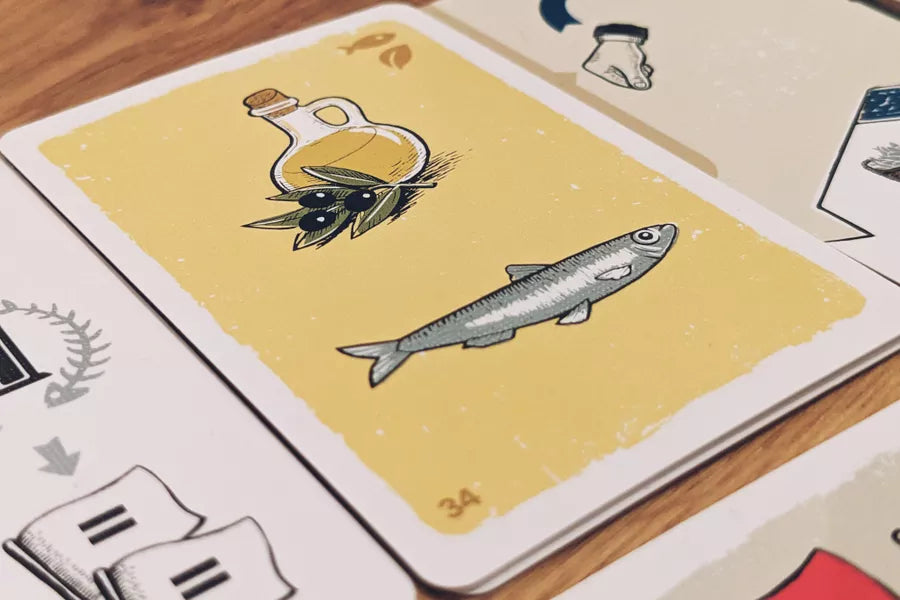
Each turn, mixed batches are drawn: fish (sardines or mackerel), tomato, oil. Some are gold, some are sand. The auction decides who chooses first.
Cannery Board
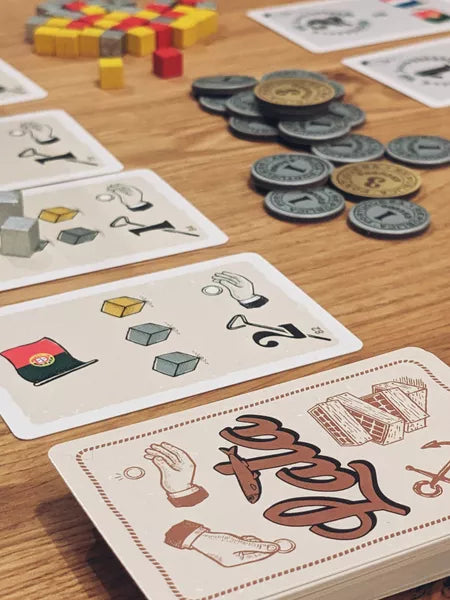
Your personal factory with production lines to activate, spaces to store raw materials and an action track. Every upgrade costs, every new line is valuable.
Market Cards
Open contracts that pay for your preserves. Some want sardines, others mackerel, still others precise mixes. Whoever arrives first gets the best margin.
Score Cards
End-game objectives: majorities in markets, types of preserves produced, upgrades completed. Bought with money during the game, they are worth victory points at the end.
🎲How to playThe rules in four steps▼
How to play
The flow of each round
Six rounds identical in structure, vastly different in choices. Each turn tightens up a bit more.
Four lots of raw materials (fish, tomato, oil) are revealed, drawn randomly. Everyone sees them, everyone calculates which one they need most.
Simultaneously, each player secretly moves their disc on the action track of their personal board: the further left you move it, the more actions you sacrifice, the higher you move in the selection order. They are revealed, and selection is made in order.
In reverse order (whoever chose the lot last acts first), you use your remaining actions to activate production lines, transform raw materials into canned goods, and buy factory upgrades.
Still in reverse order, you place your canned goods on open market contracts. Each market pays only once: whoever arrives first takes the margin, whoever arrives later sells at a discount. With the money, you buy scoring cards.
⏱️Your first gameMoment by moment chronicle▼
A game in five moments
What happens at the table
Not the rules. The experience.
Everyone looks at the lots
The four lots for the turn are turned over. One has three sardines and tomato, perfect. One only has oil, useless. The other two are mixed. Everyone lowers their gaze to their board and calculates: how many actions can I sacrifice to choose that lot without being paralyzed later?
The silent auction
Everyone secretly moves their disc on the action track. Then they reveal: whoever sacrificed the most actions chooses first. Someone laughs because they bluffed low and got a decent lot without sacrificing anything. Someone else sacrificed four actions and now has to produce and sell with crumbs.
Strained production
You have sardines, tomatoes, oil. You activate a line, produce one canned good. But you lack two actions to activate the second line, and that lot of mackerel you had planned stays there, useless. You look at the open markets: someone is about to take your best contract.
Race to the markets
Contracts are exhausted in turn order. Whoever chose the lot last sells first, and takes the fat markets. You arrive later, sell your canned goods at a reduced margin, and buy a consolation scoring card. But you still have raw materials on your board.
Score counting and surprises
End of the sixth round. Scoring cards are revealed: someone dominated the sardine market, someone else completed three upgrades and is worth a mountain of points. The winner is whoever synchronized auctions, production, and sales like clockwork, without wasting an action. The difference is always three points.
🐸Good to know beforehandThree honest things, from friends▼
Good to know beforehand
Three things a friend would tell you
Downtime increases with 4 players
The auction is simultaneous, but everyone has to calculate how many actions they can sacrifice by looking at their board and the available lots. With 4 at the table, you wait for everyone to finish thinking. With 2-3 it's smoother.
The theme is functional, not evocative
Sardines, mackerel, canned goods: the names are there, but they don't tell stories. You're optimizing a production chain, not living the saga of Portuguese canneries. If you're looking for narrative immersion, look elsewhere.
You mess up the first two games
You sacrifice too many actions for a lot you don't use, or too few and run out of fish. Timing is learned by losing: you have to play three games before you see how much it's really worth to give up an action in turn two.
🏆Victory and defeatWhat the ending rewards▼
How it ends
How to win
After six rounds, victory points are counted. Whoever has the most wins.
Victory points from
- Scoring cards bought during the game (market majorities, types of canned goods, upgrades)
- Remaining money in the bank (fixed conversion at the end of the game)
- Bonuses from secret objective cards (if present in the advanced variant)
Mistakes that cost victory
- Sacrificing too many actions in auctions and being paralyzed in production
- Accumulating raw materials without converting them into canned goods (they don't count for points)
- Arriving last at the markets and always selling at a reduced margin
Lata is an eurogame that punishes you for every wasted action and rewards you if you synchronize auctions, production, and markets like a Swiss watch. It doesn't forgive, but it doesn't cheat.
💬Frequently Asked QuestionsQuick answers before checkout▼
Frequently Asked Questions
FAQ about Lata
What mechanics does Lata use?
At its core is an action point auction (bid with limited resources), followed by production management (resource conversion), sales to open contracts (set collection and race), and purchase of scoring cards (end-game scoring). All in a flow of six rounds identical in structure.
Is it suitable as a first eurogame?
Yes, it is a solid gateway eurogame. Rules explained in 10 minutes, clear iconography, no hidden combos. The difficulty lies in evaluating how much to sacrifice in auctions, but you learn by playing. Ideal for those coming from Ticket to Ride or Splendor and wanting to step up.
Does it scale well from 1 to 4 players?
The official solo works (see dedicated section). With 2-3 players it's fluid and tense, the auction remains significant. With 4, downtime increases: everyone has to calculate their auction by looking at their board and the lots, and you wait for everyone to decide. It's not paralysis, but it slows down.
How long does a game really last?
The box says 20-45 minutes. Realistically: 30 minutes with 2, 45 with 3-4 once you know the rules. The first game will be closer to an hour because you need to understand the value of actions and lots. After three games, you'll play in 35 minutes even with 4.
Is this edition in Italian?
No, this is the English edition published by MS Edizioni. The game is almost language-independent (clear iconography, very little text on market cards), but the rulebook is in English. There are currently no official Italian editions.
The people behind the game
Who invented it, who designed it, who publishes it — and what else they've done.
Lata is a resource management eurogame for 1-4 players, lasting 20-45 minutes, recommended age 8+. Designed by Costa and Rôla, published by MS Edizioni, it sets players in the fish canneries of 1950s Portugal. The central mechanic is an action point auction: you sacrifice future actions to choose raw material lots first, then use your remaining actions to produce canned goods (sardines, mackerel) and sell them to open markets. The second chapter of the Quinas Collection after Café, Lata offers a medium-light strategic experience with quick setup and high replay value. Available on FroGames.it.
Lata EN-DE-PT
Frequently Asked Questions
The answers you're looking for, no beating around the bush.
📸Do the images match the actual product?
The photos on the website often come from BoardGameGeek and are intended to give you an idea of the game. They may vary slightly from the version you receive. The content declared by the publisher is always binding.
📦Does the content of the box match what is indicated?
We always strive to provide the correct content, but minor variations are possible due to reprints or updates. The information comes directly from the publishers. If you have any questions, please contact us!
⏳How do pre-orders work?
Pre-order the game before release, payment is immediate, and the game is reserved for you. As soon as it arrives, we'll ship it right away! If there are any delays, we'll update you promptly.
🔒Can I trust buying here?
Absolutely! Secure payments, tracked shipments, and a team that loves board games as much as you do. If something goes wrong, we'll do our best to fix it.
🛠There's a problem with my order, what should I do?
Write to us now! Whether it's a missing part, damage, or an error, we'll help you resolve it as soon as possible. Your experience truly matters to us.