
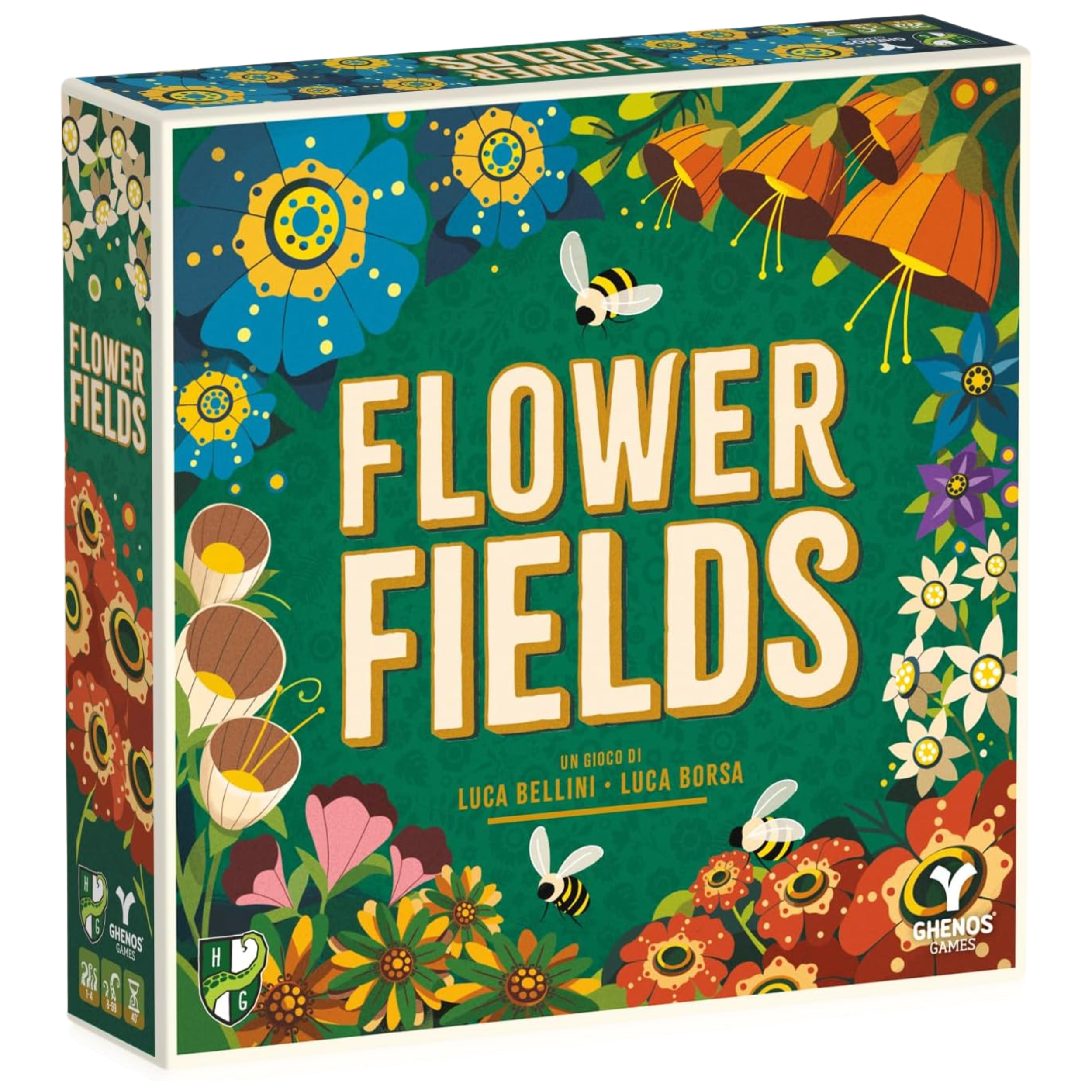
Flower Fields
🐸 Details from BoardGameGeek
Consiglio BGG sul numero di giocatori
Categorie
Meccaniche
Design & Art
Lingua
Si abbina bene con
The FroGames review
You look at the tiles arranged in a circle. The one you want is four spots away. You have two bees. You spend both of them, skip three useless tiles, and grab the perfect purple polyomino. Then you realize you don't have any more bees left to pollinate the flowerbed. Someone laughs.
WHAT IT'S ABOUT
A flowerbed puzzle where bees decide what you get
Flower Fields is designed by Luca Bellini and Luca Borsa, illustrated by Fabio Frencl, and published by Horrible Guild in 2024. It is a polyomino tile-placement game where bees are not just for theme: they are the currency you use to make better choices and increase the value of your flowerbeds. Three seasons, a 5×6 garden to fill, and scores that only grow if you combine large areas with a high density of pollinators.
Each turn, you choose a flower tile from the central circle (open drafting with an advancing Sun token) or collect bees from the supply. You can spend bees to skip tiles you don't need and take the right one. Once placed, connect the polyominoes by color, then decide whether to spend more bees to pollinate the flowerbed: every bee placed multiplies the final value of that color area. Collect beehives, dodge spiderwebs, and complete rows and columns for bonuses. At the end of the third season, whoever best optimized shape and pollination wins.
What they say abroad
"Flower Fields is a competitive tile-placement game, where your goal is to create an attractive flower garden."
— Horrible Guild
Bees are the twist that turns a simple polyomino game into a challenge of timing and priority.
— FroGames

Flower Fields
The game includes official rules for solo play: the drafting circle rotates automatically every turn and you have score targets to beat. The experience is complete, the puzzle works great without opponents, but you lose the ability to read what others need (which helps you understand when to block them in multiplayer). It remains one of the best light puzzle solitaire games of 2024.
FrogScore · FroGames editorial rating · based on the rulebook, international reviews, and gameplay sessionsWhat you'll find in the box
The components you use every game
Polyomino Flower tiles
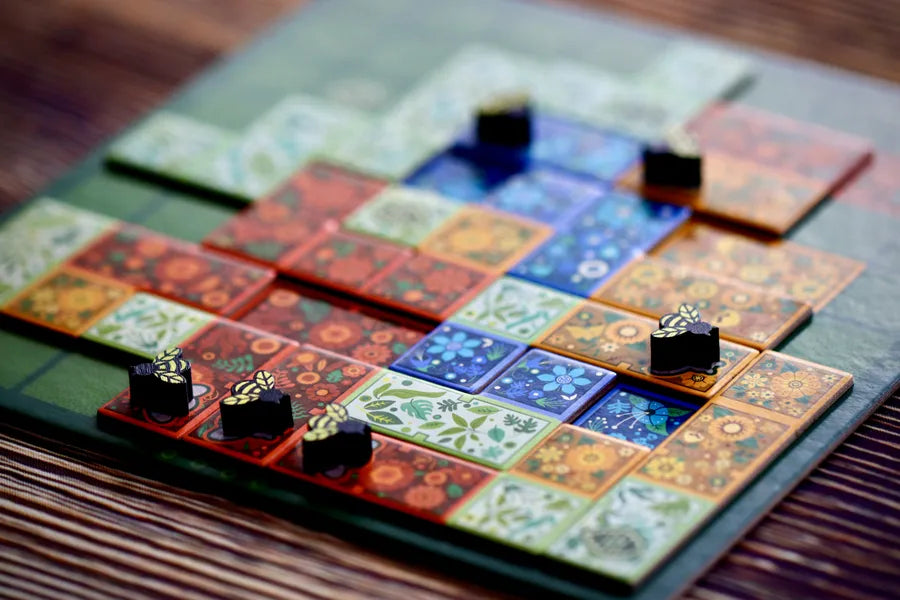
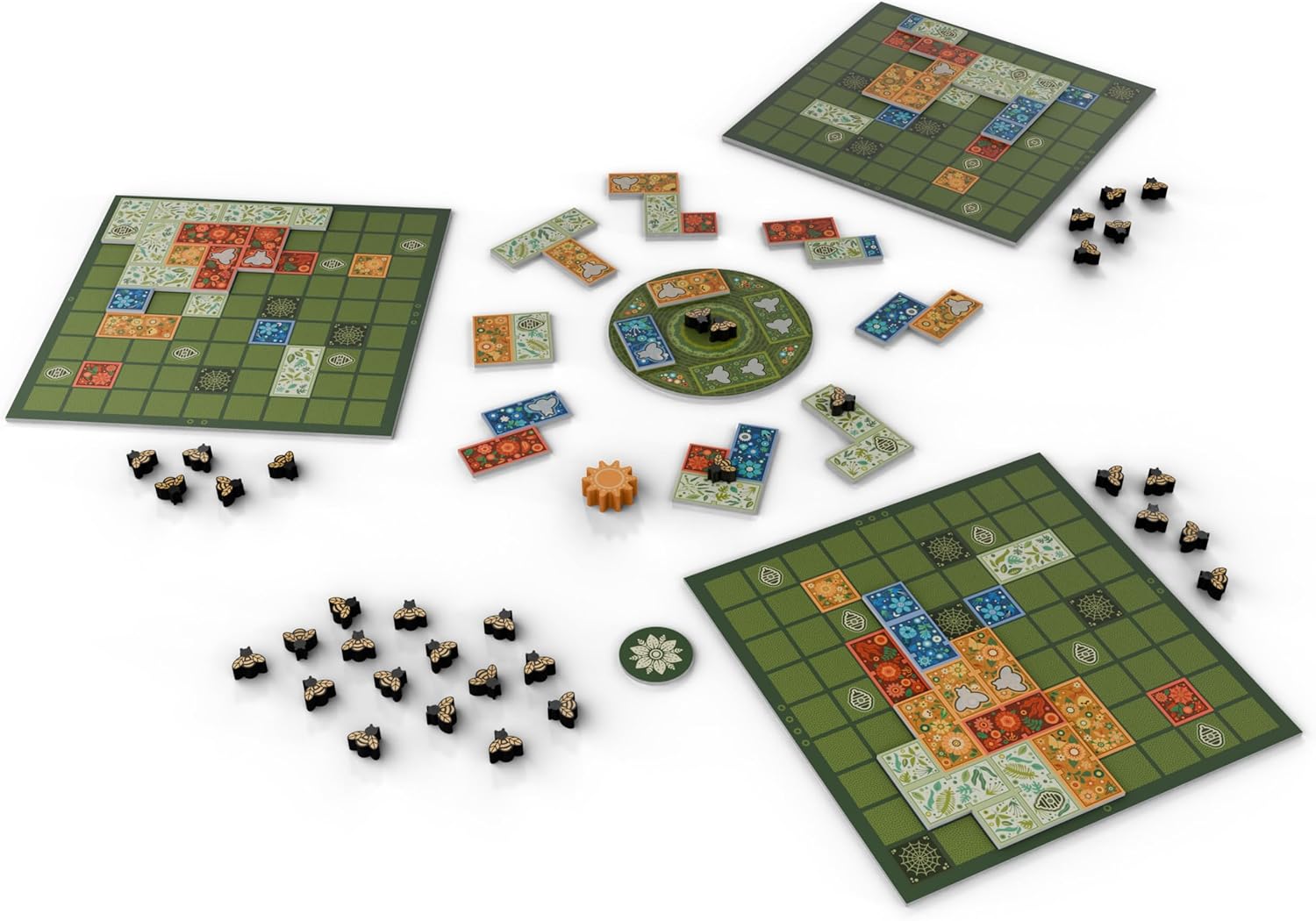
Irregular shapes of 1-4 spaces, in three colors (red, yellow, blue) plus a white wild card. Each tile has spaces for bees, beehives, or (dreaded) spiderwebs. Place them connected to at least one tile already in your 5×6 garden.
Wooden bees
The key resource: spend them to skip tiles during drafting and to pollinate finished flowerbeds. Each bee on a flowerbed multiplies the score (spaces × bees). Collect beehives to have more; spiderwebs will steal them from you.
Sun token
Moves clockwise around the circle of tiles in the center. The next available tile is always the one after the Sun. Want the one three spots ahead? Pay three bees to take it, and the Sun jumps directly there.
Personal Garden board
A 5×6 grid, empty at the start. Fill it season after season by connecting tiles. You score points for the largest color areas (multiplied by bees), white flowerbeds (1 point/space), and every completed row or column (+5).
🎲How to playThe rules in four moves▼
How to play
The flow of each turn
You make only one action per turn. Simple, fast, zero downtime.
Choose the next tile after the Sun in the circle. If you want to skip one (or more), spend 1 bee per skipped tile. Place the tile in your garden, connected to at least one other already present. Then, spend bees from your reserve to pollinate that flowerbed (the bees remain there until the end of the game).
Instead of taking a tile, take all the bees currently in the central Field (usually 2-3). Place them in your personal reserve. Use this action when you need resources for future turns or when you are not interested in the available tiles.
If the newly placed tile has a hive, you score +3 bees at the end of the season. If it has a web, you lose 2 bees from your reserve (if you have them). Some flower spaces have bee icons: when you pollinate that bed, each icon counts as +1 bee for the final score.
The season ends when the last tile leaves the circle. Collect the bees promised by the hives, then calculate the score: each color area (red/yellow/blue) is worth spaces × bees present; white areas are worth 1 point/space; each complete row or column is +5 points. After three seasons, the player with the most points wins.
⏱️Your first gameA moment-by-moment chronicle▼
A game in five moments
What happens at the table
Not the rules. The experience.
The first round is easy
Choose a tile, place it in your empty garden, easy connection. Everyone does the same. You don't need bees yet, the circle is full of tiles. Then someone takes the one you wanted, and you realize drafting is a test of reading your opponents.
The beds take shape
Now you have three scattered red areas, one compact blue one, a useless white corner. You look at the circle: there is a perfect red tile, but it's five spots ahead. Spend four bees to take it, connect it, pollinate with two more bees. Nine red spaces × three bees = 27 points. Pure satisfaction.
The hive moment
You draw a tile with a hive: +3 bees at the end of the season. You place it immediately, even if the shape is awkward, because bees are worth more than immediate points. Then someone takes a web by mistake and loses two bees. Awkward silence.
Three tiles left
The grid is almost full. You need a blue piece to close the big flowerbed, but there are only red and white ones in the circle. Take a white one, stick it in a hole, complete the row, +5 bonus points. It's not Plan A, but it works. The game rewards those who adapt.
Scoring and surprises
End of the third season, count the areas. The one who seemed behind completed all five rows (+25 points). The one with the most beautiful garden forgot to pollinate the yellow one. The winner is the one who balanced shape, bees, and bonuses. Never the one who did just one thing well.
🐸Know this beforehandThree honest things, friend-to-friend▼
Know this beforehand
Three things you must know
Slows down with 4 players
Drafting works best with 2-3 players. With 4, the circle empties faster, turns are less predictable, and the last player in turn order suffers significantly from others' choices. It's not broken, but the optimal experience is with 2 players or solo—there, every decision really counts.
The learning curve flattens
For the first 5 games, you'll discover new strategies (small, well-pollinated beds vs. large, under-pollinated ones, row bonuses, etc.). After the tenth, the game shows its bottom: it remains an excellent puzzle, but it lacks the depth to become a game you play 50 times. Perfect as a strategic filler or recurring family game.
Balance counts more than intuition
The winner isn't the one who makes the most beautiful bed or accumulates the most bees. The winner is the one who balances: shape + pollination + row completion. Doing just one thing well is not enough. If you focus only on big beds, you lose the row bonuses. If you pollinate everything, you run out of bees. The game rewards management, not inspiration.
🏆Winning and losingWhat the ending rewards▼
How it ends
How to win
End of the third season: the player with the most points wins. You count color areas, white areas, and row/column bonuses.
Scoring
- Each red/yellow/blue area is worth: number of spaces × number of bees present in that area (e.g., 9 spaces × 3 bees = 27 points). You only count the largest area of each color.
- Each white area is worth 1 point per space (bees don't count).
- Each completed row or column on the 5×6 grid is worth +5 points.
Common mistakes
- Spending all your bees on drafting and having none left to pollinate the flowerbeds (large areas without bees = low scores).
- Focusing only on one color: if the area is huge but poorly pollinated, it's worth less than three well-pollinated medium areas.
- Ignoring row/column bonuses: +5 points per completed line is often the difference between first and second place.
Flower Fields is an honest puzzle: rules in 10 minutes, depth that emerges through play, perfect scalability for solo. It doesn't revolutionize the genre, but it does what it promises very well.
💬Frequently Asked QuestionsQuick answers before the checkout▼
Frequently Asked Questions
Flower Fields FAQ
What mechanics does Flower Fields use?
Open drafting (choose tiles from a common circle by spending bees to skip those you don't want), polyomino tile placement, resource management (bees), grid coverage (fill a 5×6 grid). Scoring rewards set collection (large areas of one color) multiplied by the bees invested.
Is it really a family game or does it require experience?
It is family+ in the best sense: immediate rules, gradual depth. An 8-year-old can play their first game without issues. An experienced player will find optimizations for 10 more games. It lacks the complexity of a medium Eurogame, but it's not the banality of a pure gateway game.
How does the solitaire mode work?
Official mode: the drafting circle rotates automatically every turn (the Sun always advances), you choose when to take tiles and when to collect bees. You have score goals to beat (three difficulty levels). The experience is complete, the puzzle holds up very well, but you lose the reading your opponents component that helps you decide when to block in multiplayer.
Is it better played with 2 or 4 players?
With 2 or solo. With 4 players, the circle empties too quickly, turn order weighs heavily, and those who play last are subject to too many of others' choices. It's not broken, but the optimal experience is with 2: enough interaction in the drafting, enough control over your own decisions.
Is it available in English?
Yes, this is the Italian edition by Ghenos Games. Full rulebook in Italian, language-independent components (tiles with icons, no text). Ready to play as soon as you open the box.
The people behind the game
Who invented it, who illustrated it, who publishes it—and what else they've done.
Flower Fields is a tile-placement board game for 1-4 players, age 8+, duration 40 minutes, designed by Luca Bellini and Luca Borsa, and published by Horrible Guild (Italian edition by Ghenos Games). It uses mechanics of open drafting with resource spending (bees), polyomino tile placement, and grid coverage on a 5×6 board. Scoring is based on chromatic set collection multiplied by pollination, plus bonuses for complete rows and columns. Includes an official solo mode. Weight 2.08/5 on BoardGameGeek. Available on FroGames.it.
Frequently Asked Questions
The answers you're looking for, no beating around the bush.
📸Do the images match the actual product?
The photos on the website often come from BoardGameGeek and are intended to give you an idea of the game. They may vary slightly from the version you receive. The content declared by the publisher is always binding.
📦Does the content of the box match what is indicated?
We always strive to provide the correct content, but minor variations are possible due to reprints or updates. The information comes directly from the publishers. If you have any questions, please contact us!
⏳How do pre-orders work?
Pre-order the game before release, payment is immediate, and the game is reserved for you. As soon as it arrives, we'll ship it right away! If there are any delays, we'll update you promptly.
🔒Can I trust buying here?
Absolutely! Secure payments, tracked shipments, and a team that loves board games as much as you do. If something goes wrong, we'll do our best to fix it.
🛠There's a problem with my order, what should I do?
Write to us now! Whether it's a missing part, damage, or an error, we'll help you resolve it as soon as possible. Your experience truly matters to us.