

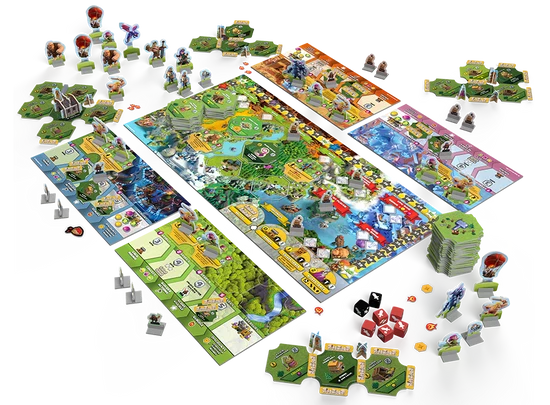
Clash of Clans - The Epic Raid
🐸 Details from BoardGameGeek
Consiglio BGG sul numero di giocatori
Categorie
Meccaniche
Design & Art
Lingua
🐸 How pre-orders work
🐸 A wise frog knows when to split the order… and when to wait for the right leap.
- Arrives
- second half of October 2026
Si abbina bene con

FroGames — Moments You'll Remember
Your village awaits. So do your enemies. Build quickly — someone's already deploying the Barbarian.
What it's about
The most feared village on the table
Clash of Clans was one of the most played mobile games in history — over 120 billion hours of gameplay. Maestro Media and Supercell bring it to the tabletop with Eric M. Lang (Blood Rage, Marvel United) and Ken Gruhl as designers, and Cranio Creations for the Italian edition.
Each player leads a clan: building their village by placing building tiles, recruiting troops from the shared market, and launching raids on enemy bases to plunder resources and earn Victory Stars. The game alternates between a simultaneous building phase — intense, tactically rich — and an attack phase where dice determine the outcome of conflicts, but choices matter more than luck.
You don't permanently destroy the opposing village: you burn buildings to get resources, then everything is rebuilt. Aggression is continuous, but no one is permanently eliminated. You win with stars, not with devastation.
A gateway game that respects the player's intelligence — in Eric Lang's own words during the design phase.
The secret of Clash of Clans: The Epic Raid in one line
Three actions per turn, a shared market to block, a village to defend and one to plunder: every decision is a real dilemma.
From the game experience

Clash of Clans: The Epic Raid
FrogScore · FroGames editorial rating · based on rules, international reviews, and game sessionsYour arsenal
What you control in each game
Your village
Town Hall at the center, building tiles around it. Each structure produces resources, defends, or unlocks new units. Building well is the foundation of everything.
Builders and Master Builders
They are your workers in worker placement. Only three actions per turn — use them to build, recruit, or defend. Blocking opponents is as valuable as building.
The raiding army
Barbarians, Archers, Giants, Wizards, P.E.K.K.A. and Dragons. Each unit has different bonuses. Those who bring Dragons ignore walls — those who focus on Giants absorb defensive damage.
Attack and Defense Dice
5 attack dice against 2 defense dice. The balance of power matters — but the outcome is never guaranteed. Every raid is a small gamble.
You're about to place the last building. Across the table, someone is already deploying their army. Welcome back to the village.
🎲Components22 types · over 400 total pieces
Come si gioca
Video dimostrativo di gameplay.
A five-act game
What happens at the table
Not the rules. The experience.
The village is still deserted
Every clan starts from the same point: a level one Town Hall, one Barbarian, one Archer. The central market is full of tiles and troops that everyone wants. The game hasn't even begun and you're already calculating what to take before someone else does.
Three actions, none easy
Build a Gold Mine, buy a Giant from the market, or upgrade the Town Hall? You only have three builders to place — and the best spots are blocked by opponents before you can decide. Building is already a duel.
The first raid
You roll five attack dice against two defense dice. Your army is small but you have the Wizard's bonus. The building burns, you collect resources, you earn your first star. Across the table, someone takes note: you'll be the next target.
The Dragon no one saw coming
Someone has built in silence, waited, recruited a Dragon. Now they launch it on the best-defended village — walls mean nothing, the Dragon flies over everything. Three buildings in flames in one turn. The table freezes. Then everyone starts building anti-dragon walls.
40 stars. Time to count.
Someone reached 40 stars. The game ends. Points are tallied, the partially burnt villages are observed, and it turns out that the one who seemed to be ahead wasn't. Everything is packed back into the box while discussing what strategy would be used next time.
How to play
The flow of each round
Two distinct phases that alternate every turn. It's learned in twenty minutes, mastered game after game.
All players simultaneously place their builders on the common board: build, recruit troops, upgrade the Town Hall or build defenses. The most advantageous spots can only be occupied by one player at a time.
Each building in your village generates Gold, Elixir or Gems based on its level. Resources are used to pay for actions in the next phase. A well-built economic engine makes a difference in the long run.
In turn order, each player chooses a target and launches their army. Attack and Defense dice are rolled. If the attack succeeds, the building burns, the attacker gains resources and stars. Defense costs nothing — building it does.
Everyone's stars are updated. If a player exceeds 40, the game ends at the end of the current round to give everyone the same opportunity for a final raid. The player with the most stars wins.
Why it's different from others
Six mechanics that make a difference
Worker placement with real blocking
The most advantageous spots on the board are exclusive: the first to arrive blocks access for others. Every action has a concrete opportunity cost — and watching your opponent take your preferred spot hurts as much as losing a raid.
Modular village to build
Your territory grows tile by tile. Each building has a cost, defensive value, and production. Layout matters: an isolated Extractor is easy to burn, one shielded by Walls much less so.
Units with special abilities
The Dragon flies over walls. The Giant absorbs damage. The P.E.K.K.A. is devastating but expensive. Each unit changes the math of the raid — and choosing what to recruit is a real strategic decision, not just a resource expenditure.
Balanced dice combat
5 attack dice against 2 defense dice: the offensive advantage is clear, but not guaranteed. Each unit modifies the pool — bring the Barbarian King and roll one more die. The outcome is never certain, but it's never pure chance.
Active defense with Walls and Towers
Cannons, Archer Towers, Wizard Towers, and Walls concretely modify the outcome of enemy raids. Investing in defense slows down your economy — but leaving your village open is an invitation to destruction.
Town Hall as progression axis
Upgrade your Town Hall and unlock more powerful buildings and defenses. It's the core of progression — but upgrading it costs resources and a construction action. Those who level up too early expose themselves; those who wait fall behind.
How it ends
One victory condition, many paths to achieve it
You win with Victory Stars, not by eliminating opponents. You can get them by attacking — or by building a Town Hall so developed that it generates them passively.
Victory
- The first player to reach 40 Victory Stars triggers the end of the game
- The game ends at the end of the current round (everyone has the same final raid opportunity)
- The player with the most total stars wins — not necessarily the one who triggered the end
Defeat
- No player is eliminated — the game is played to the end
- A poorly defended village becomes everyone else's favorite target
- Losing too many raids means giving up resources and falling behind in progression
Clash of Clans: The Epic Raid is designed by Eric M. Lang — one of the most influential designers of the last twenty years in competitive board gaming. It's not a licensed game: it's a game built to last.
Frequently Asked Questions
FAQ about Clash of Clans: The Epic Raid
Does it work even without knowing the video game?
Yes, completely. The board game is standalone and does not require any familiarity with Clash of Clans mobile. Those familiar with the mobile game will recognize units and structures, which helps to get into the tone — but the mechanics are learned at the table without prerequisites.
Does luck count too much in raids?
Dice introduce variability, but the pool is asymmetrical (5 attack vs 2 defense) and each unit modifies how many dice are rolled or which results are ignored. Army composition and target choice matter more than a single roll. It's not a game where the dice decide everything.
Does it play as well with 2 players as with 4?
With 2 players, the mutual blocking in worker placement is more intense and every decision carries more weight — the game is more tense and tactical. With 3-4 players, there's more chaos, more opportunism, and the "who attacks whom" dynamic becomes as much political as strategic. Both versions work well.
How does it differ from other Eric M. Lang games?
Compared to Blood Rage or Rising Sun, Clash of Clans: The Epic Raid is more accessible and faster. There are no asymmetrical factions or long initial drafts. Depth comes from economic management and raid timing, not complex power trees. Lang has called it one of his favorites for its ease of learning combined with tactical solidity.
Are there expansions?
Yes. The first expansion adds a new resource and new gameplay dynamics. The second, Clan War, increases the maximum player count to 6, introduces team mode, and adds traps and Spell cards that allow you to interrupt an opponent's turn. The base game is already complete — the expansions amplify the chaos.
Is it suitable as a first modern board game?
It's a good gateway for those who already have some familiarity with board games — it's not suitable for those who have never played anything more complex than a classic board game. The number of components and the management of two distinct phases require an initial settling-in game. From the second game onwards, it flows naturally.
Clash of Clans: The Epic Raid is a competitive worker placement and engine-building board game for 2–4 players (ages 14+, duration 60–90 min). Designed by Eric M. Lang and Ken Gruhl, published by Maestro Media in collaboration with Supercell, Italian edition by Cranio Creations. Main mechanics: worker placement, economic engine building, dice combat with special units. Each player manages a village with an upgradable Town Hall, Gold and Elixir extractors, defensive buildings (Cannons, Archer Towers, Wizard Towers, Walls), and an army composed of Barbarians, Archers, Giants, Wizards, P.E.K.K.A.s, and Dragons. Based on the mobile video game Clash of Clans by Supercell. Available on FroGames.it.
Clash of Clans - The Epic Raid
Frequently Asked Questions
The answers you're looking for, no beating around the bush.
📸Do the images match the actual product?
The photos on the website often come from BoardGameGeek and are intended to give you an idea of the game. They may vary slightly from the version you receive. The content declared by the publisher is always binding.
📦Does the content of the box match what is indicated?
We always strive to provide the correct content, but minor variations are possible due to reprints or updates. The information comes directly from the publishers. If you have any questions, please contact us!
⏳How do pre-orders work?
Pre-order the game before release, payment is immediate, and the game is reserved for you. As soon as it arrives, we'll ship it right away! If there are any delays, we'll update you promptly.
🔒Can I trust buying here?
Absolutely! Secure payments, tracked shipments, and a team that loves board games as much as you do. If something goes wrong, we'll do our best to fix it.
🛠There's a problem with my order, what should I do?
Write to us now! Whether it's a missing part, damage, or an error, we'll help you resolve it as soon as possible. Your experience truly matters to us.