
Cascadia Alpine Lakes
🐸 Details from BoardGameGeek
Consiglio BGG sul numero di giocatori
Categorie
Meccaniche
Design & Art
Lingua



Si abbina bene con
The FroGames Board
Choose a double tile and a wildlife token. You place them. The habitat grows upwards, lakes sparkle when surrounded, animals climb to higher ground. Every choice counts twice because it matters on the plane and in height.
WHAT IT'S ABOUT
The Pacific Northwest Rises
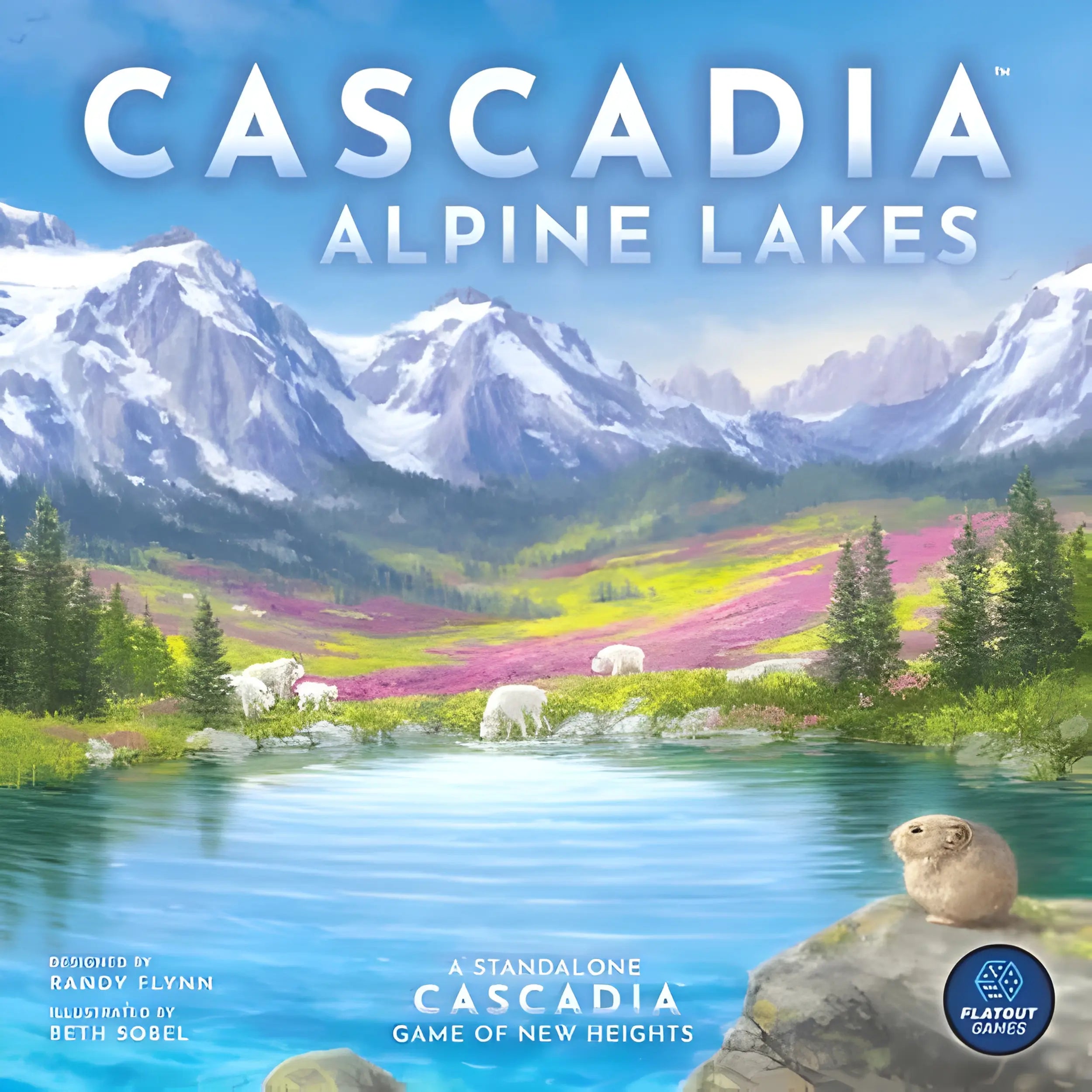
Randy Flynn returns with a standalone sequel to Cascadia, the naturalist puzzle game awarded Spiel des Jahres 2022. Beth Sobel's illustrations bring alpine lakes, coniferous forests, and high-altitude wildlife to double hexagonal tiles that stack. The game's physics change: you no longer build only on a plane, but upwards.
You draw a tile-wildlife pair and place it in your personal ecosystem, adjacent to or overlapping what's already there. And compared to the first Cascadia, the two halves of the score have swapped places: the variable cards are those of the habitats, while the five animals score points by climbing higher and competing for majorities. You win by creating the most harmonious and layered environment, with surrounded lakes and elevated wildlife.
What they say abroad
"Cascadia: Alpine Lakes is a standalone follow-up to the hit spatial puzzle game Cascadia!"
— Flatout Games
Randy Flynn took the Cascadia system and brought it to the mountains. Verticality changes everything: you no longer just think about adjacencies, but about layers. It's the sequel that expands without betraying.
— FroGames

Cascadia: Alpine Lakes
The game includes dedicated solo rules in the base manual. No automa: you set up a two-player game, and each turn the pair furthest from the decks leaves the game, while 20 scenarios and 35 objectives give you the scale to climb. The experience is complete and the spatial puzzle works very well, but it lacks the tension of competitive drafting (taking the right pair before opponents). Ideal for those who love to optimize without social pressure.
FrogScore · FroGames.it editorial rating · based on rules, international reviews, and play sessionsThe puzzle tools
What you build at the table
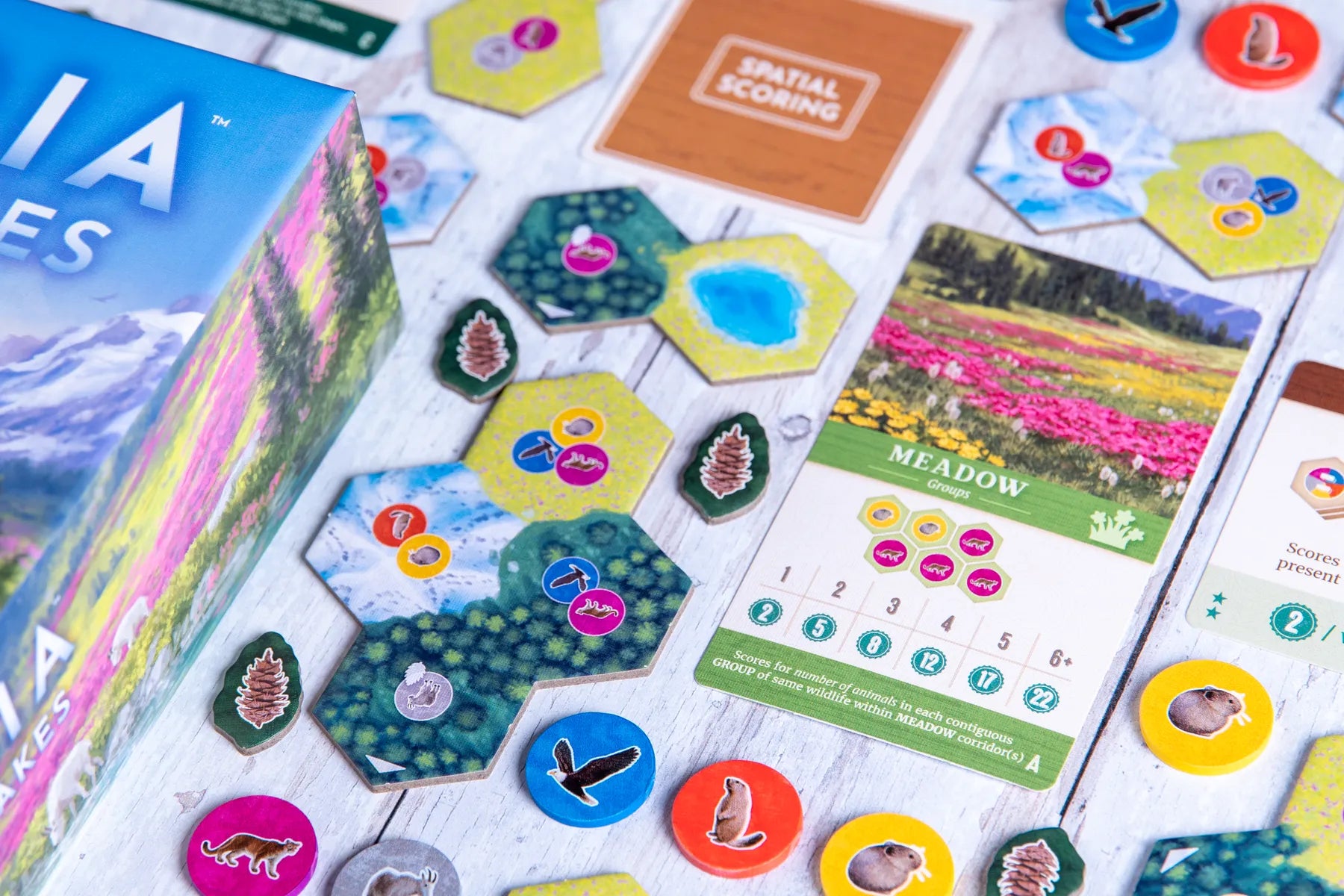
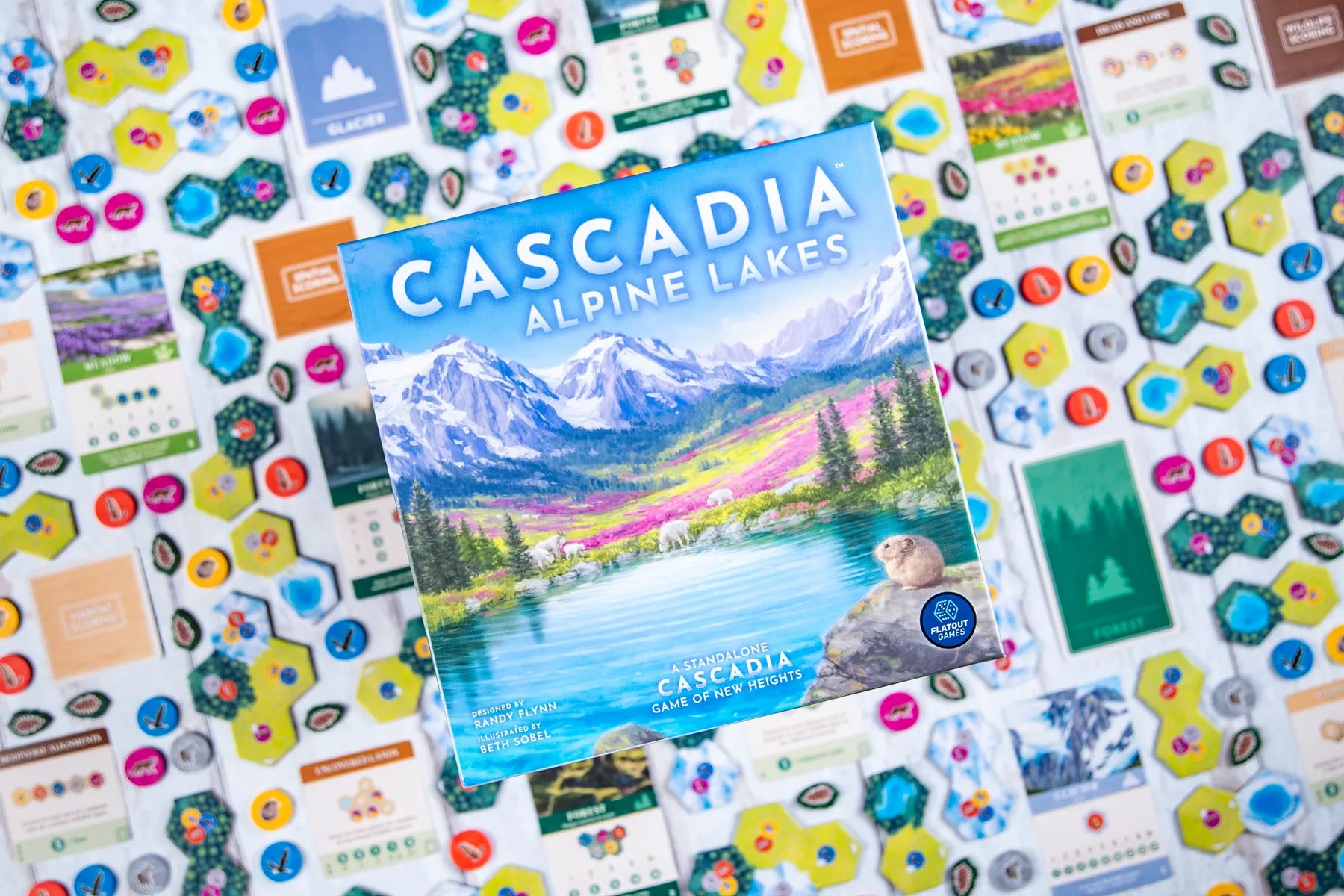
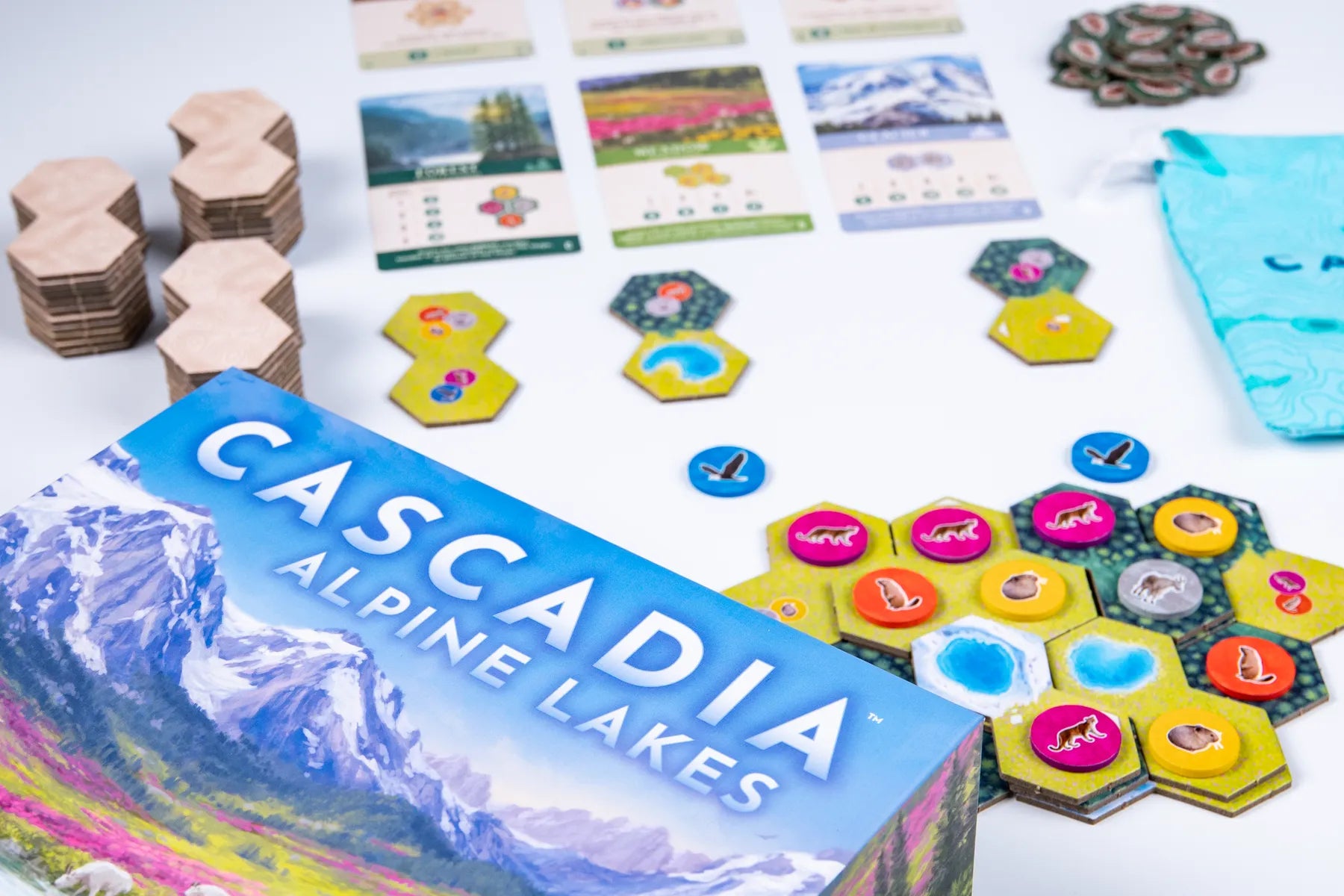
Double habitat tiles
Each tile is a double hexagon with combinations of three alpine habitats (forest, meadow, glacier). They are placed adjacently or overlapping. Height becomes a resource: lakes and high-altitude wildlife are worth more.
Wildlife tokens
Five alpine species in wood: cougar, eagle, marmot, mountain goat, and pika. Animals score points for height — from the third level upwards they are worth double — and at the end of the game they compete for majorities by species.
Alpine lakes
Special squares on the tiles where wildlife is not placed. Each lake is worth one point per level of height, doubled if it is completely surrounded. A lake on the third layer enclosed on all sides is worth six points by itself.
Objective cards
A scoring card for each of the three habitats drawn at the start of the game, plus the environment cards in advanced mode. Each game is a different spatial puzzle. Quick setup, enormous depth.
Recommended sleeves 56 cards in 2 sizes ▼
If you play often, we recommend protecting your cards with transparent sleeves to make them last longer.
| Size | Quantity |
|---|---|
| 67 × 67 mm | 36 |
| 70 × 120 mm | 20 |
| Total cards | 56 |
Come si gioca
Video dimostrativo di gameplay.
🎲How to playThe rules in four steps▼
How to play
The flow of each round
Each player takes a very simple turn: choose a pair from the central market, place it in your ecosystem. Repeat for twenty turns, until the tiles run out.
In the center there are four pairs consisting of a double habitat tile and a fauna token. Choose the one you need. The pair you take affects your opponents.
Add the tile to your ecosystem adjacent or overlapping with already present tiles. You can build upwards. Each layer raises the value of the lakes and fauna you place on it.
Place the token on a free tile showing that animal — no one is placed on lakes. If you place it on a key hexagon, you earn a nature token, to spend on mismatched pairs or to clear the market.
The taken tile and token are replaced from the stacks and the bag, then it's the next player's turn. The game lasts exactly twenty turns each: when the tiles run out, points are counted.
⏱️Your first gameThe chronicle, moment by moment▼
A game in five moments
What happens at the table
Not the rules. The experience.
First layers, first choices
Four tile-fauna pairs in the center. Choose the one that triggers your plan: maybe you want to raise goats, or surround a lake, or prepare a base for future stacking. The other players observe what you take. The draft is already a silent war.
Space becomes vertical
Someone places the first overlapping tile. The table realizes that height matters: a second-story lake surrounded is already worth four points. Everyone starts thinking in 3D. The puzzle is no longer just adjacency: it's spatial geometry.
Objectives show their teeth
Mid-game, you look at your board and realize that the game cards pull in opposite directions. The meadow wants compact groups, the glacier wants separate corridors, and the goat wants to go up exactly where the lake wants to be surrounded. You have to sacrifice something. Choose what to abandon and what to bring home.
The tower that changes everything
Someone builds a three-story ecosystem with a perfectly surrounded lake on top. The others realize they underestimated the elevation. In the last quarter of the game, the draft becomes fierce: every pair can overturn the scores.
Vertical scoring
Points are counted: habitats according to drawn cards, lakes by level and encirclement, fauna by height and majorities. Those who built vertically often win. Those who stayed flat lament their choices. Someone immediately proposes a rematch with different cards.
🐸Good to know beforehandThree honest things, from friends▼
Good to know beforehand
Three things you need to know
Verticality is trickier than it seems
Stacking changes the physics of the game. You have to visualize adjacencies on multiple planes, calculate encirclements in 3D, predict future spaces. Those coming from the basic Cascadia expect a flat puzzle and find a tower. Slow first turns, then it clicks. If you're only looking for meditative relaxation, this steps up half a notch from the original.
Scoring requires the rulebook handy
The rules are learned in five minutes, but the habitat scoring cards have nuances that the rulebook clarifies in two dedicated pages. Nothing broken: for the first game, keep it open on that page and scoring will flow. From the second game, you won't need it anymore.
Solo is honest, but loses the bite of the draft
The solo mode works and the spatial puzzle holds up, but it lacks the tension of stealing the right pair before your opponents. You set up a two-player game, discard the furthest pair each turn, and you have 20 scenarios to climb. Excellent for training or relaxation, less so for those seeking an adrenaline-filled challenge. Multiplayer remains the heart of the game.
🏆Victory and defeatWhat the ending rewards▼
How it ends
How to win
The game ends when the tiles run out, twenty turns each. Points are counted on multiple axes, and the player who has built the most harmonious and stratified ecosystem wins.
Victory
- Points from fauna: doubled from the third level up, plus majorities for each species
- Points from lakes: one per height level, doubled if completely surrounded
- Points from habitats according to the card drawn for each of the three, plus one point for each leftover nature token
Costly mistakes
- Ignoring elevation: those who build only on the flat lose huge points on lakes and high-altitude fauna
- Covering without looking: building over changes the habitat under already placed animals
- Placing fauna without reading the game's habitat cards: each time they reward different shapes
Alpine Lakes takes the Cascadia system and literally elevates it to another level. If spatial puzzles fascinate you, this is the sequel you've been waiting for.
💬Frequently asked questionsQuick answers before checkout▼
Frequently asked questions
FAQ about Cascadia: Alpine Lakes
Do I need to have played the first Cascadia?
No, Alpine Lakes is standalone. It shares the draft and placement system, but the double tiles and stacking are new. You can start here. If you already know Cascadia, the learning curve is fast, and the box also includes a mini-expansion card (Alpine Animals) that brings the new animals into the original Cascadia.
What mechanics does Cascadia: Alpine Lakes use?
The game uses tile placement, pattern building, open drafting, and layering. Each turn you draw a tile-fauna pair from a common market, then place it in your tableau. The tiles are double hexagons and can be stacked, creating a three-dimensional spatial puzzle. Variable habitat cards and 27 environment cards in the advanced mode change objectives every game.
How complex is it compared to the base Cascadia?
Half a step more complex. The turn is identical (choose pair, place), but stacking adds a layer of spatial planning. You have to think in 3D: vertical adjacencies, elevation, encirclements on multiple planes. Those seeking the pure relaxation of the first Cascadia might find it denser. Those who love brain-teasing puzzles will adore the extra complexity.
Does it scale well for all player counts?
Yes. From 1 to 4 players it works. The solo mode has dedicated rules, with twenty scenarios at three difficulty thresholds. In 2 players, the draft is surgical, every choice matters. In 3-4 players, chaos increases slightly but downtime remains low: others build while you think. Ideal for 2-3 players for maximum control.
Is it available in Italian?
This edition is in English. The texts in the game are minimal: species and habitat names on tiles, objective cards with clear icons. The rulebook is in English but language dependency is low. Those who have played the first Cascadia will have no problems.
The people behind the game
Who invented it, who designed it, who publishes it — and what else they've done.
Cascadia: Alpine Lakes is a tile placement and pattern building game for 1-4 players, ages 10 and up, lasting 30-45 minutes. Designed by Randy Flynn (standalone sequel to the award-winning Cascadia) and illustrated by Beth Sobel, it takes the naturalist puzzle of the Pacific Northwest vertically: double hexagon tiles that stack, alpine lakes that score high, fauna that ascends levels. Published by Flatout Games, it combines competitive drafting, 3D spatial construction, and modular objectives for thousands of combinations. Available on FroGames.it.
Cascadia Alpine Lakes
Frequently Asked Questions
The answers you're looking for, no beating around the bush.
📸Do the images match the actual product?
The photos on the website often come from BoardGameGeek and are intended to give you an idea of the game. They may vary slightly from the version you receive. The content declared by the publisher is always binding.
📦Does the content of the box match what is indicated?
We always strive to provide the correct content, but minor variations are possible due to reprints or updates. The information comes directly from the publishers. If you have any questions, please contact us!
⏳How do pre-orders work?
Pre-order the game before release, payment is immediate, and the game is reserved for you. As soon as it arrives, we'll ship it right away! If there are any delays, we'll update you promptly.
🔒Can I trust buying here?
Absolutely! Secure payments, tracked shipments, and a team that loves board games as much as you do. If something goes wrong, we'll do our best to fix it.
🛠There's a problem with my order, what should I do?
Write to us now! Whether it's a missing part, damage, or an error, we'll help you resolve it as soon as possible. Your experience truly matters to us.