
Níjar
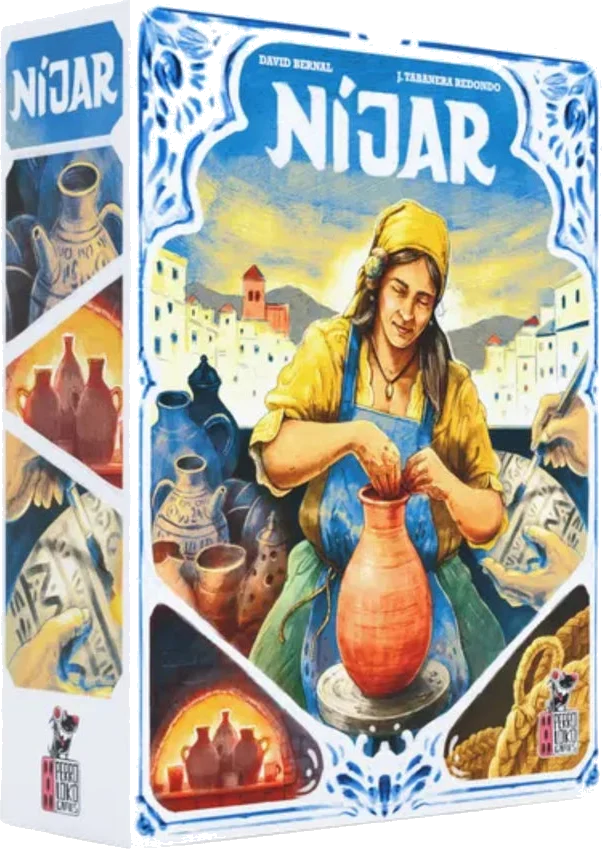
Andalusia, the 1920s: you run a pottery workshop in Níjar. Extract clay, shape, fire, paint and sell at the market. Over 3 rounds, with fewer craftswomen each time, the player with the most points wins.
What do you actually do? Bring clay to the market.
Every piece follows the same path, and each step is a different action. A fired piece can already be sold; painted, it is worth about double.
You extract it: 1 free, more by paying coins. You can hold up to 7.
On the potter's wheel: 1 Clay makes a plate, jug or pot, still unfired: it waits in your Drying Area.
From the Drying Area to a Firing Kiln. From here the piece can be sold.
Into a Glazing Workshop, paying Glazes (colours) or taking Cracks (tokens that cost points). Here it cannot be sold.
Into a Glaze Kiln: the painted piece is finished.
Up to 2 pieces per turn. Each sale lowers that piece's price by its Demand (with Demand 0 it stays).
What do you play with?
The game's words, in one minute
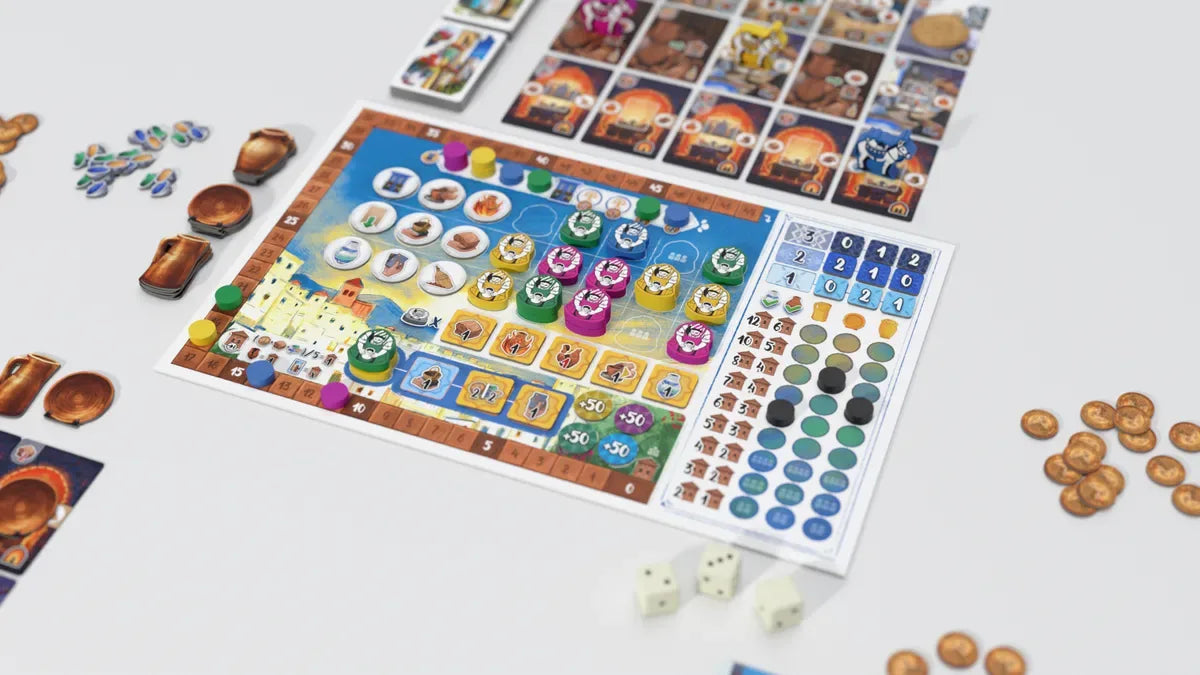
Your workers: you place them on the board to take actions. 7 in the first round, 6 in the second, 5 in the third.
A small extra effect printed under each column of the board, such as Fire 1 piece or 1 Clay. You get one per craftswoman you place.
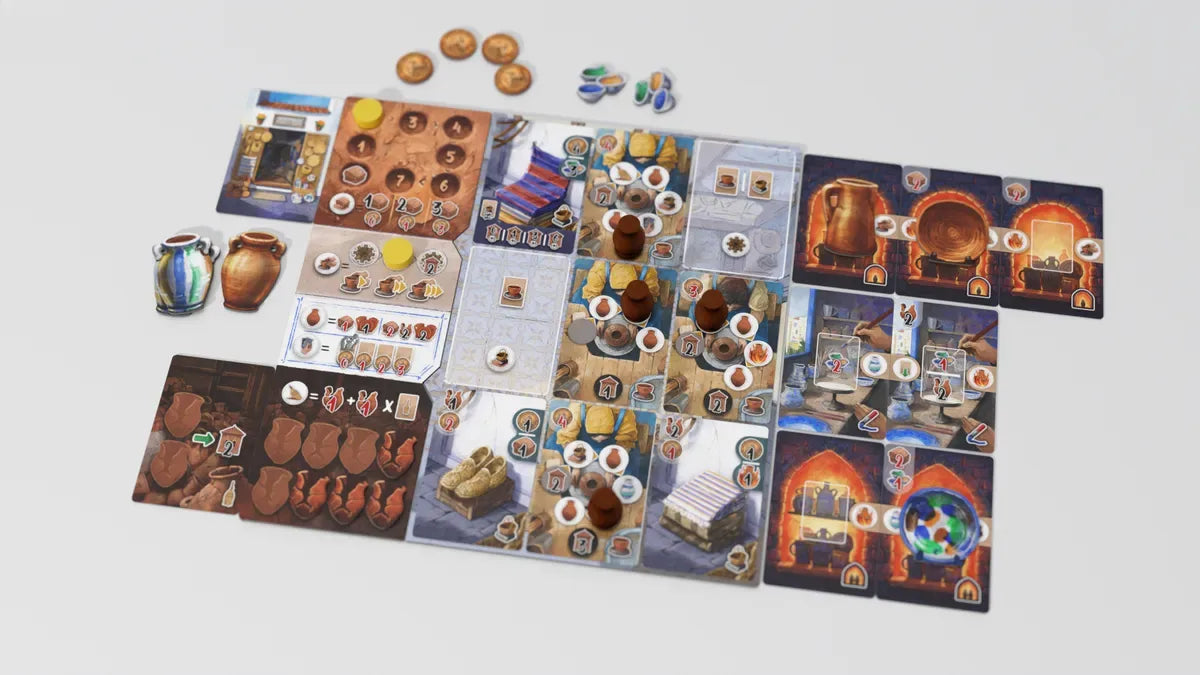
A card in your workshop with a path of spaces: a wooden vase walks along it and you take what each space gives, such as Shape.
The colours you pay to paint a piece.
Tokens that some moves make you take. Your cleaning area holds 8, and each one left there at the end costs 1 point. You get rid of them with Clean.
The coins of the game, the old Spanish ten-cent piece. On this page we simply call them coins. They pay for cards, extra clay and some costs.
A tile per piece type and per round, showing 2, 1 or 0: how much that price rises at the start of the round and how much it drops at each sale.
A card with two sides, open and closed. When you close it you stop placing craftswomen and selling, and each turn you take a bonus.
Your piece among the 15 face-up cards: the card under it is free, every other one costs 1 coin per step away.
The space of your workshop where freshly shaped, unfired pieces wait. From here they cannot be sold.
Workshop cards (esparto and jarapas, the local weaving). With the Collect Esparto action each gives one of its two rewards, such as resources or Fire 1 piece; at the end different esparto cards score points.
3 secret cards in your hand. Only those you play face down at the end of a round count; discarding one during your turn gives you any action.
The game in eight answers.
You place craftswomen, build your workshop with cards and sell pieces at a market whose prices move.
↓Depth3.3 of 5 on BGGEach turn is a single move, but every piece needs four to six steps: the challenge is lining them up.
↓LuckThree dice, only on the marketAt the start of each round dice raise prices; from round 2 the first player may reroll once. Cards are face up.
↓InteractionCompetitive, with pushingYou can take a space someone holds by placing one more craftswoman: theirs goes back. Selling lowers that price for everyone, unless its Demand is 0.
↓ReplayabilityBoard shuffled each gameThe 9 action tiles, 7 bonus tiles and 9 Demand tiles go out at random. 80 cards, 12 final scoring cards.
↓LanguageNo text on cardsCards and board use icons only, according to BoardGameGeek. The rulebook in the box is in English.
↓SoloA real automaThe Competition takes spaces from you with its craftswomen and sells at the same market, driven by 9 cards.
↓PlayersBest at 3, on BGGIn 2 and 3 some spaces are blocked, so the board stays tight. Turns are a single move, so you wait little.
↓What happens in a round?
A game is 3 rounds, then final scoring. Each round has three phases, always in the same order.
1. The market moves
Each piece type has a Demand tile for the round, showing 2, 1 or 0: its price rises by that much. Then the first player rolls three dice: the highest goes to the piece with Demand 2, the middle to Demand 1, the lowest to Demand 0, and each price rises by its die. From round 2 the first player may reroll once.
2. Turns, one move each
With the shop open you choose one: place craftswomen on a space (one more than those already there: you do one action of the row and take the column's bonus once per craftswoman), discard a final scoring card to take any action, sell up to 2 pieces, or close the shop when your craftswomen are used up. Instead of a space you can also put a single craftswoman on the Special Action: she pushes nobody away and gives its bonuses. With the shop closed, each turn you take a bonus of your choice. The round ends when every shop is closed.
3. End of round
Everyone takes back their craftswomen and puts one in the box: you go from 7 to 6 to 5. You may play one final scoring card face down, which will count at the end. The Demand tiles are flipped, and whoever took the First Player action (a board action that lets you pick your place in turn order, then take any action) plays first next round.
4. Final scoring
The final scoring cards you played count (for example points for 2 to 5 cards of one type, or 1 point per sold piece of one type), plus different esparto cards, pieces left in kilns (2 points painted, 1 plain), 2 points for the first player token and 1 point per 5 coins, Glazes and Clay left. Each crack left in your cleaning area costs 1 point. Ties go to whoever is furthest ahead in turn order.
Can you get your pieces to the market in time?
Your goal: score as many points as possible before closing your shop. It is the last round of the game: you play against one opponent who has already closed their shop, you have few craftswomen left, and pieces still in the kilns at the end are worth little, those in the Drying Area or Glazing nothing.
Last round, two players, and your opponent has already closed their shop. Each situation has a different board, workshop and market.
The rules of the turn are the real ones, simplified: no cards, donkey, esparto, Special Action, Clean or First Player; bonuses are all taken before or all after the action; the trial picks which piece to fire or paint; and the opponent does not move. Board layout, workshop, wheel spaces and market positions are examples; the market price values are those printed on the board.
Where are the decisions?
One more craftswoman
Entering an occupied space costs more craftswomen, but gives as many bonuses and sends the others home, where they can be used again that round.
At the table: Do I spend two to take their space (handing them a craftswoman back), or use just one on a free space?
Sell now or paint
A fired piece already sells. Painted it is worth about double, but it needs two more steps and Glazes (or Cracks).
At the table: Do I have the time to finish it this round?
The market drops when you sell
Each sale lowers that piece's price by its Demand. If its Demand is not 0, selling the same piece twice pays less the second time, and also lowers it for others.
At the table: Which piece is the market asking for this round?
Fewer hands each round
You go from 7 to 6 to 5 craftswomen, while the workshop keeps growing.
At the table: Do I build the workshop now or start producing?
Cracks to pay for speed
Shaping two pieces at once, and some paintings, give you cracks. Each one left costs 1 point, and with a full space you can no longer take them.
At the table: Do I speed up now and clean later?
Hidden goals
You start with 3 final scoring cards, but only those you play at the end of a round count. Discarding one during a turn gives you any action.
At the table: Do I keep it for the points, or spend it for a move?
Does it work solo? Yes, against the Competition.
Where the challenge comes from
From an automa, the Competition: a rival workshop that collects no resources and takes no actions, but places craftswomen on the board, moves its donkey and sells at your same market. It is driven by 9 cards.
What changes
The board goes on its solo side and you use 8 pieces of each type. On its turn the Competition reveals a card: it places a craftswoman where the card shows (if you are there it places two, sends yours back and scores 3 points), moves or uses its donkey to discard cards near it, then takes, paints or sells the pieces shown for that round. It has at most one piece per type.
Your round alone
You start the first round as first player and play your turns as usual, alternating with the Competition. It takes the spaces it is told to, so a space you need may be taken; if you are already there it places two and scores 3 points. The First Player action costs you 2 coins: if you skip it, the Competition starts next round. When it runs out of craftswomen or cards it closes its shop and scores 1 point per turn until the round ends.
How you win
You must score more than the Competition. At the end it scores only the first player token and its remaining pieces, not final scoring cards, esparto, resources or cracks. Three levels: Normal; Advanced, where it scores 5 points instead of 3 when it sends your craftswomen back; Expert, where on top it scores 2 instead of 1 when it cannot play for lack of craftswomen or cards, when you send it a craftswoman while its shop is closed, and when a piece it should take has run out, and you may look at its revealed cards to anticipate it.
Is it for you?
You will like it if
- you enjoy production chains where every step must be lined up
- you like worker placement where you can push others off a space
- you want a market that reacts to what everyone sells
- you want a solo mode with an opponent that actually takes spaces
Skip it if
- you want light rules: it is a full-weight Eurogame
- you do not like losing a space to someone else
- you need an Italian rulebook in the box
First game: use the setup in the rulebook.
The rulebook asks you to lay out the action tiles exactly as in its picture. And keep an eye on the Demand tiles: they tell you which piece to produce in each round.
What people ask before buying
What kind of game is Níjar?
A competitive Eurogame by David Bernal, illustrated by Jorge Tabanera Redondo, published by Perro Loko Games. 1 to 4 players, ages 14 and up, weight 3.3 of 5 on BoardGameGeek. You run a pottery workshop in 1920s Andalusia and the player with the most points after 3 rounds wins.
How does a turn work?
You do one thing: place craftswomen on the board, discard a final scoring card to take any action, sell up to 2 pieces, or close your shop. To use a space you place one more craftswoman than those already there, never where you already have yours: you do one action of the row and take the column's bonus once per craftswoman.
What happens to a craftswoman sent back?
She returns to her owner, who can use her again in that round. If her owner has already closed their shop, she goes on the shop card and gives them 2 Clay, 3 coins or 3 Glazes.
How do you make a piece?
You shape it on the potter's wheel with clay, fire it in a Firing Kiln and it can already be sold. To paint it you move it to a Glazing Workshop, paying its cost, then fire it again in a Glaze Kiln. Painted pieces are worth more at the market.
How does the market work?
Each piece type has a price that rises at the start of the round, with Demand tiles and three dice, and drops by its Demand (if it is not 0) each time someone sells that piece. Painted pieces score about double the plain ones.
How much luck is there?
Three dice at the start of each round decide how much prices rise, and from round 2 the first player may reroll. The 15 cards to acquire are face up, and final scoring cards are dealt at random.
Is there a solo mode?
Yes, with an automa called the Competition, driven by 9 cards: it places craftswomen, moves its donkey and takes, paints and sells pieces. Three difficulty levels.
How many players is it best with?
BoardGameGeek says 3. In 2 and 3 players some spaces are blocked, so the board stays tight.
How long does it take?
BoardGameGeek lists 60 to 120 minutes. There are always 3 rounds.
Which language is it in?
This is the English edition. Cards and board use only icons, so in play there is no text to read; the rulebook is in English.
Clay, fire and colour. Which will be the finest workshop in Níjar?
Our assistant has read the Níjar rulebook. Ask whatever you like: you stay on this page.