
Lesser Antilles, 19th century
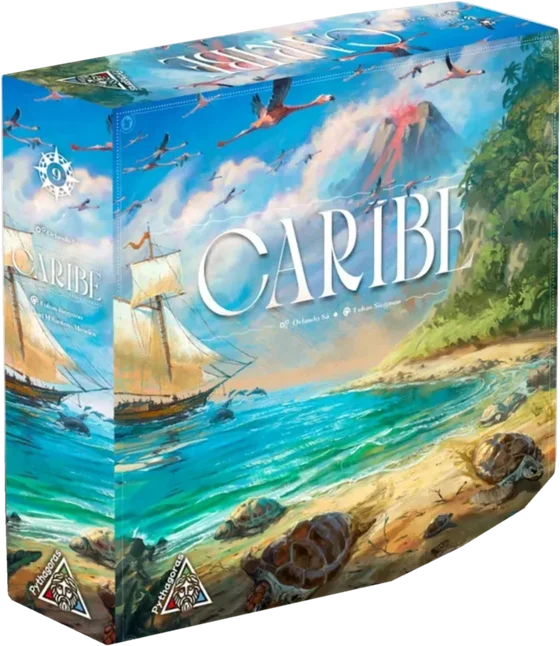
Caribe
You lead a scientific expedition: you observe flamingos, turtles and dolphins at sea, send scientists onto volcanoes, forests and coastlines, and turn it all into theories for the universities of Coimbra, London and Paris.
One letter.One row and one column.
Every turn you play a card only for the letter on top. That letter decides where on the map you can act.
What, where, and what next.
What: a sail
Five sails along the board, each with its actions: observe animals at sea, or send scientists onto a kind of terrain.
Where: a letter
You discard a card from your hand: its letter, from A to H, opens that row and that column of the map.
Then: a card
You take one of the cards under the sails. The one under yours is free.
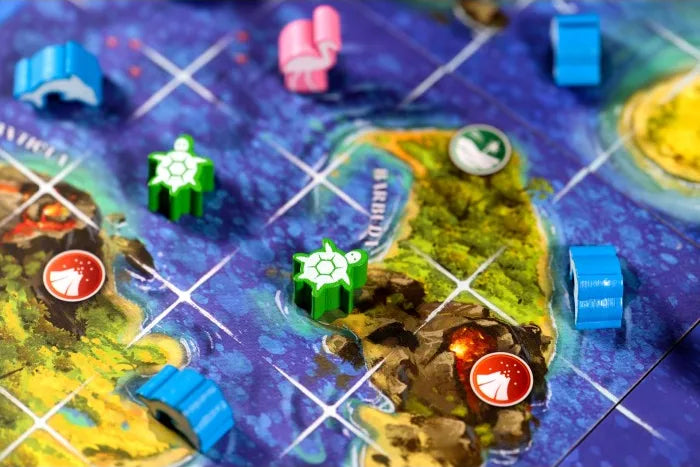
Every card is also a theory. Spend it for its letter, and the theory is gone.
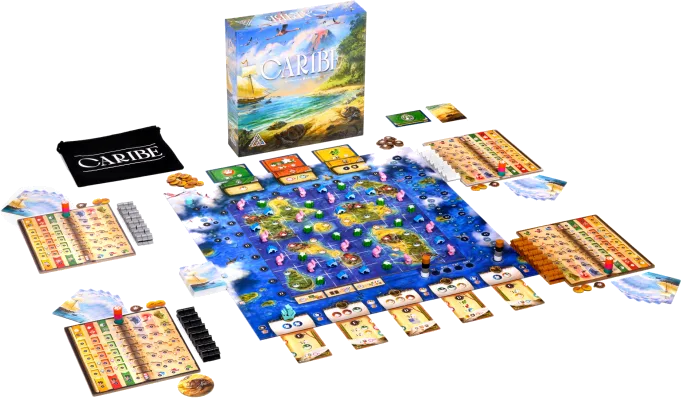
Wood, a map, a notebook.
wooden animals: 14 turtles, 14 dolphins, 14 flamingos
scientists, 24 per colour
theory cards
double-sided map tiles, 16 spaces each
university cards, 3 for each university
automa cards and solo campaign cards
Plus 4 player boards, coins, compass markers, knowledge markers and a bag for the animals.
The game in eight answers.
Action selection, coordinates on a modular map, set collection for theories.
↓ the turnBGG weight, from few votes. Simple turn, plenty of scoring to plan.
↓ scoringYou take the animals others wanted, and the action marker is shared: the sail the last player used costs you 1 coin.
The cards you draw and where the animals land at setup. Coins and compasses fix bad letters.
4 double-sided tiles in any order, animals drawn from a bag, 64 theories, 3 of 9 university cards.
Theories and universities speak in icons. The English is in the rulebook.
Against Sir Percival, an automa; beat your own score; a campaign.
↓ soloBGG poll, few votes. With fewer players some sea spaces stay empty and fewer animals go out.
Five steps, nine rounds.
- Choose a sail. Moving the action marker is free; keeping it where it is costs 1 coin.
- Set the coordinates. Discard a card: its letter opens that row and that column. The rest of the card does not count.
- Act. One action per icon on the sail, only in the open spaces: observe an animal at sea, or place a scientist on the right terrain. One scientist of yours per space.
- Side actions. Left and right of your sail: 1 coin each for one more observation, one more expedition, or a compass marker.
- Take a card. The one under your sail is free, the ones next to it cost 1 coin.
Compass markers open one more row or one more column for the turn. After rounds 3, 6 and 9 there is a scoring phase.
A turn on the map.
Goal: collect what theory G asks for with the right letter. In the real game you score theories, books and universities over 9 rounds, and the most points wins.
🦩 flamingo🐢 turtle🐬 dolphin🌋 volcano🌳 forest🏖️ coastline● your scientist· empty sea
Only G, C and H are theories you can complete here; the other cards are used only for their letter. The map is the 3-player example from the rulebook (tiles A1, B1, C1, D1), sails and theories as printed. Played alone and without opponents: in the real game the others take animals and cards before you.
Where do the points come from?
After rounds 3, 6 and 9 you score the theories in your hand whose requirements you fully meet. There are three kinds.
Animals
The animals you observed go onto your player board, left to right: each space is worth points, and two animals side by side give a bonus.
Scientists
You take your scientists off the terrain the card asks for and put them on the matching track of your board: points and bonuses again.
Quadrant
Same, but the card asks for scientists in an area of the map, on any terrain.
Books and knowledge
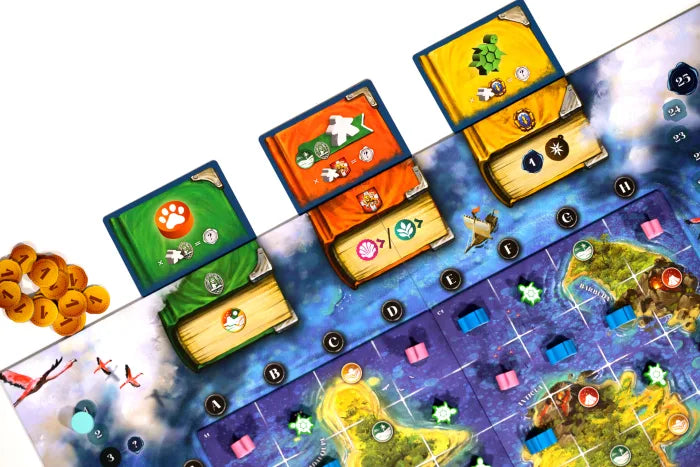
Two scored theories, a left page and a right page, make a book if at least one icon in the middle is whole: Fauna, Geology or Flora. At the end each whole icon is worth as much as your knowledge marker of that kind, up to 5.
Three universities
Some bonuses let you send a scientist from your board to a university for 1 coin. You get a bonus right away and points at the end.
Coimbra
Scientists from forests. Right away: one more expedition anywhere.
End: scientists × the knowledge marker on its cardLondon
Scientists from volcanoes. Right away: Geology or Flora one step forward.
End: scientists × the scientists on the track on its cardParis
Scientists from coastlines. Right away: 1 point and a compass marker.
End: scientists × the animals of the kind on its cardAt the very end, 1 more point for every 3 leftovers: animals not placed, scientists still on the map, coins and compass markers.
Alone against Sir Percival.
The rival is Sir Percival, Percy, a scientist who wants the credit for the best discoveries. He is driven by a deck of 16 automa cards. Three ways to play:
You vs Percy
He plays first every round: his card picks a sail, takes the card under it and tells him where to place scientists and which animals to take, scanning the map along arrows. He scores like a player. You must beat his score.
Beat your own score
Percy does not score: he only takes cards and animals away from you. At the end a table tells you how you did.
Campaign
A series of games with goals to complete: 3, 6 or 9. To move on you must win and complete at least one goal; two lost games end the campaign.
Your round alone: Percy moves first, so the sail he used will cost you 1 coin to stay on and the card under it is gone. You play your turn as usual. At scoring, Percy moves all his scientists from the map to his board.
| Level | Percy starts at | Score to beat (alone) |
|---|---|---|
| Normal | 0 | 75 |
| Hard | 15 | 100 |
| Expert | 30 | 125 |
See it on the table.
Is it for you?
You will like it if
- you like a simple turn with lots to plan around it
- you enjoy cards that do two jobs and hurt to spend
- you want a solo mode with a real rival
- a calm nature theme and wooden animals win you over
Skip it if
- you want direct fights: here you only take things before others do
- end-game scoring with multipliers bores you
- you want a light game for non-gamers
- you play mostly with five or more
Frog’s advice
First game with tiles A1, B1, C1 and D1, as the rulebook suggests. Read your hand before choosing the letter: the card you spend should be the theory you are least likely to complete.
What people ask before buying
What is Caribe?
A strategy game for 1 to 4 players by Orlando Sá, illustrated by Lukas Siegmon, published by Pythagoras. Ages 10 and up, about 100 minutes according to BGG. You lead a 19th-century scientific expedition in the Lesser Antilles: you observe animals, send scientists onto the islands and score theories.
How does a turn work?
Choose one of five sails (moving the marker is free, staying costs 1 coin), discard a card and use its letter A-H to open that row and column of the map, take the sail’s actions in the open spaces, buy side actions for 1 coin each, then take a card from under the sails: the one under yours is free, the ones next to it cost 1 coin.
What do compass markers do?
Each compass marker opens one more row or one more column for that turn. You gain them from side actions, bonuses and the Paris university, and they are discarded at the end of the turn you use them.
How do you score?
After rounds 3, 6 and 9 you score the theory cards in your hand whose requirements you meet: animals observed, scientists on a terrain, or scientists in an area of the map. They go onto your player board for points and bonuses. At the end you also score books, universities and 1 point for every 3 leftovers.
What is a book?
Two scored theories, a left page and a right page, with at least one whole knowledge icon in the middle (Fauna, Geology or Flora). At the end each whole icon is worth the value of your knowledge marker of that kind.
Can you play it solo?
Yes, in three ways: against Sir Percival, an automa who scores like a player; beat your own score against a table, with Percy only taking cards and animals; or a solo campaign of 3, 6 or 9 goals. There are three difficulty levels.
How much luck is there?
No dice. Luck is in the cards you draw and where the animals land at setup. Coins and compass markers help when your letters are wrong.
How much English is there?
The edition is in English, but theory and university cards use icons. The text is in the rulebook.
How does it play with 2, 3 or 4?
The same rules. With fewer players, fewer animals go into the bag (8, 11 or 14 of each kind) and some sea spaces stay empty, so the map stays tight. BGG voters, still few, prefer 3.
Is there a lot of setup?
The 4 map tiles are placed at random, each on a random side, and the animals are drawn from the bag onto the sea spaces. Then theory cards under the sails and your own components.
What is in the box?
Game board, 4 double-sided map tiles, 42 wooden animals, 96 scientists, 64 theory cards, 9 university cards, 4 player boards, 12 knowledge markers, 8 scoring markers, 25 coins, 15 compass markers, action, round and first player markers, a bag, 16 automa cards, 9 solo campaign cards and the rulebook.
The islands are waiting. Which letter do you play?
Our assistant has read the Caribe rulebook. Ask whatever you like: you stay on this page.


