

King
🐸 Dettagli da BoardGameGeek
Consiglio BGG sul numero di giocatori
Categorie
Meccaniche
Design & Art
Lingua
Si abbina bene con
The FroGames Card
The number 9 sun is on the table. You only have two. If you take it now, you close the epoch and those after you are left empty-handed. If you wait, someone shouts "Ra!" and snatches the set you needed. Every choice is a poorly calculated risk.
WHAT IT'S ABOUT
Auctions, sets, and the unforgiving Nile
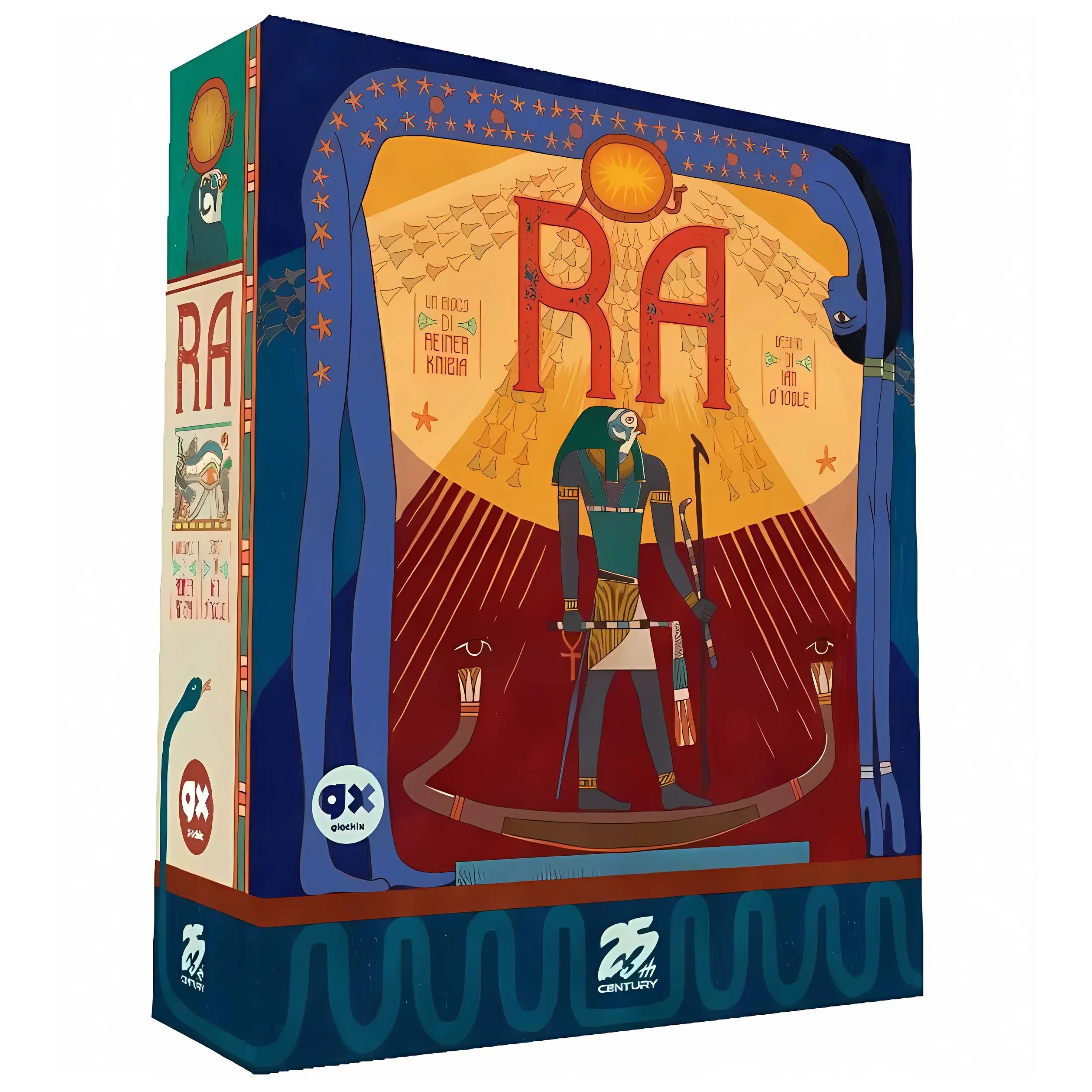
Reiner Knizia published Ra in 1999, and it has been in the BoardGameGeek hall of fame ever since. Ancient Egypt is the pretext: pharaohs, monuments, harvests, deities. But at its heart is a ruthless auction system that forces you to decide when to stop and when to risk everything.
Each player has three suns (numbered discs) with which they bid. When a sun runs out, it's gone for the entire epoch. Tiles come out of the bag one at a time: harvests that are worth points, calamities that reset, pharaohs that reward the majority. You shout "Ra!" to force an auction, or you wait for someone else to do it. The game lasts three epochs, and at the end, the player with the most points wins. But points are calculated in intertwined ways: accumulating isn't enough, you need to balance.
What they say abroad
"Ra is a masterclass in auction design, deceptively simple and endlessly replayable."
Ra is a masterclass in auction design, deceptively simple and endlessly replayable.
— The Opinionated Gamers
Three epochs are enough to understand that every sun is a burning resource, and that the best sets always arrive when you have nothing left to offer.
— FroGames

Ra
FrogScore · FroGames editorial rating · based on rules, international reviews and play sessionsWhat's on the table
Components that make a difference
The Suns
Numbered discs from 1 to 16. They are your currency: you use them to win auctions, but when they run out, you're out of the game until the next epoch. The value of the sun you bid becomes your sun for the next epoch.
The Tiles
Pharaohs, floods, monuments, deities, harvests, catastrophes. They come out of the bag one by one and accumulate on the board. Some are worth points immediately, others only if you have the complete set, others penalize you if you don't have enough.
The Ra Tile
When it comes out of the bag, a mandatory auction starts. The more Ra tiles come out, the closer the epoch gets to its end. The last Ra closes everything and those who haven't bought anything yet are left empty-handed.
The Central Board
Tiles accumulate here until someone voluntarily shouts "Ra!" or until a Ra tile comes out. The auction winner takes everything and starts over.
Come si gioca
Video dimostrativo di gameplay.
🎲How to playThe rules in four steps▼
How to play
The flow of each turn
Ra consists of very quick turns: draw, shout, or pass. But every choice triggers an auction that can turn everything upside down.
The active player draws from the bag and places it on the central board. If it's a Ra tile, a mandatory auction is triggered. If not, the player can decide whether to voluntarily shout "Ra!" or pass the turn to the next player.
When an auction starts (voluntary or forced), players clockwise can bid one of their suns. Whoever passes is out of the auction. The highest bid wins, but the sun offered becomes the new central sun, and the winner takes the old central sun along with all accumulated tiles.
The auction winner collects all tiles from the board and places them in front of them. Their sun goes to the center, and the central sun goes to them. If it was someone's last sun, that player is out of the epoch and waits for it to end.
When all Ra tiles for that epoch are out, points are counted: collected tiles, pharaohs, monuments, Niles, gods. Some categories give points, others give penalties if you don't have them. Then a new epoch begins with new suns.
⏱️Your first gameThe chronicle, moment by moment▼
A game in five moments
What happens at the table
Not the rules. The experience.
First tiles, first doubts
The bag spits out a pair of pharaohs, then a harvest, then a Nile. Nobody shouts Ra. Everyone waits for the lot to become richer. But that sun number 13 on the table stares at you: if you take it now, you gain an advantage for the rest of the epoch.
Someone shouts Ra
A catastrophe comes out of the bag, and the player after you shouts "Ra!" to force the auction before something worse comes out. Now you have to decide: do you offer your best sun for a mediocre lot, or do you pass and hope the next round goes better? Whoever passes often regrets it.
Suns are consumed
You've already spent two out of three suns. The others still have leeway. On the board is the monument you need to complete the set, but your only remaining sun is a measly 2. You offer it anyway, hoping no one bids higher. Of course, someone does.
The last Ra tile
The ninth Ra tile comes out and the epoch suddenly ends. Those who didn't buy anything are left empty-handed. You count the points: the harvests you took are worth something, but you don't have enough gods and you lose 5 points. The player to your right smiles: they had planned everything.
End of the third epoch
The last auction is over. Pharaohs, monuments, Niles, and harvests are counted. The winner is whoever has balanced everything without being exposed in any category. Someone curses because they were missing just one tile for the complete set. Someone else won with a 1-sun in the last round.
🐸Good to know beforeThree honest things, from friends▼
Good to know before
Three things you need to know
Suns don't return
Once you spend a sun, it's gone until the next epoch. If you run out of suns before others, you watch while they buy. Managing the pace is half the game, and you learn it the hard way in the first few games.
The bag dictates the pace
Tiles come out randomly. Sometimes three Ra tiles in a row end the epoch before you've had an auction. Sometimes the perfect set comes out and someone steals it from you. Luck matters, but in the long run, those who know when to take risks win.
Scores are intertwined
It's not enough to collect tiles: you need to balance them. If you have many pharaohs but zero gods, you lose points. If you have harvests but no Niles, same thing. Each category has different rules, and the first two games are spent figuring out what really matters.
🏆Victory and defeatWhat the ending rewards▼
How it ends
How to win
After three epochs, final points are counted. The player with the highest total wins, but there are many intertwined ways to score points.
Victory conditions
- Pharaohs: whoever has more scores points, whoever has fewer loses points
- Monuments, gods: complete sets are worth a lot, partial sets are worth little or nothing
- Harvests and Niles: combinations that give points only if balanced
- Final suns: whoever ends with the highest suns gets a bonus, whoever has the lowest loses points
Penalties
- Zero gods at the end of the game: lose 5 points
- Fewer pharaohs than others: lose points based on the difference
- Low suns at the end of the third epoch: whoever has the worst suns loses 5 points
Ra rewards those who know how to read the table, count remaining suns, and take risks at the right moment. Not those who accumulate the most, but those who balance best.
💬Frequently asked questionsQuick answers before checkout▼
Frequently asked questions
Ra FAQ
How many games does it take to understand Ra?
One to understand the auction mechanism, two to start reading the scores. From the third game onwards, you truly start playing: you know which tiles you need, which suns to keep, when to force an auction and when to wait. The rules are simple, the depth comes from timing.
Does it play well with 2 players?
It works, but it loses some of its bite. In a 2-player game, auctions are direct duels and lack the tension of "who bids first". With 3 or more players, Ra becomes a different game: more players = more suns in circulation = more chances of the lot you wanted being snatched away.
Is it a family game or for experts?
Both. The rules are those of a family game (10 minutes explanation), but the strategic depth is that of a medium-weight eurogame. If your friends know what an auction is and aren't intimidated by five different scoring types, Ra works very well.
What mechanics does Ra use?
Closed economy auctions: each player has a fixed number of suns and cannot replenish them until the next epoch. Set collection for final scores, and push your luck when deciding whether to shout Ra or wait for the next tile to appear.
Is it available in Italian?
Yes, the Giochix edition is completely in Italian: rulebook, board, tiles. It is language-independent once learned, as the tiles use symbols, but having everything in Italian helps in the first few games.
The people behind the game
Who invented it, who designed it, who publishes it — and what else they've done.
Ra is a strategy game for 2-5 players aged 12 and up, with games lasting 45-60 minutes. Designed by Reiner Knizia in 1999 and published in Italy by Giochix, Ra uses a closed economy auction system and set collection set in Ancient Egypt. Each player has three numbered suns with which to win auctions: when a sun is spent, it is out of play until the next epoch. Tiles are drawn from the bag one at a time and accumulate on the central board until someone shouts "Ra!" to force an auction. The game lasts three epochs and the winner is whoever best balances pharaohs, monuments, harvests, Niles, and gods. Available on FroGames.it.
King
Frequently Asked Questions
The answers you're looking for, no beating around the bush.
📸Do the images match the actual product?
The photos on the website often come from BoardGameGeek and are intended to give you an idea of the game. They may vary slightly from the version you receive. The content declared by the publisher is always binding.
📦Does the content of the box match what is indicated?
We always strive to provide the correct content, but minor variations are possible due to reprints or updates. The information comes directly from the publishers. If you have any questions, please contact us!
⏳How do pre-orders work?
Pre-order the game before release, payment is immediate, and the game is reserved for you. As soon as it arrives, we'll ship it right away! If there are any delays, we'll update you promptly.
🔒Can I trust buying here?
Absolutely! Secure payments, tracked shipments, and a team that loves board games as much as you do. If something goes wrong, we'll do our best to fix it.
🛠There's a problem with my order, what should I do?
Write to us now! Whether it's a missing part, damage, or an error, we'll help you resolve it as soon as possible. Your experience truly matters to us.