
Classic Art
🐸 Details from BoardGameGeek
Consiglio BGG sul numero di giocatori
Categorie
Meccaniche
Design & Art
Lingua



Si abbina bene con
FroGames — Moments You'll Remember
Everyone bets on different exhibits. Some bet on rarity, some on abundance. In the end, those who got it right cheer, while those who got it wrong silently count their lost chips.
WHAT IT'S ABOUT
Risky Bets on Art Exhibitions
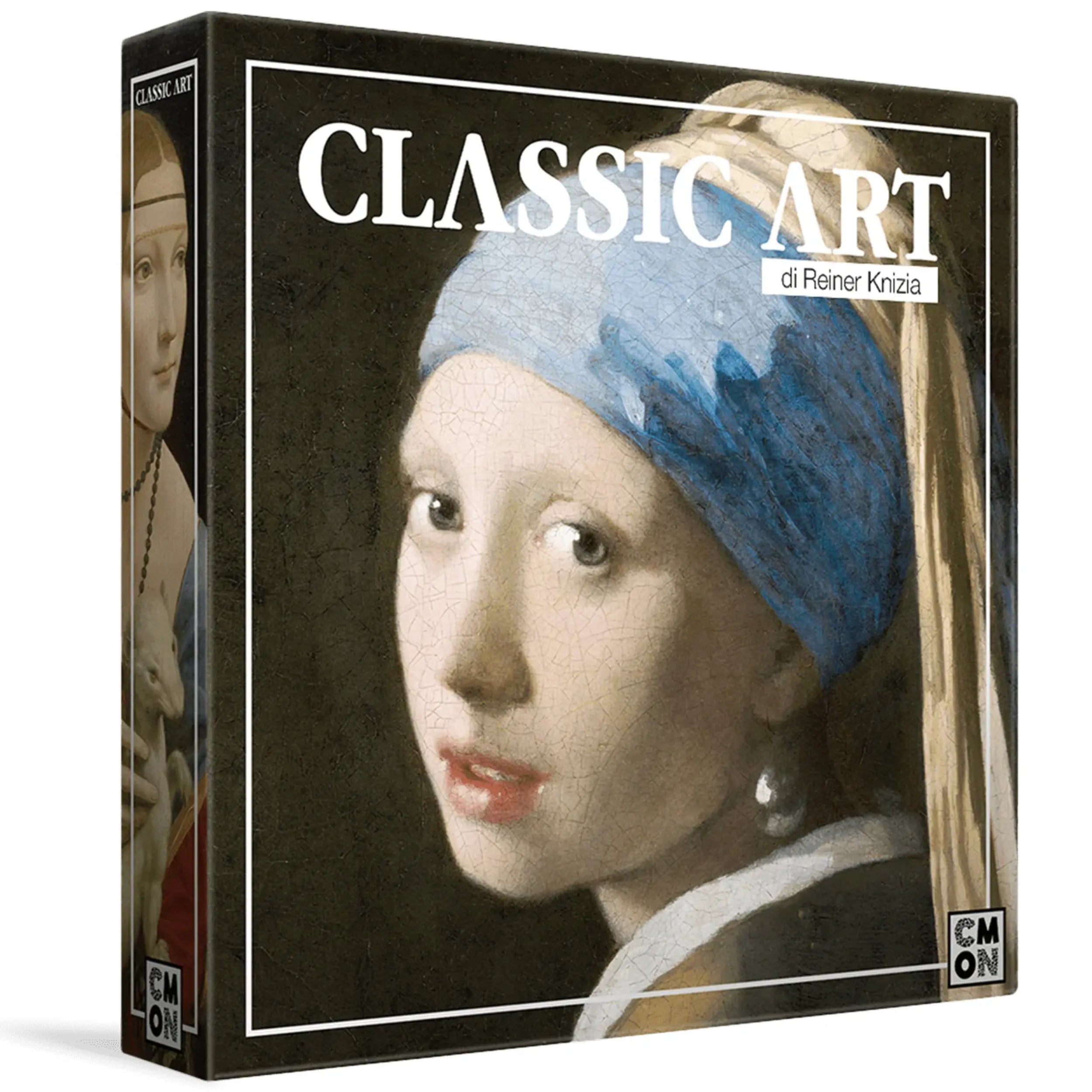
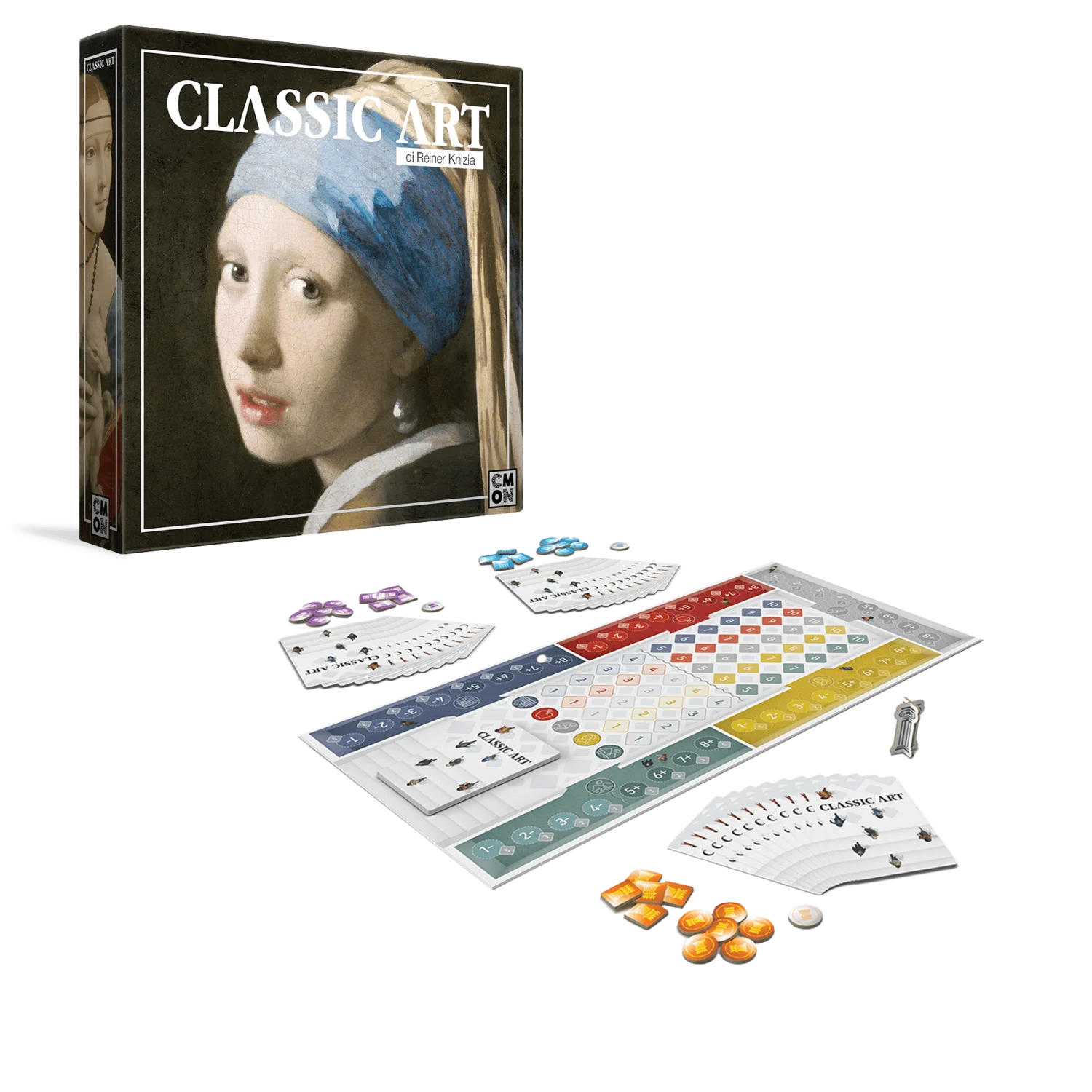
Classic Art is the 2022 version of Members Only, designed by Reiner Knizia and published by Asmodee. A game of prediction and bluffing set in the art market, where each player tries to guess how many artworks will appear in five different exhibitions. Illustrations by Chris McGloughlin, compact components (65 cards and chips).
Each game takes place over multiple seasons. You receive a hand of cards, play two cards per turn in specific exhibitions, and place chips to bet on how many artworks will end up in each exhibition. Riskier bets (extreme numbers) pay more, but guessing correctly is difficult. The first to accumulate 10 points in an exhibition closes that collection, and in the end, the player with the most total points across all exhibitions wins.
What they say abroad
A game of small reads and big bets. Each season leaves you with one question: should I have risked more?
— FroGames
Knizia knows how to present players with difficult choices using minimal mechanics. Classic Art is the perfect example.
— FroGames

Classic Art
FrogScore · editorial rating FroGames · based on rules, international reviews, and gameplay sessionsWhat's in the deck
65 cards, 5 exhibitions, endless bets
Artwork Cards
65 cards divided into 5 categories (exhibitions). Each category has 11 positive and 2 negative cards. When a positive and negative card meet, they cancel each other out.
Betting Chips
You place them on the prediction spaces (1 to 8) to bet on how many artworks will end up in an exhibition. The more extreme the number, the more it pays if you guess correctly.
High Risk Chip
Each player has one. You use it to place a double bet in a season. If you win, you double your score. If you lose, you still get it back.
Score Track
Each exhibition has a 0-10 track. When someone reaches 10 points in an exhibition, it closes. The game ends when every exhibition has at least one player at 5+.
Recommended sleeves 130 cards in 2 sizes ▼
If you play often, we recommend protecting your cards with clear sleeves to make them last longer.
| Size | Quantity |
|---|---|
| 65 × 100 mm | 65 |
| 59 × 92 mm | 65 |
| Total cards | 130 |
At the end of each season, you find out who saw it coming. And who bet too much.
Come si gioca
Video dimostrativo di gameplay.
A five-part game
What happens at the table
Not the rules. The experience.
The opening hand
You receive 7-11 cards (depending on the number of players) and look at the first two cards revealed in the exhibitions. You start calculating: I have many cards of one category, I can push that exhibition towards abundance. Or I have few cards, I bet on the rare and hope others do the same.
The first bets
Someone immediately places chips on the rare (1-4 artworks), someone else waits. You decide to take a risk: you place a chip on 2 in an exhibition where you have zero cards. You bet that no one will fill it. The table looks at you: bluff or folly?
Mid-season
Now everyone has played several cards. Exhibitions are starting to take shape: one is almost full, another only has 2 artworks. You place your high-risk chip on an extreme bet (8 artworks). If you guess right, you make a fortune. If you guess wrong, you've wasted the best turn of the season.
Last two cards
End of season: everyone plays their last two cards. Every revealed card changes the exhibitions. A negative card eliminates a positive one, and suddenly your bet on 5 artworks collapses to 3. Someone shouts, someone curses. The die is cast.
The count
The artworks in each exhibition are counted. Those who bet correctly score points (the riskier the bet, the more points they earn). Those who bet incorrectly lose their chips. Someone just scored 6 points in an exhibition and is approaching the limit of 10. The game changes: now you have to close before someone wins.
How to play
The flow of each season
A season takes place in rounds. Each round: you play cards, place bets, repeat. When everyone has 3 cards in hand, it closes.
You place 1-2 chips on a prediction space (numbers 1-8) of an exhibition. Or you pass. You can use the high-risk chip once per season to place a double bet.
You draw two cards from your hand and place them in the corresponding exhibitions (each card has a category). If positive and negative cards meet, they cancel each other out.
The next player does the same: bets (if they want) and plays two cards. This continues until everyone has only 3 cards in hand.
Everyone discards 1 face-down card and plays the last 2 in the exhibitions. The artworks in each exhibition are counted. Points are scored for correct bets. Lost chips are removed from play (except high-risk chips).
Why it's different from others
Six mechanics that make a difference
Asymmetric bets
You don't bet against opponents. You bet on the final outcome of each exhibition. Everyone can win (or lose) in the same exhibition. It's not a zero-sum game: it's a game of collective predictions.
Progressive risk/reward
Betting on 1 artwork (extreme rarity) or 8 artworks (extreme abundance) pays 4 points per chip. Betting on central numbers (3-6) pays less. The more you risk, the more you earn. But guessing extreme numbers is very difficult.
Positive and negative cards
Each category has 11 positive and 2 negative cards. When a positive and a negative card meet in the same exhibition, they cancel each other out. A sudden twist can cause an exhibition to drop from 6 artworks to 4, and all bets are overturned.
Chip recovery (safety net)
If you end a season with 0 or 1 chip remaining, you recover all your chips. You can risk everything knowing that the game gives you a second chance. But you have to calculate carefully: losing too much takes you out of the game for a season.
Separate scores per exhibition
Each exhibition has a separate 0-10 track. You only score points in exhibitions where you bet correctly. But beware: scores below 5 in an exhibition are worth zero at the end of the game. You have to balance: is it better to have 8 points in one exhibition or 4+4 in two?
Variable end condition
The game ends when each exhibition has at least one player with 5+ points. You don't know when it will end. Someone might push to finish quickly (if they are ahead) or slow down (if they need to catch up). Timing is everything.
How it ends
How to win and how to lose
The winner is whoever scores the most points by totaling all exhibitions. But it's not enough to accumulate: you must exceed the threshold of 5 in each exhibition, otherwise those points are worth zero.
Victory
- Accumulate 10 points in one or more exhibitions (close those exhibitions)
- Exceed the threshold of 5 in each exhibition where you bet (below 5, points don't count)
- Total the highest score by summing all exhibitions at the end of the game
Defeat
- Always bet on the wrong numbers and lose all your chips (you recover everything, but you've lost a season)
- Accumulate points in only one exhibition but remain below 5 in the others (those points are worth zero)
- Opponents close the exhibitions before you can catch up
Classic Art is a game where every chip placed is a bet on the behavior of others. The one with the best cards doesn't win. The one who guesses the right moments to take risks wins.
Frequently asked questions
Classic Art FAQ
How many seasons are played in a game?
It depends on how quickly players accumulate points. On average 3-5 seasons. The game ends when each exhibition has at least one player with 5+ points. Fast games (everyone aggressive on bets) last 3 seasons, slow ones 6-7.
What happens if no one bets on an exhibition?
Nothing. The exhibition still gets filled (everyone has to play two cards per turn), but no one scores points on that exhibition at the end of the season. It's rare: usually someone bets on everything, even just to position themselves.
Can I change my mind after placing a chip?
No. Once placed, the chip remains there until the end of the season. If the bet fails, you lose the chip (except for the high-risk chip, which you always recover). You must decide based on the partial information you have.
Does the high-risk chip still work if the bet fails?
Yes, in the sense that you recover the high-risk chip even if you make the wrong prediction. But you don't score points. It's a zero-cost bet (you don't lose the chip), but you have to use it well: if you make a mistake, you've wasted your only chance to double your score in that season.
Is the game available in Italian?
Yes, this Asmodee edition includes the rulebook and all materials in Italian. The cards have clear symbols and categories, almost total language independence.
Classic Art is a competitive card game for 2-5 players, ages 10 and up, lasting 30-60 minutes. Designed by Reiner Knizia and published by Asmodee, Classic Art (formerly Members Only) is a betting and hand management game where each player tries to predict how many artworks will appear in five different exhibitions. Riskier bets (extreme numbers) pay more, but guessing them correctly is difficult. Mechanics: you place chips to bet, play two cards per turn influencing the exhibitions, and only score points if you guess correctly. Includes a 2-player variant with a house deck. Accessible rules, high tactical depth. Available on FroGames.it.
Classic Art
Frequently Asked Questions
The answers you're looking for, no beating around the bush.
📸Do the images match the actual product?
The photos on the website often come from BoardGameGeek and are intended to give you an idea of the game. They may vary slightly from the version you receive. The content declared by the publisher is always binding.
📦Does the content of the box match what is indicated?
We always strive to provide the correct content, but minor variations are possible due to reprints or updates. The information comes directly from the publishers. If you have any questions, please contact us!
⏳How do pre-orders work?
Pre-order the game before release, payment is immediate, and the game is reserved for you. As soon as it arrives, we'll ship it right away! If there are any delays, we'll update you promptly.
🔒Can I trust buying here?
Absolutely! Secure payments, tracked shipments, and a team that loves board games as much as you do. If something goes wrong, we'll do our best to fix it.
🛠There's a problem with my order, what should I do?
Write to us now! Whether it's a missing part, damage, or an error, we'll help you resolve it as soon as possible. Your experience truly matters to us.