

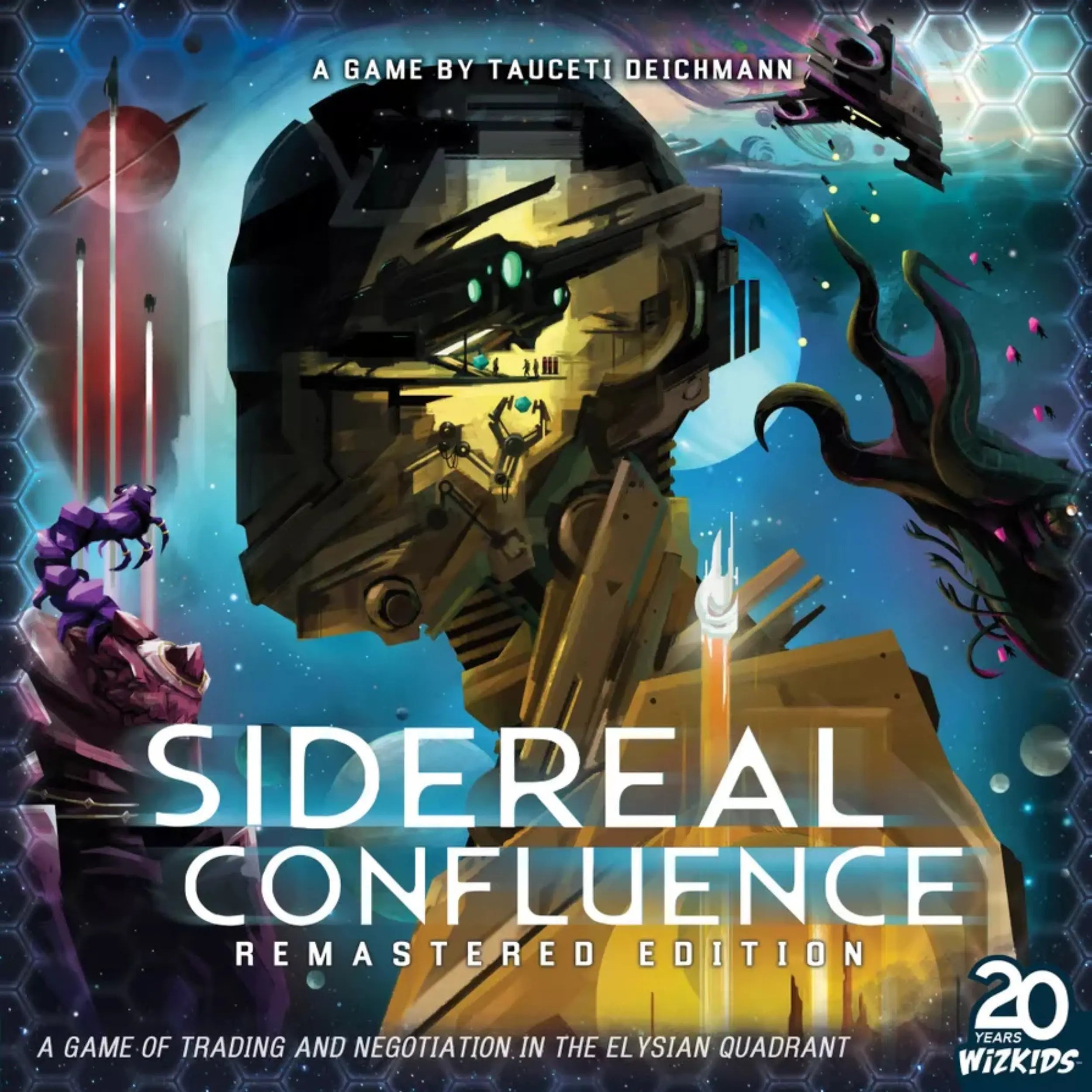

Sidereal Confluence Remastered
Sidereal Confluence
🐸 Dettagli da BoardGameGeek
Consiglio BGG sul numero di giocatori
Categorie
Meccaniche
Design & Art
Lingua






Si abbina bene con
The FroGames Card
You need white. No one produces it for free. The person next to you wants your green. Across the table, someone is offering technology. You have three minutes to close six deals or your civilization collapses.
WHAT IT'S ABOUT
A table full of aliens shouting, bargaining, and closing deals
Designed by TauCeti Deichmann and illustrated by Kwanchai Moriya, Sidereal Confluence puts 4-9 players in the shoes of completely different alien races gathered to form a trade federation. Each civilization has unique technology cards, asymmetric economies, and its own objectives. Published by WizKids in 2017, this Remastered Edition has refined the rules and layout while keeping the heart of the game intact: a chaotic negotiation where everything is on the table.
On your turn, you don't wait for others to finish. Everyone plays simultaneously. You have cards that transform cubes into other cubes, ships, or points. The problem? Your inputs never match your outputs. You have to exchange resources, ships, colonies, even borrowed technologies. You negotiate loudly, close verbal agreements, promise for the next turn. At the end of the round, everyone activates their economies together. Whoever built the most efficient chain advances. Whoever miscalculated implodes.
What they say abroad
"The most unique trading game I've ever played"
The most unique trading game I've ever played
— The Dice Tower
First game: total chaos. Second game: you start to see patterns. Third game: you're already on the phone with whoever was missing.
— FroGames

Sidereal Confluence
FrogScore · FroGames editorial rating · based on rules, international reviews, and game sessionsYour civilization
Four elements that define each race
Unique technology deck
Each race has its own technology deck. The Faderan produce ships, the Caylion duplicate resources, the Zeth manipulate time. No two decks are alike.
Resource converters
Cards that transform cubes of one color into other cubes, ships, or points. The problem: your inputs never match your outputs. You have to negotiate to fill the gaps.
Colonies
Planets you produce or conquer during the Confluence. They generate passive resources every turn, but they go up for auction: if you want that colony, you have to offer more than others.
Verbal agreements
Everything is negotiable: cubes, ships, colonies, even the temporary use of a technology. Agreements are only morally binding. Trust. Or not.
Recommended sleeves 774 cards in 1 size ▼
If you play often, we recommend protecting the cards with transparent sleeves to make them last longer.
| Size | Quantity |
|---|---|
| 63.5 × 88.9 mm | 774 |
| Total cards | 774 |
Come si gioca
Video dimostrativo di gameplay.
🎲How to playThe rules in four steps▼
How to play
The flow of each round
Two distinct phases: one chaotic and free-flowing, one silent and simultaneous.
Everyone negotiates simultaneously and loudly. You can trade cubes, ships, colonies, even promise future technologies or temporary use of a converter. Agreements are verbal. No limits. No turns. Just controlled chaos. When everyone is satisfied (or the timer runs out), you move to the next phase.
Everyone activates their cards simultaneously. Spend the cubes you obtained (or promised) to run your converters. Produce new resources, ships, points. If you lack resources, that card doesn't activate. Well-negotiated economies boom. Poorly planned ones stall.
Those who have researched technologies share them with everyone (and earn prestige points). Then auctions are held for new colonies and research teams. Bid cubes or ships in sealed envelopes; the highest bidder wins. Colonies generate passive resources each turn: those who control them have a structural advantage.
The Trade phase restarts. Newly shared technologies change everyone's possibilities. Newly conquered colonies alter the balance. Strategies evolve. Players who figured out how to intertwine others' economies dominate. The others beg for better deals.
⏱️Your first gameThe chronicle, moment by moment▼
A game in five moments
What happens at the table
Not the rules. The experience.
Choose your race
Everyone draws or chooses one of the nine alien races. Read your cards. You still don't understand how it works, but you see the gaps: you produce green but need white. Across the table, someone has the opposite problem. An idea begins to form.
The chaos of negotiations
Timer started. Everyone is talking at once. Someone yells 'who has white?' You offer three greens for two whites. Across the table, someone proposes a three-way deal you don't yet understand. You close the first trade. Then the second. Then you forget who you closed the third with.
The economy turns
The trade phase ends. Everyone turns their cards together. You count the cubes you obtained, activate the converters, produce new resources. You discover you were missing one cube to activate the best card. Next time, you'll close deals better.
The Confluence
The time of federation arrives. Those who have researched technologies share them with everyone. New colonies are auctioned: bid cubes or ships, the highest bidder wins. Someone grabs a key planet. Someone else has already figured out how to exploit the newly unlocked technologies.
End of game
After 4-6 rounds, points are tallied. The winner is the one who built the most efficient economy and converted the most resources into technologies, colonies, and final goods. Someone won because they negotiated better. Someone lost because they trusted the wrong person. Immediate replay with another race.
🐸Good to know beforehandThree honest things, from friends▼
Good to know beforehand
Three things you need to accept
The first game is a disaster
Nine different races, each with its own rules and unique cards. No one understands what they're doing on the first round. Plan 30 minutes for setup and explanation, and accept that the first two rounds will be experimental. The second game will run smoothly.
You have to talk. A lot.
It's not a game for introverts. Negotiation is simultaneous and loud. If you don't speak up, you won't close deals. If you don't close deals, your economy will stall. If a chaotic table with six people yelling offers bothers you, this game is not for you.
The right number is 6-7
It scales from 4 to 9, but with fewer than 5 players it loses its appeal: economies are too simple, negotiations less desperate. Above 8, it becomes too long and sprawling. The sweet spot is 6-7: enough players for complex negotiations, not so many that the table is paralyzed.
🏆Victory and defeatWhat the ending rewards▼
How it ends
How to win and how to lose
After 4-6 rounds (depending on the number of players), victory points are tallied.
Victory
- Researching technologies: each developed tech is worth prestige points and is shared with everyone
- Converting resources into goods: some cards produce points instead of cubes
- Final remnants: at the end of the game, convert remaining resources into bonus points
Defeat (or almost)
- Negotiating poorly: if you close unbalanced deals, your economy stalls
- Ignoring technologies: those who don't research lose prestige points and fall behind
- Trusting too much: agreements are morally binding, not legally. Someone will forget.
The winner is the one who built the most efficient economy and negotiated best. Not the one who yelled the loudest.
💬Frequently asked questionsQuick answers before checkout▼
Frequently asked questions
FAQ about Sidereal Confluence
What mechanics does Sidereal Confluence use?
Free and simultaneous negotiation, asymmetrical engine-building, resource management, sealed-bid auctions, shared tech trees, verbal contracts. It's a unique hybrid: half economic eurogame, half loud party game.
Are the races really that different?
Yes. The Faderan produce ships and earn points from their fleet. The Caylion duplicate resources with biology. The Zeth manipulate time and play extra cards. The Kit collect scraps from others. Each race has its own strategies, strengths, and weaknesses. It's not cosmetic asymmetry.
Are agreements binding?
No, legally. Yes, morally. The game is based on trust and reputation. If you break an agreement, no one will negotiate with you in subsequent rounds. In theory, you could trick everyone once. In practice, you'll be cut off and lose.
Does it work with 4 players?
Technically yes, but it loses a lot. With 4, economies are too simple, negotiations less desperate, interdependence less stringent. The game is designed for 6-7: there, negotiations explode and no one has all the resources they need.
Is it available in Italian?
The edition sold on FroGames is in English. The cards have text, but once you learn your race (first game), dependence on the language decreases: converters are iconic and you negotiate agreements verbally. However, a medium reading level of English is needed for the initial setup.
The people behind the game
Who invented it, who designed it, who publishes it — and what else they've done.
Sidereal Confluence is a negotiation and resource management game for 4-9 players designed by TauCeti Deichmann and published by WizKids. Duration 120-180 minutes, recommended age 14+. Each player controls an asymmetrical alien race with unique economy and technologies. The central mechanic is simultaneous loud negotiation: exchange resources, ships, colonies, even the temporary use of cards to build the most efficient production chain. The game combines economic engine-building and chaotic social interaction in a unique blend in the board game landscape. Available on FroGames.it.
Frequently Asked Questions
The answers you're looking for, no beating around the bush.
📸Do the images match the actual product?
The photos on the website often come from BoardGameGeek and are intended to give you an idea of the game. They may vary slightly from the version you receive. The content declared by the publisher is always binding.
📦Does the content of the box match what is indicated?
We always strive to provide the correct content, but minor variations are possible due to reprints or updates. The information comes directly from the publishers. If you have any questions, please contact us!
⏳How do pre-orders work?
Pre-order the game before release, payment is immediate, and the game is reserved for you. As soon as it arrives, we'll ship it right away! If there are any delays, we'll update you promptly.
🔒Can I trust buying here?
Absolutely! Secure payments, tracked shipments, and a team that loves board games as much as you do. If something goes wrong, we'll do our best to fix it.
🛠There's a problem with my order, what should I do?
Write to us now! Whether it's a missing part, damage, or an error, we'll help you resolve it as soon as possible. Your experience truly matters to us.