
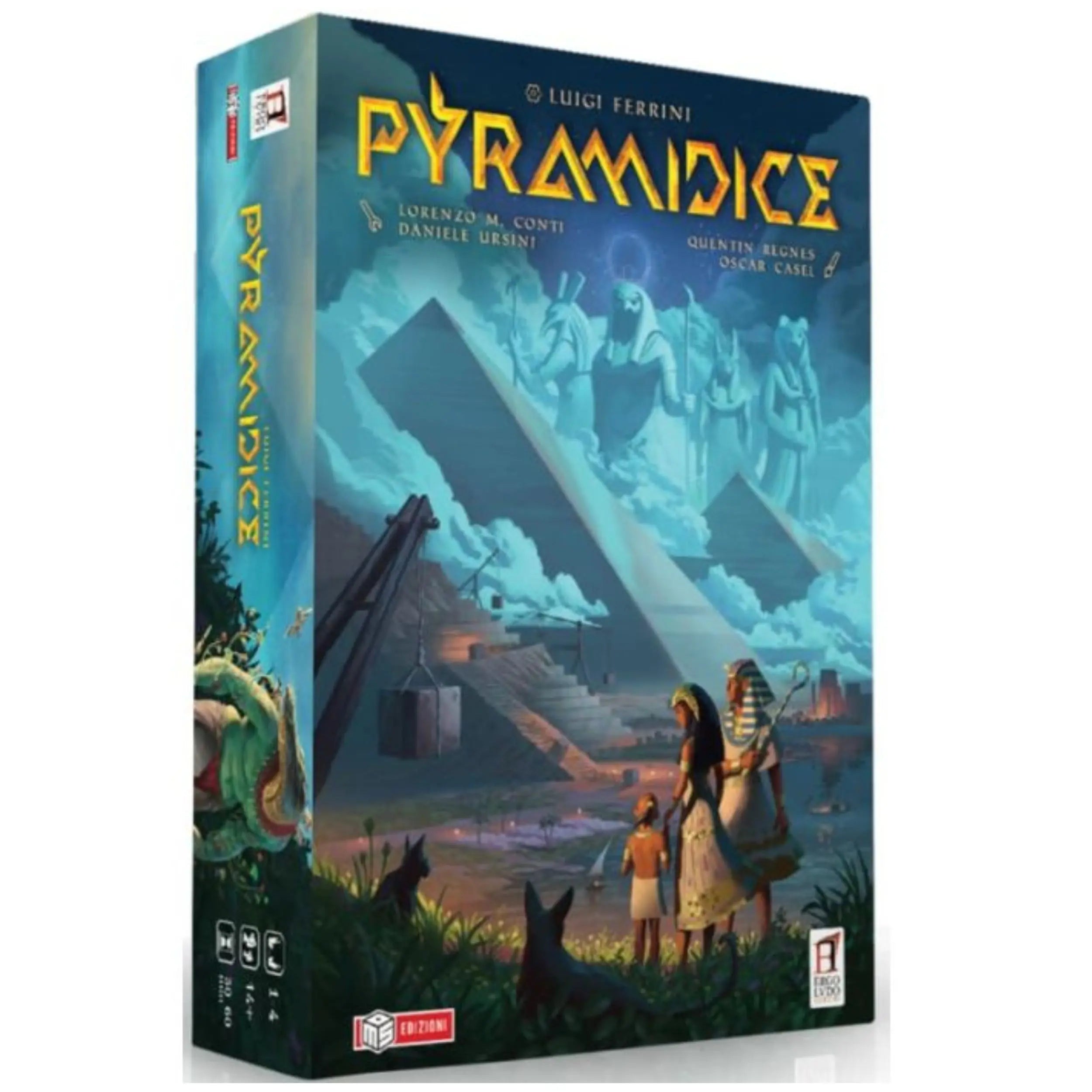

Pyramidice
🐸 Dettagli da BoardGameGeek
Consiglio BGG sul numero di giocatori
Categorie
Meccaniche
Design & Art
Lingua







Si abbina bene con
The FroGames Card
You roll the dice. Everyone wants the same outcomes. Someone calls upon a god, someone burns a Scarab, someone curses their neighbor. In the end, it's not about who has the tallest pyramid, but who made the best of their rolls.
WHAT IT IS ABOUT
Architects, pyramids, and the favor of the gods in ancient Egypt
Designed by Luigi Ferrini (known for his work on tactical games and puzzles) and illustrated by Oscar Casel, Marco Pantaleoni, and Quentin Regnes, Pyramidice was released in 2023 by MS Edizioni in Italy. The game transports you to the Giza plateau, where you are one of the Pharaoh's architects called upon to erect eternal monuments and earn immortality.
You roll dice, build combos with your cards, collect resource sets, and gain the favor of the Egyptian deities. Your goal: complete your pyramids before others and accumulate the most glory. Each turn is a mini-puzzle of optimization, where timing matters as much as luck, and where the sacred Scarab you hold can turn an entire round around. Competition is direct: the best dice are always contested, and choosing which god to invoke means understanding what your opponents are doing.
What they say abroad
"On the Giza plateau, the best architects of ancient Egypt are called to imprint the mark of the Pharaoh."
— Ergo Ludo Editions
Pyramidice is a tight race where every roll counts and every card can turn the tide. The solo mode with historical automatons works very well.
— FroGames

Pyramidice
Pyramidice includes four historical automatons (Snefru, Hemiunu, Amenhotep, Imhotep), each with different behaviors and strategies. They play by drawing cards and following simple but effective decision trees. The experience is complete, and the game scales well, even if you obviously lose the psychological interaction and bluff of multiplayer. Excellent for practice and deck testing.
FrogScore · FroGames editorial rating · based on rules, international reviews, and game sessionsWhat you hold in your hand
Your tools to dominate the plateau
Project Cards
Build your personalized deck: each card gives you actions, resources, or bonuses when you play combos. You draw, choose, optimize. Your playing style is in here.
Shared Dice
Everyone rolls together and everyone draws from the same pool. Who gets the best results first? Who knows how to wait? Timing is everything, and the Scarab can turn an adverse roll around.
Sacred Scarab
Each player has one, uses it once per round, then retrieves it. It's your ace up your sleeve: change a die, unlock a combo, save the turn. When to play it is the crucial question.
Egyptian Deities
Invoking a god gives you powerful benefits, but you must have the right resource sets. Choose wisely: each deity favors a different strategic path, and those who honor the right gods win games.
Recommended sleeves 56 cards in 1 size ▼
If you play often, we recommend protecting your cards with clear sleeves to make them last longer.
| Size | Quantity |
|---|---|
| 63.5 × 88 mm | 56 |
| Total cards | 56 |
Come si gioca
Video dimostrativo di gameplay.
🎲How to playThe rules in four steps▼
How to play
The flow of each round
Pyramidice is a game of fast, simultaneous turns: roll, choose, build, optimize.
All players roll the common dice together. Each result is a resource: stone, wood, gold, workers. The pool is shared: who gets what first?
On your turn, choose a die from the pool and play cards from your hand to activate actions, build pyramid blocks, or accumulate resources. Cards combine: play them well for powerful combos.
If you have completed a required resource set, you can invoke a deity and gain their favor: glory points, extra cards, special powers. Each god has a unique cost and benefit.
If you used your sacred Scarab this round to modify a die or unlock an action, you retrieve it at the end of the round. Then everyone draws new cards and starts over. The game ends when someone completes all their pyramids or the objective deck runs out.
⏱️Your first gameThe chronicle, moment by moment▼
A game in five moments
What happens at the table
Not the rules. The experience.
Setup and first cards
Everyone chooses their starting deck, places their empty pyramids in front of them, and takes their Scarab. Someone quickly reads the available deities. First dice roll: the hunt for the best results begins. The atmosphere is still relaxed, but you're already watching what others are taking.
First combos and first blessings
Someone completes a resource set and invokes the first deity. The others accelerate. Dice start to run out: who uses the Scarab immediately and who holds onto it? Played cards link together, the first pyramids take shape. No one is ahead yet, but everyone is studying their opponents' decks.
Tight race
Mid-game. Someone has a nearly complete pyramid, the others hurry. Good dice disappear in an instant, turns shorten. Someone curses an unlucky roll, someone burns their Scarab to save a critical action. Resources are always scarce, sets are hard to close. High tension.
The decisive round
Two players are neck and neck. One completes a pyramid and earns huge glory points. The other counters with a powerful divine blessing and gains ground. The third player is still in the running thanks to an optimized deck. Every card drawn can change everything. No one speaks, everyone calculates.
Final count
Last hand. Someone finishes their last pyramid, someone else invokes a desperate god. Points are counted: completed pyramids, resource sets, divine favors. The player who optimized their path best wins. Someone immediately asks for a rematch to test a different deck. Game finished in 45 minutes.
🐸Things to know beforehandThree honest things, from friends▼
Things to know beforehand
Three things you need to know
Mitigated luck, but present
Dice are the engine of the game. You can manage them with cards and the Scarab, but a round with all low rolls slows everyone down. If you're looking for total control, this isn't the right game. If you like to optimize within random constraints, however, it works very well.
Downtime with 4 players
With two or three players, the pace is perfect. With four, if someone goes into analysis paralysis on sets and combos, the others wait. It's not a party game: it's an optimization game, and some turns require calculation. Keep that in mind.
Gentle learning curve
The rules are explained in 15 minutes, and the iconography is clear. But you'll play badly the first game: you only discover combos by playing, you only understand the timing of divine blessings by making mistakes. From the second game onwards, the game truly opens up.
🏆Victory and defeatWhat the ending rewards▼
How it ends
How to win and how to lose
The player who accumulates the most glory points at the end of the game wins. Points come from completed pyramids, honored deities, and collected resource sets.
Victory
- Complete your pyramids: each placed block is worth points, completing them all is worth much more
- Invoke the right deities: the gods' favors grant immediate glory points and end-game bonuses
- Optimize your deck: better cards = more powerful combos = closed sets faster = more glory accumulated
Defeat (or missed victory)
- Waste your Scarab: using it too early or too late makes you lose crucial turns
- Ignore opponents: if you don't read what they're building, they'll snatch the dice and deities you needed
- Don't close sets: accumulating resources randomly without a plan leaves you with a half-built pyramid and no invoked gods
Pyramidice is a combo and timing game that plays fast, is quick to learn, and makes you want to replay it immediately with a different deck.
💬Frequently Asked QuestionsQuick answers before checkout▼
Frequently Asked Questions
FAQ about Pyramidice
What mechanics does Pyramidice use?
Pyramidice combines dice rolling (shared dice rolled each round), deck construction (build your deck during the game), set collection (gather resources to invoke deities), and variable player powers (asymmetrical powers and unique cards). It's a mix of optimization and tactics with controlled randomness.
How does solo play work?
The game includes four historical automas that simulate ancient Egyptian architects: Snefru, Hemiunu, Amenhotep, and Imhotep. Each has a deck and different behavior. You play against them as in a normal game, following simple but effective decision trees. The experience is solid and the game scales well.
How complex is it to learn?
The basic rules are explained in 15 minutes. The iconography is clear, the game flow immediate. The complexity lies in the card combos and the choice of when to use the Scarab or invoke a deity. You'll play poorly the first game, but by the second, you'll understand the rhythm. Medium-light weight (2.4/5 on BGG).
Is it suitable for casual players or does it require experience?
It works well as a family game for regular gamers, but it's not a pure gateway game. If you've already played some dice rolling and resource management games (like Splendor, King of Tokyo), you'll jump right in. If it's your first game after the classics, the curve is a bit steep. Excellent for those who want a step above gateway games without jumping into heavy eurogames.
Is it available in Italian?
Yes, this is the Italian edition published by MS Edizioni. Rulebook, cards, and components are all in Italian. Ready to play without translations or appendices.
The people behind the game
Who invented it, who designed it, who publishes it — and what else they've done.
Pyramidice is a competitive dice and deck-building board game for 1-4 players, designed by Luigi Ferrini and published by MS Edizioni. Duration 30-60 minutes, recommended age 12+, medium-light weight (2.4/5). Set in ancient Egypt, it combines dice rolling, set collection, and variable powers: build pyramids, invoke Egyptian deities, optimize card combos. Includes four historical automas for solo play (Snefru, Hemiunu, Amenhotep, Imhotep). Clear rules, immediate iconography, high replayability. Complete Italian edition. Available on FroGames.it.
Pyramidice
Frequently Asked Questions
The answers you're looking for, no beating around the bush.
📸Do the images match the actual product?
The photos on the website often come from BoardGameGeek and are intended to give you an idea of the game. They may vary slightly from the version you receive. The content declared by the publisher is always binding.
📦Does the content of the box match what is indicated?
We always strive to provide the correct content, but minor variations are possible due to reprints or updates. The information comes directly from the publishers. If you have any questions, please contact us!
⏳How do pre-orders work?
Pre-order the game before release, payment is immediate, and the game is reserved for you. As soon as it arrives, we'll ship it right away! If there are any delays, we'll update you promptly.
🔒Can I trust buying here?
Absolutely! Secure payments, tracked shipments, and a team that loves board games as much as you do. If something goes wrong, we'll do our best to fix it.
🛠There's a problem with my order, what should I do?
Write to us now! Whether it's a missing part, damage, or an error, we'll help you resolve it as soon as possible. Your experience truly matters to us.