

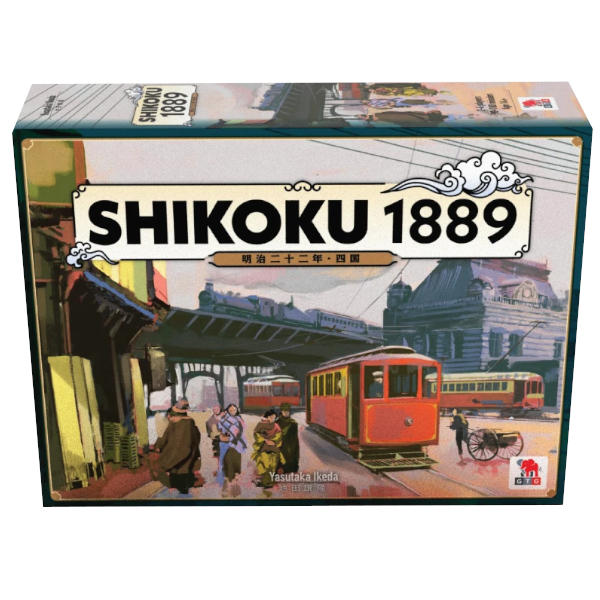
Shikoku 1889
🐸 Dettagli da BoardGameGeek
Consiglio BGG sul numero di giocatori
Categorie
Meccaniche
Design & Art
Lingua
Pre-order - leggi i dettagli
🐸 Una rana saggia sa quando dividere l’ordine… e quando aspettare il salto giusto.






Pairs well with
The FroGames Card
You just bought 40% of a company that doesn't have any tracks yet. The president wants to reinvest everything; you want immediate dividends. In two rounds, someone else might buy out both of you.
WHAT IT'S ABOUT
Railway capitalism on the smallest of the big four
In 2004, Yasutaka Ikeda designed this 18xx game set on the island of Shikoku, the smallest of Japan's four main islands. The map is a concentrated mix of mountains, coastlines, and a few cities, with limited space and competitive routes. The artwork by Karim Chakroun and Erik Frobom keeps the visual legacy of the series clean and readable. Shikoku 1889 is considered one of the most accessible entry points into the 18xx family, while maintaining the strategic complexity typical of the system.
During stock rounds, you buy shares in railway companies. Between rounds, companies operate: if you are the president, you decide where to build tracks, which cities to connect, and which trains to buy. Trains age (become obsolete), and new models drive the market. Cities gain value. In the end, the player with the most personal money and valuable shares wins. The choice between paying dividends (enriching yourself and other shareholders) or retaining them (capitalizing the company but not earning immediately) is at the heart of the game.
What they say abroad
"1889 teaches the core 18xx loop without drowning you in exceptions."
1889 teaches the 18xx loop without drowning you in exceptions.
— The Opinionated Gamers
This is a first reading based on BGG data. The card will be updated with gameplay impressions and operational details in the coming weeks. If you have specific questions about mechanics or components, please contact us: we always reply.
— FroGames

Shikoku 1889
 FrogScore · FroGames.it editorial rating · based on rulebook, international reviews, and play sessions
What's in the box
Functional components, classic 18xx aesthetics
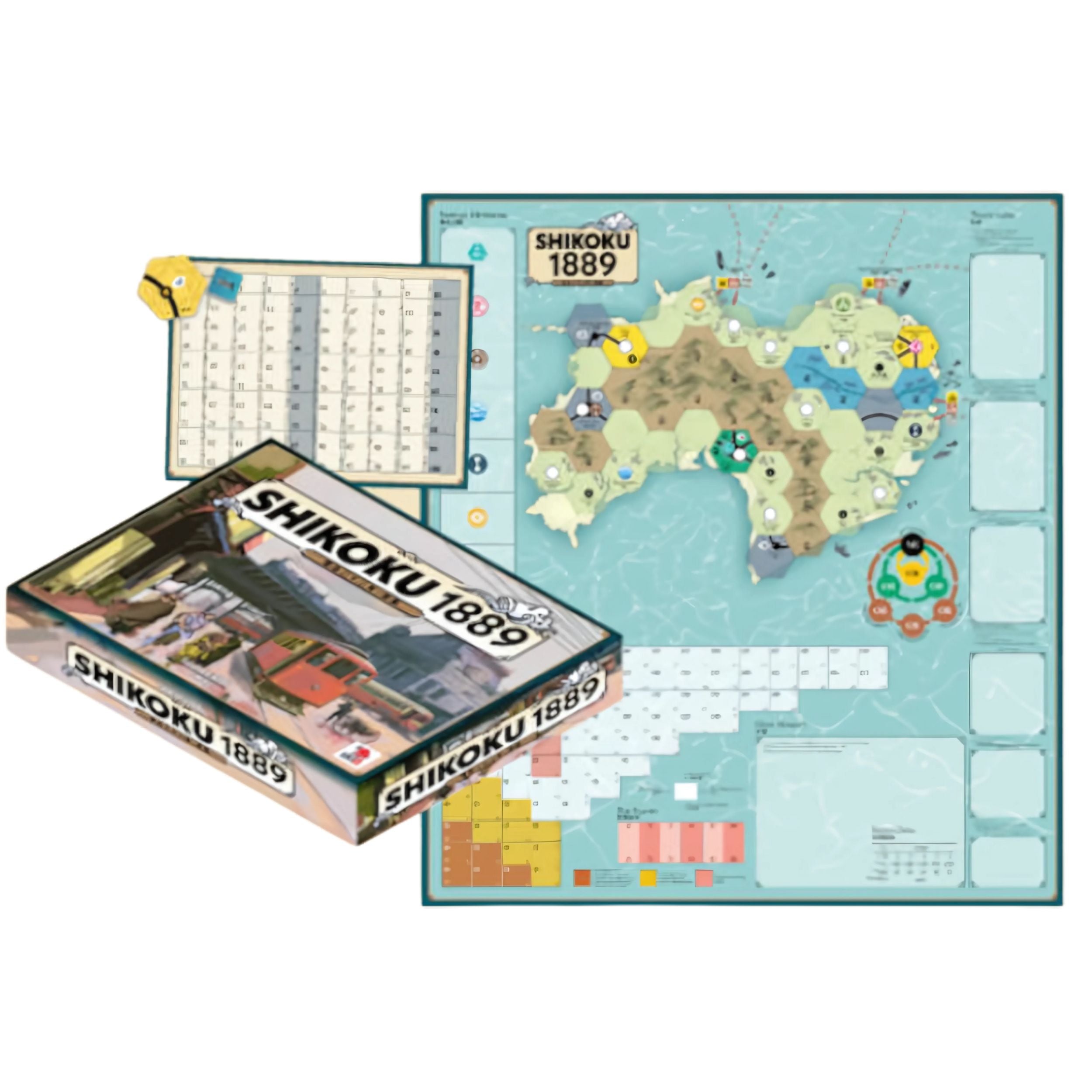
Shikoku Map
Mounted hexagonal grid representing the Japanese island. Mountains are expensive to cross, coastlines offer high-revenue port cities. Each hexagon has the construction cost printed on it.
Train Tokens
Represent models 2, 3, 4, 5, 6, and D (diesel). Older trains become obsolete when new ones arrive. Each company must own at least one to operate.
Stock Certificates
Cards representing company shares. Whoever owns 40% or more becomes president and leads operations. The value of shares rises and falls on the market during the game.
Paper Money
Personal money for players and company capital. Liquidity is always limited, and poor management can lead to bankruptcy, even if your routes are profitable.
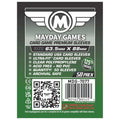
Recommended Sleeves 387 cards in 3 sizes ▼
If you play often, we recommend protecting your cards with clear sleeves to make them last longer.
| Size | Quantity |
|---|---|
| 44 × 63.5 mm | 367 |
| 100 × 150 mm | 13 |
| 63.5 × 88 mm | 7 |
| Total cards | 387 |
Come si gioca
Video dimostrativo di gameplay.
🎲How to playThe rules in four steps▼
How to play
The flow of each round
Shikoku 1889 alternates between Stock Rounds and Operating Rounds. In the former, you buy and sell shares, in the latter, companies build and generate revenue.
In turn, each player can buy ONE share certificate or pass. When everyone passes, the round ends. Prices rise if you buy, fall if you sell. Whoever becomes president of a company takes control of it.
Each company, in order of stock value, lays tiles (tracks) on the map. Yellow tracks are cheap, green and brown tracks cost more but generate more revenue. Mountain terrain costs extra.
The company runs its trains on the built routes. Each train can touch a maximum number of cities. You sum the revenues of the touched cities and decide: pay dividends (money to shareholders) or retain (money to the company).
If the company has capital, it can buy new trains. When a new model is introduced, old ones become obsolete and must be scrapped. A company MUST own at least one train: if it cannot buy one, the president pays out of pocket.
⏱️Your first gameThe chronicle, moment by moment▼
A game in five moments
What happens at the table
Not the rules. The experience.
Initial auction and first companies
Private companies are auctioned off: they give fixed bonuses and special privileges. Who pays the most for them? Who holds them back to resell them later? Already here you can see who knows the system and who is learning.
First routes and first revenues
Companies start building. Yellow tracks connect the first cities, 2-trains make the first revenues. The president decides: dividends immediately (enriches shareholders) or retain all (capitalize to expand faster). Those who time it wrong here pay dearly later.
3-trains enter, someone goes into crisis
2-trains become obsolete. Companies must buy new ones, but capital is limited. Someone is forced to sell shares to cover costs, the price plummets. The first cracks in the initial plan become chasms.
Route wars and opportunistic mergers
The map is saturated. Two companies want the same high-revenue coastal city. Whoever built it first blocks the other. Some players dump shares of weak companies and buy shares of strong ones, overturning presidencies.
Final count: cash and stock value
The game ends when the bank runs out of money or when someone triggers the exit condition. Personal money plus the value of owned shares are counted. Those who have capitalized companies too much have rich shares but little cash in hand: they often don't win.
🐸Good to know beforehandThree honest things, from friends▼
Good to know beforehand
Three things you need to know
Although 1889 is considered an "easy" 18xx, the first game requires at least one veteran at the table who knows the system. Rules on obsolescence, forced presidency, and bankruptcy are not intuitive. Budget 30-40 minutes for explanation.
If you mismanage capital or sell shares at the wrong time, you can find yourself without liquidity halfway through the game. Technically you remain in the game but you no longer have leverage: you just wait for it to end. It's not a common failure but it happens.
With 2-3 players the map is open, you can expand without direct conflict. With 5-6 players, the best routes run out quickly and you have to actively block opponents. It completely changes the type of game.
🏆Victory and defeatWhat the ending rewards▼
How it ends
How to win and how to lose
The game ends when the bank runs out of money or when a specific exit condition is met (depends on the number of players and active companies). At that point, the total value is counted.
Victory
- You have the highest total value: personal money + market value of shares you own
- You sold shares of weak companies before they crashed and bought strong ones at the right time
- You balanced personal dividends and company capitalization better than others
Elimination or defeat
- You capitalized companies too much: your shares are worth a lot but you have little personal money, someone else wins
- You went personally bankrupt: you had to cover the purchase of trains for a company you were president of and had no liquidity
- You sold shares in a panic and the market punished you: the price crashed and you never recovered
Shikoku 1889 is the first 18xx that really finishes in 3-4 hours. If you want to understand if this series is for you, start here. If you survive the first game financially, you are ready for the others.
💬Frequently asked questionsQuick answers before checkout▼
Frequently asked questions
FAQ about Shikoku 1889
Is it really simpler than other 18xx games?
Yes, in the sense that it uses canonical rules without complex exceptions. No, in the sense that if you have never played an 18xx game, stock management, obsolescence, and dividend timing remain complex concepts. It's an entry point, not a gateway.
Do you need a veteran at the table for the first game?
Highly recommended. The written rules explain the system but not the why behind the choices. An experienced player accelerates learning by hours. Alternatively, watch a full playthrough before playing.
How long does a game really last?
With veterans: 2.5-3 hours. With beginners: 4-5 hours easily, including explanation and delays due to calculations. Budget a whole evening for the first time.
What mechanics does Shikoku 1889 use?
Stock holding (buying and selling shares), route building on a hexagonal grid, tile placement (track laying), market manipulation (the stock market reacts to your moves), planned obsolescence (old trains go out of service), victory points as a resource (money is victory points).
Is it available in Italian?
No. This Grand Trunk Games edition is in English. The text is limited: city names on the map, rulebook, share certificates. The language has little impact during the game because the mechanics are numerical. Unofficial Italian translated rules are not available.
The people behind the game
Who invented it, who designed it, who publishes it — and what else they've done.
Shikoku 1889 is an economic board game for 2-6 players, lasting 180-240 minutes, recommended for ages 14+, designed by Yasutaka Ikeda. It is part of the 18xx series and simulates railway construction and stock management in 19th-century Japan. The main mechanics include stock holding, route building on a hexagonal map, tile placement, and train obsolescence. Published by Grand Trunk Games, it is considered one of the most accessible entry points into the 18xx family while maintaining the strategic depth typical of the system. Available on FroGames.it.
Shikoku 1889
Frequently Asked Questions
The answers you're looking for, no beating around the bush.
📸Do the images match the actual product?
The photos on the website often come from BoardGameGeek and are intended to give you an idea of the game. They may vary slightly from the version you receive. The content declared by the publisher is always binding.
📦Does the content of the box match what is indicated?
We always strive to provide the correct content, but minor variations are possible due to reprints or updates. The information comes directly from the publishers. If you have any questions, please contact us!
⏳How do pre-orders work?
Pre-order the game before release, payment is immediate, and the game is reserved for you. As soon as it arrives, we'll ship it right away! If there are any delays, we'll update you promptly.
🔒Can I trust buying here?
Absolutely! Secure payments, tracked shipments, and a team that loves board games as much as you do. If something goes wrong, we'll do our best to fix it.
🛠There's a problem with my order, what should I do?
Write to us now! Whether it's a missing part, damage, or an error, we'll help you resolve it as soon as possible. Your experience truly matters to us.