

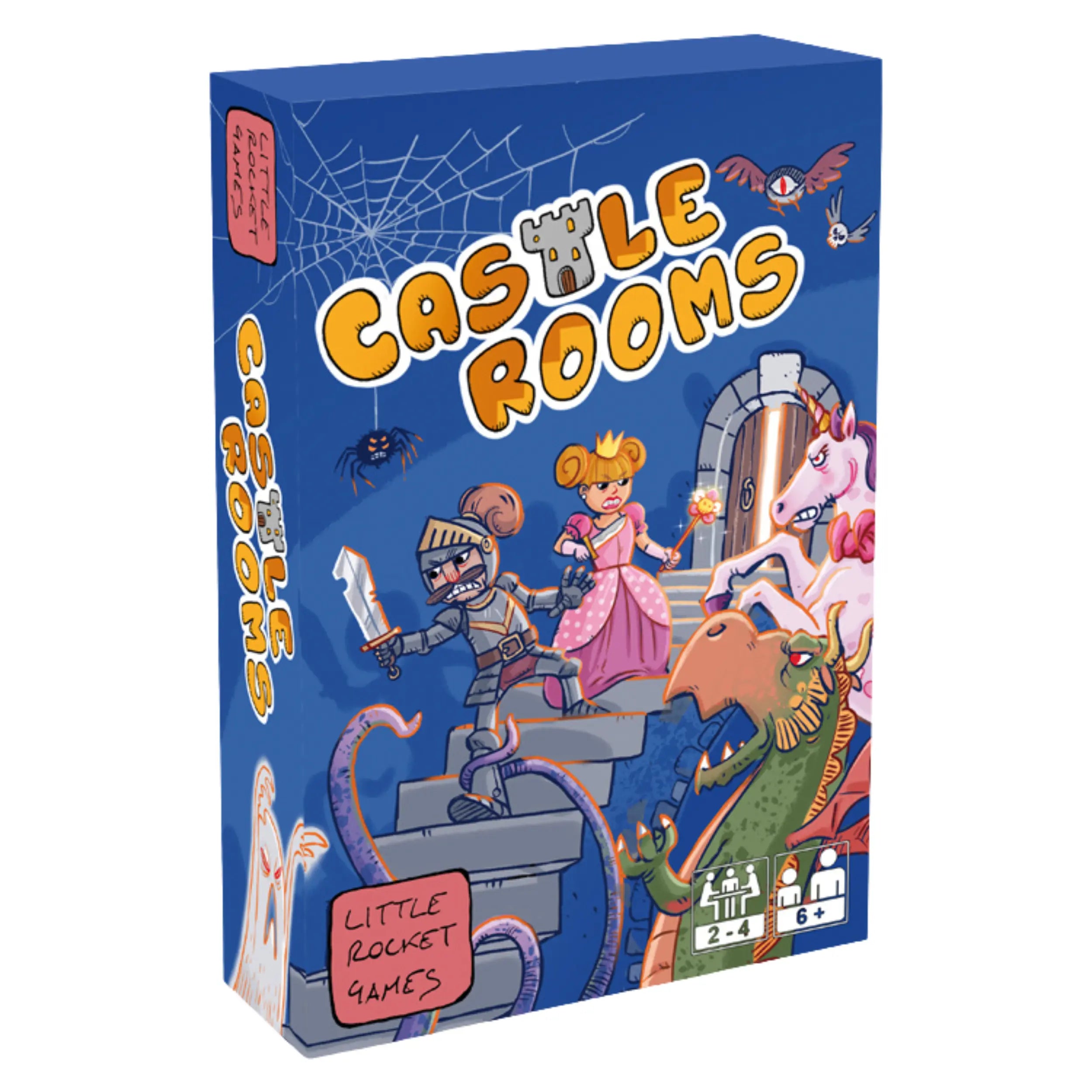
Castello Rooms
🐸 Dettagli da BoardGameGeek
Consiglio BGG sul numero di giocatori
Categorie
Meccaniche
Design & Art
Lingua
Pairs well with
FroGames — Moments You'll Remember
You play a card, glance around to see others' reactions, and suddenly you find a dragon on your most promising row. And yes, the one who placed it laughs.
WHAT IT'S ABOUT
A medieval architecture race where dragons ruin the best plans
Castle Rooms is a card game designed by Giampaolo Razzino and illustrated by Marco Salogni, published in 2020 by Little Rocket Games. Light fantasy theme, competitive building, immediate rules: the goal is to be the first master builder of the kingdom by completing a row of 10 castle rooms.
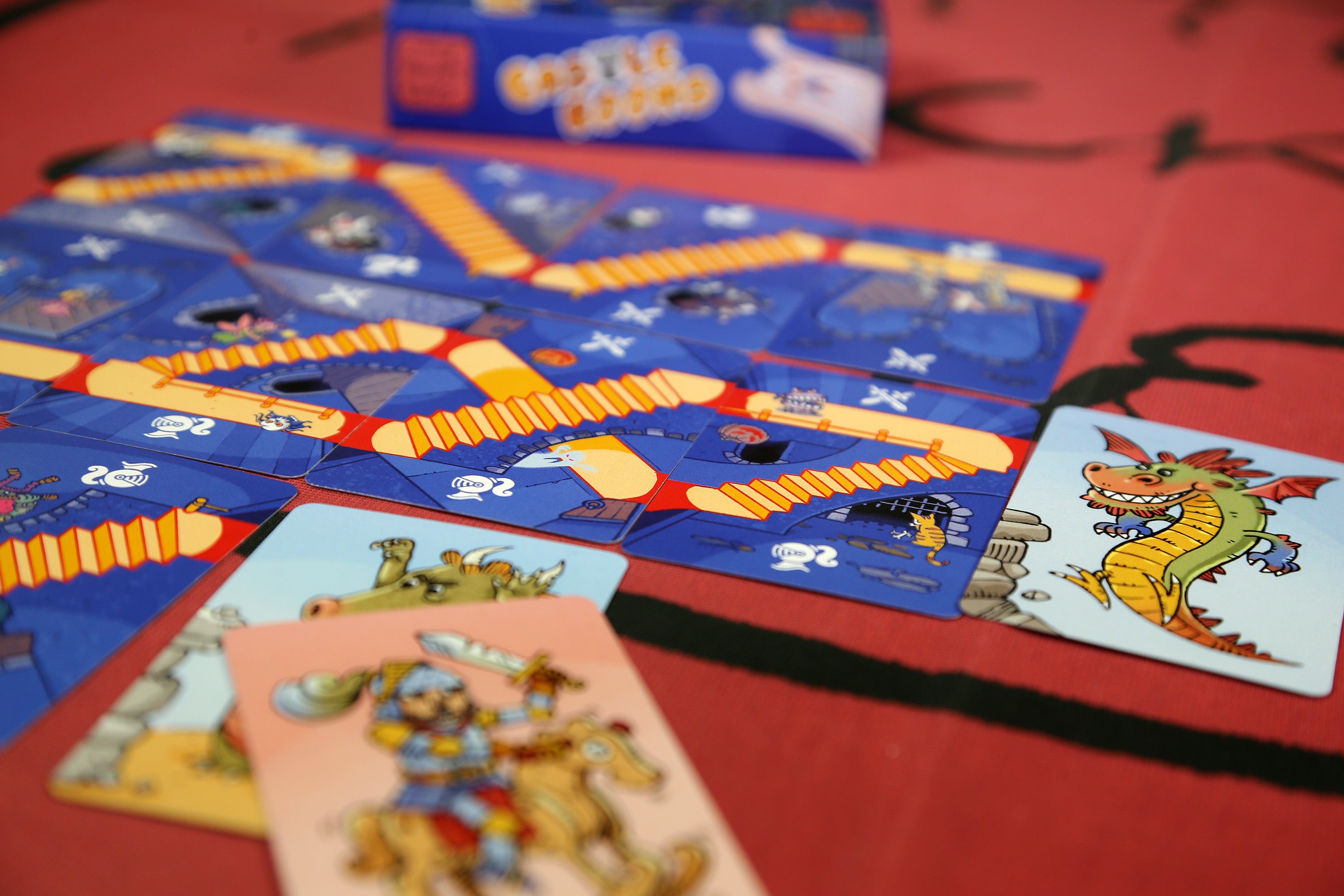
On your turn, you draw two cards and build your row by matching stairs and corridors. Symbols must match, and direction must be consistent (helmets always facing up or always facing down). Other players can place dragons on your rows to block them; you'll have to waste a knight to unblock them. First row of 10 rooms wins; if cards run out, the longest row wins.
What they say abroad
A fast-paced game that teaches pattern matching to children and becomes a sabotage race among adults.
— FroGames
Every row is a project at risk: just one dragon card at the wrong moment and you have to start over elsewhere.
— FroGames

Castle Rooms
FrogScore · FroGames editorial rating · based on rules, international reviews, and game sessionsThe castle deck
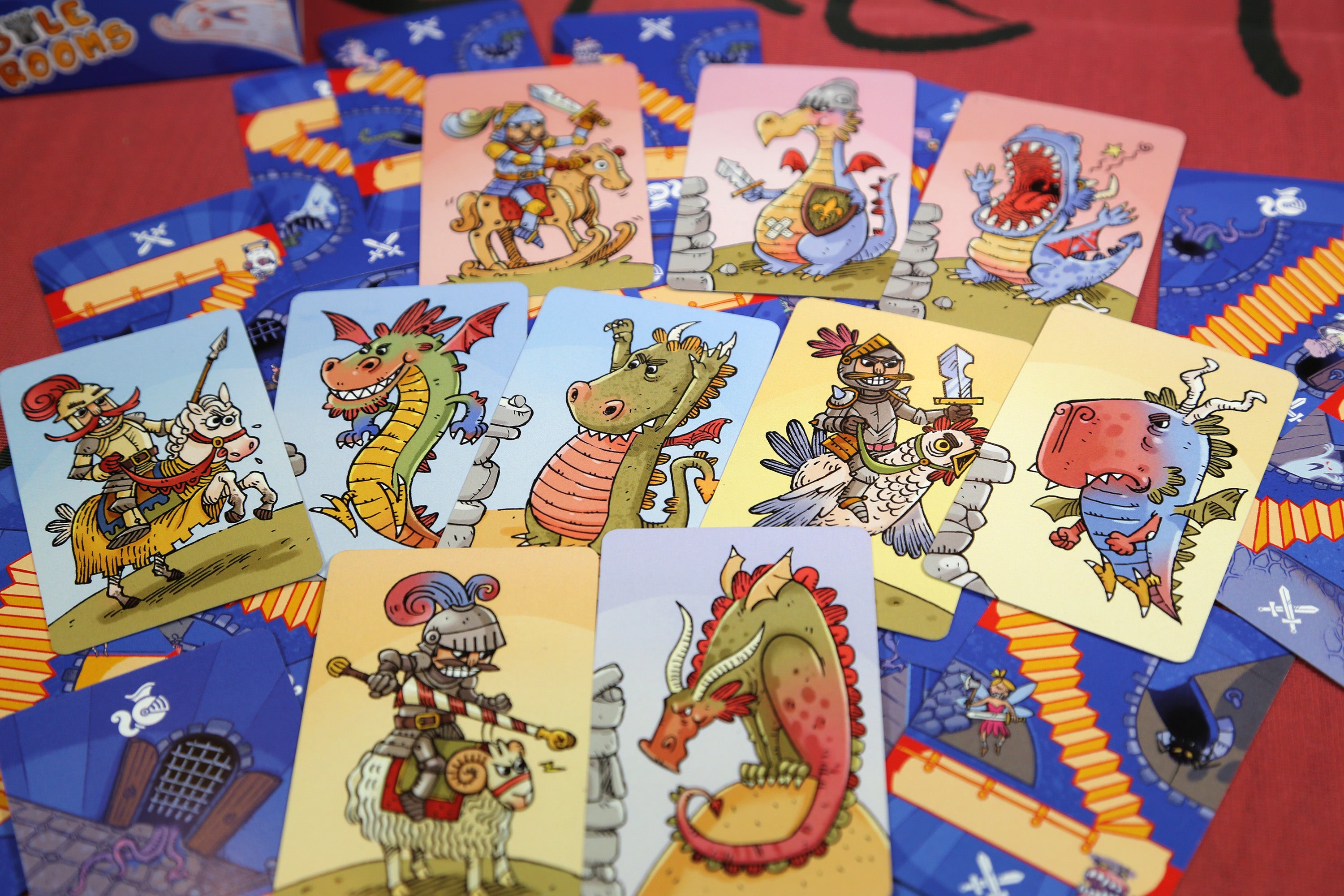
Room, dragon, and knight cards
Room Cards
56 cards in the base deck. Each room has stairs and corridors on the edges, plus two symbols (helmet or crossed swords) that you must keep oriented in the same direction along the entire row. No two rooms are alike: you need to find the right matches by drawing.
Dragon Cards
You place a dragon to the right of an opponent's row to permanently block it. From that moment on, they can no longer add rooms to that row. If they have more than two cards in hand and cannot play them, they must discard. The main weapon of sabotage.
Knight Cards
The only way to unblock your row blocked by a dragon. You play the knight on the affected row, discard both knight and dragon, and resume building. Wasting a knight is costly: better to protect yourself before the dragons arrive.
Managing multiple rows
You cannot add cards to the left, only to the right of the last one played. If your main row is blocked and you have no knights, you must open a second row with the opposite orientation (helmets down instead of up). More rows = more vulnerability to dragons.
Recommended sleeves 64 cards in 1 size ▼
If you play often, we recommend protecting your cards with clear sleeves to make them last longer.
| Size | Quantity |
|---|---|
| 57 × 88 mm | 64 |
| Total cards | 64 |
In ten minutes someone will have built a castle and someone else will have cursed a dragon. Always the same.
A game in five moments
What happens at the table
Not the rules. The experience.
First matches
You draw two cards, find a stair-corridor match, and place the first room. The others do the same. Everyone builds, no one sabotages yet. The deck is full, the dragons are sleeping. For now.
The first dragon
Someone draws a dragon. They look at the other players' rows, choose who to block. They place it with a smile. The victim protests, looks for a knight in hand, doesn't find one. They must open a second row or wait. Interaction has begun.
Multiple rows and chaos
Now everyone has two or three open rows. Some blocked, others growing. You draw hoping for the right card for the longest row, but you only find cards compatible with the blocked row. You have to decide: knight now or later? Meanwhile, the others are advancing.
The final sprint
Someone has 8 rooms in a row. The others see it, they dump all the dragons they have on their main row. They play the knight, unblock, but only have one. The second dragon arrives right after. The one who placed it laughs, the one who suffers curses.
Tenth room or empty deck
Either someone completes the 10-room row and wins outright, or the deck runs out and rooms are counted. The longest row wins. Often it's the one no one noticed, grown silently while everyone was fighting over the main row. End of game: 15 minutes, someone wants a rematch.
How to play
The flow of each turn
Draw, build, sabotage. Three actions, one minute.
Take two cards from the central deck and add them to your hand. You can hold a maximum of 2 cards in your hand at the end of your turn: if you have 3 or more, you must play or discard them before passing.
Place room cards on your open rows by matching stairs and corridors. Each row starts from the left and only grows to the right. The helmets must all have the same orientation along the row. If you open a second row, it must have the opposite orientation to the first.
If you have a dragon, you can place it to the right of an opponent's row to block it permanently (a knight is needed to unblock). If you have a knight, you can use it on your blocked row to remove the dragon. Dragon and knight are discarded together.
If you have more than 2 cards in hand, you cannot pass your turn: you must continue to play. If you only have dragons/knights and cannot use them, discard until you have 2 cards left. Then pass.
Why it's different from others
Six features that make a difference
Visual pattern matching
It's not just about matching identical symbols: you have to match stairs and corridors between two adjacent cards, creating architectural continuity. Each room has a different layout, no match is trivial. Children understand it immediately, but finding the perfect card requires attention.
Oriented rows
Each row has an orientation (helmets up or down). If your main row is blocked and you need to open a second one, it must have the opposite orientation. This limits playable cards: a card compatible with row A is not compatible with row B. Managing two rows becomes a puzzle within a puzzle.
Permanent block
A dragon placed on a row closes it until a knight arrives. It's not a slowdown: it's the death of the row. If you don't have knights in hand, that row is lost and you have to start over. The dragon doesn't remove itself, doesn't decay, doesn't move. It's fierce.
Limited resource economy
There are few knights in the deck (8 in the full game, 6 in the 2-3 player game). If you waste a knight too early or on a secondary row, you won't have one for the decisive row. You have to choose when to defend and when to accept the block.
Forced hand management
You cannot hold more than 2 cards in hand. You draw 2 each turn, so you are forced to play if you don't have matches. This speeds up the pace, prevents accumulation, and creates desperate situations: "I have three incompatible rooms and no dragon, I have to discard".
Double victory condition
You win if you complete 10 rooms in a row, or (if the deck runs out) whoever has the longest row. This means you can win even with 7 rooms if the others are stuck at 6. The final count is often surprising: the forgotten secondary row beats the massacred main row.
How it ends
How to win and how to lose
Tenth room in a row, or longest row at the end of the deck.
Victory
- You complete a row of 10 consecutive room cards: immediate victory, game over
- The deck runs out and you have the longest row among all (2nd longest row as tie-breaker, then 3rd, etc.)
- You block all opponents' rows with well-placed dragons while yours grows undisturbed
How they trick you
- You get hit by a dragon on your main row when you have 8-9 rooms and no knights in hand
- You waste knights too early on secondary rows, and when the dragon arrives on the decisive row you have no defenses
- You only draw cards incompatible with all your rows and are forced to discard, while others build
Castle Rooms is a competitive pattern matching card game with direct sabotage. It works with children, it works with adults, it ends in 15 minutes and leaves you wanting a rematch. Always.
Frequently asked questions
Castle Rooms FAQ
How many rows can I build simultaneously?
There's no limit. You can open as many rows as you want, but each new row must have the opposite orientation to the previous one (if the first has helmets up, the second must have them down, the third up again, etc.). The more rows you have, the more cards you need to manage them all, and the more vulnerable you are to other players' dragons.
Can I use a knight preventively before a dragon is placed on me?
No. The knight is only used to remove a dragon already placed on one of your rows. You cannot "armor" a row in advance. You have to wait for the dragon to arrive, then react. If you don't have knights when you are blocked, that row is lost.
What happens if I only have dragons and knights in hand but cannot play them?
If you have 3 or more cards in hand and they are all unplayable dragons/knights (e.g., all knights but none of your rows are blocked), you must discard them until you have 2 cards left. You cannot pass your turn with more than 2 cards in hand. This is a rare but brutal situation: you waste resources due to timing.
Is it better to sabotage immediately or wait?
It depends. Placing a dragon when the opponent has 3-4 rooms is a waste: they will open a second row and continue. The dragon hurts when it falls at 7-8 rooms, when starting over costs too much. But if you wait too long, you risk not having it in hand at the right moment. Timing is everything.
Is it available in Italian?
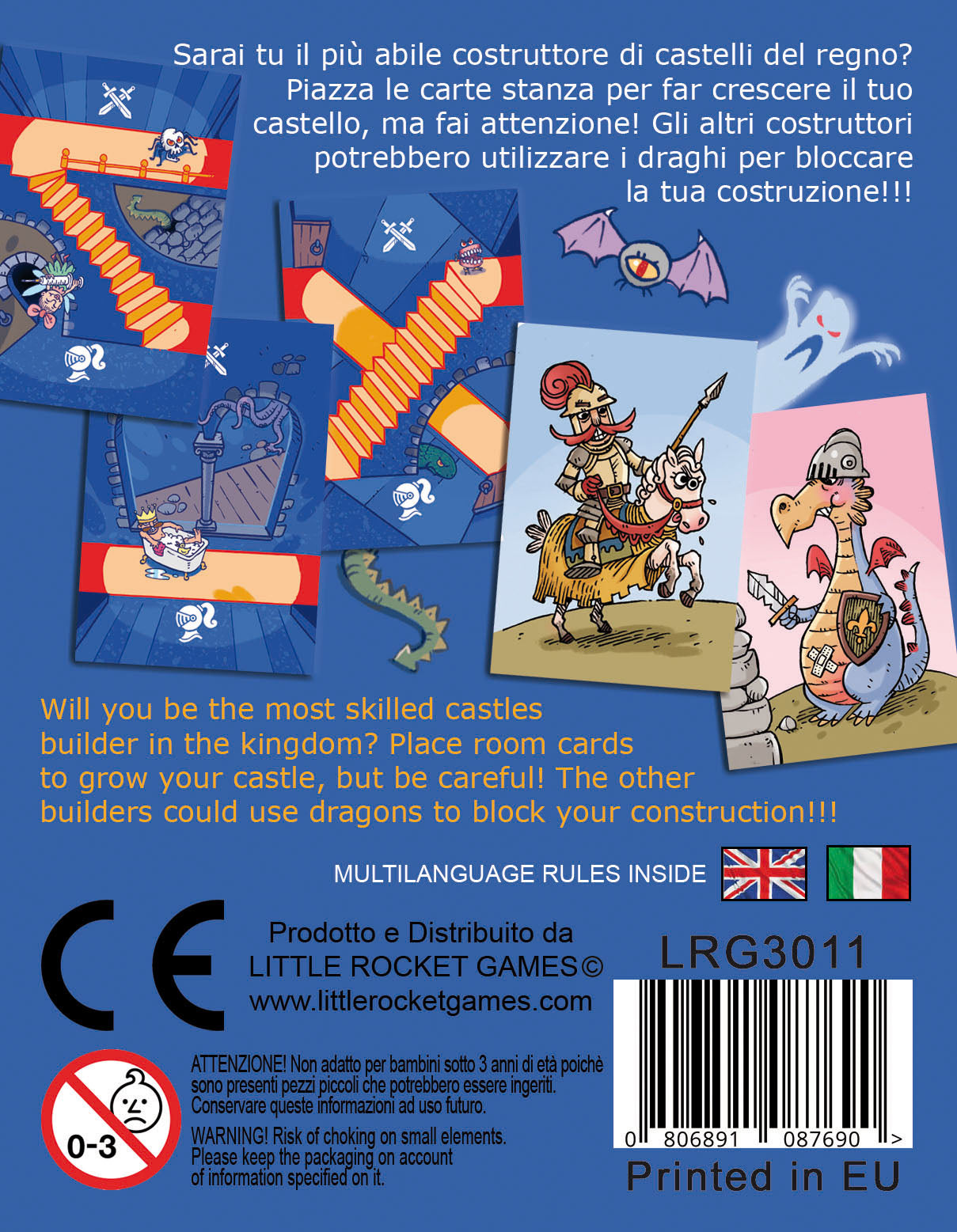
Yes, this is the Italian edition published by Little Rocket Games. The cards have minimal text (only symbols and icons for matching stairs and corridors), the rulebook is in Italian. The game works very well even with children aged 6 thanks to the immediate visual component.
Castle Rooms is a competitive card game for 2-4 players designed by Giampaolo Razzino and published by Little Rocket Games. Duration 10-20 minutes, recommended age 6 and up. Main mechanic: pattern matching and row building by matching stairs and corridors of room cards. Direct interaction through dragon cards (permanent blocking of opponent's rows) and knight cards (dragon removal). Victory condition: first 10-room row or longest row at the end of the deck. Ideal for families and as a competitive filler for adults. Available on FroGames.it.
Frequently Asked Questions
The answers you're looking for, no beating around the bush.
📸Do the images match the actual product?
The photos on the website often come from BoardGameGeek and are intended to give you an idea of the game. They may vary slightly from the version you receive. The content declared by the publisher is always binding.
📦Does the content of the box match what is indicated?
We always strive to provide the correct content, but minor variations are possible due to reprints or updates. The information comes directly from the publishers. If you have any questions, please contact us!
⏳How do pre-orders work?
Pre-order the game before release, payment is immediate, and the game is reserved for you. As soon as it arrives, we'll ship it right away! If there are any delays, we'll update you promptly.
🔒Can I trust buying here?
Absolutely! Secure payments, tracked shipments, and a team that loves board games as much as you do. If something goes wrong, we'll do our best to fix it.
🛠There's a problem with my order, what should I do?
Write to us now! Whether it's a missing part, damage, or an error, we'll help you resolve it as soon as possible. Your experience truly matters to us.