

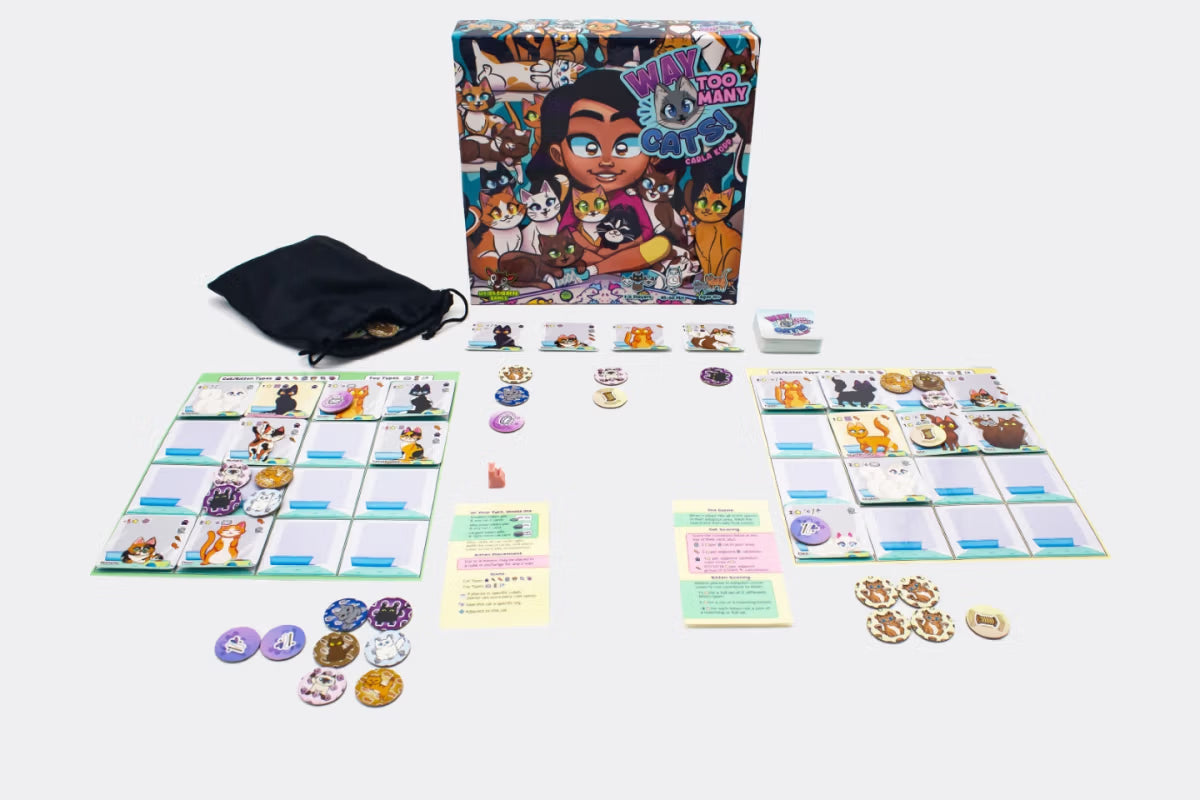
Way Too Many Cats!
🐸 Dettagli da BoardGameGeek
Consiglio BGG sul numero di giocatori
Categorie
Meccaniche
Design & Art
Lingua
Pre-order - leggi i dettagli
🐸 Una rana saggia sa quando dividere l’ordine… e quando aspettare il salto giusto.
Pairs well with
The FroGames Card
You're about to take the fifth kitten. The tabby one with the green collar. It fits perfectly in the right corner, next to the other three red ones. But if the sixth one arrives, the black one you saw in the deck, where will you put it? And most importantly: who will take care of the litter box?
WHAT IT'S ABOUT
An adoption agency where there are too many cats and never enough space
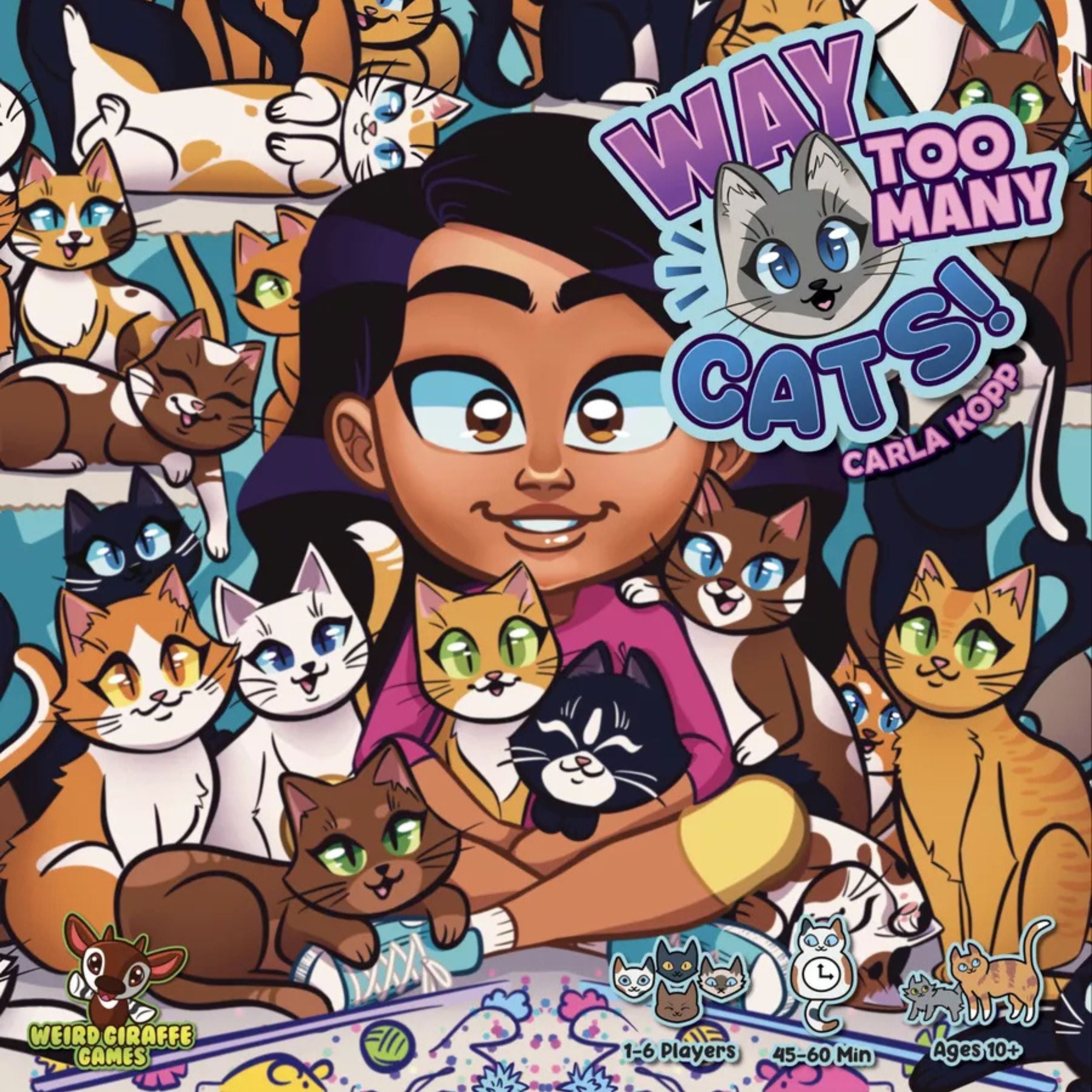
Designed by Carla Kopp and illustrated by Jay Bell, Ilyse Hines, and M.G. Patiño, Way Too Many Cats! is a competitive drafting and spatial puzzle game published by Weird Giraffe Games in 2024. Each player manages a feline adoption agency and must display their cats in the best possible conditions to attract visitors. The theme is light and colorful, but space management is concrete: each cat has specific needs, and the display case fills up quickly.
On your turn, you draw cats from the common deck and decide how many to keep: the more you take, the more potential points, but also more responsibility. You must place them in your personal grid respecting their preferences (some want to be close, others isolated, others still high or low), and each cat brings kittens that occupy additional space. The game ends when someone fills all the spaces in their display case: at that point, points are counted, and whoever has built the happiest colony wins.
What others are saying
"Way Too Many Cats is a competitive drafting spatial puzzle game about drafting cats, making each cat happy, and pressing your luck in the number of kittens you take on."
— Weird Giraffe Games
The game grows with you: simple to teach, but each game forces you to make difficult choices about when to stop.
— FroGames

Way Too Many Cats!
The game includes an official solo mode in which you face progressively more difficult challenges, trying to reach target scores. The experience is solid and the puzzle works, but it lacks the tension of competitive drafting: in solo mode, you draw and optimize without the pressure of other players stealing your best cats.
FrogScore · FroGames editorial rating · based on rules, international reviews and play sessionsWhat's in the box
The components that build your feline agency
Cat cards
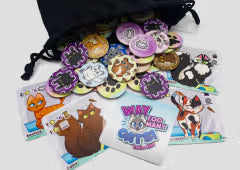
128 small cards (51×51 mm) with cats of various colors, personalities, and preferences. Each card indicates where the cat wants to be and how many kittens it brings with it. The illustrations are detailed and recognizable: the tabby with the green collar is not the same as the tabby with the red one.
Agency boards
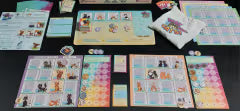
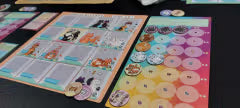
6 asymmetric grids (219×226 mm), one per player. Each grid has a different arrangement of spaces and unique objectives: some reward full columns, others color groups. Your strategy depends on the display case you get.
Personal objective cards
6 objective cards (112×226 mm) that define bonus conditions for extra points. Some require color sets, others spatial configurations. These are also asymmetric: each player plays with different objectives than the others.
Tokens and aids
Kitten tokens to track how many kittens you've adopted (and how much space they occupy), aid cards with a summary of the phases, and a notepad for scoring. Everything is very functional, no frills.
Recommended sleeves 140 cards in 3 sizes ▼
If you play often, we recommend protecting your cards with transparent sleeves to make them last longer.
| Size | Quantity |
|---|---|
| 51 × 51 mm | 128 |
| 219 × 226 mm | 6 |
| 112 × 226 mm | 6 |
| Total cards | 140 |
Come si gioca
Video dimostrativo di gameplay.
🎲How to PlayThe rules in four steps▼
How to Play
The flow of each turn
Each turn has three simple phases: draw, decide, place. The game is fast because everyone plays in parallel during the draft phase.
The active player draws a cat card from the deck and reveals it. They can choose to stop and take all drawn cards, or draw another. The more they draw, the more choice they have, but they must keep at least half (rounded up). The risk: drawing too many and ending up with useless cats or no space.
Once stopped, choose which cats to keep from those drawn (at least half, rounded up). Other players, in turn order, can take one of the discarded cats by paying a kitten (token) from their supply. This creates tension: discarding a useful cat means giving it to someone else.
You place the chosen cats in your personal grid, respecting any placement rules (some cats want to be at the top, others near cats of the same color). Each cat brings kittens with it (indicated on the card): take the corresponding tokens and fill other spaces. Kittens don't score points but take up space.
The next player becomes the active player and repeats phases 1-3. The game continues until a player fills all the spaces in their display (cats + kittens). At that point, the current round is completed (everyone plays the same number of turns) and points are counted.
⏱️Your First GameThe chronicle, moment by moment▼
A game in five moments
What happens at the table
Not the rules. The experience.
First Adoption
You draw three cats from the deck and decide whether to stop or take another. The first ones all seem good: they have useful colors, are easy to place, and bring few kittens. You choose to take two and put them in the corners of the grid. The others look at their cards and do the same. All under control, for now.
The Display Fills Up
After three turns, the grid starts to tighten. That orange cat wants to be next to another orange one, but the only free space is far away. You decide to take it anyway because it completes a color set, but now you have four kittens occupying valuable spaces. Other players have similar problems: someone complains loudly, someone counts potential points on their fingers.
Push-Your-Luck
You draw a cat perfect for your goal. You draw a second one: this one also works. You draw a third: this one is useful for the player to your right, you see them getting agitated. You draw a fourth: now you have too many cards in hand and will have to keep at least three, even if one of the four has nowhere to go. You try to fit it in anyway, sacrificing another position.
The Final Rush
One player has only three empty spaces. The game ends when someone fills everything, and you're falling behind. You start taking fewer cats per turn, looking for those that fit perfectly. But the others do the same, and the deck quickly empties. The last turn is a scramble: you draw, place, count, and hope it's enough.
The Counting
Someone fills the last space and the game ends. Points are counted: each happy cat (placed according to its preferences) scores, color sets give bonuses, personal objectives add extra points if you complete the required conditions (spatial configurations, color combinations, etc.). The player who built the most harmonious colony wins. Someone has a perfect grid but few cats; someone else has many cats but all unhappy. The difference is almost always just a few points.
🐸What to Know BeforehandThree honest things, from friends▼
What to Know Beforehand
Three things you need to consider
The draft is all push-your-luck
You don't know what's coming from the deck, and every card drawn increases the risk of ending up with incompatible cats. If you love total control and hate relying on luck, this game will frustrate you. Luck is definitely a factor, and it matters.
Scales well but changes flavor
With 2-3 players, the draft is more predictable, and you have better control over what to take. With 5-6 players, the chaos increases, good cats disappear quickly, and you have to adapt more. Both experiences work, but they are not the same game.
Asymmetrical grids are not equivalent
Some grids are objectively easier to fill or have more generous objectives. If you play with the same group often, you'll notice the imbalances. For balanced games, distribute grids randomly or rotate them between sessions.
🏆Victory and DefeatWhat the ending rewards▼
How it ends
How to win and how to lose
The game ends when a player completely fills their display (cats + kittens occupy all spaces). The current round is completed, and points are counted.
Victory
- Each cat placed according to its preferences (near other cats of its color, in specific positions, etc.) gives basic points
- Sets of cats of the same color give progressive bonuses: the more you have, the more they are worth
- Personal objectives on your objective card add points if you complete the required conditions (spatial configurations, color combinations, etc.)
Defeat (low score)
- Cats placed poorly (far from their kind, in wrong positions) give zero points or penalties
- Too many kittens without supporting cats: you occupy space without building sets or satisfying objectives
- You filled the display too quickly without optimizing positions, and others surpassed you with tidier grids
Way Too Many Cats! is an honest family game: an easy-to-learn spatial puzzle, with enough depth to keep you coming back, and a theme that works even with those who "never play games."
💬Frequently Asked QuestionsQuick answers before checkout▼
Frequently Asked Questions
FAQ about Way Too Many Cats!
What mechanics does Way Too Many Cats! use?
The game combines open drafting (you draw common cards visible to everyone), push-your-luck (you decide when to stop during drawing), set collection (collect cats of the same color for bonuses), and tile placement (you place cards in your grid respecting spatial constraints). The core is the draft: the more you draw, the higher the risk of getting useless cards.
Does it really work with 6 players?
Yes, but it changes a lot. With 6 players, the draft becomes chaotic, good cats disappear quickly, and you have to adapt more to random draws. Waiting times are minimal because everyone plays almost in parallel during the selection phase. If you're looking for control and deep planning, it's better to play with 2-4.
How long does a game actually last?
The first game, including explanation, lasts about 60 minutes. From the second game onwards, it drops to 45 minutes with 3-4 players, even less with 2. With 6 players, it extends slightly but rarely exceeds an hour. The game flows quickly because the phases are simultaneous and decisions are fast.
Is it a game for children or families?
For families, not for young children. The recommended age 8+ is realistic: it requires spatial planning, risk assessment, and the ability to count points at the end of the game. An 8-year-old can play with help, but the true target audience is players aged 10 and up, including adults. The cat theme helps engage even those who don't usually play games.
Is it available in Italian?
This edition is in English. The text on the cards is minimal (icons and symbols for cat preferences), so language dependence is low. You need to read the objective cards and scoring conditions, but once understood, you can play by sight. There are currently no localized Italian editions.
The people behind the game
Who invented it, who designed it, who publishes it — and what else they've done.
Way Too Many Cats! is a competitive draft and spatial puzzle board game for 1-6 players, designed by Carla Kopp and published by Weird Giraffe Games. Each game lasts 45-60 minutes and requires strategy, risk management, and spatial planning to build the perfect feline adoption display. Suitable for ages 8+, the game combines open drafting, push-your-luck, and set collection mechanics in an accessible yet not trivial system. Each player manages an asymmetrical grid with unique objectives, drawing cats from the common deck and deciding when to stop to avoid taking too many risks. Available on FroGames.it.
Way Too Many Cats!
Frequently Asked Questions
The answers you're looking for, no beating around the bush.
📸Do the images match the actual product?
The photos on the website often come from BoardGameGeek and are intended to give you an idea of the game. They may vary slightly from the version you receive. The content declared by the publisher is always binding.
📦Does the content of the box match what is indicated?
We always strive to provide the correct content, but minor variations are possible due to reprints or updates. The information comes directly from the publishers. If you have any questions, please contact us!
⏳How do pre-orders work?
Pre-order the game before release, payment is immediate, and the game is reserved for you. As soon as it arrives, we'll ship it right away! If there are any delays, we'll update you promptly.
🔒Can I trust buying here?
Absolutely! Secure payments, tracked shipments, and a team that loves board games as much as you do. If something goes wrong, we'll do our best to fix it.
🛠There's a problem with my order, what should I do?
Write to us now! Whether it's a missing part, damage, or an error, we'll help you resolve it as soon as possible. Your experience truly matters to us.