

Ragazzi problematici
🐸 Dettagli da BoardGameGeek
Consiglio BGG sul numero di giocatori
Categorie
Meccaniche
Design & Art
Lingua
Pre-order - leggi i dettagli
🐸 Una rana saggia sa quando dividere l’ordine… e quando aspettare il salto giusto.


Pairs well with
The FroGames card
You have 7 white cards. You must write numbers on them that sum to 21. Then you play tricks. Win the right ones and score points. Go over by even 1 and you burn the whole round. Someone curses in silence. Someone else laughs.
WHAT IT IS
A trick-taking game where you decide the cards' value
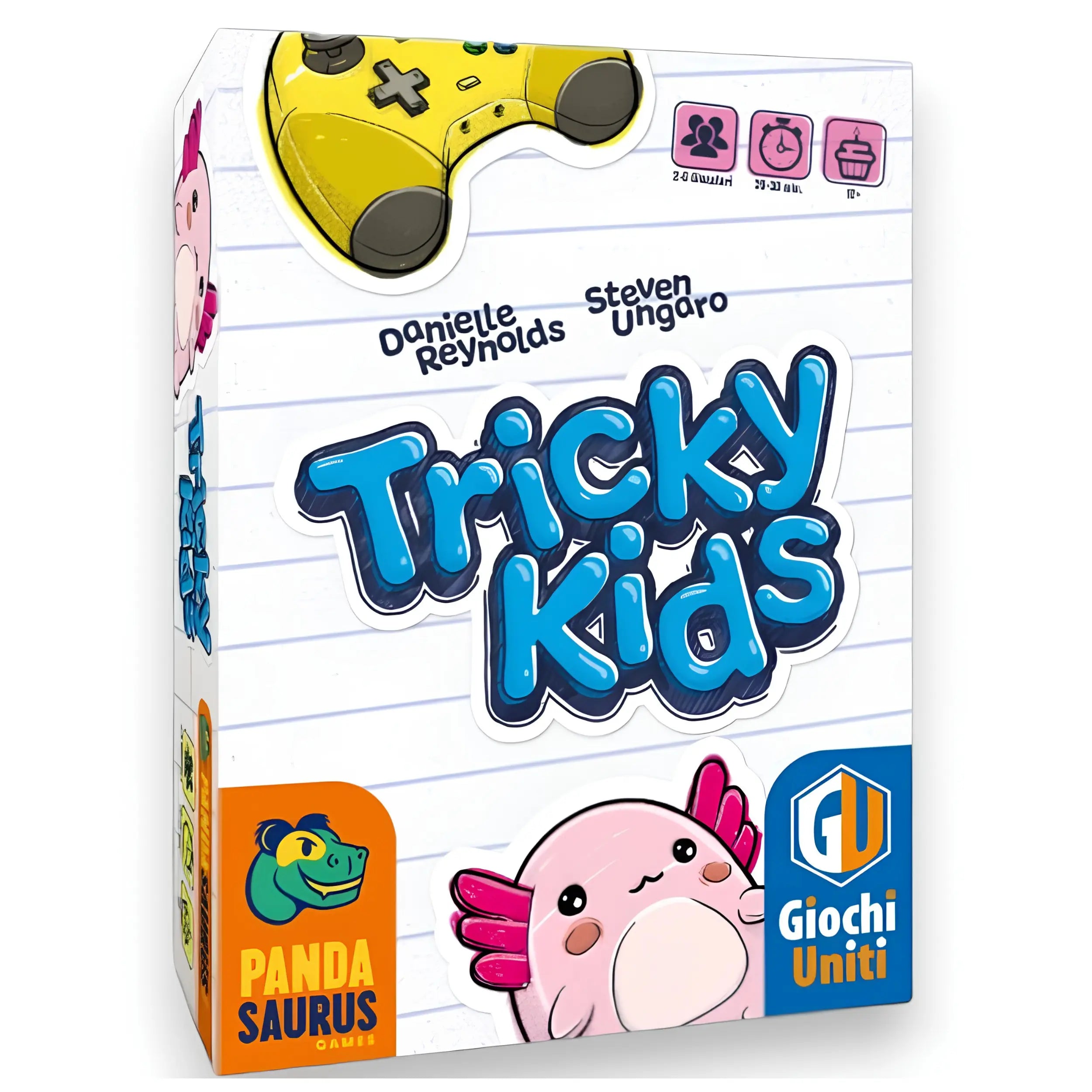
Danielle Reynolds and Steven Ungaro took classic trick-taking and stripped away certainty. In Tricky Kids, cards don't have printed numbers: you write them yourself at the start of each round, with only one constraint: the sum must be 21. Set in a surreal schoolyard where kids trade snacks and toys, the game transforms the invented economy of the playground into a trick-taking match where timing is more valuable than strength.
Each round lasts 7 tricks. Win a trick, take a point token from the line: the value of the token depends on the suit that won and when you take it. At the end of the round, you count points, but if you overshot 21 in the initial distribution, you lose everything. Three rounds, 21 total tricks, whoever has the most points wins. Optional Tricky Rule cards mix things up mid-game: swapped hands, double suits, alternative win conditions.
What they say abroad
"Welcome to the playground!"
— Pandasaurus Games
The most honest game we've played this year: the rules are two pages long, the first game takes 25 minutes, and everyone wants to play again afterwards.
— FroGames

Tricky Kids
FrogScore · FroGames editorial rating · based on rules, international reviews, and play sessionsWhat's in the box
Blank cards, markers, and point tokens
Blank cards
54 cards with no printed numbers. At the start of the round, you write your desired values on them, as long as they sum to 21. Dry-erasable, reusable every game.
Markers
One per player, erasable. You use them to write numbers on the cards. If you run out of ink, you'll have to use your own, but they generally last for dozens of games.
Point tokens
Arranged in a line at the start of the round. The value of each token depends on the suit that wins the trick and its position in the line: earlier tricks are worth less, later tricks are worth more (or vice versa).
Tricky Rule Cards
18 optional cards that change the round rules: swapped hands, cards with two suits, strange win conditions. They are drawn at the start of the round and applied immediately.
Recommended sleeves 72 cards in 2 sizes ▼
If you play often, we recommend protecting your cards with clear sleeves to make them last longer.
| Size | Quantity |
|---|---|
| 64 × 89 mm | 54 |
| 41 × 63 mm | 18 |
| Total cards | 72 |
🎲How to PlayThe rules in four steps▼
How to Play
The flow of each round
Seven tricks, a value assignment phase, a score count. Repeated three times.
Each player receives 7 blank cards. Write numbers on them (from 1 to 7, repeated or not) as long as they sum up to exactly 21. If you make a mistake and sum to 22+, you will lose all points for the round. If you sum to less than 21, you have wasted potential.
Seven tricks are played following standard trick-taking rules: players must follow suit if possible, the player who plays the highest value of the led suit wins. The winner takes the leftmost token in the row (or the first available for that suit, depending on the variant).
End of round: sum the values of the tokens won. THEN check if the numbers written on your cards summed to exactly 21. If you exceeded (22+), you lose all points just earned. If you had points from previous rounds, you lose some there too.
Erase the numbers, redeal, and start over. After 3 rounds (21 total tricks), the player with the most points wins. Optional Tricky Rules are drawn at the beginning of the round and change the rules for that round only.
⏱️Your first gameThe chronicle, moment by moment▼
A game in five moments
What happens at the table
Not the rules. The experience.
Everyone writes in silence
You have 7 blank cards in front of you. You must write numbers on them that sum up to exactly 21. You look at others' cards (they are also writing), trying to understand who is aiming for which suits. Someone writes quickly, someone erases twice. The first bluff is already here: do you make them believe you have a very strong or very weak hand?
The first trick goes wrong
Everyone plays a card face down, then they are turned up together. The led suit wins, the player who played the highest number takes the token. But the token is worth little, and you wanted to win the third trick, not this one. Someone laughs because they won with a 2. Someone else curses because they wasted their 7.
Tokens change value
Mid-round, the row of tokens has thinned. Now the remaining tokens are worth double if a specific suit wins, but you no longer have cards of that suit. You look at the discarded cards, calculate what others still have. You decide to throw away a trick so as not to waste good cards.
Someone exceeds 21
End of round, points are counted. A player discovers they wrote 22 instead of 21: they lose all points for the round. They curse, saying they made a mistake adding. The others chuckle. You hit exactly 21, take your tokens and mark your points. For now, you're ahead.
Last round, Tricky Rule active
A Tricky Rule card is drawn: hands are passed to the left after writing the numbers. Everyone curses. You write your numbers thinking about the hand you'll have after the exchange, but you don't know what your neighbor will pass you. The game ends with a 12-point trick won by a hair. Someone wins, someone immediately asks for a rematch.
🐸Good to know beforehandThree honest things, from friends▼
Good to know beforehand
Three things to know
You must sum 7 numbers to exactly 21. If you are off by one, you lose the round. With children under 10 or players who hate mental math, the game slows down or gets stuck. This is not a flaw; it's the core of the design: the pressure of 21 is intentional.
With 2-3 players you have control: you see what others are doing, you calculate probabilities. With 6 players, chaos takes over: too many variables, too many crossed bluffs. It remains fun, but it becomes more of a party game than a game of calculation. The sweet spot is 4 players.
The base game works perfectly without them. The Tricky Rule cards add variety (swapped hands, double suits, strange conditions) but some unbalance the round or slow it down too much. Introduce them after 2-3 games, once the group has grasped the rhythm. Don't use them all at once: one per round is enough.
🏆Victory and defeatWhat the ending rewards▼
How it ends
How to win and how to lose
After 3 rounds, the player with the most points wins. But points can also be lost during the game.
Victory
- You won the right tricks (those with high-value tokens for your suits)
- You hit exactly 21 in all 3 rounds (no penalties)
- You read other people's bluffs well and avoided wasting strong cards on useless tricks
Penalty and defeat
- You exceeded 21 by even just 1: you lose all points from the round just played
- You exceeded by a lot (23+): in addition to the round's points, you also lose points from previous rounds
- You won the wrong tricks (low-value tokens) and left others the ones worth triple
It's a trick-taking game that rewards those who can count quickly and bluff at the right time. The 21 penalty is ruthless, but it's also the only thing that prevents the game from becoming a deterministic calculation. It works.
💬Frequently Asked QuestionsQuick answers before checkout▼
Frequently Asked Questions
FAQ about Tricky Kids
What mechanics does Tricky Kids use?
Trick-taking (tricks with the led suit and highest value wins), hand management (you decide card values before playing them), push-your-luck (risk exceeding 21 for higher values). Optional Tricky Rules add drafting, hand swapping, variable conditions.
Is it really accessible to those unfamiliar with trick-taking?
Yes, because the fact that you write the numbers makes everything more transparent: you immediately see that 7 beats 5, you don't have to learn card hierarchies. The basic rules of trick-taking remain (follow suit, highest value wins), but manual assignment of values lowers the barrier to entry. First game in 15 minutes.
How much does math matter?
A lot. You have to sum 7 numbers to exactly 21 each round. If you make a mistake, you lose the points. It's not a game for those who hate quick mental calculations. With young children (under 10-11 years old) or adults who get stuck with numbers, the game slows down and loses pace. If your group is comfortable with basic calculations, it runs smoothly.
Are Tricky Rules necessary?
No. The base game (assign values, play 7 tricks, count points) works perfectly on its own. Tricky Rules add variety and chaos (swapped hands, double suits, strange conditions), useful after 3-4 games when the group has found standard strategies. Introduce them one at a time, not all at once.
Is it available in Italian?
Yes, this is the Italian Giochi Uniti edition. Rulebook in Italian, cards in Italian (suits have thematic names related to the schoolyard). The game is language-independent once learned (you write numbers, not words), but the rules and Tricky Rules are translated.
The people behind the game
Who invented it, who designed it, who publishes it — and what else they've done.
Tricky Kids is a trick-taking game for 2-6 players designed by Danielle Reynolds and Steven Ungaro, published by Giochi Uniti. Playtime 20-30 minutes, recommended age 12+. The distinctive mechanic: players write card values at the start of each round, adhering to the constraint of summing to exactly 21. Seven tricks are played, point tokens are won, but anyone who exceeds 21 loses everything. Three rounds, the highest score wins. Includes optional Tricky Rule cards to vary game conditions. Suitable for family game and gateway players who want an accessible but not trivial trick-taking experience. Available on FroGames.it.
Ragazzi problematici
Frequently Asked Questions
The answers you're looking for, no beating around the bush.
📸Do the images match the actual product?
The photos on the website often come from BoardGameGeek and are intended to give you an idea of the game. They may vary slightly from the version you receive. The content declared by the publisher is always binding.
📦Does the content of the box match what is indicated?
We always strive to provide the correct content, but minor variations are possible due to reprints or updates. The information comes directly from the publishers. If you have any questions, please contact us!
⏳How do pre-orders work?
Pre-order the game before release, payment is immediate, and the game is reserved for you. As soon as it arrives, we'll ship it right away! If there are any delays, we'll update you promptly.
🔒Can I trust buying here?
Absolutely! Secure payments, tracked shipments, and a team that loves board games as much as you do. If something goes wrong, we'll do our best to fix it.
🛠There's a problem with my order, what should I do?
Write to us now! Whether it's a missing part, damage, or an error, we'll help you resolve it as soon as possible. Your experience truly matters to us.