

Onitama
🐸 Dettagli da BoardGameGeek
Consiglio BGG sul numero di giocatori
Categorie
Meccaniche
Design & Art
Lingua
Pre-order - leggi i dettagli
🐸 Una rana saggia sa quando dividere l’ordine… e quando aspettare il salto giusto.



Pairs well with
The FroGames Card
Move the pawn. Swap the card. Now your moves are theirs, and theirs are yours. In three turns, that perfect move you see now will be in your opponent's hands. You must think about what you will do in two turns and what they will do with your cards.
WHAT IT'S ABOUT
A duel between masters where the rules change with every move
Shimpei Sato designed Onitama in 2014, inspired by Japanese chess and Zen martial arts. The title means "demonic ghost" and evokes the philosophy of the masters: adapt to the flow, do not resist. The illustrations by Jun Kondo and Mariusz Szmerdt evoke silent dōjō and precise movements.
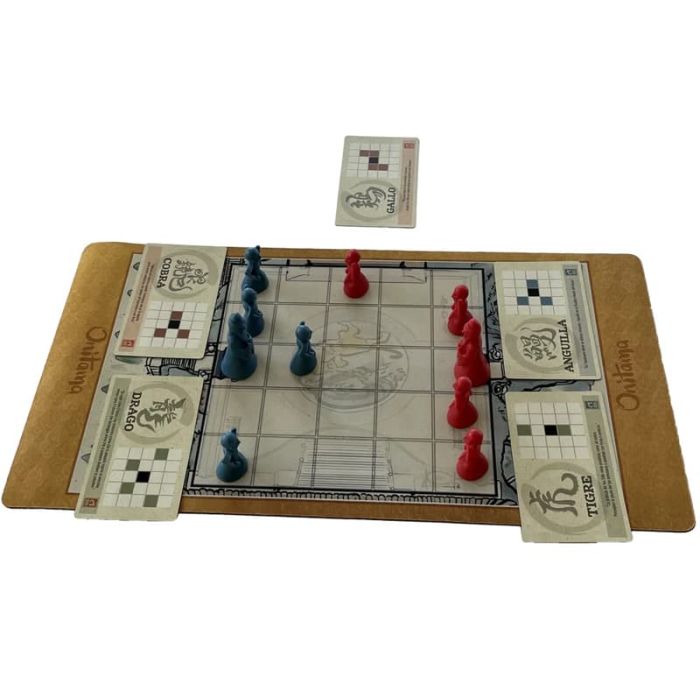
On a 5×5 grid, you move five pawns according to the cards in your hand. Each turn you swap a used card with the neutral card in the center of the table. So your moves become your opponent's, and theirs become yours. The winner is the one who captures the enemy master or moves their own master into the opponent's temple. Rules in 5 minutes, mastery in years.
What they say abroad
"Onitama distills chess to its purest tactical essence, then adds a brilliant twist that makes every game feel new."
Onitama distills chess to its purest tactical essence, then adds a brilliant twist that makes every game feel new.
— Shut Up & Sit Down
Every game is a haiku: three lines, zero unnecessary words, and in the end, you understand something you didn't see before.
— FroGames

Onitama
FrogScore · FroGames editorial rating · based on rules, international reviews and game sessionsYour tools
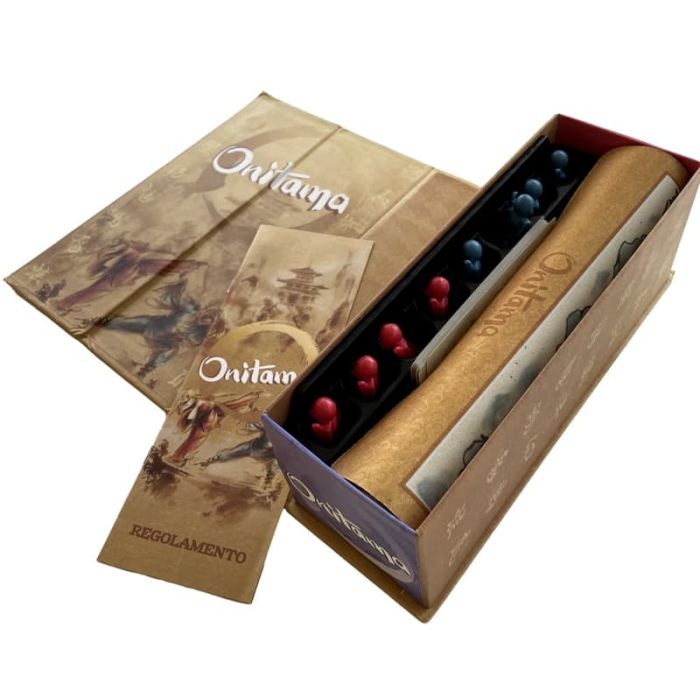
Five pawns, two cards, one master
The Master
The central pawn. If you lose it, you lose the game. If you move it into the opponent's temple, you win. It moves like the others, but counts double.
The Movement Cards
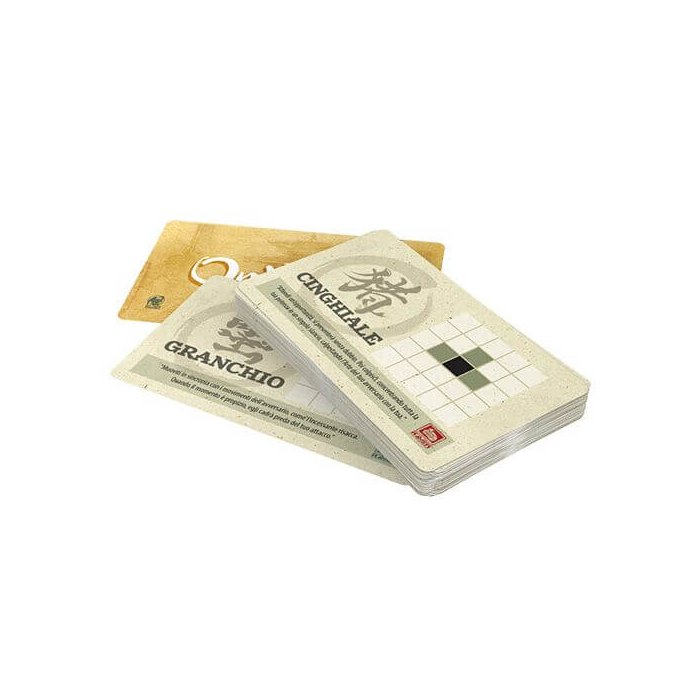
Each shows a unique movement pattern: jumps, diagonals, advances, retreats. You use a card, then swap it with the neutral one in the center. In two turns it will be your opponent's.
The Four Disciples
Normal pawns. You capture by moving onto an occupied square. Each pawn lost restricts your options, but sometimes sacrificing is the only winning move.
The Neutral Card
The fifth card, in the center of the table. It belongs to no one. When you play a card, you take this one. The flow of moves is a river: it flows from you to the opponent and back.
Recommended Sleeves 16 cards in 1 size ▼
If you play often, we recommend protecting your cards with clear sleeves to make them last longer.
| Size | Quantity |
|---|---|
| 120 × 70 mm | 16 |
| Total cards | 16 |
Come si gioca
Video dimostrativo di gameplay.
🎲How to playThe rules in four steps▼
How to play
The flow of each turn
Two actions, always the same. Complexity isn't in the rules, it's in the consequences.
Each shows a movement pattern: highlighted squares around a central point. You can move ONE pawn (or the master) according to that pattern. The central square of the pattern represents the pawn's starting position.
You move the pawn exactly as indicated by the card. If the destination square is occupied by an opposing pawn, you capture it and remove it. You cannot move onto a square occupied by your own pawn. You cannot move off the 5x5 grid.
Take the card from the center of the table and add it to your hand. The card you just played goes to the center, becoming the new neutral card. In two turns, your opponent will use it against you.
It's their turn. They choose a card, move, swap. Now the card that was neutral is in their hand. The card they had is in the center. When it's your turn again, you'll take that card. The flow continues until someone wins.
⏱️Your first gameThe chronicle, moment by moment▼
A game in five moments
What happens at the table
Not the rules. The experience.
Asymmetrical setup
You draw five movement cards at random. Two for you, two for your opponent, one in the center. Whoever has the card with the red stamp starts. Already here you understand what kind of game it will be: aggressive, defensive, chaotic. Your cards give you forward leaps, theirs lateral retreats. You must adapt.
Probing
The first three turns are a study. You move a pawn, swap the card. He moves, swaps. You take back the card that was in the center. Now you have a new move and have lost the old one. You begin to visualize the flow: in two turns you will have that card, he will have this one. The grid is still full, but you already see the traps.
The first sacrifice
He advances a pawn to an exposed square. You can capture it, but it means using the wrong card and giving him the right one. You take it anyway. Now it's 4 against 5, but the card you gave him could cost you the master in two turns. You start calculating sequences of four, five moves. The silence at the table thickens.
The read
Three pawns per side, masters in the center. You see a winning sequence in three moves. But it only works if he plays the card you think he'll play. If he plays another, your master is exposed. You have to read not just the grid, but his mind. You make your move. He thinks for thirty seconds. Then he plays the other card. You misread him.
Checkmate the master
Two pawns each, masters within jumping distance. He has the diagonal capture card. You have the straight advance one. The neutral card is a side jump. If you play now, in two turns he'll have the perfect move. If you don't play, he anticipates. You play. He captures your last pawn. You advance your master into his home square. Victory by invasion. Fifteen minutes, zero words.
🐸Things to know beforehandThree honest things, from friends▼
Things to know beforehand
Three things you need to know before buying it
Zero theming
Onitama is a pure abstract game. The Zen illustrations are beautiful, but the game is mathematical: grid, pawns, movement patterns. If you're looking for narrative or thematic immersion, this isn't the game. If you're looking for tactical depth in 20 minutes, it's perfect.
Flat learning curve for beginners
The rules can be explained in 5 minutes, but the first game against an expert is a massacre. Reading the position, timing the cards, visualizing the flow: these are only learned by playing. Patience is needed. After ten games, you start to see the moves.
Random setup, then zero luck
The five initial cards are drawn at random: this creates asymmetry and variety. But from the first turn on, it's perfect information. You see everything: the grid, your opponent's cards, the neutral card. If you lose, it's because you miscalculated or misread. You can't blame the dice.
🏆Victory and defeatWhat the ending rewards▼
How it ends
How to win (and how to lose)
Two victory conditions. Both require your master to go where it shouldn't.
Victory
- You capture the opposing master by moving one of your pawns (or your master) onto their square
- You move your master to the opposing master's starting square (the enemy Temple, the central square of their back row)
- The opponent has no legal moves on their turn (rare, but possible if completely blocked)
Defeat
- Your master is captured: immediate end, no matter how many pawns you still have
- The opposing master enters your Temple (your central back square)
- You have no legal moves: all your cards would move your pawns off the grid or onto squares occupied by your own pieces
Onitama is the abstract duel you can take anywhere and play in 15 minutes. Every game is different, every move counts, and when you lose you know exactly why.
💬Frequently Asked QuestionsQuick answers before checkout▼
Frequently Asked Questions
Onitama FAQ
What mechanics does Onitama use?
The main mechanics are Grid Movement, Hand Management, and Pattern Movement (movement according to fixed patterns shown on cards). It's a perfect information game with random setup: zero luck after the first turn.
Is it true it's like chess but faster?
Yes and no. The structure is similar (grid, capture by movement, master to protect), but the rotating movement cards change everything. In chess, the rules are fixed. In Onitama, they change every turn: your moves become your opponent's and vice versa. This eliminates memorized openings and makes every game unique. Average duration: 15-20 minutes versus 30-60 minutes for fast chess.
Can I play it with a 10-year-old?
The rules, yes, are very simple. But the tactical depth requires visualization and planning three to four moves ahead. A 10-year-old can learn to play in 5 minutes, but will need many games to compete with an experienced adult. If you're looking for an abstract game to introduce tactical concepts, Onitama is great. If you're looking for immediate competitive balance, it's better to start with something lighter.
Are there expansions or variants?
Yes. There are official expansions (Sensei's Path, Way of the Wind) that add new movement cards, increasing the possible combinations. The base game includes 16 cards (you use 5 per game), the expansions add another 16 each. All maintain the careful balance of the base game. They are not necessary, but they greatly increase variety.
Is the edition for sale in Italian?
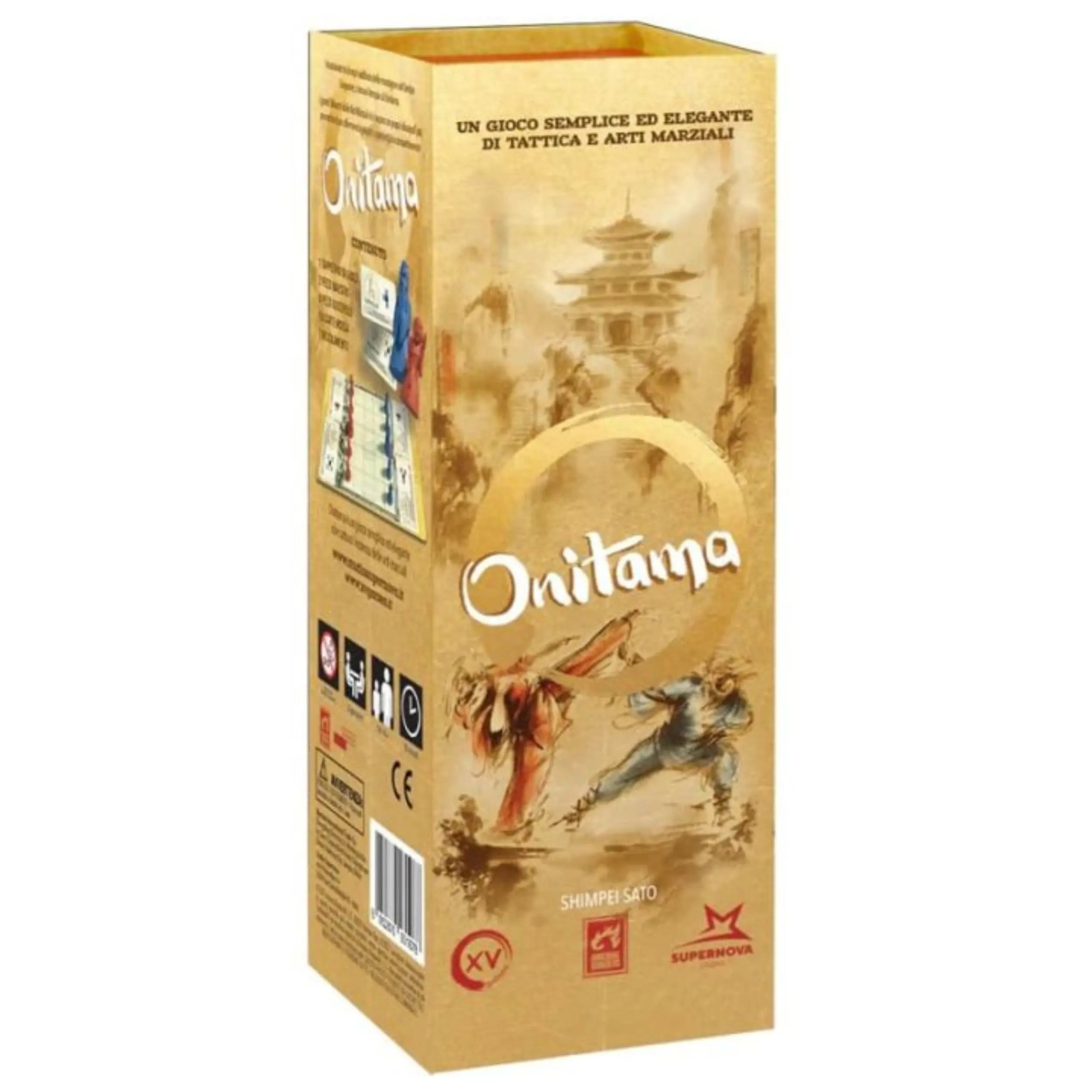
Yes. This Studio Supernova edition includes rules in Italian. The movement cards are language-independent: they only show graphical patterns, no text. The card names (e.g., Tiger, Dragon, Frog) are printed on the cards in original Japanese characters and transliterated in the Italian rulebook.
The people behind the game
Who invented it, who designed it, who publishes it — and what else they've done.
Onitama is a tactical abstract game for 2 players designed by Shimpei Sato, lasting 15-20 minutes, ages 10+. It combines Grid Movement, Hand Management, and Static Capture in a perfect information system where movement cards rotate between players each turn. Published by Studio Supernova in Italy, it uses a 5x5 grid and five movement cards per game (drawn from a deck of 16). The mechanics are immediate but the tactical depth is remarkable: every move changes the possibility space for both players. Ideal for those looking for fast cerebral duels and infinite replayability. Available on FroGames.it with immediate shipping.
Onitama
Frequently Asked Questions
The answers you're looking for, no beating around the bush.
📸Do the images match the actual product?
The photos on the website often come from BoardGameGeek and are intended to give you an idea of the game. They may vary slightly from the version you receive. The content declared by the publisher is always binding.
📦Does the content of the box match what is indicated?
We always strive to provide the correct content, but minor variations are possible due to reprints or updates. The information comes directly from the publishers. If you have any questions, please contact us!
⏳How do pre-orders work?
Pre-order the game before release, payment is immediate, and the game is reserved for you. As soon as it arrives, we'll ship it right away! If there are any delays, we'll update you promptly.
🔒Can I trust buying here?
Absolutely! Secure payments, tracked shipments, and a team that loves board games as much as you do. If something goes wrong, we'll do our best to fix it.
🛠There's a problem with my order, what should I do?
Write to us now! Whether it's a missing part, damage, or an error, we'll help you resolve it as soon as possible. Your experience truly matters to us.