


Loyalty: Rome
🐸 Dettagli da BoardGameGeek
Consiglio BGG sul numero di giocatori
Categorie
Meccaniche
Design & Art
Lingua
Pre-order - leggi i dettagli
🐸 Una rana saggia sa quando dividere l’ordine… e quando aspettare il salto giusto.
Pairs well with
The FroGames Sheet
You send a messenger to Jupiter's temple. Your rival follows, sending theirs to Mars' temple. You follow them. When the messengers are gone, only one question remains: who truly played whom?
WHAT IT IS ABOUT
Divine intrigues in the heart of the Roman Senate
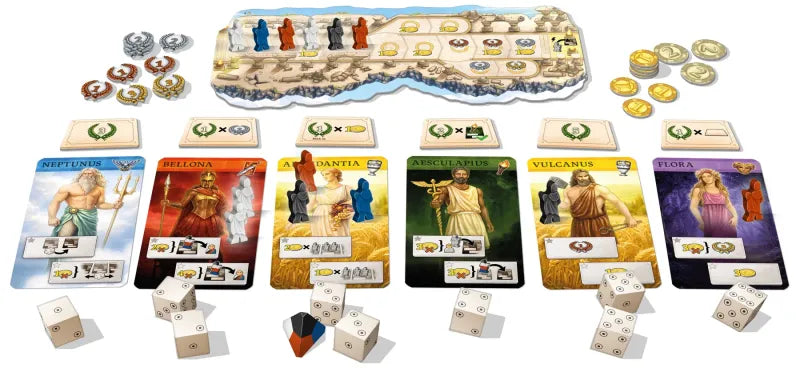
Nicholas Paschalis designs a game of majorities and worker placement in ancient Rome, where senators compete for the favor of the gods. Illustrations by Klemens Franz (Agricola, Caverna) bring to life 30 deity cards in tarot format, while components include bone-style dice and printed wooden tokens.
On your turn, you send a messenger to one of the six gods available in the Pantheon to perform actions related to that deity. But beware: other senators can follow your choice, sending their own messengers to the same temple. When you win the majority on a god on your turn, you gain its favor, the card disappears, and a new one arrives. The Pantheon changes continuously, interaction is constant, and tactical adaptation is everything.
What they say abroad
"As ambitious senators, it is your duty to uphold the Pax Deorum."
As ambitious senators, it is your duty to uphold the Pax Deorum.
— dlp games
Loyalty: Rome is a game that features dynamic majority mechanics and high interaction. From the preliminary descriptions, it promises a fast flow where every action you take can open up opportunities for others. We will update this sheet with the first reviews as soon as the game hits the tables.
— FroGames

Loyalty: Rome
FrogScore · FroGames editorial rating · first reading: based on rulebook and official presentation, updated with first playsGame elements
What you find in the box (according to the publisher)
30 Deity Cards
Tarot format, illustrated by Klemens Franz. Each god has unique actions and a favor token to claim. The deck determines which deities enter the Pantheon during the game.
Messengers
Your meeples to place on temples. When you have sent them all, you must recall them: you get gold and prestige points, then you start over. Time management is crucial.
Bone Dice
Bone dice style, likely related to divine actions or resolutions. The precise role will be known with the complete rulebook.
Printed Wooden Tokens
Gold, prestige points, and likely resources to activate temple actions. dlp games production focuses on well-crafted physical components.
🎲How to playThe rules in four steps▼
How to play
The flow of each turn (based on available info)
A turn is quick: choose a god, send a messenger, perform an action. Others can follow you. Then it's the next player's turn.
Six deities in the Pantheon, six options. Each has different actions linked to its domain. Choose where to send one of your messengers.
The messenger goes to the track of the chosen temple. Perform the action linked to that god: gold, prestige points, resources, manipulation of majorities.
Your opponents, if they have available messengers, can send one to the same temple and perform the same action. Following is part of the game, not an exception.
If you have the majority on a god at the beginning of your turn, you gain its favor token. The card disappears, a new one arrives. The Pantheon changes continuously.
⏱️Your first gameThe chronicle, moment by moment▼
A game in five moments
What should happen at the table
Not the rules. The promised experience.
The first Pantheon
Six deity cards on the table, six open temples. You look at the actions, calculate which one you need. Then you look at the others and ask yourself: if I choose Mars, will they follow me? The first turn is already psychology.
The follow
You send a messenger to Jupiter's temple. The player to your left smiles and follows you: they also send a messenger there. They get the action for free. You realize that every move you make opens a door for others.
The race for favor
You have three messengers on Venus, your opponent has two. It's their turn. If they place a third, on your turn you will have the majority and gain the favor. But if they place one elsewhere, you follow them and they lose the advantage. Pure timing.
The recall of messengers
No more messengers. You have to recall them all to continue playing, but you lose majorities on the temples. Others know this. When you recall them, they advance. When they recall, you advance. The rhythm of the game is played here.
The last god
A favor card is worth victory. It's on the table, everyone knows it. You calculate the remaining messengers, prestige points, possible actions. You send the last messenger. Someone follows you. You count. End of game.
🐸What to know beforehandThree honest things, from friends▼
What to know beforehand
Three things to keep in mind
Every action you take also helps others
The follow mechanism means that you can never play in isolation. Every choice you make opens an opportunity for those behind you. If this frustrates you instead of stimulating you, it's not the right game.
The role of dice is yet to be clarified
BGG data mentions dice rolling among the mechanics. We don't yet know how much weight they carry: whether they are central or marginal. Those who hate luck should wait for full reviews before buying.
Expected release fall 2026
The game is not yet on the market. This sheet is based on official information from publisher dlp games. We will update it with the first reviews when the game is available and played.
🏆Victory and defeatWhat the ending rewards▼
How it ends
How to win (and how to lose ground)
The player with the most prestige points wins. Points come from divine favors gained and actions taken during the game.
Victory
- Gain divine favor tokens by having the majority on temples on your turn
- Accumulate prestige points by recalling messengers and completing divine actions
- Manage timing: gaining a favor at the right time can be worth more than two favors taken too early
How you lose ground
- Send messengers without considering who can follow you: you give free resources to opponents
- Recall messengers too early or too late: the rhythm determines who advances
- Ignore the continuous change of the Pantheon: available favors change, you must adapt
Loyalty: Rome promises an hour of tactical readings and continuous counter-moves, where every decision you make also becomes a decision for others. On paper, it works. On the table, we'll find out.
💬Frequently asked questionsQuick answers before checkout▼
Frequently asked questions
FAQ about Loyalty: Rome
What mechanics does Loyalty: Rome use?
Worker placement with follow mechanism, area majority / influence, set collection, and dice rolling. The core of the game is placing messengers on temples, with the possibility for other players to follow your action. Majorities on temples determine who gains divine favors.
Is it suitable for casual players or does it require experience?
Based on available information, it seems to be a game for experienced Eurogame players. The follow mechanism and the management of dynamic majorities require reading the board and tactical planning. We do not recommend it as a first strategic game.
Does it scale well from 2 to 4 players?
We do not yet have played games to confirm this. In theory, with more players, the unpredictability of following and majorities increases. With 2 players, it should be more calculable and tactical. We will update this answer with initial feedback.
How much do the dice weigh on the game?
We don't know for sure yet. BGG lists dice rolling among the mechanics, but we don't know the precise role of the dice in actions or resolutions. Those allergic to luck should wait for full reviews before purchasing.
Is it available in Italian?
No. The edition for sale is in English (German/English edition published by dlp games, fall 2026). Text on deity cards is present, so knowledge of English is necessary to play.
The people behind the game
Who invented it, who designed it, who publishes it — and what else they've done.
Loyalty: Rome is a strategic board game by Nicholas Paschalis for 2-4 players, ages 14+, lasting 50-70 minutes, published by dlp games in 2026. It uses worker placement mechanics with a follow mechanism, area majority, and dynamic majority management: each player sends messengers to the temples of the Roman gods to gain divine favors, but opponents can follow others' actions. The Pantheon continuously changes as favors are gained, creating a tactical and interactive flow. Illustrations by Klemens Franz, tarot-sized cards, wooden components, and bone-style dice. Available on FroGames.it.
Loyalty: Rome
Frequently Asked Questions
The answers you're looking for, no beating around the bush.
📸Do the images match the actual product?
The photos on the website often come from BoardGameGeek and are intended to give you an idea of the game. They may vary slightly from the version you receive. The content declared by the publisher is always binding.
📦Does the content of the box match what is indicated?
We always strive to provide the correct content, but minor variations are possible due to reprints or updates. The information comes directly from the publishers. If you have any questions, please contact us!
⏳How do pre-orders work?
Pre-order the game before release, payment is immediate, and the game is reserved for you. As soon as it arrives, we'll ship it right away! If there are any delays, we'll update you promptly.
🔒Can I trust buying here?
Absolutely! Secure payments, tracked shipments, and a team that loves board games as much as you do. If something goes wrong, we'll do our best to fix it.
🛠There's a problem with my order, what should I do?
Write to us now! Whether it's a missing part, damage, or an error, we'll help you resolve it as soon as possible. Your experience truly matters to us.